


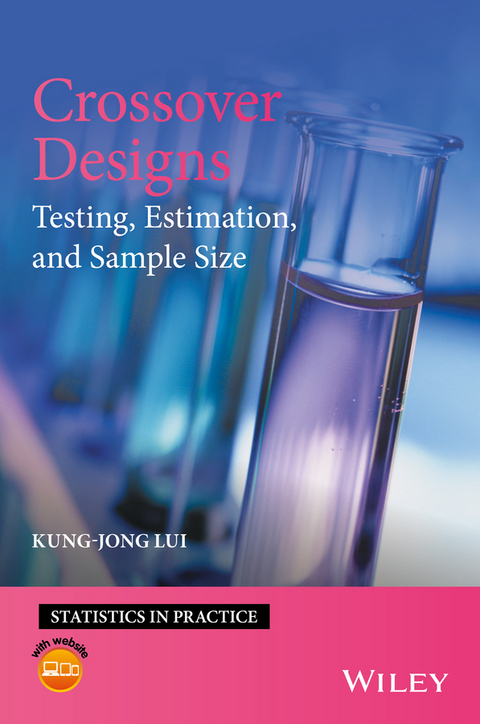
Crossover Designs (eBook)
John Wiley & Sons (Verlag)
978-1-119-11469-7 (ISBN)
A comprehensive and practical resource for analyses of crossover designs
For ethical reasons, it is vital to keep the number of patients in a clinical trial as low as possible. As evidenced by extensive research publications, crossover design can be a useful and powerful tool to reduce the number of patients needed for a parallel group design in studying treatments for non-curable chronic diseases.
This book introduces commonly-used and well-established statistical tests and estimators in epidemiology that can easily be applied to hypothesis testing and estimation of the relative treatment effect for various types of data scale in crossover designs. Models with distribution-free random effects are assumed and hence most approaches considered here are semi-parametric. The book provides clinicians and biostatisticians with the exact test procedures and exact interval estimators, which are applicable even when the number of patients in a crossover trial is small. Systematic discussion on sample size determination is also included, which will be a valuable resource for researchers involved in crossover trial design.
Key features:
- Provides exact test procedures and interval estimators, which are especially of use in small-sample cases.
- Presents most test procedures and interval estimators in closed-forms, enabling readers to calculate them by use of a pocket calculator or commonly-used statistical packages.
- Each chapter is self-contained, allowing the book to be used a reference resource.
- Uses real-life examples to illustrate the practical use of test procedures and estimators
- Provides extensive exercises to help readers appreciate the underlying theory, learn other relevant test procedures and understand how to calculate the required sample size.
Crossover Designs: Testing, Estimation and Sample Size will be a useful resource for researchers from biostatistics, as well as pharmaceutical and clinical sciences. It can also be used as a textbook or reference for graduate students studying clinical experiments.
Kung-Jong Lui, Professor, Department of Mathematics and Statistics, San Diego State University, USA.
A comprehensive and practical resource for analyses of crossover designs For ethical reasons, it is vital to keep the number of patients in a clinical trial as low as possible. As evidenced by extensive research publications, crossover design can be a useful and powerful tool to reduce the number of patients needed for a parallel group design in studying treatments for non-curable chronic diseases. This book introduces commonly-used and well-established statistical tests and estimators in epidemiology that can easily be applied to hypothesis testing and estimation of the relative treatment effect for various types of data scale in crossover designs. Models with distribution-free random effects are assumed and hence most approaches considered here are semi-parametric. The book provides clinicians and biostatisticians with the exact test procedures and exact interval estimators, which are applicable even when the number of patients in a crossover trial is small. Systematic discussion on sample size determination is also included, which will be a valuable resource for researchers involved in crossover trial design. Key features: Provides exact test procedures and interval estimators, which are especially of use in small-sample cases. Presents most test procedures and interval estimators in closed-forms, enabling readers to calculate them by use of a pocket calculator or commonly-used statistical packages. Each chapter is self-contained, allowing the book to be used a reference resource. Uses real-life examples to illustrate the practical use of test procedures and estimators Provides extensive exercises to help readers appreciate the underlying theory, learn other relevant test procedures and understand how to calculate the required sample size. Crossover Designs: Testing, Estimation and Sample Size will be a useful resource for researchers from biostatistics, as well as pharmaceutical and clinical sciences. It can also be used as a textbook or reference for graduate students studying clinical experiments.
Kung-Jong Lui, Professor, Department of Mathematics and Statistics, San Diego State University, USA.
Title Page 5
Copyright 6
Contents 9
About the author 13
Preface 14
About the companion website 16
Chapter 1 Crossover design – definitions, notes, and limitations 17
1.1 Unsuitability for acute or most infectious diseases 18
1.2 Inappropriateness for treatments with long-lasting effects 18
1.3 Loss of efficiency in the presence of carry-over effects 19
1.4 Concerns of treatment-by-period interaction 19
1.5 Flaw of the commonly used two-stage test procedure 20
1.6 Higher risk of dropping out or being lost to follow-up 20
1.7 More assumptions needed in use of a crossover design 21
1.8 General principle and conditional approach used in the book 21
Chapter 2 AB/BA design in continuous data 23
2.1 Testing non-equality of treatments 26
2.2 Testing non-inferiority of an experimental treatment to an active control treatment 27
2.3 Testing equivalence between an experimental treatment and an active control treatment 28
2.4 Interval estimation of the mean difference 29
2.5 Sample size determination 32
2.5.1 Sample size for testing non-equality 32
2.5.2 Sample size for testing non-inferiority 33
2.5.3 Sample size for testing equivalence 34
2.6 Hypothesis testing and estimation for the period effect 35
2.7 Estimation of the relative treatment effect in the presence of differential carry-over effects 37
2.8 Examples of SAS programs and results 38
Exercises 43
Chapter 3 AB/BA design in dichotomous data 46
3.1 Testing non-equality of treatments 50
3.2 Testing non-inferiority of an experimental treatment to an active control treatment 52
3.3 Testing equivalence between an experimental treatment and an active control treatment 55
3.4 Interval estimation of the odds ratio 56
3.5 Sample size determination 58
3.5.1 Sample size for testing non-equality 58
3.5.2 Sample size for testing non-inferiority 58
3.5.3 Sample size for testing equivalence 59
3.6 Hypothesis testing and estimation for the period effect 61
3.7 Testing and estimation for carry-over effects 63
3.8 SAS Program codes and likelihood-based approach 64
Exercises 67
Chapter 4 AB/BA design in ordinal data 73
4.1 Testing non-equality of treatments 78
4.2 Testing non-inferiority of an experimental treatment to an active control treatment 80
4.3 Testing equivalence between an experimental treatment and an active control treatment 81
4.4 Interval estimation of the generalized odds ratio 82
4.5 Sample size determination 83
4.5.1 Sample size for testing non-equality 83
4.5.2 Sample size for testing non-inferiority 84
4.5.3 Sample size for testing equivalence 84
4.6 Hypothesis testing and estimation for the period effect 86
4.7 SAS codes for the proportional odds model with normal random effects 88
Exercises 90
Chapter 5 AB/BA design in frequency data 91
5.1 Testing non-equality of treatments 94
5.2 Testing non-inferiority of an experimental treatment to an active control treatment 97
5.3 Testing equivalence between an experimental treatment and an active control treatment 99
5.4 Interval estimation of the ratio of mean frequencies 100
5.5 Sample size determination 102
5.5.1 Sample size for testing non-equality 102
5.5.2 Sample size for testing non-inferiority 103
5.5.3 Sample size for testing equivalence 104
5.6 Hypothesis testing and estimation for the period effect 104
5.7 Estimation of the relative treatment effect in the presence of differential carry-over effects 106
Exercises 108
Chapter 6 Three-treatment three-period crossover design in continuous data 111
6.1 Testing non-equality between treatments and placebo 118
6.2 Testing non-inferiority of an experimental treatment to an active control treatment 119
6.3 Testing equivalence between an experimental treatment and an active control treatment 120
6.4 Interval estimation of the mean difference 120
6.5 Hypothesis testing and estimation for period effects 121
6.6 Procedures for testing treatment-by-period interactions 123
6.7 SAS program codes and results for constant variance 125
Exercises 127
Chapter 7 Three-treatment three-period crossover design in dichotomous data 131
7.1 Testing non-equality of treatments 137
7.1.1 Asymptotic test procedures 137
7.1.2 Exact test procedures 139
7.1.3 Procedures for simultaneously testing non-equality of two experimental treatments versus a placebo 140
7.2 Testing non-inferiority of an experimental treatment to an active control treatment 142
7.3 Testing equivalence between an experimental treatment and an active control treatment 143
7.4 Interval estimation of the odds ratio 145
7.5 Hypothesis testing and estimation for period effects 147
7.6 Procedures for testing treatment-by-period interactions 149
7.7 SAS program codes and results for a logistic regression model with normal random effects 152
Exercises 154
Chapter 8 Three-treatment three-period crossover design in ordinal data 157
8.1 Testing non-equality of treatments 166
8.1.1 Asymptotic test procedures 166
8.1.2 Exact test procedure 168
8.2 Testing non-inferiority of an experimental treatment to an active control treatment 169
8.3 Testing equivalence between an experimental treatment and an active control treatment 169
8.4 Interval estimation of the GOR 170
8.5 Hypothesis testing and estimation for period effects 172
8.6 Procedures for testing treatment-by-period interactions 175
8.7 SAS program codes and results for the proportional odds model with normal random effects 176
Exercises 178
Chapter 9 Three-treatment three-period crossover design in frequency data 180
9.1 Testing non-equality between treatments and placebo 186
9.2 Testing non-inferiority of an experimental treatment to an active control treatment 189
9.3 Testing equivalence between an experimental treatment and an active control treatment 190
9.4 Interval estimation of the ratio of mean frequencies 191
9.5 Hypothesis testing and estimation for period effects 194
9.6 Procedures for testing treatment-by-period interactions 195
Exercises 197
Chapter 10 Three-treatment (incomplete block) crossover design in continuous and dichotomous data 199
10.1 Continuous data 201
10.1.1 Testing non-equality of treatments 204
10.1.2 Testing non-equality between experimental treatments (or non-nullity of dose effects) 205
10.1.3 Interval estimation of the mean difference 206
10.1.4 SAS codes for fixed effects and mixed effects models 208
10.2 Dichotomous data 210
10.2.1 Testing non-equality of treatments 213
10.2.2 Testing non-equality between experimental treatments (or non-nullity of dose effects) 215
10.2.3 Testing non-inferiority of either experimental treatment to an active control treatment 215
10.2.4 Interval estimation of the odds ratio 216
10.2.5 SAS codes for the likelihood-based approach 218
Exercises 219
References 224
Index 232
Statistics in practice 241
EULA 244
| Erscheint lt. Verlag | 8.8.2016 |
|---|---|
| Reihe/Serie | Statistics in Practice | Statistics in Practice |
| Sprache | englisch |
| Themenwelt | Mathematik / Informatik ► Mathematik ► Statistik |
| Mathematik / Informatik ► Mathematik ► Wahrscheinlichkeit / Kombinatorik | |
| Medizin / Pharmazie ► Medizinische Fachgebiete | |
| Studium ► Querschnittsbereiche ► Epidemiologie / Med. Biometrie | |
| Technik | |
| Schlagworte | Clinical Trials • continuous data • Crossover Design • dichotomous data • Epidemiologie • Epidemiologie u. Biostatistik • Epidemiology & Biostatistics • Exact interval estimator • Exact test procedure • frequency data • Gesundheits- u. Sozialwesen • Health & Social Care • Klinische Studien • Latin-square • Medical Science • Medical Statistics & Epidemiology • Medizin • Medizinische Statistik u. Epidemiologie • Ordinal Data • Random Effects Model • Sample Size • Statistics • Statistik |
| ISBN-10 | 1-119-11469-1 / 1119114691 |
| ISBN-13 | 978-1-119-11469-7 / 9781119114697 |
| Informationen gemäß Produktsicherheitsverordnung (GPSR) | |
| Haben Sie eine Frage zum Produkt? |
 PDF (Adobe DRM)
Kopierschutz: Adobe-DRM
Adobe-DRM ist ein Kopierschutz, der das eBook vor Mißbrauch schützen soll. Dabei wird das eBook bereits beim Download auf Ihre persönliche Adobe-ID autorisiert. Lesen können Sie das eBook dann nur auf den Geräten, welche ebenfalls auf Ihre Adobe-ID registriert sind.
Details zum Adobe-DRM
Dateiformat: PDF (Portable Document Format)
Mit einem festen Seitenlayout eignet sich die PDF besonders für Fachbücher mit Spalten, Tabellen und Abbildungen. Eine PDF kann auf fast allen Geräten angezeigt werden, ist aber für kleine Displays (Smartphone, eReader) nur eingeschränkt geeignet.
Systemvoraussetzungen:
PC/Mac: Mit einem PC oder Mac können Sie dieses eBook lesen. Sie benötigen eine
eReader: Dieses eBook kann mit (fast) allen eBook-Readern gelesen werden. Mit dem amazon-Kindle ist es aber nicht kompatibel.
Smartphone/Tablet: Egal ob Apple oder Android, dieses eBook können Sie lesen. Sie benötigen eine
Geräteliste und zusätzliche Hinweise
Buying eBooks from abroad
For tax law reasons we can sell eBooks just within Germany and Switzerland. Regrettably we cannot fulfill eBook-orders from other countries.


