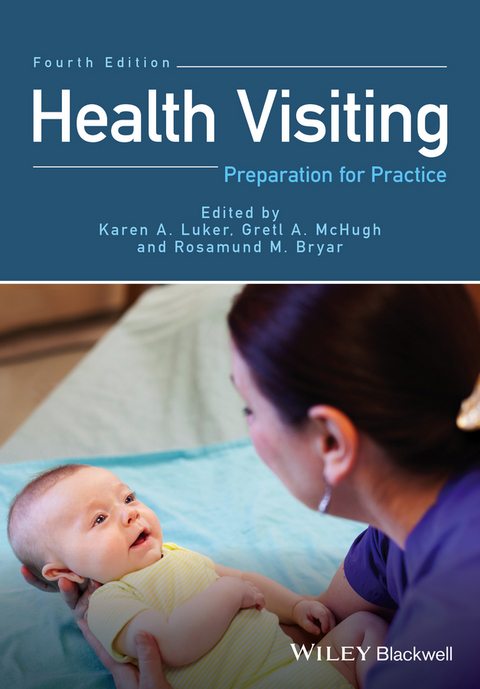
Health Visiting (eBook)
John Wiley & Sons (Verlag)
978-1-119-07859-3 (ISBN)
The fourth edition of this seminal text retains its focus on placing the health visitor at the forefront of supporting and working with children, families, individuals and communities. Health Visiting: Preparation for Practice has been fully revised and updated to reflect the changes and developments in health policy, public health priorities, and health visiting. It considers the public health role of the health visitor, and the important role and responsibilities the health visitor has with safeguarding children to ensure the child has the best possible start in life.
Key features:
- Fully updated throughout, with new content on practice and policy developments
- Takes into account the challenges and changing role of the health visitor, and the need to ensure that their practice is evidenced-based
- Includes an additional chapter on working in a multicultural society with a discussion on some of the challenges faced by health visitors
- Discusses and debates the practice of public health and working with communities
- Examines the role of the health visitor with safeguarding and child protection, as well as working within a multi-professional team
- Features case studies and learning activities
Health Visiting: Preparation for Practice is essential reading for student health visitors, public health nurses, and those on community placements, as well as other health practitioners working with and in the community.
Karen A. Luker is QNI Professor of Community Nursing in the School of Nursing, Midwifery and Social Work, The University of Manchester, UK.
Gretl A. McHugh is Professor of Applied Health Research in the School of Healthcare, The University of Leeds, UK.
Rosamund M. Bryar is Professor Emeritus Community and Primary Care Nursing, School of Health Sciences, City University London, UK.
The fourth edition of this seminal text retains its focus on placing the health visitor at the forefront of supporting and working with children, families, individuals and communities. Health Visiting: Preparation for Practice has been fully revised and updated to reflect the changes and developments in health policy, public health priorities, and health visiting. It considers the public health role of the health visitor, and the important role and responsibilities the health visitor has with safeguarding children to ensure the child has the best possible start in life. Key features: Fully updated throughout, with new content on practice and policy developments Takes into account the challenges and changing role of the health visitor, and the need to ensure that their practice is evidenced-based Includes an additional chapter on working in a multicultural society with a discussion on some of the challenges faced by health visitors Discusses and debates the practice of public health and working with communities Examines the role of the health visitor with safeguarding and child protection, as well as working within a multi-professional team Features case studies and learning activities Health Visiting: Preparation for Practice is essential reading for student health visitors, public health nurses, and those on community placements, as well as other health practitioners working with and in the community.
Karen A. Luker is QNI Professor of Community Nursing in the School of Nursing, Midwifery and Social Work, The University of Manchester, UK. Gretl A. McHugh is Professor of Applied Health Research in the School of Healthcare, The University of Leeds, UK. Rosamund M. Bryar is Professor Emeritus Community and Primary Care Nursing, School of Health Sciences, City University London, UK.
Cover 1
Title Page 5
Copyright 6
Contents 7
List of Contributors 11
Introduction 13
Prevention, public health, and health visiting 16
Health visiting: preparation for practice 18
References 20
Chapter 1 Managing Knowledge in Health Visiting 20
Introduction 20
Defining health visiting practice 22
What do health visitors do - and where do they do it? 25
Evidence-based practice 28
The current landscape of EBP 33
Managing knowledge and evidence in practice 38
Case study 1.1:Introducing new technology 38
Case study 1.2:Creating guidelines in primary care 39
Case study 1.3:Protocol-based decision making in nursing 41
Case study 1.4:Knowledge management in primary care 42
Communities of practice 47
Reflective practice 49
Clients: what do they know and how do they know it? 52
Social networking and the media 53
The debate 56
Summary 57
References 58
Activities 62
Chapter 2 Health Visiting: Context and Public Health Practice 65
Introduction 65
Public health 68
Defining 'public' 68
Defining 'health' 69
Defining 'public health' 71
Human rights and public health 72
The principles of health visiting 75
The search for health needs 77
The stimulation of an awareness of health needs 77
The influence on policies affecting health 78
The facilitation of health enhancing activities 79
Summary 80
Health inequalities 81
Summary 88
References 89
Activities 94
Chapter 3 The Community Dimension 97
Introduction 97
Public health and communities 99
Defining 'community' 101
Impact of communities on health 103
The role of health visitors in working with communities 108
Gaining an understanding of the health of your local community 112
Windshield survey 113
Public health walk 113
Health needs assessment 114
Building community capacity 122
Using health promotion models to support community working 125
Summary 128
References 130
Activities 136
Chapter 4 Approaches to Supporting Families 139
Introduction 139
Models of intervention in family life 140
Three models relevant to health visiting practice in families with young children 141
Application of the models in practice 144
Policies 145
Evidence for interventions to support families 148
Characteristics of services and programmes to support families with young children 149
Early home visiting programmes 150
First Parent Health Visiting Programme 150
Community Mothers Programme (CMP) 151
Current home visiting programmes 152
Family Nurse Partnership (FNP) Programme 152
Flying Start - Wales 155
The Triple-P (Positive Parenting Programme) 156
Maternal Early Childhood Sustained Home Visiting (MECSH) 157
Sure Start programmes 158
Summary 160
Working with families 160
Empirical evidence on relationship development 164
Challenges 166
Public health agenda 166
Level of evidence 167
Adhering to the programme criteria 167
High-needs families 168
Practice specialisation 169
Concerns about child safety 169
Adequate resources 169
Summary 170
Note 170
References 170
Activities 179
Chapter 5 Safeguarding Children: Debates and Dilemmas for Health Visitors 182
Introduction 182
The key concepts 184
Defining 'child' 184
Defining 'childhood' 186
Defining 'safeguarding' 187
Defining 'child abuse' 192
Defining 'significant harm' 199
Incidence and prevalence of child abuse 205
Assessment of vulnerable children 209
Assessment of children in need and their families 210
Common Assessment Framework (CAF) 212
Graded Care Profile (GCP) 214
Working together 215
Confidentiality and information sharing 217
Supervision 218
Summary 222
References 223
Activities 229
Chapter 6 Working with Diverse Communities 232
Introduction 232
Culture and migration 233
Cultural sensitivity and competence 234
Some useful tips for developing cultural competence 237
Institutional discrimination and organisational cultural competence 237
Understanding different cultural practices 238
Pregnancy 238
Birth customs 240
Confinement following birth 243
Breastfeeding 243
Diet, weaning, and feeding practices 244
Maternal mental health 247
Safeguarding, domestic violence, and abuse 249
Communication 251
Other communities 252
Case studies 253
Case study 6.1:Breastfeeding support project for Somali mothers in Harrow 253
Case study 6.2:New ways of delivering health visiting services for Orthodox Jewish community in Hackney 254
Summary 256
References 256
Activities 262
Chapter 7 Evaluating Practice 264
Introduction 264
Sources of evidence for practice 265
Evaluation - the problem of definition 269
Conceptualising evaluation 271
Example: tackling childhood obesity 273
Evaluation and evaluative research 275
Evaluation of health care 275
Structure, process, and outcome evaluation 278
Structure evaluation 278
Process evaluation 280
Outcome evaluation 282
Summary 284
The care planning process 284
Actual and potential problems 286
Problem solving 287
Additional issues in evaluating the practice of health visiting 287
Summary 292
References 293
Activities 299
Index 303
EULA 309
"Overall, this is an excellent and easy to read resource for anyone wishing to extend their knowledge and challenge their practice in health visiting and beyond. It should certainly assist practitioners in delivering high-quality, evidence-based care...It is both thought provoking and practical, containing a wealth of information that can be applied to assist professional development and widen knowledge"(The Journal of Health Visiting, March 2017)
| Erscheint lt. Verlag | 22.7.2016 |
|---|---|
| Sprache | englisch |
| Themenwelt | Medizin / Pharmazie ► Pflege |
| Schlagworte | Community Nursing • Families • Family • Gemeindekrankenpflege • Health • Krankenpflege • Krankenpflege im öffentl. Gesundheitswesen, Hausbesuchsdienst • Krankenpflege im öffentl. Gesundheitswesen, Hausbesuchsdienst • <p>community • Medizinische Grundversorgung • Medizinische Grundversorgung, Praxis • multi-professional</p> • nursing • Policy • Primary Care Nursing & Practice Nursing • Public • Public Health Nursing & Health Visiting • Safeguarding • visiting • Vulnerable |
| ISBN-10 | 1-119-07859-8 / 1119078598 |
| ISBN-13 | 978-1-119-07859-3 / 9781119078593 |
| Informationen gemäß Produktsicherheitsverordnung (GPSR) | |
| Haben Sie eine Frage zum Produkt? |
 PDF (Adobe DRM)
Kopierschutz: Adobe-DRM
Adobe-DRM ist ein Kopierschutz, der das eBook vor Mißbrauch schützen soll. Dabei wird das eBook bereits beim Download auf Ihre persönliche Adobe-ID autorisiert. Lesen können Sie das eBook dann nur auf den Geräten, welche ebenfalls auf Ihre Adobe-ID registriert sind.
Details zum Adobe-DRM
Dateiformat: PDF (Portable Document Format)
Mit einem festen Seitenlayout eignet sich die PDF besonders für Fachbücher mit Spalten, Tabellen und Abbildungen. Eine PDF kann auf fast allen Geräten angezeigt werden, ist aber für kleine Displays (Smartphone, eReader) nur eingeschränkt geeignet.
Systemvoraussetzungen:
PC/Mac: Mit einem PC oder Mac können Sie dieses eBook lesen. Sie benötigen eine
eReader: Dieses eBook kann mit (fast) allen eBook-Readern gelesen werden. Mit dem amazon-Kindle ist es aber nicht kompatibel.
Smartphone/Tablet: Egal ob Apple oder Android, dieses eBook können Sie lesen. Sie benötigen eine
Geräteliste und zusätzliche Hinweise
Buying eBooks from abroad
For tax law reasons we can sell eBooks just within Germany and Switzerland. Regrettably we cannot fulfill eBook-orders from other countries.
aus dem Bereich