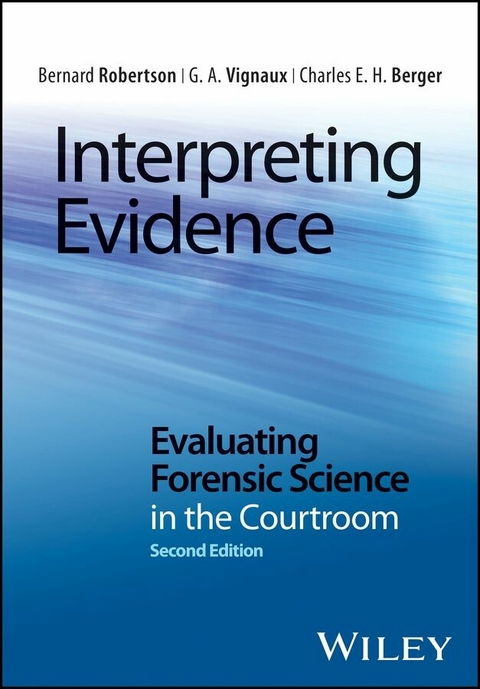
Interpreting Evidence (eBook)
John Wiley & Sons (Verlag)
978-1-118-49245-1 (ISBN)
This book explains the correct logical approach to analysis of forensic scientific evidence. The focus is on general methods of analysis applicable to all forms of evidence. It starts by explaining the general principles and then applies them to issues in DNA and other important forms of scientific evidence as examples. Like the first edition, the book analyses real legal cases and judgments rather than hypothetical examples and shows how the problems perceived in those cases would have been solved by a correct logical approach. The book is written to be understood both by forensic scientists preparing their evidence and by lawyers and judges who have to deal with it. The analysis is tied back both to basic scientific principles and to the principles of the law of evidence. This book will also be essential reading for law students taking evidence or forensic science papers and science students studying the application of their scientific specialisation to forensic questions.
This book explains the correct logical approach to analysis of forensic scientific evidence. The focus is on general methods of analysis applicable to all forms of evidence. It starts by explaining the general principles and then applies them to issues in DNA and other important forms of scientific evidence as examples. Like the first edition, the book analyses real legal cases and judgments rather than hypothetical examples and shows how the problems perceived in those cases would have been solved by a correct logical approach. The book is written to be understood both by forensic scientists preparing their evidence and by lawyers and judges who have to deal with it. The analysis is tied back both to basic scientific principles and to the principles of the law of evidence. This book will also be essential reading for law students taking evidence or forensic science papers and science students studying the application of their scientific specialisation to forensic questions.
Bernard Robertson, Barrister, Inner Temple and New Zealand Bernard Robertson is a graduate of Oxford, of the LSE, and of the National Police Staff College, Bramshill as well as being a Barrister of the Inner Temple and of New Zealand. After ten years in the Metropolitan Police, Bernard emigrated to New Zealand and taught the law of evidence at undergraduate and postgraduate levels. He and Professor Vignaux have written numerous papers on Bayesian analysis of scientific evidence and of evidence and court decision making in general. He has also been editor of The New Zealand Law Journal and of The New Zealand Law Reports, ensuring that he has kept in touch with a wide range of legal issues, including civil litigation. G. A.Vignaux, Emeritus Professor,?Victoria University, New Zealand G A (Tony) Vignaux (retired) was a physicist and an Operations Research worker, and latterly a Professor of Operations Research at Victoria University. Prior to starting work on legal questions he published on the use of Bayesian methods in physics. With Bernard Robertson he has been invited to address conferences and has been consulted on several legal cases and by enquiries into miscarriage of justice. He has participated in teaching evidence and forensic science to law students at postgraduate level. Charles Berger, Principal Scientist,?Netherlands Forensic Institute,?The NetherlandsCharles Berger is principal scientist at the Netherlands Forensic Institute (NFI), and professor of Criminalistics at Leiden University. He specializes in subjects such as evidence interpretation and forensic inference. At the NFI he is active in a number of areas such as education and research about which he publishes internationally. He also supports the NFI experts, advises the management and oversees scientific quality. He is involved in promoting logically correct reasoning and concluding, introducing more objective methods, and interpretation at the activity level. For such improvements it is essential to explain them as often and as well as possible to all the stakeholders in the justice system. It is an exciting challenge at the interfaces of the worlds of science, police, and law.
Chapter 1
Introduction
Forensic scientific evidence can help us to establish:
- that a particular person was at a given place at a given time;
- that a particular person carried out an activity, such as signing a cheque or breaking a window;
- that something was done with a particular instrument, for example, a door was forced with a particular tool, a shot fired from a particular weapon, or a call made from a particular telephone;
- a relationship between two people, for example, in paternity disputes and incest or immigration cases.
There is a whole range of techniques used for forensic purposes, and new methods are continually being added to the arsenal of the forensic scientist. Our purpose is not to discuss the technical details of these methods, which rapidly become dated. We propose to concentrate on how such evidence should be interpreted and incorporated into the court process.1
1.1 Three ‘principles’
Traditionally, several ideas have been proposed as principles for forensic science:
- Locard's ‘Principle’: A perpetrator will either leave marks or traces on the crime scene, or carry traces from the crime scene. This is often misquoted as ‘every contact leaves a trace’ but Locard never actually claimed this.
Edmond Locard (1877–1966) was a French forensic scientist. He proposed that we should always consider whether traces of the victim or crime scene can be found on the accused and whether traces of the accused can be found on the crime scene or victim. After an assault, for example, we might find skin and blood under a deceased's fingernails and infer that they come from the attacker. We might arrest a suspect on the basis of other evidence and find, on him or his clothing, fibres which might come from the deceased's clothes, blood which might come from the deceased or soil and plant material which might come from the scene.
- ‘Principle’ of individuality: Two objects may be indistinguishable but no two objects are identical.2
The combination of these two ideas together might seem to have enormous potential value to the forensic scientist. If every contact provides ample opportunity for the transfer of traces, and every trace is different that seems to be cause for optimism. However, if no two objects are identical, then, for example, no two fingerprint impressions will be identical even if they are taken from the same finger; no two samples of handwriting by the same author will be identical. The question is whether two marks have the same source, and how much our observations help us in answering that question.
We describe these two statements as proposed principles rather than laws because neither meets the standard definition of a law of science. The philosopher Karl R. Popper (1902–1994) said that for a law to be regarded as scientific it must be potentially falsifiable, that is, it must be possible, at least in theory, to design an experiment which would disprove it.3
- It seems to be impossible to design an experiment to refute the first of these principles. If an experiment fails to find an impression after two objects have been in contact, it may be that all that is revealed is the limitations of the detection process. The proposed principle that no two objects are identical does not require proof, since two objects that would be identical in every way would – by definition – be one object. Unfortunately, it does not follow from the uniqueness of every object that we can correctly point out its unique source.
- Individualisation ‘Principle’: If enough similarities are seen between two objects to exclude the possibility of coincidence, then those objects must have come from the same source.
This ‘principle’ has a long history in forensic science, as can be seen from the following quotes that span the 20th century:
The principles which underlie all proof by comparison of handwritings are very simple, and, when distinctly enunciated, appear to be self-evident. To prove that two documents were written by the same hand, coincidences must be shown to exist in them which cannot be accidental.4
When any two items have characteristics in common of such number and significance as to preclude their simultaneous occurrence by chance, and there are no inexplicable differences, then it may be concluded that they are the same, or from the same source.5
…we look for unique characteristics in the items under examination. If we find a sufficient number of characteristics to preclude the possibility or probability of their having occurred by coincidence in two different objects, we are able to form a conclusion of individualization. It's as simple as that.6
This popular so-called principle, while simple, is fraught with problems. The possibility of a coincidence can never be completely excluded, which precludes categorical statements of individualisation. There is no general criterion possible for the number of coincidences needed to decide an individualisation; whatever level is chosen is purely arbitrary. How certain we would want to be for a decision would depend on the gravity of the crime involved (e.g. capital murder versus shoplifting). How certain we could be would also depend on other evidence and information in the case. Clearly, such issues and decisions are not up to the forensic scientist but rather the trier of fact. The role of the forensic scientist is not to decide the issue, but to describe what the evidence is worth. This ‘principle’ should therefore not be used.
1.2 Dreyfus, Bertillon, and Poincaré
In 1894, Alfred Dreyfus (1859–1935), an officer in the French army, was charged with treason in what was to become one of the most famous criminal trials in history. The charges were espionage and passing information to Germany. The espionage had definitely taken place and one of the central items of evidence was the comparison of the handwriting in an incriminating note with Dreyfus's own handwriting. A prominent witness for the prosecution was Alphonse Bertillon (1853–1914).
Bertillon was a Paris police officer who rose to found a police laboratory for the identification of criminals. He was well known for proposing a system of anthropometry, which became known as Bertillonage. Anthropometry simply means the measurement of humans. Bertillonage required taking a photograph and recording a series of measurements of bone features which were known not to change after adolescence. Later, fingerprints were added to the features recorded. The basis of the system was that it would be unlikely that any two people would have the same measurements over the whole range of features.
Bertillonage suffered from a number of problems. The method was slow and expensive and was far from error free. The officers taking the measurements had to be specially trained; this involved more expense, and even then, at the levels of accuracy called for, no two would take the same measurements from the same series of features. Nor could the system be applied to juveniles.
The purpose of the system was to determine whether or not a person had the same measurements as a person who had earlier been arrested. This can be very useful, for example, when someone is arrested on suspicion of failing to attend court or when a person being sentenced denies that previous convictions relate to him. However, Bertillonage could not help investigators by providing evidence that a particular person had been, for example, at the scene of a crime.
Although fingerprints were later taken as one of the Bertillonage measurements and Bertillon himself solved a crime using fingerprints in 1902, there was no formal classification system for them. Once such systems were developed (by Galton and Henry in England and India, and Vucetich in Argentina) it was possible to quickly exclude the majority of the fingerprint collection (i.e. the other classes) on each search. Fingerprints became a far quicker and simpler method of identification than anthropometry. In the first full year of operation by the London Metropolitan Police, fingerprints identified 3 times as many persons as anthropometry and, 2 years later, 10 times as many. Not only were fingerprints far simpler and cheaper to obtain and record but they could also help investigators identify the perpetrators of crimes. Bertillonage was dropped.
Bertillon gave evidence in the Dreyfus case as a handwriting expert and claimed that Dreyfus had written the incriminating document. His evidence referred to certain similarities and multiplied together the probabilities of each of the similarities occurring by chance to arrive at a very low probability of them occurring together by chance. His evidence was subjected to devastating critique by a number of people including Poincaré, an eminent mathematician.7 Poincaré made three important points about Bertillon's evidence. The first was that Bertillon had simply erred in that the figure he produced was the probability of getting the four similarities amongst four examined characteristics. There were far more characteristics examined, and so the chances of finding four similarities were actually much greater than Bertillon's figure. The second point Poincaré made was that events that have actually occurred might be seen beforehand as highly improbable. The example he gave was the drawing of a particular number or set of numbers in a lottery. The probability that any particular set of numbers will...
| Erscheint lt. Verlag | 28.7.2016 |
|---|---|
| Sprache | englisch |
| Themenwelt | Medizin / Pharmazie ► Gesundheitsfachberufe |
| Studium ► 2. Studienabschnitt (Klinik) ► Rechtsmedizin | |
| Naturwissenschaften ► Biologie | |
| Naturwissenschaften ► Chemie ► Analytische Chemie | |
| Technik | |
| Schlagworte | Analytische Chemie • Analytische Chemie / Forensik • Bayesian • Biowissenschaften • Chemie • Chemistry • Criminology • Evidence • Forensic • Forensics • Forensic Science • Forensik • inference • Interpretation • Kriminologie • Law • Life Sciences • Logical • Probability • Rechtswissenschaft • Relevance • Statistics |
| ISBN-10 | 1-118-49245-5 / 1118492455 |
| ISBN-13 | 978-1-118-49245-1 / 9781118492451 |
| Informationen gemäß Produktsicherheitsverordnung (GPSR) | |
| Haben Sie eine Frage zum Produkt? |
 EPUB (Adobe DRM)
Kopierschutz: Adobe-DRM
Adobe-DRM ist ein Kopierschutz, der das eBook vor Mißbrauch schützen soll. Dabei wird das eBook bereits beim Download auf Ihre persönliche Adobe-ID autorisiert. Lesen können Sie das eBook dann nur auf den Geräten, welche ebenfalls auf Ihre Adobe-ID registriert sind.
Details zum Adobe-DRM
Dateiformat: EPUB (Electronic Publication)
EPUB ist ein offener Standard für eBooks und eignet sich besonders zur Darstellung von Belletristik und Sachbüchern. Der Fließtext wird dynamisch an die Display- und Schriftgröße angepasst. Auch für mobile Lesegeräte ist EPUB daher gut geeignet.
Systemvoraussetzungen:
PC/Mac: Mit einem PC oder Mac können Sie dieses eBook lesen. Sie benötigen eine
eReader: Dieses eBook kann mit (fast) allen eBook-Readern gelesen werden. Mit dem amazon-Kindle ist es aber nicht kompatibel.
Smartphone/Tablet: Egal ob Apple oder Android, dieses eBook können Sie lesen. Sie benötigen eine
Geräteliste und zusätzliche Hinweise
Buying eBooks from abroad
For tax law reasons we can sell eBooks just within Germany and Switzerland. Regrettably we cannot fulfill eBook-orders from other countries.
aus dem Bereich