


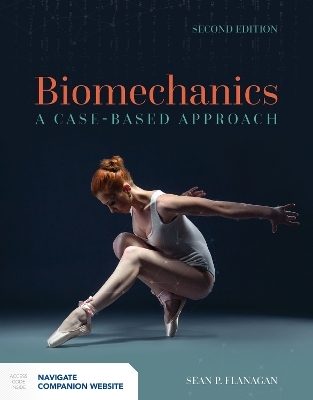
Biomechanics
A Case-Based Approach
Seiten
2018
|
Second Edition
Jones and Bartlett Publishers, Inc (Verlag)
978-1-284-10233-8 (ISBN)
Jones and Bartlett Publishers, Inc (Verlag)
978-1-284-10233-8 (ISBN)
Each new print copy includes the Navigate Companion Website which includes a variety of learning tools.
The Second Edition of Biomechanics: A Case-Based Approach emphasizes the comprehension, retention, and application of the core concepts of biomechanics through the use of problem-based learning strategies.
The author utilizes a student-centered approach by deploying a conversational writing style, tying new concepts to everyday experience, and emphasizing concepts over computation. A wide variety of pedagogical features aid this approach, with Section Questions, Competency Checks, and various boxed features serving to reinforce the content.
Biomechanics: A Case-Based Approach is organized into 18 lessons that cover the three levels of biomechanical analysis: whole body, joint, and tissue. Rather than moving from one level to the next, the author deploys a "whole-part-whole" organization in which mechanical principles are described at the whole-body level, followed by relevant discussion of the basic material mechanics of biological tissues and unique properties of the muscle-tendon complex.
Key Features:
-NEW - Process Boxes illustrate the link between inputs and outputs, providing a visual depiction of the underlying mechanics.
-NEW – Nine detailed case studies have been added throughout the text, with a summary of all nine cases presented in the final lesson.
-EXPANDED – The use of vector diagrams has been greatly expanded in the Second Edition to help students better visualize key material.
-KEY - Section Questions open each major section and present salient questions addressing the focus of the section.
-KEY – Competency Checks ask students conceptual and quantitative questions to assist in gauging their understanding of the material.
-KEY - Essential Math boxes provide a review of mathematical concepts.
-KEY – Applied Research boxes provide examples that are helpful in illustrating biomechanical concepts and present evidence of the practical value of biomechanics.
The Second Edition of Biomechanics: A Case-Based Approach emphasizes the comprehension, retention, and application of the core concepts of biomechanics through the use of problem-based learning strategies.
The author utilizes a student-centered approach by deploying a conversational writing style, tying new concepts to everyday experience, and emphasizing concepts over computation. A wide variety of pedagogical features aid this approach, with Section Questions, Competency Checks, and various boxed features serving to reinforce the content.
Biomechanics: A Case-Based Approach is organized into 18 lessons that cover the three levels of biomechanical analysis: whole body, joint, and tissue. Rather than moving from one level to the next, the author deploys a "whole-part-whole" organization in which mechanical principles are described at the whole-body level, followed by relevant discussion of the basic material mechanics of biological tissues and unique properties of the muscle-tendon complex.
Key Features:
-NEW - Process Boxes illustrate the link between inputs and outputs, providing a visual depiction of the underlying mechanics.
-NEW – Nine detailed case studies have been added throughout the text, with a summary of all nine cases presented in the final lesson.
-EXPANDED – The use of vector diagrams has been greatly expanded in the Second Edition to help students better visualize key material.
-KEY - Section Questions open each major section and present salient questions addressing the focus of the section.
-KEY – Competency Checks ask students conceptual and quantitative questions to assist in gauging their understanding of the material.
-KEY - Essential Math boxes provide a review of mathematical concepts.
-KEY – Applied Research boxes provide examples that are helpful in illustrating biomechanical concepts and present evidence of the practical value of biomechanics.
Professor, California State University, Northridge, Northridge, California
| Erscheinungsdatum | 23.08.2017 |
|---|---|
| Verlagsort | Sudbury |
| Sprache | englisch |
| Gewicht | 1134 g |
| Themenwelt | Sachbuch/Ratgeber ► Gesundheit / Leben / Psychologie |
| Studium ► 1. Studienabschnitt (Vorklinik) ► Physiologie | |
| ISBN-10 | 1-284-10233-5 / 1284102335 |
| ISBN-13 | 978-1-284-10233-8 / 9781284102338 |
| Zustand | Neuware |
| Informationen gemäß Produktsicherheitsverordnung (GPSR) | |
| Haben Sie eine Frage zum Produkt? |
Mehr entdecken
aus dem Bereich

aus dem Bereich


