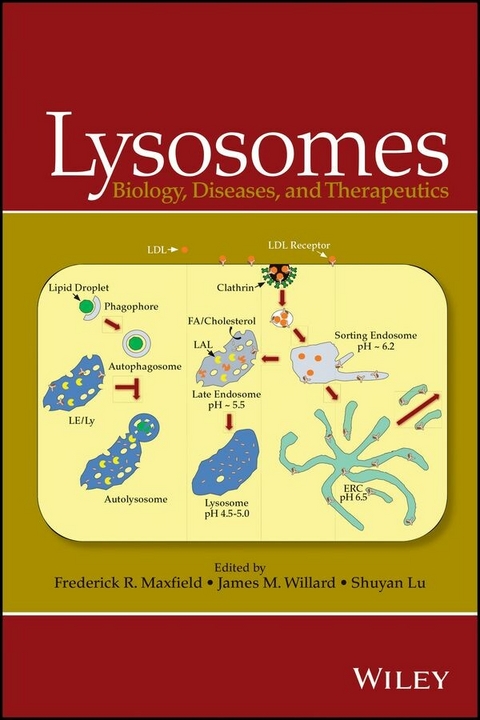
Lysosomes (eBook)
John Wiley & Sons (Verlag)
978-1-118-97831-3 (ISBN)
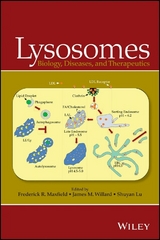
• Explores basic principles and properties of lysosomes that allow them to act as regulators of cell metabolism, therapeutic targets, and sites for activation of drug conjugates
• Discusses the role of lysosomes in metabolism, drug targeting, apoptosis, cancer, aging, inflammation, autophagy, metabolism, toxicity, and membrane repair
• Introduces new pathways in therapeutic development and new mechanisms in drug development
Frederick R. Maxfield, PhD, is Professor and Chair of the Department of Biochemistry at Weill Cornell Medical College. He has used digital imaging microscopy to characterize pH changes in endocytic organelles, to measure the kinetics of transport of molecules among organelles, and to identify new endocytic organelles such as the endocytic recycling compartment. Dr. Maxfield has published extensively on trafficking of lipids and cholesterol.
James M. Willard, PhD, has been a member of the Phospholipidosis Working Group at the Center for Drug Evaluation and Research (CDER) of the Food and Drug Administration since 2005 and Co-Chair of the group since 2011.
Shuyan Lu, MSc, has been an Investigative Toxicologist of Drug Research and Development at Pfizer for over 10 years. She studies the role of lysosomal pathways and physical chemical properties of compounds in drug-induced toxicity.
Frederick R. Maxfield, PhD, is Professor and Chair of the Department of Biochemistry at Weill Cornell Medical College. He has used digital imaging microscopy to characterize pH changes in endocytic organelles, to measure the kinetics of transport of molecules among organelles, and to identify new endocytic organelles such as the endocytic recycling compartment. Dr. Maxfield has published extensively on trafficking of lipids and cholesterol. James M. Willard, PhD, has been a member of the Phospholipidosis Working Group at the Center for Drug Evaluation and Research (CDER) of the Food and Drug Administration since 2005 and Co-Chair of the group since 2011. Shuyan Lu, MSc, has been an Investigative Toxicologist of Drug Research and Development at Pfizer for over 10 years. She studies the role of lysosomal pathways and physical chemical properties of compounds in drug-induced toxicity.
Preface
There has been a resurgence in interest in lysosomes based on exciting new discoveries over the past decade. Lysosomal function was observed microscopically in the late 19th century, and lysosomes were purified in the 1950s by the group of Christian De Duve [1]. During the same period, accumulation of undigested material in cells was observed in pathological examination of tissues from patients with a variety of diseases [2–4]. With the biochemical and morphological characterization of lysosomes, the linkage of the accumulated material with these organelles led to significant insights into the functional importance of lysosomes.
In the second half of the 20th century, there were groundbreaking studies of the biology and biochemistry of lysosomes [5–9]. These studies were linked closely with rapid developments in understanding fundamental cellular biological processes such as secretion and endocytosis. As a result, an increasingly detailed picture emerged of the biogenesis of lysosomes and their functional role in digesting internalized cargo [10, 11]. As understanding of lysosomal function increased, mechanism-based strategies for treating lysosomal diseases emerged. These included substrate reduction therapies (e.g., for Gaucher disease) [12, 13] and enzyme replacement therapies [14].
While there continued to be advances in basic cell biology and biochemistry, as well as in new therapeutic modalities, many investigators had a sense that the exciting era of discovery in lysosome biology was ending in the early 2000s. As an example, the Gordon Conference on “Lysosomes,” which for many years was one of the premier meetings on membrane traffic, changed its name to “Lysosomes and Endocytosis” in 2004.
Several related areas of investigation have blossomed over the past decade, and these have brought lysosomes back into the forefront of basic cell biology and biochemistry. One of these areas is autophagy. This process for lysosomal digestion of cytoplasmic organelles had been known for decades, but there were few handles on how to study it. With genetic studies leading to identification of key molecular components in the formation of autophagosomes and their subsequent fusion with lysosomes, it became possible to analyze this process in detail. As a result, autophagy is now recognized as playing a key role in processes including maintenance of organelle integrity, catabolism of lipid droplets, and responses to stress [15, 16]. Additionally, autophagy is essential for the survival and proliferation of some cancer cells, making it a novel target for development of therapies [17, 18]. Furthermore, genetic and molecular biological data accentuate the broad importance of the lysosome in aging and age-related diseases, including cardiovascular and neurodegenerative diseases, which make improving lysosome function an attractive target.
One of the most exciting recent developments has been the recognition that lysosomes are key regulators of signaling processes that regulate metabolism. The elucidation of the mTOR signaling pathways has shown that hydrolytic activity in lysosomes is used by the cell to sense nutrient status [19]. Among other activities, mTOR regulates autophagy to enhance the availability of new molecular building blocks when lysosomal production of catabolites is reduced. In another related area, it was recognized a few years ago that there is a coordinated transcriptional regulation of the genes involved in lysosome biogenesis [20, 21].
Along with these basic science developments, there have been important advances in the understanding of lysosomal storage disorders and in new methods for treatment. In some cases, this is beginning to turn these devastating diseases into conditions that can be managed. At the same time, there is increasing recognition that drugs used for various purposes can interact with lysosomal processes. A dramatic example of this is the discovery of mTOR as a mechanistic target for the immunosuppressive drug rapamycin [22]. Many pharmacological drugs in widespread use can affect lysosomal function [23–26], and it is important to understand the impact of these effects.
With all of these interrelated advances in understanding of lysosome biology, it seemed worthwhile to assemble an updated and integrated book on lysosomes. There are several notable earlier books on lysosomes, and a few of them will be cited here with apologies to the authors whose contributions may have been overlooked. Eric Holtzman [27] wrote a classic monograph that is still worth reading for its historical background and insights into the role of lysosomes in biology. This was followed a few years later by a book by Brian Storrie and Robert Murphy [28]. A book by Paul Saftig [29] focused on the basic biology and function of lysosomes. There have been several excellent books on lysosomal storage disorders, including one by Fran Platt and Steven Walkley [30]. More recently, there was a book emphasizing methods for the study of lysosomes [31].
The current book is intended for a broad audience of researchers interested in multiple facets of lysosome biology. Chapters 1–7 and 12 cover fundamental roles of lysosomes in physiological processes; Chapters 8–11 discusses involvement of lysosomes in various pathological conditions; Chapters 13–20 focus on the contribution of lysosomes in various aspects of drug development, including the lysosomal pathway as a target for drug discovery, toxicity, and special pharmacokinetics attributed to lysosomal accumulation and sequestration
We thank all contributors who provided their chapters despite other pressing responsibilities. We also thank our editors for their diligent effort and David B. Iaea for the cover illustration.
We hope that the broad scope, which includes both basic science and clinical applications, can promote a productive interchange among scientists working across the spectrum of lysosomal studies and nurture drug development efforts targeting lysosome pathways. Ultimately, discovery of new drugs that could improve lysosomal function will benefit multiple therapeutics areas.
References
- [1] Novikoff AB, Beaufay H, De Duve C. Electron microscopy of lysosome rich fractions from rat liver. J Biophys Biochem Cytol 1956;2:179–184.
- [2] Hers HG. alpha-Glucosidase deficiency in generalized glycogen storage disease (Pompe's disease). Biochem J 1963;86:11–16.
- [3] Baudhuin P, Hers HG, Loeb H. An electron microscopic and biochemical study of type II glycogenosis. Lab Invest 1964;13:1139–1152.
- [4] Kjellman B, Gamstorp I, Brun A, Ockerman PA, Palmgren B. Mannosidosis: a clinical and histopathologic study. J Pediatr 1969;75:366–373.
- [5] Novikoff AB, Novikoff PM. Cytochemical contributions to differentiating GERL from the Golgi apparatus. Histochem J 1977;9:525–551.
- [6] Novikoff AB. The endoplasmic reticulum: a cytochemist's view (a review). Proc Natl Acad Sci U S A 1976;73:2781–2787.
- [7] Griffiths G, Hoflack B, Simons K, Mellman I, Kornfeld S. The mannose 6-phosphate receptor and the biogenesis of lysosomes. Cell 1988;52:329–341.
- [8] Hasilik A, Neufeld EF. Biosynthesis of lysosomal enzymes in fibroblasts. Synthesis as precursors of higher molecular weight. J Biol Chem 1980;255:4937–4945.
- [9] Kaplan A, Fischer D, Achord D, Sly W. Phosphohexosyl recognition is a general characteristic of pinocytosis of lysosomal glycosidases by human fibroblasts. J Clin Invest 1977;60:1088–1093.
- [10] Kornfeld S, Mellman I. The biogenesis of lysosomes. Annu Rev Cell Biol 1989;5:483–525.
- [11] Mukherjee S, Ghosh RN, Maxfield FR. Endocytosis. Physiol Rev 1997;77:759–803.
- [12] Zimran A, Elstein D. Gaucher disease and the clinical experience with substrate reduction therapy. Philos Trans R Soc Lond B Biol Sci 2003;358:961–966.
- [13] Elstein D, Hollak C, Aerts JM, van Weely S, Maas M, et al. Sustained therapeutic effects of oral miglustat (Zavesca, N-butyldeoxynojirimycin, OGT 918) in type I Gaucher disease. J Inherit Metab Dis 2004;27:757–766.
- [14] Desnick RJ, Schuchman EH. Enzyme replacement and enhancement therapies: lessons from lysosomal disorders. Nat Rev Genet 2002;3:954–966.
- [15] Kaur J, Debnath J. Autophagy at the crossroads of catabolism and anabolism. Nat Rev Mol Cell Biol 2015;16:461–472.
- [16] Mizushima N, Levine B, Cuervo AM, Klionsky DJ. Autophagy fights disease through cellular self-digestion. Nature 2008;451:1069–1075.
- [17] Kenific CM, Debnath J. Cellular and metabolic functions for autophagy in cancer cells. Trends Cell Biol 2015;25:37–45.
- [18] Amaravadi RK, Lippincott-Schwartz J, Yin XM, Weiss WA, Takebe N, et al. Principles and current strategies for targeting autophagy for cancer treatment. Clin Cancer Res 2011;17:654–666.
- [19] Sancak Y, Bar-Peled L, Zoncu R, Markhard AL, Nada S, et al. Ragulator-Rag complex targets mTORC1 to the lysosomal surface and is necessary for its activation by amino acids. Cell 2010;141:290–303.
- [20] Palmieri M, Impey S, Kang H, di Ronza A, Pelz C, et al. Characterization of the CLEAR network reveals an integrated control of cellular clearance pathways. Hum Mol Genet 2011;20:3852–3866.
- [21] Sardiello M,...
| Erscheint lt. Verlag | 22.6.2016 |
|---|---|
| Sprache | englisch |
| Themenwelt | Medizin / Pharmazie ► Gesundheitsfachberufe |
| Medizin / Pharmazie ► Medizinische Fachgebiete ► Pharmakologie / Pharmakotherapie | |
| Naturwissenschaften ► Biologie ► Zellbiologie | |
| Naturwissenschaften ► Chemie | |
| Technik | |
| Schlagworte | amino acid sensing • autophagy • Biowissenschaften • Cell & Molecular Biology • Chemie • Chemistry • Clinical Pharmacology & Therapeutics • Drug Discovery & Development • drug induced toxicity • Klinische Pharmakologie u. Therapie • Life Sciences • Lyosom • lysosomal accumulation • lysosomal pathway • lysosomal sequestration • lysosome biogenesis • lysosomes • lysosomotropic • Medical Science • Medizin • Neurodegeneration • protein trafficking • Wirkstoffforschung • Wirkstoffforschung u. -entwicklung • Zellbiologie • Zell- u. Molekularbiologie |
| ISBN-10 | 1-118-97831-5 / 1118978315 |
| ISBN-13 | 978-1-118-97831-3 / 9781118978313 |
| Informationen gemäß Produktsicherheitsverordnung (GPSR) | |
| Haben Sie eine Frage zum Produkt? |
 EPUB (Adobe DRM)
Kopierschutz: Adobe-DRM
Adobe-DRM ist ein Kopierschutz, der das eBook vor Mißbrauch schützen soll. Dabei wird das eBook bereits beim Download auf Ihre persönliche Adobe-ID autorisiert. Lesen können Sie das eBook dann nur auf den Geräten, welche ebenfalls auf Ihre Adobe-ID registriert sind.
Details zum Adobe-DRM
Dateiformat: EPUB (Electronic Publication)
EPUB ist ein offener Standard für eBooks und eignet sich besonders zur Darstellung von Belletristik und Sachbüchern. Der Fließtext wird dynamisch an die Display- und Schriftgröße angepasst. Auch für mobile Lesegeräte ist EPUB daher gut geeignet.
Systemvoraussetzungen:
PC/Mac: Mit einem PC oder Mac können Sie dieses eBook lesen. Sie benötigen eine
eReader: Dieses eBook kann mit (fast) allen eBook-Readern gelesen werden. Mit dem amazon-Kindle ist es aber nicht kompatibel.
Smartphone/Tablet: Egal ob Apple oder Android, dieses eBook können Sie lesen. Sie benötigen eine
Geräteliste und zusätzliche Hinweise
Buying eBooks from abroad
For tax law reasons we can sell eBooks just within Germany and Switzerland. Regrettably we cannot fulfill eBook-orders from other countries.
aus dem Bereich