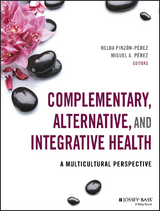
Complementary, Alternative, and Integrative Health (eBook)
John Wiley & Sons (Verlag)
978-1-118-88042-5 (ISBN)
HELDA PINZÓN-PÉREZ, PHD, CNS, MCHES, FNS, is a professor in the Department of Public Health and School of Nursing at California State University, Fresno. She is a native of Colombia. Her research interests are international health as well as alternative medicine and integrative healing.
MIGUEL A. PÉREZ, PHD, MCHES, CGS, FAAHE, is a health educator who specializes in international adolescent health issues, applied research, and cultural competence. He is the author of a textbook in health education, co-edited a couple of books, and written several book chapters, in addition to peer-reviewed publications and numerous conferences, many based on his research on migrant and adolescent health risk behaviors.
Complementary, Alternative, and Integrative Health: A Multicultural Perspective provides a critical analysis of non-allopathic healing practices, including their uses, limitations, and scientific basis. The evidence-based discussion explores complementary, alternative, and integrative health (CAIH) across various cultural and ethnic groups both in the U.S. and internationally, to give you a greater understanding of the different modalities including a literature-backed examination of proven methods and questionable practices within a cross-cultural framework. Each chapter highlights the scientific analysis of the practices relevant to each group, and guides you toward independent analysis of the risks and benefits of the practices discussed. Emphasizing the student as a future health professional, this book includes case studies, examples, questions, and discussion problems that underscore the role of health educators in educating consumers about CAIH practices.
HELDA PINZÓN-PÉREZ, PHD, CNS, MCHES, FNS, is a professor in the Department of Public Health and School of Nursing at California State University, Fresno. She is a native of Colombia. Her research interests are international health as well as alternative medicine and integrative healing. MIGUEL A. PÉREZ, PHD, MCHES, CGS, FAAHE, is a health educator who specializes in international adolescent health issues, applied research, and cultural competence. He is the author of a textbook in health education, co-edited a couple of books, and written several book chapters, in addition to peer-reviewed publications and numerous conferences, many based on his research on migrant and adolescent health risk behaviors.
Preface vii
Acknowledgments xiii
About the Editors xv
About the Contributors xvii
Chapter 1 Exploring Complementary, Alternative, and Integrative Health: Overview, Limits, and Controversies 1
Cyndi Guerra, Cheryl Hickey, and Helda Pinzón-Pérez
Chapter 2 Mind-Body Medicine 29
Catherine L. Zeman
Chapter 3 Natural Complementary and Alternative Medicine Modalities 57
Cheryl Hickey and Cyndi Guerra
Chapter 4 Manipulative and Body-Based Practices 83
Kathleen Rindahl, Helda Pinzón-Pérez, and Georgina Castle
Chapter 5 Ayurveda and Other Complementary Health Approaches 121
Peter Garcia and Monika Joshi
Chapter 6 The Role of Spirituality in Healing 145
Dominick L. Sturz
Chapter 7 Complementary, Alternative, and Integrative Health Approaches among American Indians and Alaska Natives 177
Vickie D. Krenz and Amber Huhndorf
Chapter 8 Complementary, Alternative, and Integrative Health Approaches among Hispanics/Latinos 207
Raffy R. Luquis and Joel Arboleda Castillo
Chapter 9 Complementary, Alternative, and Integrative Health Approaches among African Americans 235
Pierre E. Wright and Steven B. Owens
Chapter 10 Complementary, Alternative, and Integrative Health Approaches among Asian Americans, Native Hawaiians, and Pacific Islanders 259
Liliana Rojas-Guyler and Mariamma K. Mathai
Chapter 11 Complementary, Alternative, and Integrative Health Approaches among Caucasian/European Americans 283
Kara N. Zografos
Chapter 12 Complementary, Alternative, and Integrative Health Approaches among West Asian American Communities 305
Gina Marie Piane and Brandon M. Eggleston
Chapter 13 Complementary, Alternative, and Integrative Health: Beyond the Paradigm of CAM 323
Helda Pinzón-Pérez, Miguel A. Pérez, and Raffy R. Luquis
Index 351
PREFACE
In December 2014, in an omnibus budget measure signed by President Obama, Congress changed the name of the National Center for Complementary and Alternative Medicine (NCCAM) to the National Center for Complementary and Integrative Health (NCCIH) (NCCIH, 2015a). The editors and contributors of this volume welcome this change since it reflects the center's commitment to enhance public and scientific understanding of alternative, complementary, and integrative health practices, instead of only medical practices. Throughout this book, both names NCCAM and NCCIH will be utilized, depending on the terminology used by the bibliographical sources consulted.
This book emphasizes a new understanding of complementary and alternative medicine (CAM). It reflects an emphasis on complementary, alternative, and integrative health (CAIH) while recognizing the value that the term CAM has brought historically to our understanding of alternative models of care. In this book, the acronym CAM is replaced by CAIH to reflect the current understanding of complementary and integrative health. The acronym CAM will be utilized only when the bibliographical references consulted for this publication used that term.
Various names were considered for the title of this book, one of them being “Integrative, Complementary, and Traditional Health Practices,” a term used by the American Public Health Association for one of its professional sections (2015). A second potential title was “Complementary, Alternative, and Integrative Health Care,” which was used by the University of North Carolina at Chapel Hill (University of North Carolina at Chapel Hill School of Medicine, 2015). A third potential title was “Complementary and Integrative Medicine,” which was used by the Mayo Clinic (2015) and the University of Texas MD Anderson Cancer Center (2015). Also considered was “Traditional and Complementary Medicine,” used by the World Health Organization (WHO) in its 2013 document, “WHO Traditional Medicine Strategy 2014–2023.” The editors chose to embrace the vision of the NCCIH and provide a more comprehensive perspective by using the term complementary, alternative, and integrative health, which places the emphasis on health and wellness rather than on the medical model. Although NCCIH refers to these practices as complementary and integrative health (CIH) approaches, the editors of this book added the word alternative in the acronym to acknowledge that consumers still use some of these practices as alternative forms of care.
In this book, the term CAIH is used to transition consumers and health professionals to the new terminology that may guide research and evidence-based practice in the future. Our hearts and scientific discovery remain committed to enhance the understanding of complementary, alternative, and integrative health approaches.
Why a Book on CAIH?
Multiple books have been published on CAM, but very few have captured the recent changes in the NCCIH and the new terms associated with traditional, complementary, alternative, and integrative health. This book responds to the need to train customers and health professionals on these recent changes. The editors and authors of this publication hope that this book begins to address this need.
This book also emphasizes the importance of the multicultural perspective of CAIH approaches. Multiple chapters of this book discuss the use of CAIH and CAM practices among various ethnic and cultural groups. Some sections emphasize the relevance of the concepts for health educators, since the editors are Master Certified Health Education Specialists and since all health professionals have a responsibility to educate the public on health-related issues.
Another reason for the publication of this book is the increasing use of complementary, alternative, and integrative health approaches worldwide and in the United States. Data from the WHO (2004) show that up to 80% of people in developing countries use traditional medicine as a primary source of healthcare. In the United States, results from the 2012 National Health Interview Survey indicated that 33.2% of US adults and 11.6% of US children age 4 to 17 used complementary health approaches (Clarke et al., 2015; NCCIH, 2015b). Despite their wide usage, however, CAIH and CAM practices continue to be misunderstood, are not always regulated, and are controversial among US healthcare practitioners.
A common concern expressed by detractors of CAIH is the lack of “scientific evidence” for many of the claims made by proponents, concerns that are heightened only by charlatans who sometimes employ deceptive marketing practices to lure unsuspecting consumers to try treatments that may in fact place their health status at risk. Proponents of CAIH point to the increasing body of evidence that supports the use of certain modalities such as acupuncture and tout fewer side effects as a reason for its use. Despite continuing controversies, there is agreement that more information is needed; that healthcare providers ought to be better versed in CAIH; and that consumers and healthcare providers must increase their communication related to CAIH. Currently, several efforts are under way to address these issues.
In the year 2000, WHO released the General Guidelines for Methodologies on Research and Evaluation of Traditional Medicine in an effort to maximize the proper utilization of traditional medicine, as well as to provide guidelines for research and evaluation initiatives on this topic. This official WHO publication set the framework for the scientific evaluation of CAIH and CAM and provided ethical guidelines for its evaluation and implementation.
In the United States, the need to improve communication between patients and providers has resulted in advocacy efforts to achieve that goal with very specific results. An important step in improving such communication is to train future generations of health professionals on CAIH. Howell (2012), a reporter from the Association of American Medical Colleges, discussed the value of incorporating CAM into the curriculum of medical schools to empower doctors to actively discuss with their patients the use of CAM. According to Howell, the emphasis on incorporating CAM training for health professionals began when the National Center for Complementary and Alternative Medicine launched the CAM Education Project in 1999.
This book aims to be a resource for students and health professionals to better understand CAIH approaches and translate that knowledge into more effective communication patterns with consumers. It is imperative that healthcare practitioners, including health educators, better understand the most common CAIH practices employed by individuals, since research results indicate that some populations employ CAM along with, and in some cases in lieu of, allopathic treatments. In addition, patients do not always reveal this information to their healthcare providers (NCCIH, 2015c).
Key Features of This Book
This book uses the acronym CAIH, which stands for complementary, alternative, and integrative health. This acronym collectively refers to common names used in the past and new emerging terms. The use of this acronym represents an attempt to reach consensus on the terminology to be used since there are multiple terms associated with the fields of traditional healing, alternative medicine, and integrative health, which can be confusing to both consumers and professionals alike. These terms show the transformation of the concepts and the evolution of our understanding of these fields. This book is based on the WHO's definition of complementary/alternative medicine, which is “the sum total of the knowledge, skills, and practices based on the theories, beliefs, and experiences indigenous to different cultures, whether explicable or not, used in the maintenance of health as well as in the prevention, diagnosis, improvement or treatment of physical and mental illness” (n.d., p. 1).
Since the classification of CAM therapies has varied throughout the years, this book groups CAM therapies into the divisions originally suggested by the NCCAM and integrates the new divisions currently proposed by the NCCIH. Initially, NCCAM (2014) divided CAM modalities into five categories: (1) alternative medical systems, (2) mind-body interventions, (3) biologically based treatments, (4) manipulative and body-based methods, and (5) energy therapies. Later, NCCAM grouped CAM practices into four categories: (1) natural products, (2) mind and body medicine, (3) manipulative and body-based practices, and (4) other CAM practices. This classification was revised again, and in 2015, NCCIH (2015b) divided complementary health approaches into three subgroups: (1) natural products, (2) mind and body practices, and (3) other complementary health approaches.
Most of the chapters in this book were written by a team of CAM practitioners and academicians working on CAIH. The combination of the real-life experience provided by CAM practitioners and the scientific approach given by university professors and other academicians in CAIH provides a unique approach to the reader's understanding of CAIH and CAM.
This edited volume is designed to provide a foundation to CAIH healing practices. It explores proven methods and provides a framework for questioning the efficacy of CAIH while exploring its use within a cross-cultural framework. Six chapters are dedicated to the exploration of CAIH in the racial and ethnic groups most commonly found in the United States. Since the current literature uses the term CAM, each...
| Erscheint lt. Verlag | 17.6.2016 |
|---|---|
| Reihe/Serie | Public Health/AAHE |
| Public Health/AAHE | Public Health/AAHE |
| Sprache | englisch |
| Themenwelt | Sachbuch/Ratgeber ► Gesundheit / Leben / Psychologie ► Alternative Heilverfahren |
| Medizin / Pharmazie ► Naturheilkunde | |
| Schlagworte | Alternative Medicine & Complementary Therapies • alternative medicine analysis • AMA resolution #514 • Bildungswesen • CAM benefits • CAM education • CAM in public health • CAM modalities • CAM risks • CAM scientific basis • CAM supportive care • CAM therapies • complementary, alternative, and integrative health • Complementary, Alternative, and Integrative Health: A Multicultural Perspective • complementary medicine • consumer health education • cultural CAM use • cultural health traditions • Education • evidence-based alternative medicine • Gesundheits- u. Sozialwesen • Gesundheitsvorsorge • Gesundheitsvorsorge Alternative Medizin u. ergänzende Therapien • Gesundheitsvorsorge Alternative Medizin u. ergänzende Therapien • Health & Social Care • health education • Helda Pinzon-Perez • holistic medicine for professionals • Integrative Medicine • international CAM • K-12 • K-12 / Lehrerbildung • Miguel A. Perez • non-allopathic healing • Public Health • Public Health / Ausbildung u. Verhaltensweisen • Public Health Behavior & Education • Teacher Education (K-12) |
| ISBN-10 | 1-118-88042-0 / 1118880420 |
| ISBN-13 | 978-1-118-88042-5 / 9781118880425 |
| Informationen gemäß Produktsicherheitsverordnung (GPSR) | |
| Haben Sie eine Frage zum Produkt? |
 EPUB (Adobe DRM)
Kopierschutz: Adobe-DRM
Adobe-DRM ist ein Kopierschutz, der das eBook vor Mißbrauch schützen soll. Dabei wird das eBook bereits beim Download auf Ihre persönliche Adobe-ID autorisiert. Lesen können Sie das eBook dann nur auf den Geräten, welche ebenfalls auf Ihre Adobe-ID registriert sind.
Details zum Adobe-DRM
Dateiformat: EPUB (Electronic Publication)
EPUB ist ein offener Standard für eBooks und eignet sich besonders zur Darstellung von Belletristik und Sachbüchern. Der Fließtext wird dynamisch an die Display- und Schriftgröße angepasst. Auch für mobile Lesegeräte ist EPUB daher gut geeignet.
Systemvoraussetzungen:
PC/Mac: Mit einem PC oder Mac können Sie dieses eBook lesen. Sie benötigen eine
eReader: Dieses eBook kann mit (fast) allen eBook-Readern gelesen werden. Mit dem amazon-Kindle ist es aber nicht kompatibel.
Smartphone/Tablet: Egal ob Apple oder Android, dieses eBook können Sie lesen. Sie benötigen eine
Geräteliste und zusätzliche Hinweise
Buying eBooks from abroad
For tax law reasons we can sell eBooks just within Germany and Switzerland. Regrettably we cannot fulfill eBook-orders from other countries.
aus dem Bereich