


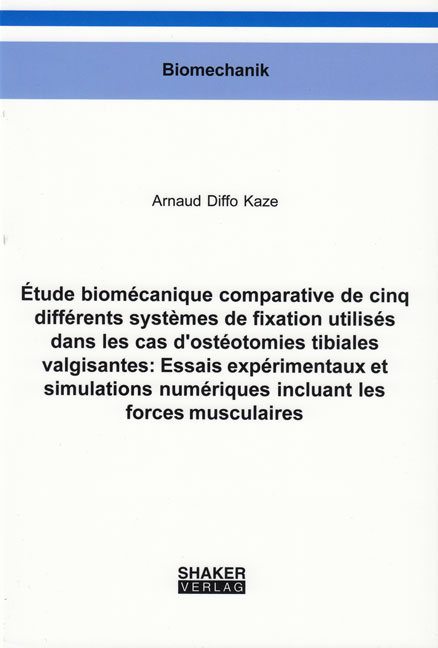
Étude biomécanique comparative de cinq différents systèmes de fixation utilisés dans les cas d'ostéotomies tibiales valgisantes: Essais expérimentaux et simulations numériques incluant les forces musculaires
Seiten
- Keine Verlagsinformationen verfügbar
- Artikel merken
Performing tests or measurements in order to investigate the biomechanical behavior of the knee joint is very difficult and, when possible, mostly invasive. On the other hand when the tests are performed on physical prototypes (such as artificial bones often used to perform osteotomy tests for example), the difficulty resides on the experimental reproduction of the realistic mechanical environments in which the body evolves daily. Beside this difficulty, if one considers the boundary and the loading conditions which should be apply while performing the tests, one comes up additionally against the lack of accurate knowledge about the real conditions which exist.
Assessment of individual muscle forces during human movement can push forward the consideration of realistic loading of the joints while performing the experimental tests or numerical simulations. But until today direct measurement of muscle forces is not feasible. Contact forces between the bones that build articulation are measurable by means of telemetric instrumentation incorporated in prosthesis.
The musculoskeletal modeling offered a solution to that issue by providing models that enable the calculation of muscle forces. In the present work, muscles forces during a normal walk calculated by such a validated model have been applied to a finite element model of the lower limb in order to build a numerical model which can push forward the analysis of knee biomechanics. A comparison of five different currently used implants for open-wedge high tibial osteotomy has been performed by experimental study, and also by numerical analysis. The experimental study consisted in static compression loading to failure and dynamic loading to failure tests on artificial composite tibias. The numerical analysis simulated a simple loading, consisting in applying a vertical compressive load on the tibia plateau, and a realistic loading that take into account the muscle forces.
Comparing the simple loading to the realistic loading considering the muscle forces showed that the simple loading, used during the mechanical tests, is compatible with a realistic loading of the tibia with the leg at 15 % of the gait cycle during slow walking. Observations from numerical simulations considering the realistic loading emphasized the necessity to take into account the muscle forces in the testing protocols and implant design process. The results of the numerical simulations considering the simple loading were in line with the findings of the experimental study. All the implants tested showed sufficient stability during static loading. All the specimens failed due to fracture of the opposite cortical bone.
Simplifications were made to reduce the complexity of the different physical and numerical models; hence the transposition of the obtained results to clinical settings should be done with precaution. L'objectif majeur de ce projet a consisté en une étude biomécanique comparative de la stabilité mécanique des cinq différents systèmes de fixation suivant, utilisés dans les cas d'ostéotomie tibiale de valgisation : Contour Lock HTO, PEEKPower HTO, iBalance HTO, TomoFix standard et TomoFix « small stature ».
La comparaison s'est faite de façon expérimentale à l'aide d'essais statiques et cycliques, puis numériquement en utilisant des simulations par la méthode des éléments finis.
Les forces des muscles, déterminées à partir d'un modèle musculo-squelettique, ont été appliquées aux modèles éléments finis du membre inférieur simulant la phase d'appui du cycle de la marche. Les modèles éléments finis réalisés comprennent les fémur, tibia et fibula, ainsi que les ménisques, les couches de cartilage articulaire du genou. L'étude comparative des implants par des simulations numériques s'est faite en considérant deux chargements distincts : (1) application d'une force compressive sur le plateau tibial et (2) considération des forces musculaires.
La comparaison des deux types de chargement a montré que le chargement (1) utilisé lors des essais en laboratoire est compatible avec un chargement réaliste du tibia. Les observations issues des simulations numériques considérant le chargement (2) ont montré la nécessité de tenir compte des forces musculaires dans les protocoles d'essais et des processus de conception des implants. Les résultats des simulations numériques considérant le chargement (1) ont été conformes aux résultats expérimentaux. Tous les implants testés ont été suffisamment résistants à l'endommagement lors du chargement statique. Toutefois, il faudrait donc procéder avec précaution lors du transfert des résultats obtenus dans des contextes cliniques.
Assessment of individual muscle forces during human movement can push forward the consideration of realistic loading of the joints while performing the experimental tests or numerical simulations. But until today direct measurement of muscle forces is not feasible. Contact forces between the bones that build articulation are measurable by means of telemetric instrumentation incorporated in prosthesis.
The musculoskeletal modeling offered a solution to that issue by providing models that enable the calculation of muscle forces. In the present work, muscles forces during a normal walk calculated by such a validated model have been applied to a finite element model of the lower limb in order to build a numerical model which can push forward the analysis of knee biomechanics. A comparison of five different currently used implants for open-wedge high tibial osteotomy has been performed by experimental study, and also by numerical analysis. The experimental study consisted in static compression loading to failure and dynamic loading to failure tests on artificial composite tibias. The numerical analysis simulated a simple loading, consisting in applying a vertical compressive load on the tibia plateau, and a realistic loading that take into account the muscle forces.
Comparing the simple loading to the realistic loading considering the muscle forces showed that the simple loading, used during the mechanical tests, is compatible with a realistic loading of the tibia with the leg at 15 % of the gait cycle during slow walking. Observations from numerical simulations considering the realistic loading emphasized the necessity to take into account the muscle forces in the testing protocols and implant design process. The results of the numerical simulations considering the simple loading were in line with the findings of the experimental study. All the implants tested showed sufficient stability during static loading. All the specimens failed due to fracture of the opposite cortical bone.
Simplifications were made to reduce the complexity of the different physical and numerical models; hence the transposition of the obtained results to clinical settings should be done with precaution. L'objectif majeur de ce projet a consisté en une étude biomécanique comparative de la stabilité mécanique des cinq différents systèmes de fixation suivant, utilisés dans les cas d'ostéotomie tibiale de valgisation : Contour Lock HTO, PEEKPower HTO, iBalance HTO, TomoFix standard et TomoFix « small stature ».
La comparaison s'est faite de façon expérimentale à l'aide d'essais statiques et cycliques, puis numériquement en utilisant des simulations par la méthode des éléments finis.
Les forces des muscles, déterminées à partir d'un modèle musculo-squelettique, ont été appliquées aux modèles éléments finis du membre inférieur simulant la phase d'appui du cycle de la marche. Les modèles éléments finis réalisés comprennent les fémur, tibia et fibula, ainsi que les ménisques, les couches de cartilage articulaire du genou. L'étude comparative des implants par des simulations numériques s'est faite en considérant deux chargements distincts : (1) application d'une force compressive sur le plateau tibial et (2) considération des forces musculaires.
La comparaison des deux types de chargement a montré que le chargement (1) utilisé lors des essais en laboratoire est compatible avec un chargement réaliste du tibia. Les observations issues des simulations numériques considérant le chargement (2) ont montré la nécessité de tenir compte des forces musculaires dans les protocoles d'essais et des processus de conception des implants. Les résultats des simulations numériques considérant le chargement (1) ont été conformes aux résultats expérimentaux. Tous les implants testés ont été suffisamment résistants à l'endommagement lors du chargement statique. Toutefois, il faudrait donc procéder avec précaution lors du transfert des résultats obtenus dans des contextes cliniques.
| Erscheinungsdatum | 15.07.2016 |
|---|---|
| Reihe/Serie | Berichte aus der Biomechanik |
| Verlagsort | Aachen |
| Sprache | französisch |
| Maße | 148 x 210 mm |
| Gewicht | 377 g |
| Einbandart | geklebt |
| Themenwelt | Studium ► 1. Studienabschnitt (Vorklinik) ► Physiologie |
| Schlagworte | Arthrose • forces musculaires • ostéotomie tibiale de valgisation (OTV) |
| ISBN-10 | 3-8440-4599-6 / 3844045996 |
| ISBN-13 | 978-3-8440-4599-4 / 9783844045994 |
| Zustand | Neuware |
| Informationen gemäß Produktsicherheitsverordnung (GPSR) | |
| Haben Sie eine Frage zum Produkt? |
Mehr entdecken
aus dem Bereich



aus dem Bereich


