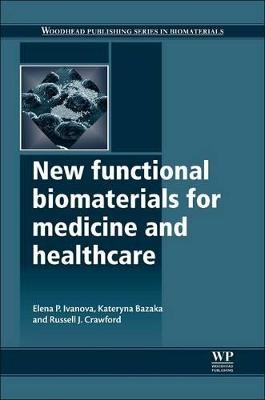
New Functional Biomaterials for Medicine and Healthcare
Woodhead Publishing Ltd (Verlag)
978-0-08-101540-7 (ISBN)
- Titel wird leider nicht erscheinen
- Artikel merken
The book begins with an overview of the use of biomaterials in contemporary healthcare and the process of developing novel biomaterials; the key issues and challenges associated with the design of complex implantable systems are also highlighted. The book then reviews the main materials used in functional biomaterials, particularly their properties and applications. Individual chapters focus on both natural and synthetic polymers, metallic biomaterials, and bio-inert and bioactive ceramics.
Advances in processing technologies and our understanding of materials and their properties have made it possible for scientists and engineers to develop more sophisticated biomaterials with more targeted functionality. New Functional Biomaterials for Medicine and Healthcare provides an ideal one-volume summary of this important field that represents essential reading for scientists, engineers, and clinicians, and a useful reference text for undergraduate and postgraduate students.
Elena P. Ivanova is a Professor at the Swinburne University of Technology, Melbourne, Australia. Kateryna Bazaka is a Postdoctoral Research Fellow at the School of Engineering and Physical Sciences, James Cook University, Australia. Roy J. Crawford was Vice Chancellor of the University of Waikato, New Zealand. Prior to this he was Pro Vice-Chancellor for Research at Queen's University Belfast in Northern Ireland, United Kingdom. At Queen's University, Professor. Crawford was responsible for establishing the Polymer Processing Research Centre which included the Research Group on rotational moulding of plastics, which he also founded. In 1998, he was elected as a Fellow of the Royal Academy of Engineering, and in 2005 was elected as a Fellow of the Society of Plastics Engineers. In the 2015 Queen's Birthday Honours, Prof. Crawford was appointed a Companion of the New Zealand Order of Merit, for services to tertiary education. Prof. Crawford sadly passed away in 2016.
Author contact details
Woodhead Publishing Series in Biomaterials
Preface
Chapter 1: Introduction to biomaterials and implantable device design
Abstract:
1.1 Introduction
1.2 Biomaterials and their applications
1.3 Biomaterial development and realisation
1.4 Implantable systems design
1.5 Device-associated infections
1.6 Current trends in biomaterials design and fabrication
Chapter 2: Natural polymer biomaterials: advanced applications
Abstract:
2.1 Introduction
2.2 Chitin and chitosan
2.3 Alginate
2.4 Collagen
2.5 Gelatin
2.6 Hyaluronic acid
2.7 Fibrinogen
2.8 Silk fibroin
2.9 Viral particles and bacteriophage capsids for drug delivery
2.10 Immunocytes as 'Trojan horses' for molecule delivery
2.11 Future trends
Chapter 3: Advanced synthetic polymer biomaterials derived from organic sources
Abstract:
3.1 Introduction
3.2 Poly(ester)s and poly(ester) block copolymers
3.3 Poly(2-oxazoline)s
3.4 Poly(alkyl carbonate)s
3.5 Poly(ether)s
3.6 Polypeptides
3.7 Poly(anhydride)s
3.8 Poly(urethane)s
3.9 Conclusion
Chapter 4: Advanced synthetic and hybrid polymer biomaterials derived from inorganic and mixed organic-inorganic sources
Abstract:
4.1 Introduction
4.2 Synthetic inorganic polymers
4.3 Silicon-based inorganic polymers
4.4 Poly(phosphazene)s
4.5 Organic-inorganic hybrid polymers
4.6 Geopolymers
4.7 Conclusion
Chapter 5: Metallic biomaterials: types and advanced applications
Abstract:
5.1 Introduction
5.2 Stainless steel
5.3 Co-Cr alloys
5.4 Ti and Ti-based alloys
5.5 Noble metal alloys
5.6 Shape memory alloys
5.7 Biodegradable metals
5.8 Conclusion
Chapter 6: Cytotoxicity and biocompatibility of metallic biomaterials
Abstract:
6.1 Introduction
6.2 Cytotoxicity and biocompatibility of metals and alloys
6.3 Effect of load and wear on implant degradation
6.4 Macrophage-mediated inflammatory events
6.5 Role of bacterial endotoxins in triggering a particle-induced inflammatory response
6.6 Osteoclast-mediated bone resorption
6.7 Osteolysis as a function of implant-associated mechano-transduction
6.8 Surface modification as a means of enhancing biocompatibility and corrosion resistance
6.9 Conclusion
Chapter 7: Bioinert ceramic biomaterials: advanced applications
Abstract:
7.1 Introduction
7.2 Hardness, high compressive strength and wear resistance of bioinert refractory polycrystalline compounds
7.3 Techniques for the fabrication of bioinert ceramic implants
7.4 Conclusion
Chapter 8: Advanced bioactive and biodegradable ceramic biomaterials
Abstract:
8.1 Introduction
8.2 The development of bioactive ceramics for tissue engineering
8.3 Calcium phosphates
8.4 Bioactive glasses
8.5 Conclusion
Index
| Erscheinungsdatum | 14.06.2016 |
|---|---|
| Reihe/Serie | Woodhead Publishing Series in Biomaterials |
| Verlagsort | Cambridge |
| Sprache | englisch |
| Maße | 156 x 234 mm |
| Themenwelt | Medizin / Pharmazie ► Physiotherapie / Ergotherapie ► Orthopädie |
| Technik ► Maschinenbau | |
| Technik ► Medizintechnik | |
| Technik ► Umwelttechnik / Biotechnologie | |
| ISBN-10 | 0-08-101540-2 / 0081015402 |
| ISBN-13 | 978-0-08-101540-7 / 9780081015407 |
| Zustand | Neuware |
| Informationen gemäß Produktsicherheitsverordnung (GPSR) | |
| Haben Sie eine Frage zum Produkt? |
aus dem Bereich