


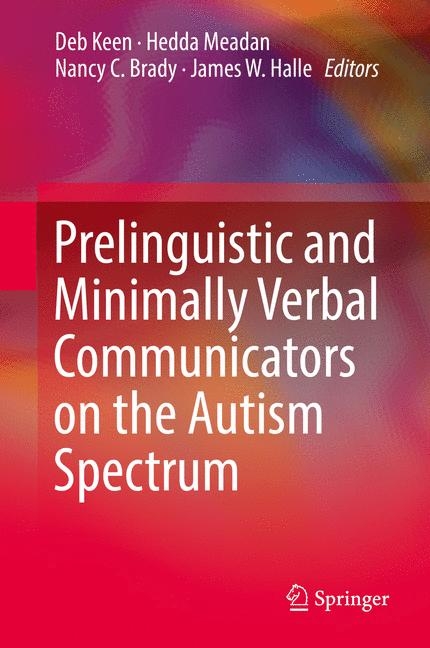
Prelinguistic and Minimally Verbal Communicators on the Autism Spectrum (eBook)
XVIII, 260 Seiten
Springer Singapore (Verlag)
978-981-10-0713-2 (ISBN)
This book draws on contemporary theory and recent findings to provide researchers, professionals, undergraduate and graduate students with essential resources, allowing them to better understand and support children, youth and adults with autism and significant communication impairments. The book consists of 11 chapters organized into 3 sections detailing typical and atypical prelinguistic development for individuals on the autism spectrum, together with a range of assessment and intervention approaches that clinicians and educators can draw on in practice. The book adopts a lifespan perspective, recognizing that there is an important and particularly challenging sub-group of children on the spectrum who remain minimally verbal beyond the age of 8 years. Each chapter summarizes current research on a selected topic, identifies key challenges faced by researchers, educators and clinicians, and considers the implications for research and practice. The concluding chapter considers issues of research translation and how educators and clinicians can encourage the use of evidence-based practices for prelinguistic and minimally verbal individuals.
Deb Keen is a Professor of Education with the Autism Centre of Excellence in the School of Education and Professional Studies at Griffith University, Brisbane, Australia. She has published extensively on her research into ways to enhance participation and engagement of individuals with autism and their families in home, school, and community. She is particularly interested in evidence-based practice, communication, problem behavior, early intervention, and family-centered practice.Hedda Meadan is an associate professor in the Department of Special Education at the University of Illinois at Urbana-Champaign and a board-certified behavior analyst. Her areas of interest include social communication skills of young children with autism and other developmental disabilities, intervention methods to enhance these spheres of functioning, and families of individuals with disabilities.Nancy Brady is an associate professor at the Department of Speech Language Hearing Sciences and Disorders, University of Kansas. She is an ASHA fellow and past chair of the National Joint Committee on Communication Needs of Persons with Severe Disabilities (NJC). Her current research, funded by the National Institutes of Health, is focused on improving assessments for expressive communication in individuals with minimal verbal skills associated with intellectual and developmental disabilities, and on longitudinal analyses of development in fragile X syndrome. Jim Halle is a professor emeritus in the Department of Special Education at the University of Illinois at Urbana-Champaign. For more than 40 years, he has been involved in research related to communication and language development among children with autism and other developmental disabilities. His program of research has focused on examining both social communication of young children with significant intellectual disability and the ecological factors that facilitate and discourage communicative growth. His methodological and conceptual approach is characterized by single-case research and applied behavior analysis.
Section 1 Prelinguistic Communication Development.- Chapter 1 Introduction to Prelinguistic and Minimally Verbal Communicators on the Autism Spectrum.- Chapter 2 Prelinguistic Communication Development.- Chapter 3 Prelinguistic Communication and Joint Attention.- Chapter 4 Transitions to Intentional and Symbolic Communication in Typical Development and in Autism Spectrum Disorder.- Section 2 Assessment of Prelinguistic and Minimally Verbal Communication.- Chapter 5 Standardized Assessment of Prelinguistic Communication.- Chapter 6 Individualized Assessment of Prelinguistic Communication.- Chapter 7 Functional Assessment of Problematic Forms of Prelinguistic Behavior.- Section 3 Interventions for Prelinguistic and Minimally Verbal Commuicators.- Chapter 8 Social Communication Interventions.- Chapter 9 Augmentative and Alternative Communication Applications for Persons with ASD and Complex Communication Needs.- Chapter 10 Parent Involvement in Communication Interventions.- Chapter 11 Translating Research to Practice in Prelinguistic Communication.
| Erscheint lt. Verlag | 5.5.2016 |
|---|---|
| Zusatzinfo | XVIII, 260 p. 2 illus. |
| Verlagsort | Singapore |
| Sprache | englisch |
| Themenwelt | Geisteswissenschaften ► Psychologie ► Entwicklungspsychologie |
| Medizin / Pharmazie ► Medizinische Fachgebiete ► Neurologie | |
| Medizin / Pharmazie ► Medizinische Fachgebiete ► Psychiatrie / Psychotherapie | |
| Sozialwissenschaften ► Pädagogik ► Sozialpädagogik | |
| Sozialwissenschaften ► Soziologie | |
| Schlagworte | Adult responsiveness • Assessment of prelinguistic behaviour • Augmentative and alternative communication • Autism spectrum disorder • Communication breakdowns • Communication Interventions • Complex communication needs • Early Intervention • Funtional assessment of problem behaviour • Intentional communication • Joint attention • Language Development • Parent mediated interventions • Preintentional communication • Prelinguistic communication • Presymbolic communition • Research to practice in autism spectrum disorders • Severe disability • Social communication • Translational research |
| ISBN-10 | 981-10-0713-6 / 9811007136 |
| ISBN-13 | 978-981-10-0713-2 / 9789811007132 |
| Informationen gemäß Produktsicherheitsverordnung (GPSR) | |
| Haben Sie eine Frage zum Produkt? |
 PDF (Wasserzeichen)
DRM: Digitales Wasserzeichen
Dieses eBook enthält ein digitales Wasserzeichen und ist damit für Sie personalisiert. Bei einer missbräuchlichen Weitergabe des eBooks an Dritte ist eine Rückverfolgung an die Quelle möglich.
Dateiformat: PDF (Portable Document Format)
Mit einem festen Seitenlayout eignet sich die PDF besonders für Fachbücher mit Spalten, Tabellen und Abbildungen. Eine PDF kann auf fast allen Geräten angezeigt werden, ist aber für kleine Displays (Smartphone, eReader) nur eingeschränkt geeignet.
Systemvoraussetzungen:
PC/Mac: Mit einem PC oder Mac können Sie dieses eBook lesen. Sie benötigen dafür einen PDF-Viewer - z.B. den Adobe Reader oder Adobe Digital Editions.
eReader: Dieses eBook kann mit (fast) allen eBook-Readern gelesen werden. Mit dem amazon-Kindle ist es aber nicht kompatibel.
Smartphone/Tablet: Egal ob Apple oder Android, dieses eBook können Sie lesen. Sie benötigen dafür einen PDF-Viewer - z.B. die kostenlose Adobe Digital Editions-App.
Buying eBooks from abroad
For tax law reasons we can sell eBooks just within Germany and Switzerland. Regrettably we cannot fulfill eBook-orders from other countries.
aus dem Bereich


