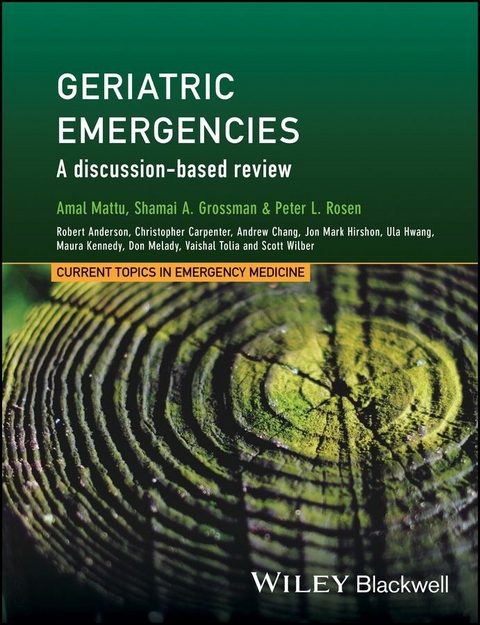
Geriatric Emergencies (eBook)
John Wiley & Sons (Verlag)
978-1-118-75331-6 (ISBN)
The elderly represent the fastest growing segment of the population in developed countries, reflected in the patient population presenting to EDs and hospitals. These patients more often than not have greater co-morbidities, more complicated workups and utilize more laboratory and radiologic services.
This text is designed to teach emergency physicians how best to care for this specific demographic of patients. It addresses physiologic changes, high-risk conditions, and atypical presentations associated with elderly patients in the ED that result in frequent misdiagnosis or delays in diagnosis. It instructs the readers how best to care for elderly patients in order to minimize morbidity and mortality, addressing some of the difficult psychosocial issues that confront health care providers that care for elderly patients, such as psychiatric disease and end-of-life care. The utility of this text is not limited to emergency physicians, but it should be useful to all health care providers involved in the treatment of elderly patients with acute medical or surgical conditions.
Series Editors: Shamai Grossman, Assistant Professor of Medicine; Director, Clinical Decision Unit and Cardiac Emergency Center. Beth Israel Deaconess Medical Center, Boston, MA. Peter Rosen, Senior Lecturer Emergency Medicine Harvard Medical School; Attending Emergency Physician Beth Israel Deaconess Medical Center; Visiting Clinical Professor Emergency Medicine University of Arizona; Professor Emergency Medicine University of California San Diego, MA. Editor-Chief: Amal Mattu, MD, Professor of Emergency Medicine and Vice Chair, Department of Emergency Medicine, University of Maryland School of Medicine, Baltimore, MD, USA. Dr. Mattu is one of the leading emergency medicine educators in the US and a strong advocate for geriatric emergency medicine training. He has authored or co-authored 5 books for Wiley, including his extremely successful ECGs for Emergency Physicians titles, which have been perennial bestsellers. Dr. Mattu is Consulting Editor for Emergency Medicine Clinics of North America; he is a popular speaker at conferences around the world and he has won multiple awards for his excellence in teaching, including national awards from the American College of Emergency Physicians, the American Academy of Emergency Medicine, and the Council of Residency Directors in Emergency Medicine.
Cover 1
Title Page 5
Copyright 6
Contents 7
List of Contributors 9
Chapter 1 General assessment of the elderly patient 15
Section I: Case presentation 15
Section II: Case discussion 15
Section III: Concepts 20
Section IV: Decision-making 24
References 25
Chapter 2 Physiologic changes with aging 27
Section I: Case presentation 27
Section II: Case discussion 27
Section III: Concepts 31
Cardiovascular system - a tired pump, hardened pipes, and frayed wires 31
Pulmonary - decreased endurance and a decrease in oxygen tension 34
Renal - a loss of mass, altered drug sensitivity 34
Hematology/immunology - waning defenses, dull weapons 35
Neurologic - preserved attention, difficulty learning new tricks 35
Musculoskeletal - keeping it together gets harder to do 36
Gastrointestinal - slow and uncoordinated 37
Genitourinary - incontinence is not a given 38
Endocrine - the salt, sugar, and spice of life 38
Section IV: Decision-making 39
References 39
Chapter 3 Functional assessment of the elderly 42
Section I: Case presentation 57
Section II: Case discussion 57
Section III: Concepts 60
Section IV: Decision making 69
References 69
Chapter 4 Pharmacological issues in the elderly 57
Section I: Case presentation 72
Section II: Case discussion 73
Section III: Concepts 77
Delirium treatment and management 81
Section IV: Decision Making 82
References 82
Chapter 5 Altered mental status in the elderly 72
Section I: Case presentation 85
Section II: Case discussion 85
Section III: Concepts 88
Section IV: Decision-making 93
References 93
Chapter 6 Geriatric psychiatric emergencies 85
Section I: Case Presentation 97
Section II: Case discussion 97
Section III: Concepts 102
Initial workup 103
Testing 108
Section IV: Decision-making 109
References 110
Chapter 7 Acute abdominal pain in the elderly: Surgical causes 97
Section I: Case presentation 113
Section II: Case discussion 113
Section III: Concepts 117
Section IV: Decision-Making 121
References 122
Chapter 8 Nonsurgical abdominal pain in the elderly 113
Section I: Case presentation 124
Section II: Case discussion 124
Section III: Concepts 129
Section IV: Decision-making 134
Acknowledgment 134
References 134
Chapter 9 Back pain 124
Section I: Case presentation 137
Section II: Case discussion 137
Section III: Concepts 141
Testing for patients with headache 149
Treatment 149
Section IV: Decision-making 150
References 150
Chapter 10 Headache 137
Section I: Case presentation 153
Section II: Case discussion 153
Case resolution 158
Section III: Concepts 158
Acute coronary syndrome (ACS) 159
Congestive heart failure 160
Atrial fibrillation 161
Pneumonia 162
Asthma and COPD 163
Pulmonary embolism 163
Section IV: Decision-making 164
References 164
Chapter 11 Dyspnea in the elderly 153
Section I: Case presentation 166
Section II: Case Discussion 166
Section III: Concepts 171
Section IV: Decision-making 177
References 178
Chapter 12 Acute chest pain in the geriatric patient 166
Section I: Case presentation 182
Section II: Case discussion 182
Section III: Concepts 187
Acute coronary syndrome 187
Atrial fibrillation 191
Heart failure 196
Conclusion 199
Section IV: Decision-making 199
References 200
Chapter 13 Acute cardiac disease in elder patients 182
Section I: Case presentation 205
Section II: Case discussion 205
Section III: Concepts 210
Background and epidemiology 210
Etiologies 211
Evaluation 212
Testing 213
Disposition 213
Conclusion 214
Section IV: Decision-making 214
References 215
Chapter 14 Syncope in Geriatrics 205
Section I: Case presentation 217
Section II: Case discussion 217
Section III: Concepts 222
Types of strokes 223
Treatment 225
Conclusion 227
Section IV: Decision-making 227
References 227
Chapter 15 Stroke 217
Section I: Case presentation 232
Section II: Case Discussion 232
Section III: Concepts 237
Sepsis in the elderly 237
Lower respiratory infections 240
Genitourinary infections 241
Skin/soft tissue infections 242
Central nervous system infections 243
Section IV: Decision-making 243
References 244
Chapter 16 Infections 232
Section I: Case presentation 248
Section II: Case discussion 248
Section III: Concepts 252
Section IV: Decision-making 263
References 263
Chapter 17 Dizziness and vertigo in the geriatric population 248
Section I: Case presentation 266
Section II: Case discussion 266
Section III: Concepts 270
Pathophysiology 271
Generalized weakness and nonspecific complaints 271
Frailty 272
Functional decline 274
Treatment and disposition 275
Section IV: Decision-making 275
References 276
Chapter 18 Weakness and functional decline 266
Section I: Case presentation 278
Section II: Case discussion 278
Section III: Concepts 283
Section IV: Decision-making 290
References 291
Chapter 19 Emergency department evaluation of falls in the elderly 278
Section I: Case presentation 294
Section II: Case discussion 294
Section III: Concepts 302
Section IV: Decision-making 312
References 312
Chapter 20 Trauma in the geriatric patient 294
Section I: Case presentation 318
Case outcome 318
Section II: Case discussion 319
Section III: Concepts 323
Elderly physiology 323
Diagnosis 324
Laboratory diagnostics 326
Radiographic diagnostics 326
Management of surgical issues 327
Pain management 328
Pharmacology 328
Preoperative clearance 329
Elective versus emergent surgery 330
End-of-life issues 331
Section IV: Decision-making 332
References 332
Chapter 21 Surgical considerations in the elderly 318
Section I: Case presentation 335
Section II: Case discussion 335
Section III: Concepts 340
Specific oncologic emergencies 341
Biochemical emergencies 342
Local tumor effects 345
Hematologic emergencies 348
Section IV: Decision-making 357
References 358
Chapter 22 Oncologic emergencies 335
Section I: Case presentation 365
Section II: Case discussion 365
Section III: Concepts 368
Section IV: Decision-making 371
Conclusion 374
References 374
Chapter 23 Elder abuse and neglect 365
Section I: Case presentation 377
Section II: Case discussion 377
Section III: Concepts 383
Pain assessment 385
Pain scales 386
Pharmacologic pain management for elderly patients 387
Nonpharmacologic interventions 392
Discharge pain management 392
Pain management monitoring and quality assurance 393
Summary 394
Section III: Decision making 395
References 395
Chapter 24 Geriatric emergency pain management case 377
Section I: Case presentation 400
Section II: Case discussion 400
Section III: Concepts 402
Section IV: Decision-making 406
References 407
Chapter 25 Ethical issues and end-of-life care 400
Section I: Case presentation 408
Section II: Case discussion 409
Case resolution 415
Section III: Concepts 415
Section IV: Decision-making 419
References 419
Chapter 26 Geriatric dispositions and transitions of care 408
Section I: Case presentation 421
Section II: Case discussion 421
Section III: Concepts 423
Section IV: Decision-making 428
Conclusions 428
References 428
Chapter 27 The geriatric ED 421
Section I: Case presentation 421
Section II: Case discussion 421
Section III: Concepts 423
Section IV: Decision-making 428
Conclusions 428
References 428
Index 431
EULA 451
| Erscheint lt. Verlag | 19.5.2016 |
|---|---|
| Reihe/Serie | CTEM - Current Topics in Emergency Medicine |
| CTEM - Current Topics in Emergency Medicine | Current Topics in Emergency Medicine |
| Mitarbeit |
Stellvertretende Herausgeber: Robert Anderson, Christopher R. Carpenter, Andrew Chang, Jon Mark Hirshon, Ula Hwang, Maura Kennedy, Don Melady, Vaishal Tolia, Scott Wilbur |
| Sprache | englisch |
| Themenwelt | Medizin / Pharmazie ► Allgemeines / Lexika |
| Medizin / Pharmazie ► Medizinische Fachgebiete ► Geriatrie | |
| Medizin / Pharmazie ► Medizinische Fachgebiete ► Notfallmedizin | |
| Schlagworte | Acute • Co-morbidity • elderly • Emergency • Emergency Medicine & Trauma • end-of-life • geriatric medicine • Geriatrie • Medical Science • Medizin • Mortality • Notfallmedizin • Notfallmedizin u. Traumatologie • Psychosocial |
| ISBN-10 | 1-118-75331-3 / 1118753313 |
| ISBN-13 | 978-1-118-75331-6 / 9781118753316 |
| Informationen gemäß Produktsicherheitsverordnung (GPSR) | |
| Haben Sie eine Frage zum Produkt? |
 PDF (Adobe DRM)
Kopierschutz: Adobe-DRM
Adobe-DRM ist ein Kopierschutz, der das eBook vor Mißbrauch schützen soll. Dabei wird das eBook bereits beim Download auf Ihre persönliche Adobe-ID autorisiert. Lesen können Sie das eBook dann nur auf den Geräten, welche ebenfalls auf Ihre Adobe-ID registriert sind.
Details zum Adobe-DRM
Dateiformat: PDF (Portable Document Format)
Mit einem festen Seitenlayout eignet sich die PDF besonders für Fachbücher mit Spalten, Tabellen und Abbildungen. Eine PDF kann auf fast allen Geräten angezeigt werden, ist aber für kleine Displays (Smartphone, eReader) nur eingeschränkt geeignet.
Systemvoraussetzungen:
PC/Mac: Mit einem PC oder Mac können Sie dieses eBook lesen. Sie benötigen eine
eReader: Dieses eBook kann mit (fast) allen eBook-Readern gelesen werden. Mit dem amazon-Kindle ist es aber nicht kompatibel.
Smartphone/Tablet: Egal ob Apple oder Android, dieses eBook können Sie lesen. Sie benötigen eine
Geräteliste und zusätzliche Hinweise
Buying eBooks from abroad
For tax law reasons we can sell eBooks just within Germany and Switzerland. Regrettably we cannot fulfill eBook-orders from other countries.
aus dem Bereich