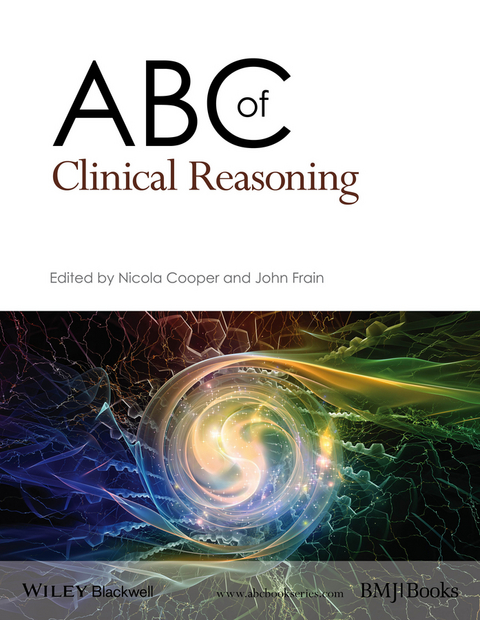
ABC of Clinical Reasoning (eBook)
John Wiley & Sons (Verlag)
978-1-119-05910-3 (ISBN)
Being a good clinician is not just about knowledge - how doctors and other healthcare professionals think, reason and make decisions is arguably their most critical skill. While medical schools and postgraduate training programmes teach and assess the knowledge and skills required to practice as a doctor, few offer comprehensive training in clinical reasoning or decision making. This is important because studies suggest that diagnostic error is common and results in significant harm to patients - and errors in reasoning account for the majority of diagnostic errors.
The ABC of Clinical Reasoning covers core elements of the thinking and decision making associated with clinical practice - from what clinical reasoning is, what it involves and how to teach it. Informed by the latest advances in cognitive psychology, education and studies of expertise, the ABC covers:
- Evidence-based history and examination
- Use and interpretation of diagnostic tests
- How doctors think - models of clinical reasoning
- Cognitive and affective biases
- Metacognition and cognitive de-biasing strategies
- Patient-centred evidence based medicine
- Teaching clinical reasoning
From an international team of authors, the ABC of Clinical Reasoning is essential reading for all students, medical professionals and other clinicians involved in diagnosis, in order to improve their decision-making skills and provide better patient care.
Nicola Cooper is Consultant Physician and Honorary Clinical Associate Professor, Derby Teaching Hospitals NHS Foundation Trust, and Division of Medical Sciences and Graduate Entry Medicine, University of Nottingham, UK
John Frain is General Practitioner and Director of Clinical Skills, Division of Medical Sciences and Graduate Entry Medicine, University of Nottingham, UK
Being a good clinician is not just about knowledge how doctors and other healthcare professionals think, reason and make decisions is arguably their most critical skill. While medical schools and postgraduate training programmes teach and assess the knowledge and skills required to practice as a doctor, few offer comprehensive training in clinical reasoning or decision making. This is important because studies suggest that diagnostic error is common and results in significant harm to patients and errors in reasoning account for the majority of diagnostic errors. The ABC of Clinical Reasoning covers core elements of the thinking and decision making associated with clinical practice from what clinical reasoning is, what it involves and how to teach it. Informed by the latest advances in cognitive psychology, education and studies of expertise, the ABC covers: Evidence-based history and examination Use and interpretation of diagnostic tests How doctors think models of clinical reasoning Cognitive and affective biases Metacognition and cognitive de-biasing strategies Patient-centred evidence based medicine Teaching clinical reasoning From an international team of authors, the ABC of Clinical Reasoning is essential reading for all students, medical professionals and other clinicians involved in diagnosis, in order to improve their decision-making skills and provide better patient care.
Nicola Cooper is Consultant Physician and Honorary Clinical Associate Professor, Derby Teaching Hospitals NHS Foundation Trust, and Division of Medical Sciences and Graduate Entry Medicine, University of Nottingham, UK John Frain is General Practitioner and Director of Clinical Skills, Division of Medical Sciences and Graduate Entry Medicine, University of Nottingham, UK
Title Page 5
Copyright Page 6
Contents 7
Contributors 8
Preface 9
Chapter 1 Clinical Reasoning: An Overview 11
Introduction 11
What is clinical reasoning? 11
Why is clinical reasoning important? 12
History and examination 12
Probability and diagnostic tests 13
Clinicians are human too 13
Clinical reasoning matters to patients 14
Summary 14
Further reading/resources 15
Chapter 2 Evidence-Based History and Examination 16
Introduction 16
Evidence-based history 16
Natural history and context 17
Evidence-based physical examination 18
Using likelihood ratios 18
The limitations of evidence?based history and examination 19
Example: diagnosing stable coronary artery disease 20
Combining clinical findings 21
Conclusions 21
Further reading/resources 21
Chapter 3 Using and Interpreting Diagnostic Tests 22
Introduction 22
Normal values 22
Factors other than disease that influence test results 22
Operating characteristics 23
Sensitivity and specificity 23
Prevalence of disease in the population 24
Thresholds 25
Summary 26
Further reading/resources 26
Chapter 4 Models of Clinical Reasoning 27
Introduction 27
Deductive reasoning 27
Hypothetico-deductive reasoning 27
Inductive reasoning 28
Abductive reasoning 28
Rule-based/categorical/deterministic reasoning 28
Probabilistic reasoning 29
Causal reasoning 29
Making a diagnosis – hypothesis generation and modification 29
Type 1 and type 2 thinking – dual process theory 29
Errors in the diagnostic process 30
The reasoning of experts versus novices 31
Summary 31
Further reading/resources 31
Chapter 5 Cognitive Biases 32
Introduction 32
Case history 32
Anchoring 33
Search satisficing 33
Confirmation bias 33
Cognitive miser function 33
Common cognitive biases 34
Is bias only a type 1 thinking problem? 34
Cognitive biases and expert intuition 34
Summary 36
Further reading/resources 36
Chapter 6 Human Factors 37
Introduction 37
Error in healthcare 37
The limitations of human performance 39
Communication within teams 40
Embedding human factors in healthcare 41
Summary 42
Further reading/resources 42
Chapter 7 Metacognition and Cognitive Debiasing 43
Introduction 43
‘Brutish automatism’ 43
Cognitive debiasing 44
Established strategies 44
Newly evolving strategies 46
Situational vulnerability to bias 46
Overall challenges of debiasing 46
Summary 48
Further reading/resources 48
Chapter 8 Using Guidelines, Scores and Decision Aids 49
Introduction 49
Clinical guidelines 49
Scores and decision aids 49
The pitfalls of using guidelines, scores and decision aids 50
Applying clinical guidelines in practice – helping patients to share decision-making 52
Summary 53
Further reading/resources 53
Chapter 9 Teaching Clinical Reasoning 54
Introduction 54
A spiral curriculum 54
Educational theories relevant to clinical reasoning 55
How knowledge is organised 55
Deliberate practice and the development of expertise 57
Teaching techniques 57
Case-based interventions 58
Reflection and metacognition strategies 58
Reflection in clinical reasoning 58
Summary 60
Further reading/resources 60
Recommended Books, Articles and Websites 61
Popular 61
For students and teachers 61
Academic 61
Articles 61
Websites (all accessed February 2016) 62
Index 63
EULA 66
"Sound decision making is routinely cited as
a cornerstone of clinical practice. But what
techniques actually underlie this process,
and why does it ? all too often ? go wrong?
The answers to these questions, and more,
are provided by the authors of this book,
who have successfully compressed the
burgeoning subject of clinical reasoning into
a succinct and easily accessible textbook...
The text attempts to cover a lot of ground
for such a slim volume and occasional
sections seem a little cramped. The overall
effect, though, is to enthusiastically and
intelligently convey the importance of a so far
underappreciated yet vital aspect of clinical
practice.
Readers should not expect this text to
provide a complete summary of the subject
(a comprehensive bibliography is supplied).
Nor should they expect a single reading to
provide an instant remedy to deficiencies
in their own decision making because, as
the editors state, developing sound clinical
reasoning is a ?lifelong? task. With that in
mind, picking up this book would make an
excellent start."(BJGP Open, 24th February 2017)
| Erscheint lt. Verlag | 19.5.2016 |
|---|---|
| Reihe/Serie | ABC Series | ABC Series |
| Sprache | englisch |
| Themenwelt | Medizin / Pharmazie ► Allgemeines / Lexika |
| Medizin / Pharmazie ► Gesundheitswesen | |
| Medizin / Pharmazie ► Medizinische Fachgebiete ► Allgemeinmedizin | |
| Schlagworte | Allgemeine u. Innere Medizin • Allgemeinpraxis, hausärztliche Praxis • Allgemeinpraxis, hausärztliche Praxis • Bias • biases • Clinical • Clinical Reasoning • Cognitive • de-biasing • Decision • Decision Making • Diagnostic • Education • error • Errors • evidence-based • Evidence-based Health Care • Evidenzbasierte Forschung im Gesundheitswesen • General & Internal Medicine • General Practice/Family Practice • Interpretation • <p>think • Medical Science • Medizin • Metacognition • Patient-Centred • Practice • Psychology • reason • Skills • tests</p> |
| ISBN-10 | 1-119-05910-0 / 1119059100 |
| ISBN-13 | 978-1-119-05910-3 / 9781119059103 |
| Informationen gemäß Produktsicherheitsverordnung (GPSR) | |
| Haben Sie eine Frage zum Produkt? |
 PDF (Adobe DRM)
Kopierschutz: Adobe-DRM
Adobe-DRM ist ein Kopierschutz, der das eBook vor Mißbrauch schützen soll. Dabei wird das eBook bereits beim Download auf Ihre persönliche Adobe-ID autorisiert. Lesen können Sie das eBook dann nur auf den Geräten, welche ebenfalls auf Ihre Adobe-ID registriert sind.
Details zum Adobe-DRM
Dateiformat: PDF (Portable Document Format)
Mit einem festen Seitenlayout eignet sich die PDF besonders für Fachbücher mit Spalten, Tabellen und Abbildungen. Eine PDF kann auf fast allen Geräten angezeigt werden, ist aber für kleine Displays (Smartphone, eReader) nur eingeschränkt geeignet.
Systemvoraussetzungen:
PC/Mac: Mit einem PC oder Mac können Sie dieses eBook lesen. Sie benötigen eine
eReader: Dieses eBook kann mit (fast) allen eBook-Readern gelesen werden. Mit dem amazon-Kindle ist es aber nicht kompatibel.
Smartphone/Tablet: Egal ob Apple oder Android, dieses eBook können Sie lesen. Sie benötigen eine
Geräteliste und zusätzliche Hinweise
Buying eBooks from abroad
For tax law reasons we can sell eBooks just within Germany and Switzerland. Regrettably we cannot fulfill eBook-orders from other countries.
aus dem Bereich