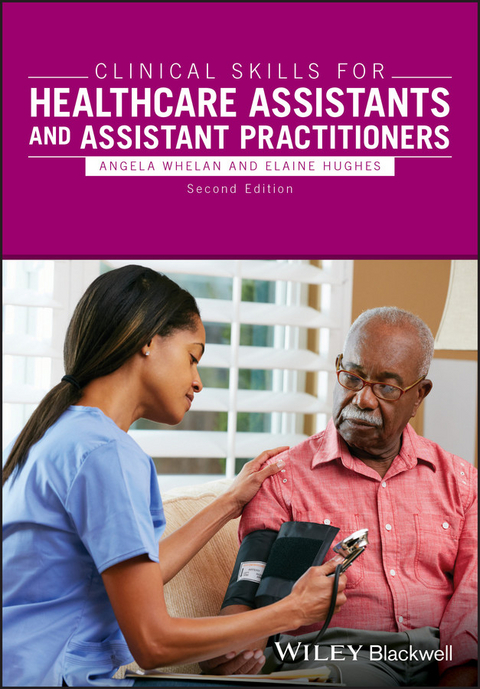
Clinical Skills for Healthcare Assistants and Assistant Practitioners (eBook)
John Wiley & Sons (Verlag)
9781118281970 (ISBN)
Clinical Skills for Healthcare Assistants and Assistant Practitioners is an accessible, easy-to-read guide, outlining the fundamental and core skills integral to clinical practice.
Fully updated in its second edition, this book is divided into three sections; the first looks at fundamental skills applicable to all staff, such as accountability, communication and record keeping. Section two explores core clinical skills such as respiratory care, pulse, blood glucose management and catheter care. Section three outlines complex clinical skills that require more in-depth training, such as medication and intravenous cannulation.
An invaluable resource for healthcare assistants and assistant practitioners, this book will also be of use to newly qualified practitioners, and students in health and social care.
Angela Whelan is a Senior Lecturer, Teaching and Learning Fellow, and Programme Lead, in the Faculty of Health and Social Care at Edge Hill University, UK.
Elaine Hughes is a Senior Lecturer in Adult Nursing, Deputy Programme Co-ordinator BSc(Hons), and a SOLSTICE Fellow, in the Faculty of Health at Edge Hill University, UK.
Clinical Skills for Healthcare Assistants and Assistant Practitioners is an accessible, easy-to-read guide, outlining the fundamental and core skills integral to clinical practice. Fully updated in its second edition, this book is divided into three sections; the first looks at fundamental skills applicable to all staff, such as accountability, communication and record keeping. Section two explores core clinical skills such as respiratory care, pulse, blood glucose management and catheter care. Section three outlines complex clinical skills that require more in-depth training, such as medication and intravenous cannulation. An invaluable resource for healthcare assistants and assistant practitioners, this book will also be of use to newly qualified practitioners, and students in health and social care.
Angela Whelan is a Senior Lecturer, Teaching and Learning Fellow, and Programme Lead, in the Faculty of Health and Social Care at Edge Hill University, UK. Elaine Hughes is a Senior Lecturer in Adult Nursing, Deputy Programme Co-ordinator BSc(Hons), and a SOLSTICE Fellow, in the Faculty of Health at Edge Hill University, UK.
Chapter 1
Accountability
Learning objectives
- Identify the current plans regarding regulation of healthcare assistants and assistant practitioners
- Define accountability
- Relate accountability to the healthcare assistant and assistant practitioner role
- Describe the duty of care and how it relates to negligence
- Discuss consent
- List the key elements of the Mental Capacity Act
Aim of this chapter
The aim of this chapter is to enable healthcare assistants and assistant practitioners to understand the issues and concept of accountability relating both to their role and to others around them.
This chapter covers accountability and issues surrounding accountability in relation to clinical skills. Healthcare assistants, healthcare support workers and assistant practitioners form an integral part of the contemporary flexible ‘nursing family’ (RCN 2004). A substantial proportion of essential nursing care is now delivered by the unregistered branch of the nursing family with some personnel such as assistant practitioners undertaking work previously performed by registered staff (RCN 2012). Registration and regulation of healthcare assistants, health support workers and assistant practitioners continues to be debated (Vaughan et al. 2014)
Regulation and registration
Registration refers to the process by which professionals such as nurses are registered with a regulatory body. Registered staff are professionally accountable to their respective regulatory bodies, for example nurses are accountable to the Nursing Midwifery Council (NMC) and allied health professionals to the Health and Care Professions Council (HCPC). Regulation refers to a set of rules that members are required to follow by law (Law Commission et al. 2012: 68): for example, nurses are regulated by the NMC and legally have to follow the rules set out by that specific body; for nurses, therefore, the NMC is the main focus for regulatory accountability (NMC 2015b). The Nursing Midwifery Council regulates nurses and midwives in England, Wales, Scotland and Northern Ireland and exists to protect the public. They set standards of education, training, conduct and performance so that nurses and midwives can deliver high-quality healthcare throughout their careers. The NMC makes sure that nurses and midwives keep their skills and knowledge up to date and uphold a set of professional standards. There is a clear and transparent processes used to investigate nurses and midwives who fall short of those standards. In the event of a serious error, professional misconduct, failure to respect professional boundaries or unethical conduct, a registered nurse is held accountable and can be removed from the register. The NMC hold a register of nurses and midwives allowed to practise in the UK (NMC 2015b).
Healthcare assistants and assistant practitioners
Both assistant practitioners and healthcare assistants remain unregistered and without a regulatory body, unlike registered nurses. They do, however, have codes of conduct and it is imperative practitioners become familiar with them.
In Scotland, since 2011 all new HCAs have been required to meet induction standards and comply with a code of conduct, while employers are required to sign up to a code of practice (Scottish Government 2010). In Wales there is an All Wales Code of Conduct for healthcare support workers (Welsh Assembly Government 2011). In addition, the Hywel Dda Health Board introduced a code of conduct for healthcare support workers, along with an employers' code of practice ‘to provide an assurance framework for public protection’ (Horner 2012; Hywel Dda Health Board 2015). A voluntary register, but no mandatory regulatory system, exists in Northern Ireland. In England, the Coalition Government rejected the recommendation made in Robert Francis's report into the failings at the Mid Staffordshire Foundation Trust (Francis 2013), that recommended all healthcare support workers should be regulated. Instead Camilla Cavendish (DH 2013b) was asked by the Secretary of State to review and make recommendations on the recruitment, learning and development, management and support of healthcare assistants and social care support workers. The resulting report, published in July 2013, found that the preparation of healthcare assistants and social care support workers for their roles within care settings was inconsistent, and one of the recommendations was the development of the Care Certificate. In the absence of registration and a regulatory body, all unregistered health and social care workers are recommended to read the chapters of this book and consider them alongside and in addition to the Care Certificate. Local codes have also been developed, please become familiar with your local policy and code(s)
Skills for Health and Skills for Care published the Code of Conduct (2013) for healthcare support workers and adult social care workers. Although this code is voluntary it is seen as best practice. This Code of Conduct sets the standard of conduct expected of healthcare support workers and adult social care workers, outlining the behaviour and attitudes that are expected of those working in health and social care settings to provide safe, compassionate care and support (Skills for Health and Skills for Care 2013).
The role of the assistant practitioner operates at band 4 or above and has emerged since it was first introduced in the Northwest of England in 2002 to cover a number of professions and settings. This role was introduced in the UK to complement the work of registered professionals, working across professional boundaries, and now performs many tasks previously undertaken by registered staff (Vaughan et al. 2014). Skills for Health (2009: 1) defined the role of the Assistant Practitioner as:
An Assistant Practitioner is a worker who competently delivers health and social care to and for people. They have a required level of knowledge and skill beyond that of the traditional healthcare assistant or support worker. The Assistant Practitioner would be able to deliver elements of health and social care and undertake clinical work in domains that have previously only been within the remit of registered professionals. The Assistant Practitioner may transcend professional boundaries. They are accountable to themselves, their employer, and, more importantly, the people they serve.
Think about it
Identify other professional groups within your clinical area and find out about the professional bodies to which they report. What are your thoughts about registration? What advantages do you think are attached to registration and are there any negatives?
Responsibilities and accountability
Accountability and responsibility are words that are often used interchangeably by health professionals as though they have the same meaning (Griffith 2015). Responsibility means having control or authority over someone or something (Griffith and Tenegnah 2010). Carvallo et al. (2012) identify responsibility as accepting a task or duty that you have been given and accepting that task willingly. So it can be seen that responsibilities are linked to your role, which means you require training and assessment of the necessary knowledge, skills, values and ability to undertake a particular task or duty. In order to be responsible, Dimond (2011) asserts it is also necessary to have legal knowledge, as ignorance of the law is no defence. So as an HCA or AP you are responsible for your practice and for ensuring the interventions undertaken are in the best interests of your patients. Responsibility equates to the duty of care in law. Scrivener et al. (2011) explain that the duty of care applies whether the task involves bathing a patient or complex surgery – in each case there is the opportunity for harm to occur. In this context, the question that arises concerns the standard of care expected of practitioners performing these tasks. This is the legal liability the practitioner owes to the patient. By accepting the responsibility to perform a task the practitioner must ensure the task is performed competently, at least to the standard of the ordinarily competent practitioner in that type of task.
Accountability
Accountability is crucial to the protection of the public and individual patients and is a complex concept to understand (Griffith and Tengnah 2010). Nurses are bound by the NMC to be accountable (NMC 2015a). Dimond (2011) reports four arenas of accountability relating to registered nurses:
- 1. Accountable to the Public via criminal law and criminal courts.
- 2. Accountable to the Patients via civil law, civil courts.
- 3. Accountable to the Employer via contract of employment, employment tribunal.
- 4. Accountable to the Profession via NMC, Conduct and Competence Committee.
Mullen (2014) points out that HCAs and APs are not accountable to a professional body, but they are accountable to the other arenas. Additionally there are also general responsibilities related to accountability laid out for all staff in the NHS Constitution (see Boxes 1.1 and 1.2 for a summary of responsibilities relating to accountability (Mullen 2014)). Put quite simply, Griffith and Tengnah (2010) define accountability as ‘being answerable for your personal acts or omissions to a higher authority with whom you have a legal relationship’.
Box 1.1 Accountability
Code of...
| Erscheint lt. Verlag | 28.4.2016 |
|---|---|
| Sprache | englisch |
| Themenwelt | Medizin / Pharmazie ► Medizinische Fachgebiete |
| Medizin / Pharmazie ► Pflege | |
| Schlagworte | Accountability • Assistant Practitioners • Blood pressure • Cannulation • Care • Catheter care • clinical practice • Clinical Skills • Communication • Einführungen in die Krankenpflege • Einführungen in die Krankenpflege • fluid balance • General Clinical Nursing • Gesundheits- u. Sozialwesen • Glucose Monitoring • Health & Social Care • Healthcare Assistants • Introductions to Nursing • Klinische Krankenpflege • Krankenpflege • medicine management • nursing • Pulse Oximetry • Recording a 12-lead ECG • Record keeping • Respiratory • Skills • Temperature • Urinalysis • Venepuncture |
| ISBN-13 | 9781118281970 / 9781118281970 |
| Informationen gemäß Produktsicherheitsverordnung (GPSR) | |
| Haben Sie eine Frage zum Produkt? |
 EPUB (Adobe DRM)
Kopierschutz: Adobe-DRM
Adobe-DRM ist ein Kopierschutz, der das eBook vor Mißbrauch schützen soll. Dabei wird das eBook bereits beim Download auf Ihre persönliche Adobe-ID autorisiert. Lesen können Sie das eBook dann nur auf den Geräten, welche ebenfalls auf Ihre Adobe-ID registriert sind.
Details zum Adobe-DRM
Dateiformat: EPUB (Electronic Publication)
EPUB ist ein offener Standard für eBooks und eignet sich besonders zur Darstellung von Belletristik und Sachbüchern. Der Fließtext wird dynamisch an die Display- und Schriftgröße angepasst. Auch für mobile Lesegeräte ist EPUB daher gut geeignet.
Systemvoraussetzungen:
PC/Mac: Mit einem PC oder Mac können Sie dieses eBook lesen. Sie benötigen eine
eReader: Dieses eBook kann mit (fast) allen eBook-Readern gelesen werden. Mit dem amazon-Kindle ist es aber nicht kompatibel.
Smartphone/Tablet: Egal ob Apple oder Android, dieses eBook können Sie lesen. Sie benötigen eine
Geräteliste und zusätzliche Hinweise
Buying eBooks from abroad
For tax law reasons we can sell eBooks just within Germany and Switzerland. Regrettably we cannot fulfill eBook-orders from other countries.
aus dem Bereich