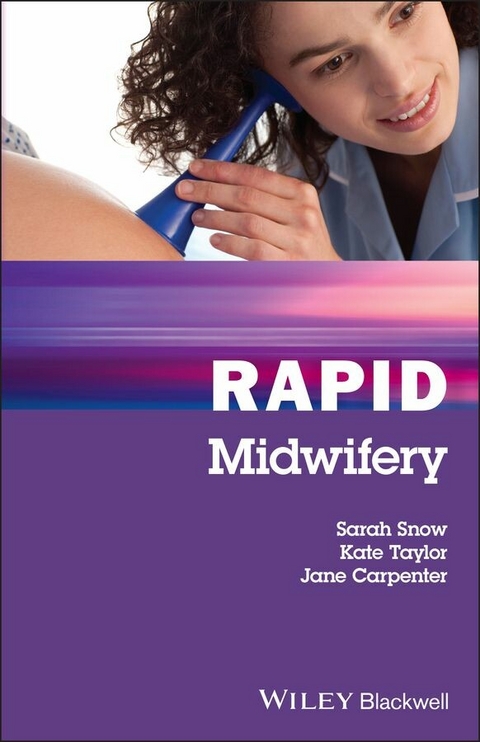
Rapid Midwifery (eBook)
John Wiley & Sons (Verlag)
978-1-119-02338-8 (ISBN)
Sarah Snow, PGCert (teacher health & social care); MSc; BSc; DPSM/ADM; RM; RGN, is principal lecturer and lead midwife for education at Oxford Brookes University. Kate Taylor, MSc; RM; BSc, is senior lecturer at the University of Worcester. Jane Carpenter, DPhil; MRes; BSc, is a third year MSc pre-registration midwifery student at Oxford Brookes University.
Preface vii
Acknowledgement ix
I Antenatal Care 2
Antenatal Health Assessment 3
Anxiety and Depression 6
Bio-physical Tests 8
Bleeding in Pregnancy 15
Fetal Growth and Development 18
Gestational Diabetes Mellitus 21
Infections in Pregnancy 23
Intrahepatic Cholestasis of Pregnancy 33
Minor Disorders of Pregnancy 35
Pre-conceptual Health 37
Pre-eclampsia 39
Preparation for Parenthood 42
References 43
II Labour and Birth 49
First Stage of Labour 50
Promoting Normality 58
Second Stage of Labour 61
Third Stage of Labour 67
Challenges 70
Cord Prolapse 70
Eclampsia 71
Primary Postpartum Haemorrhage 74
Shoulder Dystocia 77
References 78
III Postnatal Care 85
Contraception and Sexual Health 86
Facilitating Breastfeeding 88
Postnatal Health Assessment 91
Mental Illness After Childbirth 94
References 96
IV Hot Topics 99
Breech Birth 100
Domestic Abuse 104
Obesity 106
Recognising the Deteriorating Woman 108
Sepsis 110
References 112
Conclusion: Top Tips for Examination Success 115
Preparation - Revision 115
Trying a Different Strategy 116
Being in the Exam 116
Reference 117
Index 119
Part II
Labour and Birth
First Stage of Labour
A pregnancy is considered to be at term from 37+0 to 41+6 weeks' gestation and during this time most women labour spontaneously (NICE 2008). However, prolonged pregnancy (over 42 weeks' gestation) will occur in 5–10% of all women (NICE 2008) and some women will labour prematurely. It is not fully understood what causes the onset of labour although it is thought to be multifactorial in nature (Kamel 2010).
The first stage of labour is often defined in two phases: the latent phase of labour and established first stage. NICE (2014a) defines the latent phase of labour as a period of time, not necessarily continuous, where painful contractions occur alongside cervical effacement and dilatation up to 4 cm. Established labour is defined as regular painful contractions with progressive cervical dilatation from 4 cm up to full dilatation (NICE 2014a).
Key Points
- Provision of support during labour and childbirth is recognised internationally and nationally as a core role of the midwife (RCM 2012a). Current NICE guidance (NICE 2014a) states that all women should receive one-to-one care during established labour and that women should only be left on their own for short periods or at their own request. This clearly highlights the importance of continuous high-quality midwifery care and support during labour (RCM 2012a).
- The latent phase of labour can be particularly challenging for women, especially if it is long-lasting, which can be exhausting and discouraging (RCM 2012d). Good antenatal education and early assessment advice should encourage women to remain at home during the latent phase, if they feel able. Admission to hospital during the latent phase may increase intervention rates (Bailit et al. 2005).
- Evidence has shown that women who receive continuous support in labour are more likely to have spontaneous vaginal birth and less likely to require intrapartum analgesia or to be dissatisfied with the care they received (Hodnett et al. 2011). They also have shorter labours, are less likely to require operative deliveries, are less likely to require epidural analgesia and are less likely to have a baby with a low 5-minute APGAR score (Hodnett et al. 2011).
- Giving a definitive answer to the question of how long a labour will last is difficult, due not least to inaccuracies in measuring labour length (RCM 2012c). In addition, several factors can influence the length of the first stage of labour, including, but not limited to, parity (Lawrence et al. 2013), fetal position at labour onset (Simkin 2010), presence of continuous care in labour (Hodnett et al. 2011) and use of upright birth positions (Lawrence et al. 2013).
- For some women, induction or augmentation of labour may be indicated. Various methods can be used to mimic or replicate physiological labour. However, any such intervention will be associated with risk and disrupt physiological processes, making informed choice essential.
Essential Physiology
- Certain hormones, notably oestrogen and progesterone, are accepted as having an important role in maintaining uterine quiescence during pregnancy and in initiating uterine activity at labour onset (Kamel 2010).
- The roles of other hormones (such as prostaglandins) and other factors (such as inflammatory reactions) are currently poorly understood. There may be yet other factors still to be discovered.
- The hormone oxytocin causes the continuation of uterine contractions via a positive feedback loop. If this loop is broken, contractions will be disrupted (Chapman and Charles 2013).
- Oxytocin is often referred to as a ‘shy hormone’. In order to promote oxytocin release, women should feel safe, secure and supported (Westbury 2015). Feelings of stress or panic cause the release of catecholamines which, in turn, inhibit oxytocin; whereas oxytocin itself encourages the release of endorphins (Westbury 2015). It is a key part of the midwife's role to enable oxytocin release by creating a sense of privacy, calm and safety.
- Uterine contractions during the first stage of labour cause effacement (thinning or shortening of the cervical length) and dilatation (opening) of the cervix; they also aid fetal descent into the pelvis:
- In normal uterine action, contractions begin in the cornua of the uterus and spread downwards. This is known as fundal dominance.
- The upper segment of the uterus contracts and retracts powerfully, whereas the lower segment contracts only slightly but dilates.
- The coordination between the upper and lower uterine segments is balanced during normal labour and is known as polarity.
- The uterus has a low resting tone between contractions, which is essential for fetal oxygenation (Walsh 2011).
- For a nulliparous woman, the cervix may not begin to dilate until it is fully (100%) effaced. For parous women, however, effacement and dilatation may occur simultaneously. Full dilatation is reached at about 10 cm.
- Women may experience a ‘show’ as their cervix dilates. This ‘operculum’ forms a mucus plug over the cervix during pregnancy. The mucoid show may contain streaks of bloody discharge; however, fresh red blood loss is not a normal part of a show.
- As the fetus descends through the cervix, it separates the small bag of membranes in front, the forewaters, from the remainder that follows behind, the hindwaters:
- The forewaters aid effacement and early dilatation of the cervix.
- The hindwaters help to equalize uterine pressure, thereby offering some protection for the fetus and placenta (Walsh 2011).
- At some point during labour, the membranes surrounding the amniotic fluid will rupture. Prior to this bulging, forewaters can often be felt on vaginal examination (Chapman and Charles 2013).
- Spontaneous rupture of membranes normally occurs towards the end of the first stage of labour (RCM 2015b). This can lead to stronger application of the fetal head to the cervix during contractions, intensifying the positive feedback loop and leading to transition and the second stage of labour.
- The membranes can also rupture before labour onset or during the second stage, or rarely a baby can be born within the amniotic sac.
Essentials of Midwifery Care
- Women should be encouraged to write down their birth preferences prior to labour onset. If this has been done, these should be read and discussed with the woman and her birth partner.
- It is important to listen to and understand a woman's preferences for pain relief during labour and to support her in her choices (NICE 2014a).
- A woman's chosen birth partners have an important role to play, providing emotional support and advocacy. They should be included in discussions of birth options and be encouraged to provide practical support tasks where appropriate (RCM 2012e).
- Alongside the emotional support provided, continuous assessment of maternal and fetal well-being is another essential component of a midwife's role during established labour. NICE (2014a) summarises this as follows:
- Ongoing consideration of a woman's desire for pain relief, including enabling her to request pain relief at any point during labour.
- Encouragement to stay well hydrated. A light diet should be supported if the woman desires.
- Auscultation of the fetal heart rate. For low-risk women this should be carried out for 1 minute immediately after a contraction, using either a Pinard stethoscope or Doppler ultrasound. Accelerations and decelerations should be recorded if heard.
- Continuous electronic fetal monitoring should be used only if indicated. Telemetry can be used to enable active labour and birth.
- Maternal observations should be recorded and documented on a partogram, including:
- the frequency of contractions half-hourly;
- hourly pulse;
- 4-hourly temperature and blood pressure;
- frequency of passing urine;
- vaginal loss and liquor colour should be monitored.
- The partogram is currently recommended for use in established labour by NICE (2014a). However, the authors of a recent Cochrane review (Lavender et al. 2013) stated that they cannot recommend the routine use of partograms for standard labour management and care.
- Recent evidence has highlighted that the spectrum of normal progress in labour may be much wider than previously accepted, particularly up to cervical dilatation of 6 cm (Zhang et al. 2010).
- A vaginal examination is one of many methods of assessment that a midwife can use to monitor the progress of labour (Shepherd and Cheyne 2013); its importance should not be over-emphasised.
- Abdominal palpation, monitoring contractions for frequency, length and strength and observing behavioural cues of the woman are other important midwifery tools. A midwife should use all of her skills to assess labour progress.
- Current NICE guidance (NICE 2014a) states that vaginal examinations should be offered 4-hourly or if there is concern about progress, or in response to a woman's wishes.
- Approximately 20% of women may have the urge to push before full dilatation of the cervix (Charles 2013a). Belief that ‘early’ pushing will cause an oedematous cervix is based on very little evidence (Perez-Botella and Downe 2006) and instructing a woman at the end of first stage not to push if she has the urge to do so is unnecessary (Charles...
| Erscheint lt. Verlag | 31.3.2016 |
|---|---|
| Reihe/Serie | Rapid |
| Rapid | Rapid |
| Sprache | englisch |
| Themenwelt | Medizin / Pharmazie ► Gesundheitsfachberufe ► Hebamme / Entbindungspfleger |
| Medizin / Pharmazie ► Pflege | |
| Schlagworte | Antenatal • Bereavement • complimentary therapies • Contraception • Emergencies in Midwifery • Family planning • Geburtshilfe • Gynäkologie u. Geburtshilfe • Gynäkologie u. Geburtshilfe • Health Promotion • Hebamme • Hebammenpraxis • Infant feeding • Intranatal • Krankenpflege • Krankenpflege i. d. Frauenheilkunde • loss</p> • <p>midwifery • Medical Science • medicines management • Medizin • Midwifery • midwifery care • newborn • nursing • Obstetrics & Gynecology • parenthood • Perinatal Mental Health • pharmacology • Psychology • Public Health • Sociology • Student • Team working • Women's Health Nursing |
| ISBN-10 | 1-119-02338-6 / 1119023386 |
| ISBN-13 | 978-1-119-02338-8 / 9781119023388 |
| Informationen gemäß Produktsicherheitsverordnung (GPSR) | |
| Haben Sie eine Frage zum Produkt? |
 EPUB (Adobe DRM)
Kopierschutz: Adobe-DRM
Adobe-DRM ist ein Kopierschutz, der das eBook vor Mißbrauch schützen soll. Dabei wird das eBook bereits beim Download auf Ihre persönliche Adobe-ID autorisiert. Lesen können Sie das eBook dann nur auf den Geräten, welche ebenfalls auf Ihre Adobe-ID registriert sind.
Details zum Adobe-DRM
Dateiformat: EPUB (Electronic Publication)
EPUB ist ein offener Standard für eBooks und eignet sich besonders zur Darstellung von Belletristik und Sachbüchern. Der Fließtext wird dynamisch an die Display- und Schriftgröße angepasst. Auch für mobile Lesegeräte ist EPUB daher gut geeignet.
Systemvoraussetzungen:
PC/Mac: Mit einem PC oder Mac können Sie dieses eBook lesen. Sie benötigen eine
eReader: Dieses eBook kann mit (fast) allen eBook-Readern gelesen werden. Mit dem amazon-Kindle ist es aber nicht kompatibel.
Smartphone/Tablet: Egal ob Apple oder Android, dieses eBook können Sie lesen. Sie benötigen eine
Geräteliste und zusätzliche Hinweise
Buying eBooks from abroad
For tax law reasons we can sell eBooks just within Germany and Switzerland. Regrettably we cannot fulfill eBook-orders from other countries.
aus dem Bereich