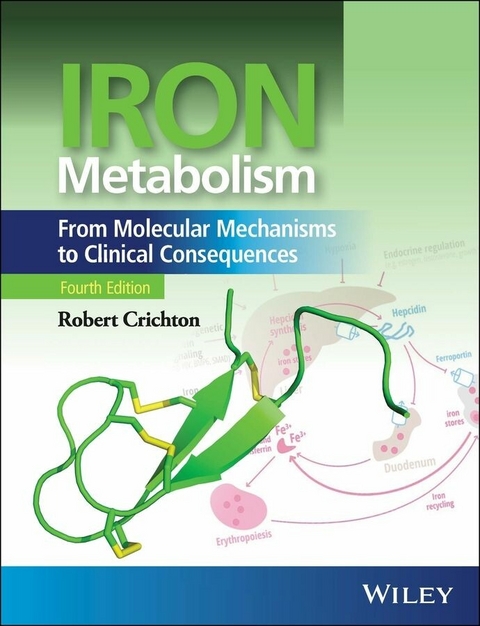
Iron Metabolism (eBook)
John Wiley & Sons (Verlag)
978-1-118-92563-8 (ISBN)
Iron is indispensable for the growth, development and well-being of almost all living organisms. Biological systems from bacteria, fungi and plants to humans have evolved systems for the uptake, utilisation, storage and homeostasis of iron. Its importance for microbial growth makes its uptake systems a natural target for pathogenic microorganisms and parasites. Uniquely, humans suffer from both iron deficiency and iron overload, while the capacity of iron to generate highly reactive free radicals, causing oxidative stress, is associated with a wide range of human pathologies, including many neurodegenerative diseases. Whereas some essential metal ions like copper and zinc are closely linked with iron metabolism, toxic metals like aluminium and cadmium can interfere with iron metabolism. Finally, iron metabolism and homeostasis are key targets for the development of new drugs for human health.
The 4th edition of Iron Metabolism is written in a lively style by one of the leaders in the field, presented in colour and covers the latest discoveries in this exciting area. It will be essential reading for researchers and students in biochemistry, molecular biology, microbiology, cell biology, nutrition and medical sciences. Other interested groups include biological inorganic chemists with an interest in iron metabolism, health professionals with an interest in diseases of iron metabolism, or of diseases in which iron uptake systems are involved (eg. microbial and fungal infections, cancer, neurodegenerative disorders), and researchers in the pharmaceutical industry interested in developing novel drugs targeting iron metabolism/homeostasis.
Professor Robert Crichton, Department of Biochemistry, Université Catholique de Louvain, Belgium
Professor Crichton has worked on cytochrome c in Glasgow, insect haemoglobins in Munich, ferritins and transferrins in Glasgow and Berlin, and on all these areas plus new developments in the understanding of iron-protein interactions in Louvain-la-Neuve. He is the author of Metal-Based Neurodegeneration.
Iron is indispensable for the growth, development and well-being of almost all living organisms. Biological systems from bacteria, fungi and plants to humans have evolved systems for the uptake, utilisation, storage and homeostasis of iron. Its importance for microbial growth makes its uptake systems a natural target for pathogenic microorganisms and parasites. Uniquely, humans suffer from both iron deficiency and iron overload, while the capacity of iron to generate highly reactive free radicals, causing oxidative stress, is associated with a wide range of human pathologies, including many neurodegenerative diseases. Whereas some essential metal ions like copper and zinc are closely linked with iron metabolism, toxic metals like aluminium and cadmium can interfere with iron metabolism. Finally, iron metabolism and homeostasis are key targets for the development of new drugs for human health.The 4th edition of Iron Metabolism is written in a lively style by one of the leaders in the field, presented in colour and covers the latest discoveries in this exciting area. It will be essential reading for researchers and students in biochemistry, molecular biology, microbiology, cell biology, nutrition and medical sciences. Other interested groups include biological inorganic chemists with an interest in iron metabolism, health professionals with an interest in diseases of iron metabolism, or of diseases in which iron uptake systems are involved (eg. microbial and fungal infections, cancer, neurodegenerative disorders), and researchers in the pharmaceutical industry interested in developing novel drugs targeting iron metabolism/homeostasis.
Professor Robert Crichton, Department of Biochemistry, Université Catholique de Louvain, Belgium Professor Crichton has worked on cytochrome c in Glasgow, insect haemoglobins in Munich, ferritins and transferrins in Glasgow and Berlin, and on all these areas plus new developments in the understanding of iron-protein interactions in Louvain-la-Neuve. He is the author of Metal-Based Neurodegeneration.
'This textbook is clearly a milestone which should be to hand for every researcher and scholar working on or interested in the biochemistry and clinical aspects of iron. Those needing to go further in depth on some specific aspects will find not only an excellent starting point but also their pathway through the impressive list of references at the end of each chapter.' Acta Cryst (International Union of Crystallography), November 2017
Preface
It is astonishing to realise that a slim volume of some 260 pages (Crichton, 1991), first conceived in the course of a discussion with the egregious Ellis Horwood at the Christmas buffet of the Royal Society of Chemistry Inorganic Biochemistry Discussion Group, has grown to such a size. Ellis Horwood had established his own scientific publishing house, Ellis Horwood Limited, based in the charming old Market Cross House in the West Sussex town of Chichester and, with his usual inimitable enthusiasm, he persuaded me – rather easily as it turned out – to contribute to his series of Inorganic Chemistry books. The outcome was Inorganic Biochemistry of Iron Metabolism, and any thoughts of subsequent editions had certainly not crossed my mind.
I say rather easily, because since the publication of the proceedings of the second meeting on proteins of iron storage and transport (Crichton, 1975), there had been a void which was crying out to be filled for a definitive work which would bring together an overview of the dramatic developments which had been taking place in the field of iron metabolism since then. All of the manuscripts of the presentations at that meeting in Louvain-la-Neuve were incorporated into the book Proteins of Iron Storage and Transport in Biochemistry and Medicine, produced by North Holland/American Elsevier in record time – the meeting was held from 2nd–5th April, 1975 and the book (all 454 pages) appeared in July of that year! They included the contribution by Jean Montreuil and Genevieve Spik from Lille, who arrived without a manuscript, but after being closeted in an office with an English-speaking secretary, duly produced the goods before the end of the meeting, as well as Clem Finch’s Concluding Remarks recorded on a Dictaphone at the end of the meeting, typed that evening during the concluding Banquet, and duly dispatched, corrected, the following morning along with all of the other camera-ready texts. This volume, which represented the first time that all of the major figures on the iron scene had published jointly what was a sort of ‘state of the art of iron metabolism, 1975’, sold over 600 copies, and was still being cited more than a decade after the meeting itself. However, despite intermittent efforts after the New York meeting in 1977, the Sapporo meeting in 1983 and the Lille meeting in 1985 (Brown et al., 1977; Uroshizaki et al., 1983; Spik et al., 1985), there was a real potential for a book that would bring together all aspects of iron metabolism.
My decision to undertake this ambitious project was greatly facilitated by the fact that I was in line for a sabbatical – in reality six rather than 12 months – which I spent at the invitation of Professor Robert Freedman in the Biology Department of the University of Kent in Canterbury. Ironically (no pun intended) for the author of a book on inorganic chemistry, my office was in the Chemistry Department. In those prehistoric times one hunted down references on the shelves of the University library overlooking the majestic and historical Cathedral, photocopied them (a new innovation), and then read them, highlighting the important sections. When the references (hunted down in Chemical Abstracts) were not available in Canterbury, one undertook a day trip to London to consult the Science Library there. Then, with reams of fluorescent highlighted papers, one sat down to write one’s own text, mostly in my flat on the Canterbury Road in the agreeable seaside town of Whitstable, with its beach and bracing sea air.
The outcome, in 12 chapters, is quite similar to this 4th edition, dealing with iron chemistry, the importance of iron in biology, microbial, plant and fungal iron uptake, transferrin and its receptor (a relatively recent discovery), intracellular iron, iron homeostasis, iron absorption, iron deficiency and overload, iron and oxidative damage and finally, iron and infection. There were some 800 references in all, regrouped at the end of the book, in the classical chemical presentation without title, but with the final page number. I would think that, with the resources then available, I had read the abstracts of all of the articles (in Chemical Abstracts) and read the better part of 50–60% of the most important articles. The figures were entirely in black and white!
When, ten years later, I undertook a 2nd edition (Crichton, 2001), the title – now Inorganic Biochemistry of Iron Metabolism. From Molecular Mechanisms to Clinical Consequences – had been transferred to John Wiley & Sons, and the 326-page outcome even had a central glossy page insert which included 16 ‘Plates’ of coloured figures (all of the others were black and white). For this edition I enlisted the help of six colleagues, Volkmar Braun and Klaus Hantke for microbial iron uptake, Jo Marx and Manuela Santos for the pathophysiology of iron deficiency and iron overload, Roberta Ward for the chapter on oxidative stress, and Johann Boelaert for iron and infection. There were some 1500 references, this time regrouped at the end of each chapter, but again without titles. Once again, it is probable (I cannot speak for my colleagues) that at least the abstracts of the papers cited had been read as well as most of the key articles.
By the time of the 3rd edition (Crichton, 2009), I had returned to the essentially single author format, with two chapters being entrusted to my long-term collaborator, Roberta Ward. Reflecting the way the field was growing, the microbial iron chapter included a view of intracellular iron metabolism, while the plant and fungal chapter highlighted the extraordinary developments in our understanding of yeast iron uptake systems. Although discovered just after the 2nd edition, hepcidin was relegated to the iron absorption chapter in which systemic iron balance was reviewed. The chapter on iron and infection was replaced by a new chapter on brain iron homeostasis and its perturbation in neurodegenerative diseases. Virtually all of the figures were in colour, and the 2200 references this time included titles (which makes for a lot more work – as a colleague remarked, “you can always invent the final page number, but the title……?”, yet I think it is more useful in deciding if the reader really wants to hunt it down).
This 4th edition has reached even larger dimensions, with the number of references soaring to over 3500. As in the previous edition, we begin with a chapter on the solution chemistry of iron in biological media, the biologically very important interactions of iron with dioxygen, followed by a short review of hydrolysis of iron salts, the characterisation of ferrihydrite and its ageing to more crystalline products. The chapter concludes with a section on biomineralisation, with particular emphasis on magnetite formation by magnetotactic bacteria. The essential role of iron in biology is once again reviewed in Chapter 2, illustrated by examples drawn where possible from the recent literature.
The section on microbial iron has been subdivided this time into two chapters to take account of the important role of iron acquisition in the virulence of microbial pathogens and, in particular, as potential antimicrobial therapeutic targets. Chapter 3 discusses iron uptake from ferric siderophores in Gram-negative and Gram-positive bacteria, as well as the systems used by both classes of bacteria to take up Fe2+. Iron release from siderophores and intracellular iron metabolism are then reviewed, and the chapter concludes with a discussion of the mechanisms involved in the regulation of gene expression by iron.
Iron sequestration provides the innate host defence, known as nutritional immunity, which leads bacterial and fungal pathogens to scavenge iron from their hosts. Chapter 4 is devoted to iron assimilation by pathogens, beginning with an overview of host defence mechanisms and nutritional immunity. The importance of pathogenicity islands, horizontally transferred mobile genetic elements involved in the dissemination of antibiotic resistance and virulence genes in pathogenic organisms, which frequently also encode iron uptake systems, specific to pathogenic strains (Gyles and Boerlin, 2014) is then outlined. Pathogen-specific iron uptake systems, involving pathogen-specific siderophores, host sources of iron such as transferrin, lactoferrin and haem, ferrous iron and ferric citrate, are then analysed. The structural basis of iron piracy by pathogenic Neisseria from human transferrin has been elucidated (Noinaj et al., 2012). These studies establish a rational basis for the host specificity of TbpA, the TonB-dependent outer membrane transporter for human transferrin, show how TbpA promotes iron release from transferrin, and elucidate how TbpB, the lipoprotein coreceptor, facilitates this process. Recent cloning and sequencing of transferrin orthologues from 21 hominoid monkey species (Barber and Elde, 2014) revealed that hominoid transferrin has undergone recurrent positive selection at the binding interface with bacterial TbpA, providing a mechanism to counteract bacterial iron piracy. The regulation of pathogen iron uptake by Fur and Fur homologues, and by pathogen ECF sigma factors, are discussed, and we conclude with a brief outline of the strategies employed by opportunistic fungal pathogens, which represent a growing health threat, to acquire iron from their host.
Our understanding of iron uptake by plants and fungi has been greatly influenced by the fulgurant progress in genome sequencing, and Chapter 5 presents our current...
| Erscheint lt. Verlag | 30.3.2016 |
|---|---|
| Sprache | englisch |
| Themenwelt | Medizinische Fachgebiete ► Innere Medizin ► Endokrinologie |
| Studium ► 1. Studienabschnitt (Vorklinik) ► Biochemie / Molekularbiologie | |
| Naturwissenschaften ► Biologie ► Biochemie | |
| Naturwissenschaften ► Chemie ► Anorganische Chemie | |
| Naturwissenschaften ► Chemie ► Organische Chemie | |
| Technik | |
| Schlagworte | Bioanorganische Chemie • Biochemie • Biochemie u. Chemische Biologie • Biochemistry (Chemical Biology) • bioinorganic chemistry • Biowissenschaften • Cell & Molecular Biology • chelator • Chemie • Chemistry • Deficiency • Eisenstoffwechsel • Ferritin • Hepcidin • homeostasis • iron • Life Sciences • Metabolism • overload • Siderophore • Transferrin • Zell- u. Molekularbiologie |
| ISBN-10 | 1-118-92563-7 / 1118925637 |
| ISBN-13 | 978-1-118-92563-8 / 9781118925638 |
| Informationen gemäß Produktsicherheitsverordnung (GPSR) | |
| Haben Sie eine Frage zum Produkt? |
 EPUB (Adobe DRM)
Kopierschutz: Adobe-DRM
Adobe-DRM ist ein Kopierschutz, der das eBook vor Mißbrauch schützen soll. Dabei wird das eBook bereits beim Download auf Ihre persönliche Adobe-ID autorisiert. Lesen können Sie das eBook dann nur auf den Geräten, welche ebenfalls auf Ihre Adobe-ID registriert sind.
Details zum Adobe-DRM
Dateiformat: EPUB (Electronic Publication)
EPUB ist ein offener Standard für eBooks und eignet sich besonders zur Darstellung von Belletristik und Sachbüchern. Der Fließtext wird dynamisch an die Display- und Schriftgröße angepasst. Auch für mobile Lesegeräte ist EPUB daher gut geeignet.
Systemvoraussetzungen:
PC/Mac: Mit einem PC oder Mac können Sie dieses eBook lesen. Sie benötigen eine
eReader: Dieses eBook kann mit (fast) allen eBook-Readern gelesen werden. Mit dem amazon-Kindle ist es aber nicht kompatibel.
Smartphone/Tablet: Egal ob Apple oder Android, dieses eBook können Sie lesen. Sie benötigen eine
Geräteliste und zusätzliche Hinweise
Buying eBooks from abroad
For tax law reasons we can sell eBooks just within Germany and Switzerland. Regrettably we cannot fulfill eBook-orders from other countries.
aus dem Bereich