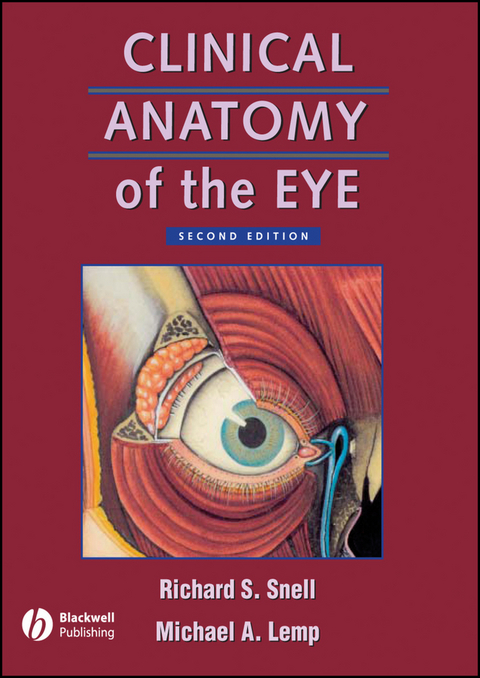
Clinical Anatomy of the Eye (eBook)
John Wiley & Sons (Verlag)
978-1-118-69100-7 (ISBN)
Richard S Snell, MD, PhD, Emeritus Professor of Anatomy, The George Washington School of Medicine and Health Sciences, Washington D.C.
Michael A Lemp, MD, Clinical Professor of Ophthalmology, Georgetown University Medical Center, President, University of Ophthalmic Consultants of Washington, Washington D.C.
Clinical Anatomy of the Eye has proved to be a very popular textbook for ophthalmologists and optometrists in training all over the world. The objective of the book is to provide the reader with the basic knowledge of anatomy necessary to practice ophthalmology. It is recognised that this medical speciality requires a detailed knowledge of the eyeball and the surrounding structures. The specialist's knowledge should include not only gross anatomic features and their development, but also the microscopic anatomy of the eyeball and the ocular appendages. The nerve and blood supply to the orbit, the autonomic innervation of the orbital structures, the visual pathway, and associated visual reflexes should receive great emphasis. The practical application of anatomic facts to ophthalmology has been emphasised throughout this book in the form of Clinical Notes in each chapter. Clinical problems requiring anatomic knowledge for their solution are presented at the end of each chapter. Illustrations are kept simple and overview drawings of the distribution of the cranial and autonomic nerves have been included.
Richard S Snell, MD, PhD, Emeritus Professor of Anatomy, The George Washington School of Medicine and Health Sciences, Washington D.C. Michael A Lemp, MD, Clinical Professor of Ophthalmology, Georgetown University Medical Center, President, University of Ophthalmic Consultants of Washington, Washington D.C.
Preface;.
1. Development of the eye and the ocular appendages;.
2. An overview of the anatomy of the skull;.
3. The orbital cavity;.
4. The paranasal sinuses;.
5. The ocular appendages;.
6. The eyeball;.
7. The anatomy of the eyeball as seen with the ophthalmoscope,
slit lamp, and gonioscope;.
8. Movements of the eyeball and the extrocular muscles;.
9. The orbital blood vessels;.
10. Cranial nerves part I: Those nerves directly associated with
the eye and orbit;.
11. Cranial nerves part II: Those nerves not directly associated
with the eye and orbit;.
12. The autonomic nervous system;.
13. The visual pathway;.
Index
"The most stunning aspect of this book is that the authors serve the needs of all levels of expertise...this format greatly aids the clinician...and guides the beginner..." American Journal of Ophthalmology on the first edition
CHAPTER 1
Development of the Eye and the Ocular Appendages
CHAPTER OUTLINE
Macular Area and Fovea Centralis
The Ciliary Body and Suspensory Ligaments of the Lens
The Anterior and Posterior Chambers
The Lacrimal Sac and Nasolacrimal Duct
Absence of Pigment in the Retina and Iris
Atresia of the Nasolacrimal Duct
Congenital Fistulas of the Lacrimal Sac
Introduction
The eye is formed from both ectoderm and mesenchyme. The ectoderm that is derived from the neural tube gives rise to the retina, the nerve fibers of the optic nerve, and the smooth muscle of the iris. The surface ectoderm on the side of the head forms the corneal and conjunctival epithelium, the lens, and the lacrimal and tarsal glands. The mesenchyme forms the corneal stroma, the sclera, the choroid, the iris, the ciliary musculature, part of the vitreous body, and the cells lining the anterior chamber. The endothelium of the cornea is believed to be of neural crest origin.
The reader should note the importance of the induction of one ocular tissue by another during development. The lens, for example, is induced to develop by the presence of the optic vesicle. The presence of the developing lens induces the formation of the cornea and stimulates the development of the vitreous body. The presence of the developing lens is also important for the normal growth of the pigment layer of the retina, which in turn influences the differentiation of the mesenchyme into the choroid and the sclera. How this induction process is brought about remains to be determined.
The Eyeball
The rudimentary eyeball develops as an ectodermal diverticulum from the lateral aspect of the forebrain (Fig. 1-1). The diverticulum grows out laterally toward the side of the head, and the end becomes slightly dilated to form the optic vesicle, while the proximal portion becomes constricted to form the optic stalk (Fig. 1-1). At the same time, a small area of surface ectoderm overlying the optic vesicle thickens to form the lens placode. The lens placode invaginates and sinks below the surface ectoderm to become the lens vesicle. Meanwhile, the optic vesicle becomes invaginated to form the double-layered optic cup. The inferior edge of the optic cup is deficient, and this notch is continuous with a groove on the inferior aspect of the optic stalk called the optic or choroidal fissure (Fig. 1-1). Vascular mesenchyme now grows into the optic fissure and takes with it the hyaloid artery. Later, this fissure becomes narrowed by growth of its margins around the artery, and by the seventh week of embryonic development the fissure closes, forming a narrow tube, the optic canal, inside the optic stalk (Fig. 1-2). Failure of the fissure to close completely results in coloboma formation (see p. 18), which may include the pupil, ciliary body, and choroid or optic nerve. By the fifth week, the lens vesicle loses contact with the surface ectoderm and lies within the mouth of the optic cup, the edges of which form the future pupil (Fig. 1-3).
The Retina
The retina develops from the optic cup. For purposes of description, the retina may be divided into two developmental layers, the pigment layer and the neural layer.
The pigment layer is formed from the outer thinner layer of the optic cup (Fig. 1-3). It is a single layer of cells that become columnar in shape and develop pigment granules (melanosomes) within their cytoplasm.
Figure 1-1
(A) Dorsal view, showing the formation of the optic vesicle, which grows out as a diverticulum from the lateral aspect of the forebrain. (B) Coronal section of diencephalon, showing a thickening of the surface ectoderm overlying the optic vesicle to form the lens placode. (C) Coronal section of diencephalon, showing the lens placode invaginating and sinking below the surface ectoderm. Note that the optic vesicle is also becoming invaginated. (D) The formation of the lens vesicle, the optic cup, and the choroidal fissure.
Figure 1-2
(A-E) A series of diagrams illustrating the formation of the optic cup from the optic vesicle. Note that the inferior edge of the optic cup is deficient, and that this notch is continuous with the choroidal fissure. The lips of the choroidal fissure fuse around the hyaloid artery and vein.
The neural layer is formed from the inner layer of the optic cup. However, in the region of the cup that overlaps the lens, the inner layer is not differentiated into nervous tissue. This anterior one-fifth of the inner layer persists as a layer of columnar cells, which, together with the pigmented epithelium of the outer layer, extend forward onto the posterior surface of the developing ciliary body and iris (Fig. 1-4).
The posterior four-fifths of the inner layer of the optic cup undergoes cellular proliferation, forming an outer nuclear zone and an inner marginal zone, devoid of nuclei (Fig. 1-3). Later, the cells of the nuclear zone invade the marginal zone so that the neural part of the retina is made up of an inner and an outer neuro-blastic layer. The inner neuroblastic layer forms the ganglion cells, the amacrine cells, and the bodies of the sustentacular fibers of Müllre. The outer neuroblastic layer gives rise to the horizontal and rod and cone bipolar nerve cells and the rod and cone cells. By the eighth month of fetal life all the layers of the retina can be recognized. It should be noted that the retinal photoreceptor cells continue to form after birth so that the retina develops the ability for increasing resolution and sensitivity.
Thus, the inner layer of the optic cup may be divided into a small non-nervous portion near the edge of the cup and a large photosensitive portion, the two being separated by a wavy line, the ora serrata (Fig. 1-4).
It is interesting to remember that the cavity of the optic vesicle is continuous through the optic canal with the cavity of the diencephalon (i.e., that part which will form the third ventricle). Early in development, the outermost layer of cells of the nuclear zone have cilia, which are continuous with the ciliated ependymal cells of the third ventricle. Later, during the seventh week of development, the cilia of the cells of the nuclear zone disappear and are believed to be replaced by the outer segments of the rods and cones during the fourth month.
Figure 1-3
The eye at different stages of development. (A) The formation of the lens from the lens vesicle and its nourishment by the hyaloid artery. Note the further development of the inner and outer layers of the optic cup and the continued presence of the cavity of the optic vesicle. (B) The development of the cornea, the anterior chamber, and the pupillary membrane. The cavity of the lens vesicle is still present. The eyelids have fused and remain so until the seventh month before birth.
Figure 1-4
(A, B) The eye in advanced stages of development. Note the degeneration of the hyaloid vessels and the persistence of the hyaloid canal in the vitreous body. The remains of the hyaloid vessels become the central artery and vein of the retina. The lacrimal gland has developed as an outgrowth of the conjunctival sac.
Macular Area and Fovea Centralis
The macular area first develops as a localized increase of superimposed nuclei in the ganglion cell layer, lateral to the optic disc, just after midterm. During the seventh month there is a peripheral displacement of the ganglion cells, leaving a central shallow depression, the fovea centralis. The inner segments of the foveal cones decrease in width, but the outer segments are elongated. This permits an increase in foveal cone density. At birth, the ganglion cells have been reduced to a single layer in the fovea, and by 4 months of age the cone nuclei in the center of the fovea have no ganglion cells covering them. The reason for the newborn’s imperfect central fixation is that the cones do not fully develop until several months after birth.
The Optic Nerve
The ganglion cells of the retina develop axons that converge to a point where the optic stalk leaves the posterior surface of the optic cup. This site will later become the optic disc. The axons now pass among the cells that form the inner layer of the stalk (Fig....
| Erscheint lt. Verlag | 9.4.2013 |
|---|---|
| Sprache | englisch |
| Themenwelt | Medizin / Pharmazie ► Medizinische Fachgebiete ► Augenheilkunde |
| Studium ► 1. Studienabschnitt (Vorklinik) ► Anatomie / Neuroanatomie | |
| Schlagworte | Anatomic • anatomy • BASIC • Book • Clinical • Eye • eyeball • Gross • Knowledge • Medical • Medical Science • Medizin • Necessary • Objective • Ophthalmologie u. Optometrie • Ophthalmologists • Ophthalmology • Ophthalmology & Optometry • Popular • Practice • Reader • specialists knowledge • Speciality • Structures • surrounding • Textbook |
| ISBN-10 | 1-118-69100-8 / 1118691008 |
| ISBN-13 | 978-1-118-69100-7 / 9781118691007 |
| Informationen gemäß Produktsicherheitsverordnung (GPSR) | |
| Haben Sie eine Frage zum Produkt? |
 EPUB (Adobe DRM)
Kopierschutz: Adobe-DRM
Adobe-DRM ist ein Kopierschutz, der das eBook vor Mißbrauch schützen soll. Dabei wird das eBook bereits beim Download auf Ihre persönliche Adobe-ID autorisiert. Lesen können Sie das eBook dann nur auf den Geräten, welche ebenfalls auf Ihre Adobe-ID registriert sind.
Details zum Adobe-DRM
Dateiformat: EPUB (Electronic Publication)
EPUB ist ein offener Standard für eBooks und eignet sich besonders zur Darstellung von Belletristik und Sachbüchern. Der Fließtext wird dynamisch an die Display- und Schriftgröße angepasst. Auch für mobile Lesegeräte ist EPUB daher gut geeignet.
Systemvoraussetzungen:
PC/Mac: Mit einem PC oder Mac können Sie dieses eBook lesen. Sie benötigen eine
eReader: Dieses eBook kann mit (fast) allen eBook-Readern gelesen werden. Mit dem amazon-Kindle ist es aber nicht kompatibel.
Smartphone/Tablet: Egal ob Apple oder Android, dieses eBook können Sie lesen. Sie benötigen eine
Geräteliste und zusätzliche Hinweise
Buying eBooks from abroad
For tax law reasons we can sell eBooks just within Germany and Switzerland. Regrettably we cannot fulfill eBook-orders from other countries.
aus dem Bereich