Positive Psychology and Change (eBook)
John Wiley & Sons (Verlag)
978-1-118-79389-3 (ISBN)
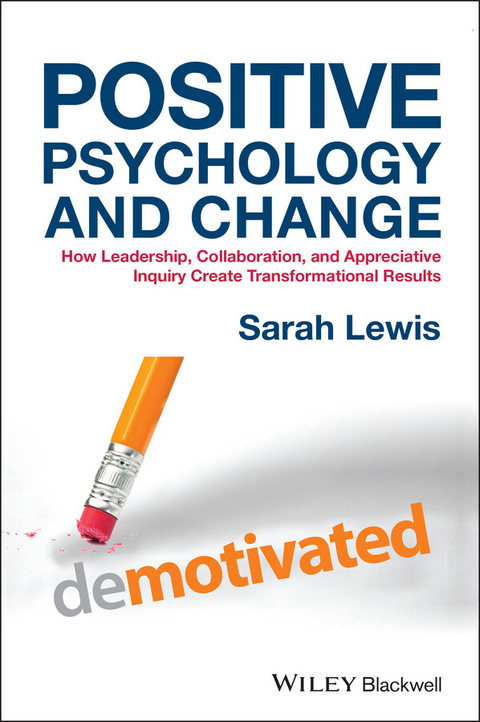
Positive Psychology and Change explores how areas of positive psychology such as strengths, flow, and psychological capital can be applied to the everyday challenges of leading a dynamic and adaptive work community, and how collaborative group approaches to transformational change can be combined with a positive mindset to maintain optimism and motivation in an unpredictable working environment.
- Articulates a unique vision for organizational leadership in the 21st century that combines positive psychology, Appreciative Inquiry (AI), and collaborative group technologies
- Focuses on four specific co-creative approaches (Appreciative Inquiry, Open Space, World Café and SimuReal) and the ways in which they surpass traditional methods for organizational change
- Explains the latest theory, research, and practice, and translates it into concrete, actionable ideas for meeting the day-to-day challenges of effective and adaptive leadership and management
- Includes learning features such as boxed text, short case studies, stories, and cartoons
Sarah Lewis, an acknowledged expert on positive psychology and Appreciative Inquiry, is Managing Director and Principal Psychologist at Appreciating Change (www.acukltd.com). She is an Associated Fellow of the British Psychological Society and a Principal Member of the Association of Business Psychologists. She is the author of Appreciative Inquiry for Change Management (Second Edition, 2016) and Positive Psychology at Work (Wiley-Blackwell, 2011). Her work is informed by a positive and appreciative view of organizations, and she also has particular expertise in systemic consultation, Open Space, World Café, and SimuReal. She is a frequent presenter at national and international conferences, facilitates large group events and regularly runs workshops on 'The Psychology of Change' through the CIPD.
Positive Psychology and Change explores how areas of positive psychology such as strengths, flow, and psychological capital can be applied to the everyday challenges of leading a dynamic and adaptive work community, and how collaborative group approaches to transformational change can be combined with a positive mindset to maintain optimism and motivation in an unpredictable working environment. Articulates a unique vision for organizational leadership in the 21st century that combines positive psychology, Appreciative Inquiry (AI), and collaborative group technologies Focuses on four specific co-creative approaches (Appreciative Inquiry, Open Space, World Caf and SimuReal) and the ways in which they surpass traditional methods for organizational change Explains the latest theory, research, and practice, and translates it into concrete, actionable ideas for meeting the day-to-day challenges of effective and adaptive leadership and management Includes learning features such as boxed text, short case studies, stories, and cartoons
SARAH LEWIS, an acknowledged expert on positive psychology and Appreciative Inquiry, is Managing Director and Principal Psychologist at Appreciating Change (www.acukltd.com). She is an Associated Fellow of the British Psychological Society and a Principal Member of the Association of Business Psychologists. She is the author of Appreciative Inquiry for Change Management (2nd edition, 2016) and Positive Psychology at Work (Wiley-Blackwell, 2011). Her work is informed by a positive and appreciative view of organizations, and she also has particular expertise in systemic consultation, Open Space, World Café and Simu-Real. She is a frequent presenter at national and international conferences, facilitates large group events and regularly runs workshops on "The Psychology of Change" through the CIPD.
About the Author xi
Foreword xiii
Preface xix
Acknowledgements xxiii
1 The Legacy of Twentieth-Century Ideas about Organizational Change 1
Introduction 2
A Changing World 3
The Roots of Many Change Models 4
Legacy Thinking about Organizational Change 6
The Legacy Beliefs of Lewin and Taylor in Our Understanding of Organizational Change 8
Conclusion 20
2 The Challenge of Leadership 21
Introduction 23
Should Decisiveness Be the Priority in Leaders? 24
The Need to Make a Difference 26
What Does Shifting the Organizational Metaphor Mean for Leaders? 29
New Definition of Leadership 30
Doing Leadership Differently 30
Characteristics of a New Leadership Style 32
Conclusion 50
3 Helping People Engage Positively with Imposed Change 51
Introduction 53
Typical Experience of Imposed Change 53
Unintended Consequences of Imposed Change 55
Understanding the Psychological Impact of Imposed Change on People 55
Accessing Psychological Resources to Increase Efficacy and Resilience 60
Conclusion 75
4 A Different Approach to Organizations and Change 77
Introduction 78
Key Factors that Create Living Human System Learning and Change 78
Distinctive Features of Co-creative Approaches to Change 80
Principles of Practice for Achieving Change in Living Human Systems 88
Conclusion 96
5 Using Positive Psychology to Achieve Change at the Team and Individual Level 97
Introduction 98
Principles 98
Positive and Appreciative Practices 105
Conclusion 117
6 Appreciative Inquiry 119
Introduction 121
Process 122
Purpose 123
Recommended Use 123
Key Ideas 123
Critical Success Factors 128
Key Skills 132
Origins of the Methodology 136
When to Use and Counter-indications 136
Conclusion 139
7 World Café 141
Introduction 143
The Process 143
Purpose 145
Recommended Use 145
Key Ideas 147
Critical Success Factors 151
Key Skills 157
Origins of the Methodology 158
Conclusion 160
8 Open Space 161
Introduction 162
Purpose 163
The Process 164
Recommended Use 167
Key Ideas 170
Critical Success Factors 173
Key Skills 176
Origins of the Methodology 181
Conclusion 183
9 Simu-Real 185
Introduction 188
Purpose 189
The Process 190
Recommended Use 191
Key Ideas 192
Critical Success Factors 194
Key Skills 200
Origins of the Methodology 202
Long-Term Effects 202
When to Use and When Not to 203
Conclusion 203
10 Pulling It All Together 205
Introduction 205
Rise of Planned Change Approaches 205
Co-creative Approaches to Change 207
Features of Co-created Change 208
Linking Theory, Research, and Practice 215
Time for Something Different 216
Bringing Emergent Change Insights to Planned Change Projects 219
Positive: The Whole Strengths Spectrum Approach to Change 223
Conclusion 226
References 227
Index 237
"This book is a doorway into generative, strengths-inspired and solutions-focused change. It gives leaders the gift of new eyes and teaches how humility might just be a leader's greatest strength. It brings the joy of high quality connections back into the field of organization development. And it reminds us that we can create conditions - the evidence base is there - to confirm our deepest conviction: that human beings are good. Read this wonderful book carefully."
David Cooperrider, Weatherhead School of Management, Case Western Reserve University
"We need to develop work organizations in which people thrive and find positive meaning in life rather than being impoverished and exhausted by organizational change. This book offers a profoundly important guide to how we can create such organizations, providing the theoretical rationale, evidence and practical steps necessary to achieve transformational change. Every manager and leader of every organization should not only read it but immediately put it into practice."
Michael West, Lancaster University Management School
"Sarah Lewis is one of those rare management writers able to combine academic research with practical relevance. In Positive Psychology and Change she offers a fresh, evidence-based rethinking of how large group organizational change methods work and many practical suggestions for how to use them successfully."
Gervase R. Bushe, Beedie School of Business, Simon Fraser University
1
The Legacy of Twentieth-Century Ideas about Organizational Change
Picture the scene. I’m watching Boardwalk Empire on DVD with someone who came of age well into the twenty-first century. We get to the scene where a young “gofer” is asked his name by another gofer. He replies, “Al, Al Capone.” My young friend says, “Wasn’t he a real person?” I don’t answer immediately, pausing while I wait for a suitable gap in the dialogue. She answers her own question: “Yes he was.” She reads a few sentences about Al Capone from her iPhone. She then asks, “Are any of the other characters real?” “I don’t know,” I say. A slight pause and then, “What’s Nucky’s proper name?” “Enoch.” She looks up “Enoch Thompson” on the phone. “Oh yes, he’s real too.” Throughout our programme-watching her phone whistles at her intermittently, and each time she attends for maybe 30 seconds, smiling, pouting, texting.
There is nothing new in this account, and everything. My dinosaur ways, such as watching a DVD rather than viewing content direct from the internet, my assumption that all relevant information is present in the vision and sound on the screen, my distance from my electronic “work” devices (it is the weekend, my mobile phone is in a bag somewhere, undoubtedly still on silent from the last meeting on Friday), all mark me out as essentially from the pre-digital age. My young friend engages with the world differently. Her phone lives in her hand. She is a cyber-person at one with the internet. It is always on and so is she. Any curiosity, mild or strong, can be instantly gratified. When she cooks a meal, before we are allowed to eat it a picture must be sent to friends. Arrangements with friends are so fluid as to be at times indiscernible to the naked eye as commitments. Fraught and loaded conversations with the boyfriend about “the state of the relationship” are conducted in 20-word text bites. She truly lives in a different world to me.
Introduction
My young friend and her colleagues are the inhabitants and creators of future, as yet unrealized, organizations. These organizations need to be fit for the changing world. At present we are in a state of transition from the solid certainties of the latter half of the twentieth century (the programme is shown once, at 9.00 p.m. on BBC1 – make it or miss it) to the increasing fluidity of the twenty-first century (watch it now, watch it later, on the TV, on a tablet, legally or illegally – whatever, whenever). This isn’t only the case in the media world; it can be argued that the organizational development world is in a similar state of flux.
Many of the organizational development approaches and techniques that are in common use in organizations today were developed in the1940s and 1950s. Most of the theorists were male, European and living in America. Their ideas are located in a specific time and context. Their ideas and theories are not timeless truths about organizations and organizational life; rather they are a product of, and are suited to, their time and context. This chapter examines the key features of these organizational development models and their influence on current beliefs about how to produce organizational change. First though, a reminder of how much the world has changed since the 1940s.
A Changing World
The jury is still out on whether the recession of the last six years (as experienced by most of the Western world at least), is a temporary glitch in the upward path of increasing productivity and affluence, or the dawning of a new economic world order. What it has brought into sharp unavoidable focus is the interconnectedness of the world, and the complexity of that interconnectedness. Michael Lewis’s books The Big Short (2010) and Boomerang (2011) spell out in words of few syllables how the US property and financial markets came crashing down, bursting property bubbles all over Western Europe, and bringing other markets down with them. One of the many insights to be drawn from this calamitous tale is that the level of complexity developed in the money market obscured the connective links between actions. One of the few who seemed to understand something of this before the event is Nassim Taleb, who, in his book The Black Swan (2008) (a somewhat more challenging read than Michael Lewis, and not for the faint hearted), essentially says that the real threat isn’t what can be predicted, precisely because we can prepare for that; it is what can’t be predicted. And his argument essentially is that the degree of fundamental unpredictability, for organizations, is growing partly because of the increasing level of complexity and interconnectivity of the world at large.
Unpredictability and complexity create challenges for change initiatives. When there is a high degree of unpredictability and complexity it becomes more obvious that not all the variables relevant to a situation can be known. Not all the likely consequences of actions can be predicted in their entirety, and the effects of our actions can’t be bounded. Cheung-Judge and Holbeche note that “overall the challenges for leaders relate to dealing with the complexity, speed and low predictability of today’s competitive landscape” (2011, p. 283). And yet we all, leaders and consultants, frequently act in the organizational change context as if we can control all the variables and predict all the consequences of our actions. A contributing factor to this misplaced sense of omniscience is that many of our change theories and models are predicated on the idea that organizational change is predictable and controllable. To understand this, we need to recognize that many of them are the direct descendants of ideas developed over 60 years ago, when the world was a very different place.
The Roots of Many Change Models
In the 1940s Europe was busy tearing itself apart in the second large-scale conflict of the century. It managed to drag in most of the rest of the world through alliance and empire as the war ranged over large parts of the globe. Every continent (barring the South Pole) and almost every country was involved. The German Nazi party gave itself the mission of purifying the German race by removing various Nazi-defined undesirable or foreign elements that lived among them. This desire to eradicate perceived threat was focused mainly on the large German and later Polish and other annexed countries’ Jewish populations, but it was also aimed at homosexual men, Gypsies, and the mentally deficient. As the reality of the Nazi ambition became apparent, many under threat sought to leave Europe. America was a place of sanctuary before and during the war for those under threat of death, particularly the European Jewish population.
The genocidal intent of the Nazis and the industrialization of death through the extermination camps were a horrific and terrifying new reality in the world of human possibility. After the war the phrase “never again” encapsulated the ambition of many to understand and prevent such a tragedy from ever happening again. Many people devoted their remaining lives to trying to understand how it was possible for people to persuade themselves that such ambition and activity was not only acceptable but desirable and to be actively pursued. For some this expressed itself in an interest in understanding group dynamics. Organizations are a particular expression of social grouping. One German American Jewish refugee in particular wanted to understand how what had happened had happened, and more particularly, how to prevent it happening again.
Kurt Lewin was an immigrant German Jewish psychologist who found employment at Cornell University and then MIT. An applied researcher, he was interested in achieving social change and he developed the research methodology known as action research as a way of creating practical and applicable knowledge. As part of his work and research, Lewin developed models to understand and effect organizational change which still reverberate in organizational thinking. His three-step model of organizational change (1947), namely, unfreeze, change, freeze, is at the base of many more recent change models. This model understands organizations to exist in an essentially stable state, one that is periodically interrupted by short episodes of disruptive change. The use of the “frozen” image to describe the before and after state around the period of change suggests not so much stability as a deep stolidity, like a block of ice. This suggests that change is not something that might grow internally from within the organization, but rather something external that needs to be applied to organizations to encourage change, to create the necessary unfreezing of the present state to allow change to happen. Lewin also described these external forces as a force field, and advocated force field analysis.
He suggested that at any point a stable organizational state is held in place by a force field of restraining and driving forces (1947). The field is revealed through the creation of a vector analysis diagram of any particular context, identifying the pertinent forces. The restraining forces, things such as organizational norms, structure, and so on, he argued, hold the situation in place. Driving forces, such as managerial desire or the consequences of not...
| Erscheint lt. Verlag | 4.3.2016 |
|---|---|
| Sprache | englisch |
| Themenwelt | Geisteswissenschaften ► Psychologie |
| Medizin / Pharmazie ► Medizinische Fachgebiete ► Psychiatrie / Psychotherapie | |
| Wirtschaft ► Betriebswirtschaft / Management ► Unternehmensführung / Management | |
| Schlagworte | Appreciative Inquiry (AI) • Business & Management • Collaborative Leadership • Creativity & Innovation Management • Führung • Führung • group change • Human Resources • Innovations- u. Kreativitätsmanagement • Innovations- u. Kreativitätsmanagement • Leadership • <p>Organizational change • Management • Management f. Führungskräfte • Management f. Führungskräfte • Management / Leadership • Open Space • Organizational & Industrial Psychology • Positive Psychologie • Psychologie • Psychologie i. d. Arbeitswelt • Psychology • SimuReal • Wirtschaft u. Management • workplace leadership</p> • World Café |
| ISBN-10 | 1-118-79389-7 / 1118793897 |
| ISBN-13 | 978-1-118-79389-3 / 9781118793893 |
| Informationen gemäß Produktsicherheitsverordnung (GPSR) | |
| Haben Sie eine Frage zum Produkt? |
 EPUB (Adobe DRM)
Kopierschutz: Adobe-DRM
Adobe-DRM ist ein Kopierschutz, der das eBook vor Mißbrauch schützen soll. Dabei wird das eBook bereits beim Download auf Ihre persönliche Adobe-ID autorisiert. Lesen können Sie das eBook dann nur auf den Geräten, welche ebenfalls auf Ihre Adobe-ID registriert sind.
Details zum Adobe-DRM
Dateiformat: EPUB (Electronic Publication)
EPUB ist ein offener Standard für eBooks und eignet sich besonders zur Darstellung von Belletristik und Sachbüchern. Der Fließtext wird dynamisch an die Display- und Schriftgröße angepasst. Auch für mobile Lesegeräte ist EPUB daher gut geeignet.
Systemvoraussetzungen:
PC/Mac: Mit einem PC oder Mac können Sie dieses eBook lesen. Sie benötigen eine
eReader: Dieses eBook kann mit (fast) allen eBook-Readern gelesen werden. Mit dem amazon-Kindle ist es aber nicht kompatibel.
Smartphone/Tablet: Egal ob Apple oder Android, dieses eBook können Sie lesen. Sie benötigen eine
Geräteliste und zusätzliche Hinweise
Buying eBooks from abroad
For tax law reasons we can sell eBooks just within Germany and Switzerland. Regrettably we cannot fulfill eBook-orders from other countries.
aus dem Bereich