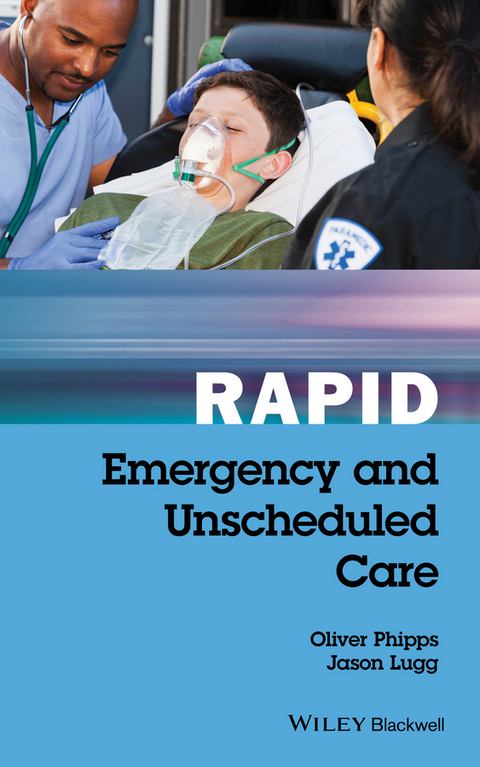
Rapid Emergency and Unscheduled Care (eBook)
John Wiley & Sons (Verlag)
978-1-119-03587-9 (ISBN)
Rapid Emergency and Unscheduled Care outlines the fundamental skills and knowledge necessary to work in the emergency and unscheduled care setting, including pre-hospital care.
- Highlights key history/assessment knowledge, identifying red-flags, and defining and assisting with making a diagnosis
- Explores over 140 presenting ailments, with core information on definition, aetiology, epidemiology, history, examination, investigations and management.
Incorporating words of wisdom and advice from experienced practitioners, this A-Z reference book is essential for all those working in emergency care settings, including doctors, nurse practitioners, nurses, paramedics, and allied health professionals.
Jason Lugg, Lead Nurse & Emergency Nurse Practitioner, Emergency Department, Bristol Royal Infirmary & Associate Lecturer in Emergency Care, University of the West of England.
Oliver Phipps, Advanced Nurse Practitioner, North Bristol NHS Trust & Visiting Lecturer University of the West of England.
Rapid Emergency and Unscheduled Care outlines the fundamental skills and knowledge necessary to work in the emergency and unscheduled care setting, including pre-hospital care. Highlights key history/assessment knowledge, identifying red-flags, and defining and assisting with making a diagnosis Explores over 140 presenting ailments, with core information on definition, aetiology, epidemiology, history, examination, investigations and management. Incorporating words of wisdom and advice from experienced practitioners, this A-Z reference book is essential for all those working in emergency care settings, including doctors, nurse practitioners, nurses, paramedics, and allied health professionals.
Jason Lugg, Lead Nurse & Emergency Nurse Practitioner, Emergency Department, Bristol Royal Infirmary & Associate Lecturer in Emergency Care, University of the West of England. Oliver Phipps, Advanced Nurse Practitioner, North Bristol NHS Trust & Visiting Lecturer University of the West of England.
List of contributors
Preface
Acknowledgement
List of abbreviations
Cardiovascular
Abdominal aortic aneurysm
Anaphylaxis
Aortic dissection
Atrial fibrillation
Bradycardia
Deep vein thrombosis
Heart failure
Hypertension
Ischaemic lower limb
Myocarditis
Pericarditis
Shock
Tachycardia
Ear, Nose & Throat (ENT)
Acute sore throat
Auricular haematoma
Epiglottis
Epistaxis
Foreign body
Glandular fever
Mumps
Nose injury
Otitis externa
Otitis media
Peritonsillar abscess
Endocrine
Diabetes type one
Diabetes type two
Diabetic ketoacidosis
Hyperkalemia
Hypokalemia
Gastroenterology
Abdominal trauma
Appendicitis
Billiary colic
Cholecystitis
Crohn's Disease
Diverticulitis
Gastroenteritis
Gastrointestinal bleeding (upper)
Gastrointestinal bleeding (lower)
Gastrointestinal perforation
Gastro-oesophageal reflux disease (GORD)
Irritable bowel syndrome (IBS)
Pancreatitis (acute)
Pancreatitis (chronic)
Paralytic ileus
Peptic ulcer disease
Peritonitis
Small bowel obstruction
Ulcerative colitis
Genitourinary
Acute kidney injury
Chronic renal failure
Renal colic
Testicular torsion
Urinary tract infection
Infections, Sepsis & Infectious Diseases
Malaria
Sepsis
Septic Arthritis
Typhoid
Mental Health Emergencies
Mental Health Overview
Characteristics of different psychiatric illnesses
Acute confusion and delirium
Acute psychosis
Acute anxiety & panic attacks
Deliberate self-harm
Mental Health Act overview
Musculoskeletal
Achilles tendon injury
Ankle injuries
Back pain (acute)
Calcanium fractures
Compartment syndrome
Elbow injuries
Femoral injuries
Foot injuries
Gastocnemius muscle tears
Hand injuries
Knee injuries
Neck pain / Traumatic neck sprain
Pelvic fractures
Plantar fasciitis
Pulled elbow
Shoulder and clavicle injuries
Spinal injuries
Tibia and fibular fractures
Traumatic amputation
Upper limb injuries
Volar plate injuries
Wrist injuries
Neurology
Bells Palsy
Encephalitis
Epilepsy
Giant Cell Arthritis
Guillain Barre Syndrome
Meningitis
Migraine
Minor head injuries
Status epilepticus
Stroke
Subarachnoid haemorrhage
Subdural haemorrhage
Obstetric & Gynecology
Eclampsia
Ectopic pregnancy
Hypermesis gravidarum
Miscarriage
Pre-eclampsia
Vaginal bleeding
Opthalmology
Acute glaucoma
Anterior uveitis
Blunt trauma
Chemical injury
Conjunctivitis
Corneal injury
Foreign bodies
Loss of vision
Subcongunctival haemorrhage
Superglue injuries
UV radiation injury
Overdose & Poisoning
Alcohol misuse & intoxication
Carbon monoxide poisoning
Drug misuse
Paracetamol overdose
Poisoning
Respiratory
Asthma
Chest Sepsis
Chest Wall Injury
Chronic obstructive pulmonary disease (COPD)
Croup
Cystic fibrosis
Flail Chest
Haemothorax
Lung cancer
Open chest injury
Pulmonary embolism
Pneumothorax
Tension pneumothorax
Skin
Abcessess
Animal bites
Burn to the skin
Cellulitis
Dermatophyte infection
Human Bites
Impetigo
Necrotising Faciitis
Scabies
Varicella
The Electrocardiogram
Index
Cardiovascular
Abdominal aortic aneurysm
Definition
An abdominal aortic aneurysm (AAA) is defined as an enlargement of the aorta by at least 1.5 times its normal diameter. The normal diameter of the aorta is ~2 cm and increases with age. Most AAA are small and not dangerous; however when they increase in size, they are prone to rupture causing a life-threatening condition.
Epidemiology
It is estimated that in 95% of patients, AAA is a complication of atherosclerosis. Risk factors include being male, hypertension, increasing age, smoking and a family history of AAA.
History
- Asymptomatic and often detected on routine abdominal imaging or NHS screening programme.
- Patient may feel pulsatile mass in abdomen.
- Backache.
- Aching pain in the epigastrium and central abdomen to the back.
- In rupture the patient will have severe abdominal pain, often epigastric and radiating to the back.
- May be accompanied by collapse.
- Symptoms can be similar to renal colic.
Examination
The patient should be assessed using the ABCDE approach with appropriate step interventions. Specific points to increase the likely diagnosis of a ruptured AAA include:
- Signs of shock
- Abdominal tenderness and guarding
- Palpable abdominal mass – often pulsatile
- Weak or absent lower limb pulses
Investigations
- Bloods:
- FBC
- U&Es
- LFTs
- Clotting screen
- Cross-match
- Arterial blood gas
- ECG
- CXR and AXR
- CT abdomen
- FAST ultrasound scan
Management
- Transfer direct to the emergency department (ED) with pre-alert.
- ABCDE approach.
- Oxygen (set SpO2 target).
- IV access × 2.
- Cautious IV fluid resuscitation to maintain blood pressure (systolic ~90 mmHg or radial pulse presence), ideally with blood products.
- Analgesia.
- Early discussion with appropriate surgeons.
- Prepare for theatre.
Acute coronary syndrome
Definition
Acute coronary syndrome (ACS) is an umbrella term that encompasses:
- Unstable angina
- Non-ST segment elevation myocardial infarction (NSTEMI)
- ST segment elevation myocardial infarction (STEMI)
Aetiology
ACS is commonly caused by rupture of an atheromatous plaque in a coronary artery. This results in the accumulation of fibrin and platelets to repair the damage. This results in a thrombus formation leading to partial or complete occlusion of the coronary artery and distal myocardial cell death.
Epidemiology
Around 114 000 patients with ACSs are admitted to the hospital each year in the United Kingdom. Coronary heart disease (CHD) is the most common cause of death in the United Kingdom with around one in five men and one in seven women dying each year from CHD.
History
- Consider the history of chest pain or discomfort.
- Cardiovascular (CVS) risk factors.
- Family history of CHD.
- History of CHD, previous treatment and investigations:
- Pain or discomfort in the chest and/or the arms, back or jaw lasting longer than 15 minutes
- Chest pain with nausea and vomiting, sweating and/or breathlessness
- Abrupt deterioration in stable angina, with recurring chest pain discomfort occurring more frequently with little or no exertion and often lasting longer than 15 minutes.
Examination
- Clinical examination is often of little value in diagnosing ACS.
- It can identify alternative causes of chest pain (localised tenderness).
- Look for evidence of the aforementioned symptoms (sweating, SOB, shock).
- Full CVS, respiratory and abdominal assessment.
- Look for signs of heart failure.
- Examine chest wall for local tenderness and other possible causes of chest pain (costochondritis).
Investigations
- Vital signs – RR, HR, BP (both arms) and SpO2
- Cardiac monitoring – to identify underlying rhythm and arrhythmias
- 12-Lead ECG:
- To confirm a cardiac basis for presentation and may show pre-existing structural or CHD.
- ECG changes that occur during episodes of angina (ischaemia) T-wave inversion or ST segment depression.
- Look for ST segment elevation suggestive of an STEMI.
- Bloods:
- FBC, U&Es, LFTs, clotting screen and glucose
- Troponin – should be taken immediately in suspected ACS, but negative result can only be used to rule ACS at 6 and 12 hours, respectively
- CXR – useful to show complications of ischaemia (e.g. pulmonary oedema) or to explore alternative diagnoses (e.g. pneumothorax, aortic aneurysm)
Management
- Refer to local protocols and care pathways.
- 999 Ambulance is required for transfer direct to cardiology in cases of STEMI for primary coronary intervention (PCI) or ED in other cases of ACS.
- IV access.
- IV morphine (dose titrated to pain with antiemetic).
- Oxygen (as required to meet target oxygen saturation of 94–98%).
- Nitrates (GTN if systolic BP > 90 mmHg).
- Aspirin (stat dose of 300 mg).
TOP TIP:
- Chest pain relieved by GTN does not exclude ACS.
- A normal ECG does not exclude an ischaemic cause.
Anaphylaxis
Definition
Anaphylaxis is a severe, life-threatening and systemic hypersensitivity reaction to a foreign protein. Common examples include drugs, food products and insect stings. The resulting vasodilation and bronchospasm causes life-threatening symptoms.
Aetiology
True anaphylaxis does not occur on the first exposure to the allergen as the patient needs to have been exposed previously and therefore sensitised to the protein. Further repeated exposure leads to significant histamine release that increases on each subsequent exposure.
Epidemiology
The incidence of anaphylaxis is increasing in the United Kingdom and is suggested to be around 1–3 reactions per 10 000 population per annum. The overall prognosis of anaphylaxis is good. Mortality is increased within the asthmatic population, specifically those with poorly controlled asthma. Mortality rates from anaphylaxis in the United Kingdom are estimated at around 20 per annum.
History
- May be PMH of anaphylaxis or allergic response
- Sudden onset of symptoms (usually within minutes)
- Identifiable trigger (not always possible)
Examination
Patients with suspected anaphylaxis should be assessed using the ABCDE approach as follows:
Airway
- Hoarse voice
- Airway swelling
- Stridor
Breathing
- Shortness of breath
- Tachypnoea
- Tiredness/exhaustion
- Cyanosis
- Respiratory arrest
Circulation
- Signs of shock (pale and clammy)
- Tachycardia
- Hypotension
- Cardiac arrest
Skin/Mucosal
- Often first feature
- Erythema
- Urticaria
- Angioedema
Others
- Gastrointestinal disturbance (abdominal pain, vomiting and diarrhoea)
Investigations
- Investigation should not delay resuscitation.
- Vital sign monitoring should be established (RR, SpO2, HR and ECG monitoring).
- 12-Lead ECG.
- CXR.
- ABG.
- Bloods (including mast-cell tryptase to confirm anaphylaxis diagnosis).
Management
- Call for help.
- Lie flat and raise legs (some patients may benefit from sitting up if respiratory distress is the key feature, blood pressure is not compromised and the patient is not feeling dizzy or does not faint).
- Give intramuscular adrenaline.*
- High flow oxygen.
- IV access and fluid challenges of 500–1000 ml in adults and 20 ml/kg in children.*
- IV antihistamine.*
- IV steroids.*
*Please see the latest guidelines for specific drugs and doses.
Please refer to the latest guidelines from the Resuscitation Council (UK) available at www.resus.org.uk.
Reproduced with the kind permission from the Resuscitation Council (UK).
Aortic dissection (thoracic)
Definition
Aortic dissection is the tearing within the thoracic aorta allowing for blood to create a false lumen between the inner and the outer tunica media. There are different types classified by location. Type A involves the ascending aorta and is most common, whereas type B involves the descending aorta. Aortic dissection can lead to occlusion of the aorta and its branches (carotid, coronary, subclavian, spinal,...
| Erscheint lt. Verlag | 25.2.2016 |
|---|---|
| Reihe/Serie | Rapid |
| Rapid | Rapid |
| Sprache | englisch |
| Themenwelt | Medizin / Pharmazie ► Gesundheitsfachberufe |
| Medizin / Pharmazie ► Medizinische Fachgebiete ► Notfallmedizin | |
| Pflege ► Fachpflege ► Anästhesie / Intensivmedizin | |
| Schlagworte | Acute • Acute, Critical & Emergency Care • Community • Diagnosis • Doctor • Emergency • Emergency Medicine & Trauma • Intensivpflege • Intensiv- u. Notfallpflege • Krankenpflege • Medical Science • Medizin • Notfallmedizin • Notfallmedizin u. Traumatologie • Notfallpflege • Nurse • nursing • Nursing Special Topics • paramedic • Pre-hospital • Spezialthemen Krankenpflege |
| ISBN-10 | 1-119-03587-2 / 1119035872 |
| ISBN-13 | 978-1-119-03587-9 / 9781119035879 |
| Informationen gemäß Produktsicherheitsverordnung (GPSR) | |
| Haben Sie eine Frage zum Produkt? |
 EPUB (Adobe DRM)
Kopierschutz: Adobe-DRM
Adobe-DRM ist ein Kopierschutz, der das eBook vor Mißbrauch schützen soll. Dabei wird das eBook bereits beim Download auf Ihre persönliche Adobe-ID autorisiert. Lesen können Sie das eBook dann nur auf den Geräten, welche ebenfalls auf Ihre Adobe-ID registriert sind.
Details zum Adobe-DRM
Dateiformat: EPUB (Electronic Publication)
EPUB ist ein offener Standard für eBooks und eignet sich besonders zur Darstellung von Belletristik und Sachbüchern. Der Fließtext wird dynamisch an die Display- und Schriftgröße angepasst. Auch für mobile Lesegeräte ist EPUB daher gut geeignet.
Systemvoraussetzungen:
PC/Mac: Mit einem PC oder Mac können Sie dieses eBook lesen. Sie benötigen eine
eReader: Dieses eBook kann mit (fast) allen eBook-Readern gelesen werden. Mit dem amazon-Kindle ist es aber nicht kompatibel.
Smartphone/Tablet: Egal ob Apple oder Android, dieses eBook können Sie lesen. Sie benötigen eine
Geräteliste und zusätzliche Hinweise
Buying eBooks from abroad
For tax law reasons we can sell eBooks just within Germany and Switzerland. Regrettably we cannot fulfill eBook-orders from other countries.
aus dem Bereich