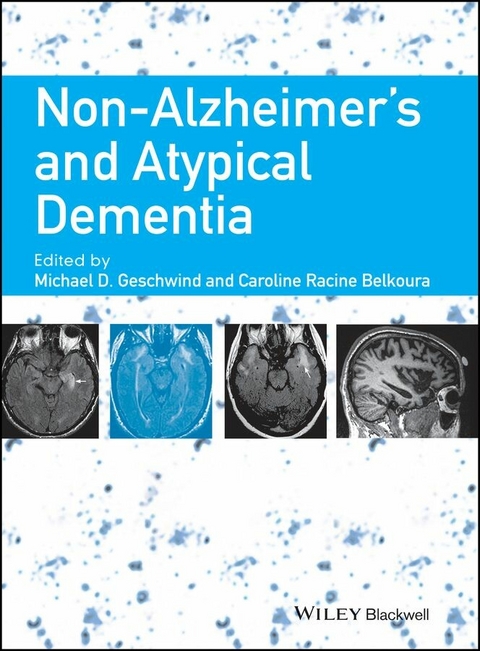
Non-Alzheimer's and Atypical Dementia (eBook)
John Wiley & Sons (Verlag)
978-1-118-79767-9 (ISBN)
- Focuses on non-Atypical Dementia
- Multidisciplinary approach to diagnosis and management
- Allows development of management and care plan strategies
- Practical approach including case studies
- Written by a world-renowned editorial team
Michael Geschwind, MD PhD
Dr. Geschwind received his MD and PhD in neuroscience through the National Institutes of Health-sponsored Medical Scientist Training Program at the Albert Einstein College of Medicine in New York. He completed his internship in internal medicine at the University of California, Los Angeles Medical Center, his neurology residency at the Johns Hopkins University School of Medicine in Baltimore and his fellowship in behavioral neurology at the UCSF Memory and Aging Center (MAC). He joined the Memory and Aging Center faculty in 2003 and is an Associate Professor of Neurology.
Dr. Geschwind evaluates patients in the MAC new patient clinic and participates in the management and care for these patients in the MAC continuity clinic. He is active in the training of medical students and residents at UCSF. Dr. Geschwind teaches a national course and lectures, both nationally and internationally, on the assessment of rapidly progressive dementias, including human prion diseases.
Dr. Geschwind's primary research interest is the assessment and treatment of rapidly progressive dementias, including prion diseases such as Creutzfeldt-Jakob disease (CJD). Dr. Geschwind helped establish an inpatient hospital program for the assessment of rapidly progressive dementias at UCSF, one of the first of its kind in the country. He ran the first ever US treatment study for CJD. He also has an active research interest in cognitive dysfunction in movement disorders, such as Huntington's disease, corticobasal degeneration (CBD), progressive supranuclear palsy (PSP) and other Parkinsonian dementias.
Caroline Racine Belkoura, PhD
Caroline Racine Belkoura received her BA in Psychology from Boston University, where she completed an honors thesis exploring visual-perceptual deficits in patients with stroke and traumatic brain injury. From 1997-1999 she worked as a research assistant with Dr. Dan Schacter at Harvard University on studies examining false memories in healthy aging. Dr. Racine Belkoura went on to obtain an MA and PhD in Clinical Psychology at Washington University in St. Louis, specializing in Neuropsychology and Aging. Her research at Washington University examined changes in frontal lobe function during healthy aging using both behavioral and neuroimaging methods (e.g., fMRI). She completed her clinical internship in Neuropsychology at Duke University in 2005 and afterward completed a two-year postdoctoral fellowship in Neuropsychology at the UCSF Memory and Aging Center. Since 2009, she has been an Assistant Professor in Neurological Surgery at UCSF. Currently, she evaluates patients with movement disorders who are undergoing workup for deep brain stimulation (DBS), as well as patients who are suspected of having atypical parkinsonian disorders. Her research focuses on cognitive and behavioural changes in the context of Parkinson's disease and related disorders, and how DBS affects cognition and mood.
Dementia is the most common type of neurodegenerative disorder. Non-Alzheimer's and Atypical Dementia concentrates on each form of dementia individually, considering symptoms, diagnosis and treatment Focuses on non-Atypical Dementia Multidisciplinary approach to diagnosis and management Allows development of management and care plan strategies Practical approach including case studies Written by a world-renowned editorial team
Michael Geschwind, MD PhD Dr. Geschwind received his MD and PhD in neuroscience through the National Institutes of Health-sponsored Medical Scientist Training Program at the Albert Einstein College of Medicine in New York. He completed his internship in internal medicine at the University of California, Los Angeles Medical Center, his neurology residency at the Johns Hopkins University School of Medicine in Baltimore and his fellowship in behavioral neurology at the UCSF Memory and Aging Center (MAC). He joined the Memory and Aging Center faculty in 2003 and is an Associate Professor of Neurology. Dr. Geschwind evaluates patients in the MAC new patient clinic and participates in the management and care for these patients in the MAC continuity clinic. He is active in the training of medical students and residents at UCSF. Dr. Geschwind teaches a national course and lectures, both nationally and internationally, on the assessment of rapidly progressive dementias, including human prion diseases. Dr. Geschwind's primary research interest is the assessment and treatment of rapidly progressive dementias, including prion diseases such as Creutzfeldt-Jakob disease (CJD). Dr. Geschwind helped establish an inpatient hospital program for the assessment of rapidly progressive dementias at UCSF, one of the first of its kind in the country. He ran the first ever US treatment study for CJD. He also has an active research interest in cognitive dysfunction in movement disorders, such as Huntington's disease, corticobasal degeneration (CBD), progressive supranuclear palsy (PSP) and other Parkinsonian dementias. Caroline Racine Belkoura, PhD Caroline Racine Belkoura received her BA in Psychology from Boston University, where she completed an honors thesis exploring visual-perceptual deficits in patients with stroke and traumatic brain injury. From 1997-1999 she worked as a research assistant with Dr. Dan Schacter at Harvard University on studies examining false memories in healthy aging. Dr. Racine Belkoura went on to obtain an MA and PhD in Clinical Psychology at Washington University in St. Louis, specializing in Neuropsychology and Aging. Her research at Washington University examined changes in frontal lobe function during healthy aging using both behavioral and neuroimaging methods (e.g., fMRI). She completed her clinical internship in Neuropsychology at Duke University in 2005 and afterward completed a two-year postdoctoral fellowship in Neuropsychology at the UCSF Memory and Aging Center. Since 2009, she has been an Assistant Professor in Neurological Surgery at UCSF. Currently, she evaluates patients with movement disorders who are undergoing workup for deep brain stimulation (DBS), as well as patients who are suspected of having atypical parkinsonian disorders. Her research focuses on cognitive and behavioural changes in the context of Parkinson's disease and related disorders, and how DBS affects cognition and mood.
Notes on contributors, vi
1 Introduction, 1
Michael D. Geschwind and Caroline Racine Belkoura
2 The multidisciplinary evaluation of the atypical dementia patient, 6
Michael D. Geschwind and Caroline Racine Belkoura
3 Atypical Alzheimer's disease, 17
Sharon J. Sha and Gil D. Rabinovici
4 Vascular cognitive impairment: Diagnosis and treatment, 30
Helena C. Chui and Liliana Ramirez-Gomez
5 Frontotemporal dementia, 49
David C. Perry and Howard J. Rosen
6 Lewy body dementias (DLB/PDD), 64
Carol F. Lippa and Katherine L. Possin
7 Corticobasal degeneration and progressive supranuclear palsy, 77
Suzee E. Lee and Bruce L. Miller
8 Repeat expansion diseases and dementia, 90
Praveen Dayalu, Roger L. Albin and Henry Paulson
9 Prion diseases and rapidly progressive dementias, 103
Leonel T. Takada and Michael D. Geschwind
10 Autoimmune dementias, 123
Andrew McKeon and Sean J. Pittock
11 Toxic and metabolic dementias, 134
Michelle Mattingly, Katie Osborn and Leon Prockop
12 Leukoencephalopathies/leukodystrophies, 150
Gregory M. Pastores and Swati A. Sathe
13 Infectious causes of dementia, 170
Cheryl A. Jay, Emily L. Ho and John Halperin
14 Rheumatologic and other autoimmune dementias, 186
Laura J. Julian and Christopher M. Filley
15 Comprehensive management of the patient with an atypical dementia, 202
Jennifer Merrilees, Cynthia Barton, Amy Kuo and Robin Ketelle
Index, 215
"This deceptively slim volume, looking more like an atlas than a textbook, is actually a thorough, carefully organized, and well-referenced text on atypical dementias. Unlike most multiauthor medical textbooks, this one is divided into discrete chapters on individual syndromes, with overlap only in the general introductory chapter, a chapter on multidisciplinary evaluation, and a concluding chapter on management of patients with all types of atypical dementias. I would recommend the book both as useful background reading and as a ready reference when a neurologist, psychiatrist, or internist
encounters a patient with any of the atypical dementias.....Overall, the book is a very useful volume to have on hand when questions arise about a patient with cognitive issues, as well as a book to read from cover to cover. As I noted at the outset, the book is exceptionally cohesive, with all chapters similarly outlined and topics skillfully organized, thus minimizing repetition. I have also found several of Dr Geschwind's articles about atypical and rapidly progressive dementing illnesses to be very useful, especially proposing the mnemonic VITAMINS to outline the causes of dementiasto" (Cogn Behav Neurol 29:4 Dec-16)
CHAPTER 1
Introduction
Michael D. Geschwind and Caroline Racine Belkoura
University of California, San Francisco, San Francisco, CA, USA
This book was developed in order to provide a clinically relevant review of non-Alzheimer’s and atypical dementia syndromes. Specifically, we felt there was a need for a broad but comprehensive overview of the differential diagnoses for atypical dementia that could be utilized by health-care providers who encounter these patients in their clinical practice, including neurologists, primary care providers, psychiatrists, neuropsychologists, nurses, social workers, etc. Where relevant, we have included clinical case studies in each chapter to help illustrate key or unique diagnostic features of each disorder and to provide a “real-world” view of how each disorder might present in the clinic.
Multidisciplinary evaluation of the atypical dementia patient
In this chapter, the editors review a framework for the clinical evaluation of the patient with a suspected atypical dementia syndrome. In particular, we focus on the benefits of a multidisciplinary evaluation with a team that includes a combination of a neurologist, neuropsychologist, psychiatrist, nurse, and social worker. Each team member brings a unique set of skills to the evaluation, which enables an in-depth and comprehensive assessment of a variety of domains, including relevant history, neurological function, cognitive abilities, mood and behavior, and daily function. Obtaining information from both the patient and a close family member or friend is essential as many atypical syndromes lead to loss of insight, and thus, more accurate reporting might come from someone other than the patient themselves. We have found that a case conference approach, where all team members meet after seeing the patient to review all relevant findings and discuss the case in detail, leads to a more accurate differential diagnosis, which can then be relayed to the patient and their family members in a timely fashion.
Atypical Alzheimer’s disease
In this chapter, Sharon Sha and Gil Rabinovici review the atypical presentations of Alzheimer’s disease (AD), which by definition present with symptoms other than memory loss and therefore might not meet most standard diagnostic criteria for AD. These patients tend to be younger than “typical” AD cases and might present with visuospatial complaints, executive dysfunction, behavioral changes, or language impairment. Additionally, often, patients meet diagnostic criteria for posterior cortical atrophy (PCA, a visual dysfunction syndrome), corticobasal syndrome (CBS, executive dysfunction or behavioral syndrome), and/or primary progressive aphasia (PPA, language syndrome) disorders that have not historically associated with AD pathology; however, recent research has demonstrated that a significant portion of these clinical syndromes are ultimately found to have AD pathology at autopsy. Neuropsychological testing and atrophy patterns on MRI often are very helpful in the differential diagnosis of the clinical syndrome. PET imaging with amyloid binding agents such as Pittsburgh compound B (PiB) or florbetapir F18 might provide additional, if not even more convincing, evidence of underlying AD pathology. The recognition of AD pathology as a causative factor in these atypical syndromes is important because of available symptomatic treatments and ongoing clinical trials for AD. Future diagnostic criteria for AD will need to incorporate the possibility of atypical presentations in order to increase sensitivity.
Vascular cognitive impairment: Diagnosis and treatment
In this comprehensive chapter, Helena Chui and Liliana Ramirez Gomez first review the complex history and terminology of vascular contributions to cognitive impairment. They postulate that the physiological effects of vascular brain impairment (VBI) lead to variable vascular cognitive impairment (VCI), depending on the location, extent, and severity of injury. White matter imaging methods including structural (i.e., white matter hyperintensities) and functional (diffusion tensor imaging) techniques provide the most useful information regarding the extent of VBI. VCI usually involves slowed processing speed and executive dysfunction but can vary widely depending on the location of pathology. The effect of VBI is additive and might be worsened by the presence of other underlying neuropathological conditions (i.e., AD). Risk factors for VBI/VCI include hypertension, hyperlipidemia, and diabetes, which suggest that the risk profile for cognitive impairment in many individuals could be lowered via lifestyle modifications. Current pharmacological treatments (i.e., cholinesterase inhibitors, NMDA receptor blockers) are symptomatic in nature, and firm evidence regarding their utility is lacking.
Frontotemporal dementia
In this chapter by David Perry and Howard Rosen, the clinical syndrome of frontotemporal dementia (FTD) and its underlying pathological etiologies (frontotemporal lobar degeneration (FTLD)) are reviewed. Newly developed diagnostic criteria for FTD have been developed, which identify three core clinical syndromes: (i) behavioral variant FTD (bvFTD), (ii) semantic variant primary progressive aphasia (svPPA, also called semantic dementia), and (iii) nonfluent variant primary progressive aphasia (nfvPPA). The most common presentation is bvFTD, with initial symptoms that might include apathy, disinhibition, loss of empathy, and other personality changes and MRI revealing relative atrophy of the fronto-insular cortex and underlying white matter. Cognitive testing often reveals relative deficits in executive function, although cognition might be relatively preserved early in the disorder. The hallmark features of svPPA include word-finding deficits and loss of semantic knowledge for words and objects, with MRI usually revealing relative atrophy in the left anterior temporal lobe. Bilateral temporal lobe atrophy becomes more prevalent over the course of the disease with additional frontal lobe involvement and behavioral symptoms including loss of empathy, and compulsions might appear (although they are not usually a presenting feature as in bvFTD). Slow and effortful speech is a classic feature of nfvPPA, with frank mutism being common over the course of the disease. MRI typically reveals asymmetric atrophy of the left inferior frontal cortex. Other clinical syndromes, including motor neuron disease (i.e., amyotrophic lateral sclerosis (ALS), progressive supranuclear palsy (PSP), and corticobasal syndrome (CBS)), can overlap significantly with FTD syndromes and are referred to as FTD spectrum disorders. The underlying neuropathology of FTD is complex, and research in this field is evolving rapidly. As a general guideline, svPPA tends to be associated with TDP-43 pathology, nfvPPA tends to be associated with tau pathology, and bvFTD is associated with a variety of pathologies (TDP-43, tau, FUS, PSP, and CBD). Treatments for these disorders are currently symptomatic, although clinical trials are in development.
Lewy body dementias
In this chapter, dementia with Lewy bodies (DLB) and Parkinson’s disease with dementia (PDD) are reviewed by Carol Lippa and Katherine Possin. Both disorders feature a parkinsonian motor syndrome (i.e., rigidity, bradykinesia, tremor), cognitive impairment (visuospatial dysfunction, fluctuations in attention/arousal, and executive dysfunction), and neuropsychiatric symptoms (depression, anxiety, visual hallucinations). DLB is usually associated with relatively simultaneous onset of cognitive and motor symptoms, while PDD is associated with cognitive impairment in the setting of an established PD diagnosis (usually occurring >1 year after motor symptoms). Both syndromes are disorders of alpha-synuclein and are associated with underlying Lewy body pathology. Concomitant AD pathology is often present. Structural MRI findings are often grossly normal for age, while clinical symptoms associated with alpha-synuclein disorders (i.e., REM sleep behavior disorder, anosmia, autonomic dysfunction) might provide additional confirmation of a suspected DLB or PDD diagnosis. The treatment of the motor symptoms is usually with standard dopaminergic therapies utilized in PD, while acetylcholinesterase inhibitors often improve attention deficits and visual hallucinations. Neuropsychiatric symptoms might require SSRIs or low doses of newer antipsychotic agents such as quetiapine. These patients are susceptible to delirium, and exposure to anesthetics, anticholinergics, and antipsychotics should be closely monitored.
Corticobasal degeneration and progressive supranuclear palsy
Suzee Lee and Bruce Miller define the terms in the title of their chapter as reflecting the neuropathological entities of corticobasal degeneration (CBD) and progressive supranuclear palsy (PSP), which are both disorders of tau. They move on to discuss the typical clinical presentations of CBD as (i) nonfluent variant PPA (nfvPPA), (ii) an executive motor (EM) syndrome, and (iii) behavioral variant FTD (bvFTD). The clinical syndromes of nfvPPA and bvFTD have been reviewed in Chapter 5. EM syndrome typically presents with early executive dysfunction and motor impairment, often including axial rigidity and dystonia. MRI findings might include relative atrophy in the left frontal cortex. The clinical syndrome associated with pathological PSP is labeled PSP syndrome (PSP-S), which typically presents with oculomotor abnormalities (reduced saccade velocity and...
| Erscheint lt. Verlag | 23.2.2016 |
|---|---|
| Sprache | englisch |
| Themenwelt | Medizin / Pharmazie ► Medizinische Fachgebiete ► Geriatrie |
| Medizin / Pharmazie ► Medizinische Fachgebiete ► Neurologie | |
| Schlagworte | Age • Alzheimer's • Alzheimer's disease • Atypical Dementia • carers • Care strategies • Caroline Racine • dementia • Diagnosis • elderly • Family • geriatric medicine • Geriatrie • Individuals • management plan • Medical Science • Medizin • Michael Geschwind • Multidisciplinary approach • Neurologie • Neurology • Non-Alzheimer's and Atypical Dementia • Non-Alzheimer's Dementia • Psychiatrie • Psychiatry |
| ISBN-10 | 1-118-79767-1 / 1118797671 |
| ISBN-13 | 978-1-118-79767-9 / 9781118797679 |
| Informationen gemäß Produktsicherheitsverordnung (GPSR) | |
| Haben Sie eine Frage zum Produkt? |
 EPUB (Adobe DRM)
Kopierschutz: Adobe-DRM
Adobe-DRM ist ein Kopierschutz, der das eBook vor Mißbrauch schützen soll. Dabei wird das eBook bereits beim Download auf Ihre persönliche Adobe-ID autorisiert. Lesen können Sie das eBook dann nur auf den Geräten, welche ebenfalls auf Ihre Adobe-ID registriert sind.
Details zum Adobe-DRM
Dateiformat: EPUB (Electronic Publication)
EPUB ist ein offener Standard für eBooks und eignet sich besonders zur Darstellung von Belletristik und Sachbüchern. Der Fließtext wird dynamisch an die Display- und Schriftgröße angepasst. Auch für mobile Lesegeräte ist EPUB daher gut geeignet.
Systemvoraussetzungen:
PC/Mac: Mit einem PC oder Mac können Sie dieses eBook lesen. Sie benötigen eine
eReader: Dieses eBook kann mit (fast) allen eBook-Readern gelesen werden. Mit dem amazon-Kindle ist es aber nicht kompatibel.
Smartphone/Tablet: Egal ob Apple oder Android, dieses eBook können Sie lesen. Sie benötigen eine
Geräteliste und zusätzliche Hinweise
Buying eBooks from abroad
For tax law reasons we can sell eBooks just within Germany and Switzerland. Regrettably we cannot fulfill eBook-orders from other countries.
aus dem Bereich