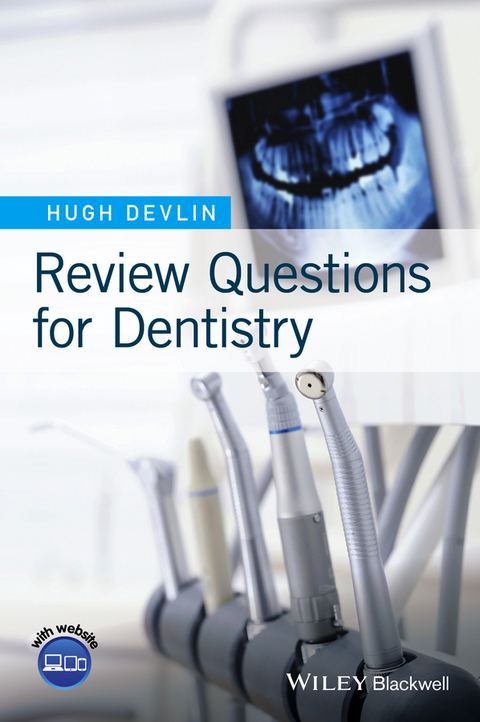
Review Questions for Dentistry (eBook)
John Wiley & Sons (Verlag)
978-1-118-81503-8 (ISBN)
Review Questions for Dentistry is an essential exam practice tool designed for undergraduate dentistry students, postgraduate MJDF candidates, and overseas candidates sitting their OREs. Using the questions as a platform for learning consolidation, this exam preparation guide provides feedback to students to enable them to assess their knowledge and understanding of the subject.
- Features multiple question formats including MCQs, EMQs, SAQs and find the missing word questions
- Answers include detailed explanations to help expand and consolidate learning
- The text is divided into two sections; introductory questions and questions exploring the subjects in more detail
- The book is accompanied by a companion website offering further interactive self-assessment tools
Hugh Devlin is Professor of Restorative Dentistry at the School of Dentistry, University of Manchester, UK and Associate Editor of the 'Journal of Prosthodontics' and the journal 'Gerodontology'. He is the Director of the Restorative and Aesthetic Dentistry MSc course at the University. This innovative course is taught mainly online. Hugh is also Director of Manchester Imaging Ltd., a University spin-out company. In 2011, Hugh was the recipient of the IADR Distinguished Scientist Award (Research in Prosthodontics and Implants Award).
Hugh Devlin is Professor of Restorative Dentistry at the School of Dentistry, University of Manchester, UK and Associate Editor of the 'Journal of Prosthodontics' and the journal 'Gerodontology'. He is the Director of the Restorative and Aesthetic Dentistry MSc course at the University. This innovative course is taught mainly online. Hugh is also Director of Manchester Imaging Ltd., a University spin-out company. In 2011, Hugh was the recipient of the IADR Distinguished Scientist Award (Research in Prosthodontics and Implants Award).
About the companion website, vii
Introduction: How to approach answering multiple choice questions, ix
Section 1: Questions testing the introductory aspects of the subject
1 Endodontics, 3
2 Periodontology, 11
3 Operative dentistry, 19
4 Prosthodontics, 25
5 Medical and surgical aspects of oral and dental health, 33
6 Paediatric dentistry, public dental health and orthodontics, 40
Section 2: Questions exploring the subjects in more detail
7 Endodontics, 51
8 Periodontology, 75
9 Operative dentistry, 97
10 Prosthodontics, 118
11 Medical and surgical aspects of oral and dental health, 153
12 Paediatric dentistry, public dental health and orthodontics, 171
Further reading, 176
Index, 183
Chapter 1
Endodontics
Questions
- The ideal position for the access cavity in anterior maxillary teeth should
- conserve as much of the pulp chamber roof as possible
- be positioned close to the incisal edge
- be positioned over the cingulum of the tooth
- be positioned to allow access to the apical region of the root canal
- utilise any existing cervical labial restorations to avoid any further damage to the tooth
- Choose the option which correctly completes this sentence. The working length can be defined as the distance from a reference point on the crown of the tooth
- to the cemento-dentinal junction of the root apex or apical constriction
- to the anatomic root apex
- to a point about 2.5 mm short of the radiographic apex
- to the enamel-dentine junction
- to the radiographic apex
- An apex locator is an electrical device which is used to measure the working length. This device works using
- magnetic flux
- electrical conductance
- electrical Impedance
- light
- solar energy
- A Gates-Glidden bur is used to prepare
- the apical third of a root canal
- the apical third of a root canal when it is particularly curved
- the access cavity
- the coronal two-thirds of the root canal
- the apical root canal when a file cannot be negotiated to the working length
- During root canal treatment which description best describes the phenomenon of ‘apical transportation of the root canal’ or ‘zipping’?
- Where the original shape of the root canal is preserved
- Where a strip perforation occurs near the coronal end of the canal
- An apical perforation
- A lateral perforation
- The file tends to straighten out during preparation of curved canals with uneven enlargement of the apical part of the canal
- An initial ‘glide pathway’ in endodontics is created using
- rotary endodontic instruments
- anti-curvature filing
- frequent irrigation
- manual preparation to a no.10 ISO size file
- EDTA (ethylenediaminetetraacetic acid)
- Temporary obturation of the access cavity may be necessary between appointments. Which is the material that provides the best seal?
- Coltosol F (Coltene Whaledent), which is a non-eugenol temporary filling material
- Fermit (Ivoclar vivadent), which is a resin-based material
- IRM (Caulk/Densply, USA), which is a reinforced zinc oxide/eugenol material
- Cotton wool with a 2 mm covering layer of Cavit temporary filling material
- Cotton wool plug
- Complete the following sentence. The endodontic access cavity in an upper first molar is centred over
- the disto-occlusal aspect of the tooth
- the palato-occlusal aspect of the tooth
- the mesio-palatal cusp
- the mesio-occlusal aspect of the tooth
- any existing restorations to avoid further iatrogenic damage to the tooth
- Various solutions have been used as endodontic irrigants. Which of the following solutions is the most cost-effective endodontic irrigant?
- 2.25% sodium hypochlorite
- 2% chlorhexidine
- Sterile saline
- Local anaesthetic solution
- Sterile water
- The placement of a satisfactory root canal filling has been completed, but it is recommended to radiographically review the endodontic treatment to determine if healing has taken place. Complete the following sentence. Root canal treatment should be reassessed radiographically
- at 3 months after the initial treatment
- at 6 months after the initial treatment
- at 9 months after the initial treatment
- at 1 year after the initial treatment
- at 2 years after the initial treatment
- Choose the option which correctly completes the following sentence.
In internal root resorption- the typical appearance on a periapical radiograph involves an ovate, often symmetrical, widening of the root canal
- cone beam computerised tomography (CBCT) has no place in the diagnosis of these lesions due to the high radiation dose
- the affected teeth are painful in the early stages, and pain is often the presenting symptom
- surgical endodontic therapy is the preferred treatment option in most cases
- the lesion can be monitored as spontaneous repair can occur
- What is the prevalence of a second canal in the mesiobuccal root of the permanent maxillary first molar?
- Between 5 and 10% of these teeth
- Between 11 and 20% of these teeth
- Between 21 and 30% of these teeth
- Between 30 and 40% of these teeth
- Over 50% of these teeth
- AH Plus® (Dentsply International) is a typical, modern endodontic sealer material. Choose the best option from the following statements which describe the properties of this material.
- It has very good dimensional stability
- It tends to discolour the tooth
- It is radiolucent
- It has poor tissue compatibility
- It tends to release formaldehyde
- Of the following options, the best definition of ‘apexification’ is that it
- is normal development of the vital root
- involves inducing a calcified wall at the apex of a non-vital tooth
- is vital pulp treatment
- is vital pulp treatment involving normal physiological root development
- has the same definition as ‘apexogenesis’
- There is a small swelling in the labial sulcus associated with a carious, non-vital upper left central incisor. The swollen area and tooth are painful to touch. What is your diagnosis and immediate treatment?
Answers
- Correct answer D: The ideal position of the access cavity is midway between the incisal edge and the cingulum, which will allow the least restricted access to the apical region of the root canal. A pre-operative radiograph is often helpful in obtaining the correct bur angulation. The access cavity should be smooth without any overhanging dentine.
- Correct answer A: The cemento-dentinal junction (or apical constriction) is the ideal position for location of the apical reference point (see Pratten, D.H. and McDonald, N.J. Comparison of radiographic and electronic working lengths. J. Endod., 1996, 22: 173–6). Electrical apex locators are being increasingly used as they provide a more accurate determination of the working length than radiographic methods. These instruments detect the apical constriction, which is the boundary between the pulpal and periodontal tissues. The location of the apical constriction varies between 0.5 and 2 mm from the radiographic apex.
Traditionally, the cemento-dentinal junction and the apical constriction have been thought of as being coincident; however, this is not always true (see Hassanien, E.E., Hashem, A. and Chalfin, H. Histomorphometric study of the root apex of mandibular premolar teeth: an attempt to correlate working length measured with electronic and radiograph methods to various anatomic positions in the apical portion of the canal. J. Endod., 2008, 34: 408–12). Extending root canal preparation to the apical constriction minimises any extrusion of infected debris into the apical periodontal tissues. However, the consequences of not removing any infected pulpal tissue between the coronal apical constriction and the cemento-dentinal junction have not been fully investigated.
- Correct answer C: Apex locators measure the electrical impedance between the apical foramen and a reference electrode placed in the mouth.
- Correct answer D: Gates-Glidden burs are onion-shaped burs of different sizes used to pre-flare the coronal two-thirds of the canal. To avoid lateral perforation of the root they have a blunt end and are used passively at low speed (about 2500 rpm).
- Correct answer E
- Correct answer D: A glide path is a prepared, a smooth channel that extends from the opening of the root canal in the pulp chamber to the apical constriction. Prior to using rotary endodontic files, the creation of an initial glide path to the working length with at least a size no. 10 hand file is essential. This can be performed using a size no. 10 stainless steel K-file which allows good tactile sensation. The rotary files then enlarge the width of the glide path to provide a continuously tapering canal. Anti-curvature filing is when the operator directs most of the force applied during filing away from the inner walls of curved root canals. This prevents a strip perforation of the thin inner walls.
Apical patency is a controversial technique which aims to create a smooth, debrided canal from the apical constriction to the canal orifice. Typically a size no. 10 Flexofile is passively introduced but if this encounters resistance, files of progressively smaller diameter (sizes 8 and 6) are used until the canal orifice is reached.
- Correct answer A: Uçtaşli and Tinaz (2000) showed that a 3.5 mm thick layer of Coltosol provided a better endodontic seal than cements such as Fermit or IRM of similar thickness (Uçtaşli, M.B. and Tinaz, A.C. Microleakage of different types of temporary restorative materials used in endodontics. J. Oral. Sci., 2000, 42: 63–7). However, this was an in vitro die penetration...
| Erscheint lt. Verlag | 23.2.2016 |
|---|---|
| Sprache | englisch |
| Themenwelt | Medizin / Pharmazie ► Gesundheitsfachberufe |
| Medizin / Pharmazie ► Medizinische Fachgebiete | |
| Medizin / Pharmazie ► Zahnmedizin ► Chirurgie | |
| Schlagworte | BDS • Berufspraxis i. d. Zahnmedizin • Dental Professional Practice • dentistry • dentistry exam practice • dentistry revision • Einführung i. d. Zahnmedizin • Einführung i. d. Zahnmedizin • Endodontics • Introductions to Dentistry • <p>dentistry • MFDS • mjdf • Operative Dentistry • oral and dental health • ore • orthodontics</p> • Pediatric Dentistry • Periodontology • postgraduate dentistry • undergraduate dentistry • Zahnmedizin |
| ISBN-10 | 1-118-81503-3 / 1118815033 |
| ISBN-13 | 978-1-118-81503-8 / 9781118815038 |
| Informationen gemäß Produktsicherheitsverordnung (GPSR) | |
| Haben Sie eine Frage zum Produkt? |
 EPUB (Adobe DRM)
Kopierschutz: Adobe-DRM
Adobe-DRM ist ein Kopierschutz, der das eBook vor Mißbrauch schützen soll. Dabei wird das eBook bereits beim Download auf Ihre persönliche Adobe-ID autorisiert. Lesen können Sie das eBook dann nur auf den Geräten, welche ebenfalls auf Ihre Adobe-ID registriert sind.
Details zum Adobe-DRM
Dateiformat: EPUB (Electronic Publication)
EPUB ist ein offener Standard für eBooks und eignet sich besonders zur Darstellung von Belletristik und Sachbüchern. Der Fließtext wird dynamisch an die Display- und Schriftgröße angepasst. Auch für mobile Lesegeräte ist EPUB daher gut geeignet.
Systemvoraussetzungen:
PC/Mac: Mit einem PC oder Mac können Sie dieses eBook lesen. Sie benötigen eine
eReader: Dieses eBook kann mit (fast) allen eBook-Readern gelesen werden. Mit dem amazon-Kindle ist es aber nicht kompatibel.
Smartphone/Tablet: Egal ob Apple oder Android, dieses eBook können Sie lesen. Sie benötigen eine
Geräteliste und zusätzliche Hinweise
Buying eBooks from abroad
For tax law reasons we can sell eBooks just within Germany and Switzerland. Regrettably we cannot fulfill eBook-orders from other countries.
aus dem Bereich