Instant Anatomy (eBook)
John Wiley & Sons (Verlag)
978-1-119-15940-7 (ISBN)
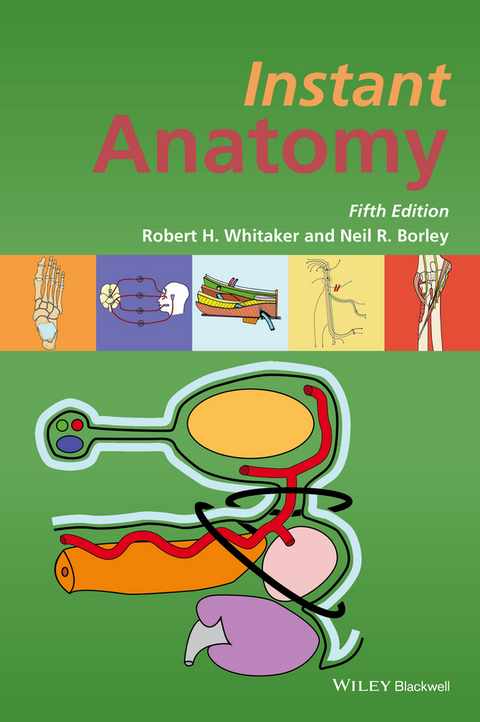
Instant Anatomy presents anatomy and anatomical relationships in a simple, unique, schematic manner to aid the speedy understanding and retrieval of anatomical facts. It shows structures such as nerves and blood vessels in their entirety, unlike the partial, regional presentations given in most textbooks.
Covering the major aspects of anatomy, each section presents the relevant structures in double page spreads, with clear, full-colour diagrams on the left and concise text for each structure on the right. This new fifth edition includes more surface anatomy such as new myotome maps, bones of the hands and feet, principles of movement at shoulder and hip and images to clarify the understanding of the inguinal region and the lesser sac of the stomach.
Ideal for use alongside a core anatomy textbook, Instant Anatomy is the perfect quick reference guide for medical students, surgeons, radiologists and those in many other specialties. The companion website at www.instantanatomy.net with its podcasts and wide ranging multiple choice questions provide invaluable exam preparation.
Robert H. Whitaker, MA, MD, MChir, FRCS, FMAA, Selwyn College, University of Cambridge
Neil R. Borley, MB, BS, FRCS, FRCS (ed), Cheltenham General Hospital, Cheltenham
Robert H. Whitaker, MA, MD, MChir, FRCS, FMAA, Selwyn College, University of Cambridge Neil R. Borley, MB, BS, FRCS, FRCS (ed), Cheltenham General Hospital, Cheltenham
Preface to fifth edition, vi
Preface to first edition, vii
Notes on the text, viii
1 Arteries, 1
2 Veins, 47
3 Lymphatics, 59
4 Autonomic nervous system, 72
5 Cranial nerves, 91
6 Peripheral nerves, 115
7 Dermatomes and cutaneous nerve distribution, 147
8 Muscles, 155
9 Joints, 181
10 Ossification times, 191
11 Foramina--skull and spine, 197
12 Position of structures according to vertebral levels, 205
13 Pharyngeal derivatives, 207
14 Surface anatomy and key areas, 211
Rules and exceptions, 267
1: Arteries
- Coronary arteries
- Ascending & arch of aorta
- Internal carotid artery, vertebrobasilar system & circle of Willis
- Ophthalmic artery
- External carotid artery
- Maxillary artery
- Middle meningeal artery
- Subclavian artery
- Axillary artery
- Brachial artery
- Radial artery
- Ulnar artery
- Thoracic (descending) aorta
- Abdominal aorta
- External iliac artery
- Coeliac trunk
- Superior mesenteric artery
- Inferior mesenteric artery
- Internal iliac artery
- Femoral artery
- Popliteal artery
- Anterior tibial artery
- Posterior tibial artery
- Fibular (peroneal) artery
- Arterial anastomoses around scapula
- Arterial anastomoses around hip
Coronary arteries
Coronary Arteries
From: Ascending aorta
To: Myocardium
Right coronary artery. Originates from the anterior aortic sinus. It passes anteriorly between the pulmonary trunk and the right auricle to reach the atrioventricular sulcus in which it runs down the anterior surface of the right cardiac border and then onto the inferior surface of the heart. It terminates at the junction of the atrioventricular sulcus and the posterior interventricular groove by anastomosing with the circumflex branch of the left coronary artery and giving off the posterior interventricular (posterior descending) artery. It supplies the right atrium and part of the left atrium, the sinuatrial node in 60% of cases, the right ventricle, the posterior part of the interventricular septum and the atrioventricular node in 80% of cases.
Left coronary artery. Arises from the left posterior aortic sinus. It passes laterally, posterior to the pulmonary trunk and anterior to the left auricle to reach the atrioventricular groove where it divides into an anterior interventricular (formally left anterior descending) artery and circumflex branches. The circumflex artery runs in the atrioventricular sulcus around the left border of the heart to anastomose with the right coronary artery. The anterior interventricular artery descends on the anterior surface of the heart in the anterior interventricular groove and around the apex of the heart into the posterior interventricular groove where it anastomoses with the posterior interventricular branch of the right coronary artery. The left coronary artery supplies the left atrium, left ventricle, anterior interventricular septum, sinuatrial node in 40% of cases and the atrioventricular node in 20%.
Dominance. In approximately 10% of hearts the posterior interventricular artery arises from the circumflex artery (left coronary) and then most of the left ventricle and interventricular septum are supplied by the left coronary artery. The heart is said to have left cardiac dominance.
Ascending & arch of aorta
Ascending & Arch of Aorta
From: Left ventricle
To: Descending aorta
Ascending aorta. Arises at the vestibule of the left ventricle at the level of the third left costal cartilage and passes upwards and slightly to the right to a point behind the sternum at the level of the manubriosternal joint (second costal cartilage) where it becomes the arch of the aorta. It is enclosed in fibrous and serous pericardium. Anterior to it are the right auricle, the infundibulum of the right ventricle and pulmonary trunk. Posterior, lie the left atrium, the right pulmonary artery and right main bronchus. To the left lie the pulmonary trunk and the left auricle. To the right are the superior vena cava and the right atrium.
Arch of aorta. The arch begins posterior to the manubriosternal joint at the level of the second costal cartilage and passes posterior and to the left, over the left main bronchus to end at the left side of the body of T4 vertebra. Its highest level is the mid-point of the manubrium sterni and at this level its three main branches emerge. Anterior and to the left of the arch are (from anterior to posterior) the left phrenic nerve, vagal and sympathetic contributions to the cardiac plexus, and the left vagus. Also, the left superior intercostal vein runs forwards on the arch anterior to the vagus and posterior to the phrenic nerve. Lateral to all these structures are the pleura and left lung. Posterior and to the right of the arch are the trachea, deep cardiac plexus, left recurrent laryngeal nerve, oesophagus, thoracic duct and the body of T4. Inferior to the arch are the pulmonary bifurcation, the left main bronchus, the ligamentum arteriosum and the left recurrent laryngeal nerve. From its superior surface emerge the brachiocephalic artery, the left common carotid and left subclavian arteries. Within the adventitia of the ascending and arch of the aorta lie baro- and chemoreceptors.
Brachiocephalic artery. Arises from the convexity of the aortic arch behind the manubrium sterni and passes upwards and posteriorly to the right. It divides into the right subclavian and right common carotid arteries posterior to the right sternoclavicular joint. Anterior to it are the left brachiocephalic vein with the right inferior thyroid vein entering it, and the thymic remnants. The artery initially lies anterior to the trachea and then passes to lie on its right lateral side. On the right of the artery are the right brachiocephalic vein, upper part of the superior vena cava, the pleura and the cardiac branches of the vagus. The main vagal trunk is more posterolateral. At the origin of the brachiocephalic artery the left common carotid artery lies posteriorly on its left.
Ascending & arch of aorta
Common carotid arteries. The right common carotid artery arises from the brachiocephalic artery as it divides posterior to the right sternoclavicular joint, whilst the left common carotid arises from the convexity of the aortic arch. Both end as the arteries bifurcate at the level of the upper border of the thyroid cartilage (C4).
Left common carotid artery (thorax). Lying anterior to the thoracic part of this artery are the left brachiocephalic vein and the thymic remnant. Posterior to it in its lower part are the left subclavian artery and the trachea whilst further superiorly there is the left recurrent laryngeal nerve, the thoracic duct and the left side of the oesophagus. On its right at its origin is the brachiocephalic artery but as it ascends the inferior thyroid veins and the trachea come to lie on its right side. To its left lie the vagus, the left phrenic nerve and the left pleura and lung.
Both common carotid arteries (cervical). Ascend in the neck slightly laterally from a point posterior to the sternoclavicular joint to end at the level of the upper border of the thyroid cartilage (C4) at which point there is a dilatation—the carotid sinus (a baroreceptor). On the posterior aspect of the bifurcation there is the carotid body (a chemoreceptor). Lying between left and right arteries, and medial to each, progressively from below are the trachea, recurrent laryngeal nerves, thyroid gland, larynx and pharynx. Each artery lies in its carotid sheath with the internal jugular vein lateral to it and the vagus nerve between and posterior to them both.
Internal carotid, vertebrobasilar system & circle of Willis
Note: (1) Labyrinthine usually arises from anterior inferior cerebellar; (2) posterior spinal may come from vertebral
Internal Carotid Artery, Vertebrobasilar System & Circle of Willis
From: Bifurcation of the common carotid arts (C4) & first parts of subclavian arts
To: Terminal brs
The internal carotid artery angles from the bifurcation slightly posteriorly to reach the carotid canal through which it enters the skull to end as middle and anterior cerebral arteries. At its origin it possesses a dilatation in which lie the carotid sinus and body. In the neck it is crossed laterally by, from below up, the pharyngeal branch of the vagus (X), glossopharyngeal nerve (IX), stylopharyngeus and styloglossus. It lies on the pharyngeal wall and the pharyngobasilar fascia. Within the carotid canal it turns 90 degrees anteromedially to run through the petrous temporal bone where it lies medial to the middle ear. It then turns 90 degrees superiorly to pass across the upper limit of the foramen lacerum. It then turns 90 degrees anteriorly to pass forwards, lateral to the body of the sphenoid which it grooves. Here it lies in the medial wall of the cavernous sinus with the abducent nerve (VI) on its lateral side. At the anterior end of the cavernous sinus it turns 90 degrees superiorly and then 90 degrees posteriorly to pass medial to the anterior clinoid process and lateral to the pituitary stalk and optic chiasma. It ends as terminal branches on the medial surface of the temporal lobe.
Anterior cerebral artery is formed by the bifurcation of the internal carotid artery. It passes anteriorly over the optic nerve to arch over the genu of the corpus callosum on the medial aspect of the cerebral hemispheres where it ends as terminal branches.
Middle cerebral artery is formed by the bifurcation of the internal carotid artery. It runs laterally into the sylvian fissure and then posterosuperiorly in the sulcus where it divides into terminal branches.
Basilar artery is formed by the junction of the left and right vertebral arteries...
| Erscheint lt. Verlag | 22.2.2016 |
|---|---|
| Reihe/Serie | Instant |
| Instant | Instant |
| Sprache | englisch |
| Themenwelt | Medizin / Pharmazie ► Medizinische Fachgebiete ► Chirurgie |
| Studium ► 1. Studienabschnitt (Vorklinik) ► Anatomie / Neuroanatomie | |
| Schlagworte | anatomical • Anatomie • anatomy • Arteries • body systems • joints • lymphatic • medical education • Medical Science • Medizin • Medizinstudium • muscles • student exam revision • Veins |
| ISBN-10 | 1-119-15940-7 / 1119159407 |
| ISBN-13 | 978-1-119-15940-7 / 9781119159407 |
| Informationen gemäß Produktsicherheitsverordnung (GPSR) | |
| Haben Sie eine Frage zum Produkt? |
 EPUB (Adobe DRM)
Kopierschutz: Adobe-DRM
Adobe-DRM ist ein Kopierschutz, der das eBook vor Mißbrauch schützen soll. Dabei wird das eBook bereits beim Download auf Ihre persönliche Adobe-ID autorisiert. Lesen können Sie das eBook dann nur auf den Geräten, welche ebenfalls auf Ihre Adobe-ID registriert sind.
Details zum Adobe-DRM
Dateiformat: EPUB (Electronic Publication)
EPUB ist ein offener Standard für eBooks und eignet sich besonders zur Darstellung von Belletristik und Sachbüchern. Der Fließtext wird dynamisch an die Display- und Schriftgröße angepasst. Auch für mobile Lesegeräte ist EPUB daher gut geeignet.
Systemvoraussetzungen:
PC/Mac: Mit einem PC oder Mac können Sie dieses eBook lesen. Sie benötigen eine
eReader: Dieses eBook kann mit (fast) allen eBook-Readern gelesen werden. Mit dem amazon-Kindle ist es aber nicht kompatibel.
Smartphone/Tablet: Egal ob Apple oder Android, dieses eBook können Sie lesen. Sie benötigen eine
Geräteliste und zusätzliche Hinweise
Buying eBooks from abroad
For tax law reasons we can sell eBooks just within Germany and Switzerland. Regrettably we cannot fulfill eBook-orders from other countries.
aus dem Bereich