


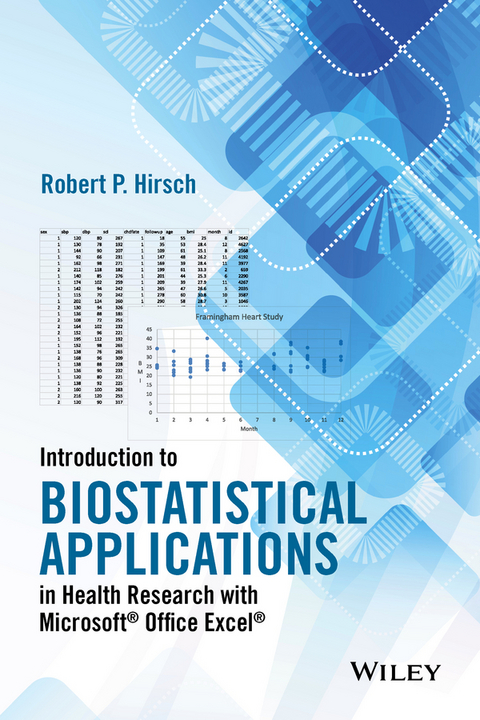
Introduction to Biostatistical Applications in Health Research with Microsoft Office Excel (eBook)
John Wiley & Sons (Verlag)
978-1-119-08999-5 (ISBN)
A practical and methodological approach to the statistical logic of biostatistics in the field of health research
Focusing on a basic understanding of the methods and analyses in health research, Introduction to Biostatistical Applications in Health Research with Microsoft® Office Excel® provides statistical concepts for interpreting results using Excel. The book emphasizes the application of methods and presents the most common methodological procedures in health research, which includes multiple regression, ANOVA, ANCOVA, logistic regression, Cox regression, stratified analysis, life table analysis, and nonparametric parallels.
The book is constructed around a flowchart that outlines the appropriate circumstances for selecting a method to analyze a specific set of data. Beginning with an introduction to the foundational methods of statistical logic before moving on to more complex methods, Introduction to Biostatistical Applications in Health Research with Microsoft® Office Excel® also includes:
- Detailed discussions of how knowledge and skills in health research have been integrated with biostatistical methods
- Numerous examples with clear explanations that use mostly real-world health research data in order to provide a better understanding of the practical applications
- Implements Excel graphic representations throughout to help readers evaluate and analyze individual results
- An appendix with basic information on how to use Excel
- A companion website with additional Excel files, data sets, and homework problems as well as an Instructor's Solutions Manual
Introduction to Biostatistical Applications in Health Research with Microsoft® Office Excel® is an excellent textbook for upper-undergraduate and graduate-level courses in biostatistics and public health. In addition, the book is an appropriate reference for both health researchers and professionals.
A practical and methodological approach to the statistical logic of biostatistics in the field of health research Focusing on a basic understanding of the methods and analyses in health research, Introduction to Biostatistical Applications in Health Research with Microsoft Office Excel provides statistical concepts for interpreting results using Excel. The book emphasizes the application of methods and presents the most common methodological procedures in health research, which includes multiple regression, ANOVA, ANCOVA, logistic regression, Cox regression, stratified analysis, life table analysis, and nonparametric parallels. The book is constructed around a flowchart that outlines the appropriate circumstances for selecting a method to analyze a specific set of data. Beginning with an introduction to the foundational methods of statistical logic before moving on to more complex methods, Introduction to Biostatistical Applications in Health Research with Microsoft Office Excel also includes: Detailed discussions of how knowledge and skills in health research have been integrated with biostatistical methods Numerous examples with clear explanations that use mostly real-world health research data in order to provide a better understanding of the practical applications Implements Excel graphic representations throughout to help readers evaluate and analyze individual results An appendix with basic information on how to use Excel A companion website with additional Excel files, data sets, and homework problems as well as an Instructor s Solutions Manual Introduction to Biostatistical Applications in Health Research with Microsoft Office Excel is an excellent textbook for upper-undergraduate and graduate-level courses in biostatistics and public health. In addition, the book is an appropriate reference for both health researchers and professionals.
Robert P. Hirsch, PhD, is on the faculty for the Foundation for the Advanced Education in the Sciences within the Graduate School at the National Institutes of Health. He is also a retired Professor of Epidemiology and Biostatistics and Adjunct Professor of Statistics at The George Washington University. Dr. Hirsch is the author of numerous books in the field of health research and practice.
Chapter 1
Thinking About Chance
In the introduction to this first part of the text, we learned that chance is used to select samples from the population that are, in the long run, representative of the population from which they came (Figure 1.1). Before we can appreciate how chance influences the composition of those samples, however, we need to understand some things about chance itself. In this chapter, we will look at the basic properties of chance and see how the chances of individual events can be combined to address health issues.
Figure 1.1 Chance determines which data values in the population end up in the sample.
1.1 Properties of Probability
To begin with, we should point out that there are two terms that can be used interchangeably: chance and probability. In everyday language, probability (or chance) tells us how many times something happens relative to the number of times it could happen. For example, we might think of the probability that a patient presenting with a sore throat has streptococcal pharyngitis. If we can expect 1 patient to actually have streptococcal pharyngitis out of every 10 patients seen with a sore throat, then the probability of having streptococcal pharyngitis is 0.10. Or equivalently, there is a 10% chance that a person selected at random from among persons with sore throats would have strep throat.
In statistical terminology, the number of times something happens is called its frequency and that “something” is called an event. The opportunities for an event to occur are called observations.1 When using the concept of probability, we need to understand that there are two possible results for each observation: either the event occurs or the event does not occur. In the previous example, the event was streptococcal pharyngitis and the patients seen with a sore throat were the observations.
Everyday language is often cumbersome when discussing issues in statistics. An alternative approach is to examine events and observations graphically. We do this by constructing a Venn diagram. In a Venn diagram, we use a rectangle to symbolize all of the observations and a circle to symbolize those observations in which the event occurs. Figure 1.2 is a Venn diagram we could use to think about the probability that a patient with a sore throat has streptococcal pharyngitis.
Figure 1.2 An example of a Venn diagram. The rectangular area represents all observations. The circular area represents the observations in which the event occurs. The area within the rectangle but outside of the circle represents those observations in which the event did not occur.
There are some aspects of observations and events that are evident in a Venn diagram. For instance, we can see that the entire rectangle outside of the circle corresponds to observations in which the event does not occur. When an event does not occur, we say that the complement of the event occurs. In this case, the event is having strep throat and its complement is not having strep throat.
The way a Venn diagram tells us about the magnitude of the probability is by the area of the circle representing the event relative to the area of the entire rectangle. A way we can compare these areas is by creating a Venn equation. A Venn equation uses the parts of a Venn diagram in a mathematical equation that show how the probability of an event is calculated. For the probability that a patient with sore throat has streptococcal pharyngitis, the Venn equation would look like Figure 1.3.
Figure 1.3 A Venn equation illustrating the probability a patient with sore throat has streptococcal pharyngitis.
A Venn equation helps us see another property of probabilities, that probabilities have a distinct range of possible values. Since an event cannot exist without an observation, the circle can only be as big as the rectangle. In other words, the numerator must be a subset of the denominator. The result of this property is to make the largest possible value for a probability equal to one (or 100%). The value of one occurs when every observation in the denominator is also an event in the numerator. When the probability of an observation being an event has a value of one, it is certain that the event will occur.
The numerator of a probability contains the number of events. The largest value possible is equal to the number of observations. The smallest value possible is zero. If the numerator of a probability is equal to zero, this implies that none of the observations are events and, therefore, the probability is equal to zero as well. A probability of zero indicates that it is impossible for an event to occur. A probability can be no smaller than zero and no larger than one.2
When we want to calculate a probability, it is easier to use some mathematical shorthand. To symbolize a probability, we use a lowercase p followed by a set of parentheses. Within those parentheses, we identify the event addressed by the probability. Then, the equation looks like this:
Next, let us take a look at an example that illustrates calculation of a probability and its interpretation.
Example 1.1
Suppose we did throat cultures for 100 patients who complained of a sore throat and 10 of those cultures were positive for streptococcus. What is the probability a person picked at random would have a positive strep culture?
In this question, a positive strep test is the event and someone with sore throat is an observation. To calculate the probability of a person having a positive strep culture, we can use Equation (1.1).
Thus, there is a probability of 0.1 (or a 10% chance) that a person selected from the group of patients with a sore throat would be positive for streptococcus.
A part of the shorthand we use to show how probabilities are calculated concerns the complement of an event (i.e., an observation in which the event does not occur). Rather than inserting the description of the complement of the event within the parentheses, we more often put a bar over the description of the event. So, p(event¯) stands for the probability of the complement of the event occurring (i.e., the probability of the event not occurring). For the complement of having strep throat, we could use p(strep¯). There are two properties of a collection of events that an event and its complement always demonstrate. The first is mutual exclusion. A collection of events is said to be mutually exclusive if it is impossible for two or more events to occur in a single observation. In this case, it is certainly impossible for a person both to have strep throat and to not have strep throat.
The second property of an event and its complement is that they are collectively exhaustive. A collection of events is said to be collectively exhaustive if every observation is certain to consist of at least one of the events. Here, this implies that every person with a sore throat either has or does not have strep throat. Clearly, this is true.
For events that are both mutually exclusive and collectively exhaustive (like an event and its complement), there is a special relationship among the events: The sum of their probabilities is equal to one. In mathematical language, the relationship between the probability of an event occurring and the probability of the complement of the event occurring is shown in Equation (1.2):
A little bit of algebra shows us that we can calculate the probability of the complement of an event by subtracting the probability of the event from one. This is shown in Equation (1.3):
This relationship can also be described in graphic language as in the Venn equation in Figure 1.4.
Figure 1.4 A Venn equation illustrating the relationship between the probability of the complement of the event (e.g., not having strep throat) and the probability of the event (e.g., having strep throat).
So far, we have seen how we can think about probabilities using everyday language, graphic language, and mathematical language. Each one of these ways of examining statistical issues has its own advantages. The sort of things we have learned about probability includes the fact that probabilities have a discrete range of possible values ranging from zero (indicating that the event cannot occur) to one (indicating that the event always occurs). Also, we have examined the relationship between an event and its complement. This relationship has two important properties of a collection of events. These properties are mutually exclusive and collectively exhaustive. A collection of events is mutually exclusive if only one of the events can occur in a single observation. To be collectively exhaustive, the collection of events needs to encompass every possibility so that at least one of the events occurs in every observation. Next, we...
| Erscheint lt. Verlag | 22.2.2016 |
|---|---|
| Sprache | englisch |
| Themenwelt | Mathematik / Informatik ► Mathematik ► Statistik |
| Mathematik / Informatik ► Mathematik ► Wahrscheinlichkeit / Kombinatorik | |
| Studium ► Querschnittsbereiche ► Epidemiologie / Med. Biometrie | |
| Technik | |
| Schlagworte | ANCOVA • ANOVA • Biostatistician • Biostatistics • Biostatistik • Cox Regression • Data Science • Data Sets • Epidemiologie • Epidemiologie u. Biostatistik • Epidemiology & Biostatistics • Excel</p> • Gesundheits- u. Sozialwesen • Health & Social Care • Health Research • Life Table Analysis • Logistic Regression • <p>health • Medical Science • Medical Statistics & Epidemiology • Medizin • Medizinische Statistik u. Epidemiologie • multiple regression • nonparametric methods • Public Health • Statistics • Statistik • Stratified Analysis |
| ISBN-10 | 1-119-08999-9 / 1119089999 |
| ISBN-13 | 978-1-119-08999-5 / 9781119089995 |
| Informationen gemäß Produktsicherheitsverordnung (GPSR) | |
| Haben Sie eine Frage zum Produkt? |
 EPUB (Adobe DRM)
Kopierschutz: Adobe-DRM
Adobe-DRM ist ein Kopierschutz, der das eBook vor Mißbrauch schützen soll. Dabei wird das eBook bereits beim Download auf Ihre persönliche Adobe-ID autorisiert. Lesen können Sie das eBook dann nur auf den Geräten, welche ebenfalls auf Ihre Adobe-ID registriert sind.
Details zum Adobe-DRM
Dateiformat: EPUB (Electronic Publication)
EPUB ist ein offener Standard für eBooks und eignet sich besonders zur Darstellung von Belletristik und Sachbüchern. Der Fließtext wird dynamisch an die Display- und Schriftgröße angepasst. Auch für mobile Lesegeräte ist EPUB daher gut geeignet.
Systemvoraussetzungen:
PC/Mac: Mit einem PC oder Mac können Sie dieses eBook lesen. Sie benötigen eine
eReader: Dieses eBook kann mit (fast) allen eBook-Readern gelesen werden. Mit dem amazon-Kindle ist es aber nicht kompatibel.
Smartphone/Tablet: Egal ob Apple oder Android, dieses eBook können Sie lesen. Sie benötigen eine
Geräteliste und zusätzliche Hinweise
Buying eBooks from abroad
For tax law reasons we can sell eBooks just within Germany and Switzerland. Regrettably we cannot fulfill eBook-orders from other countries.


