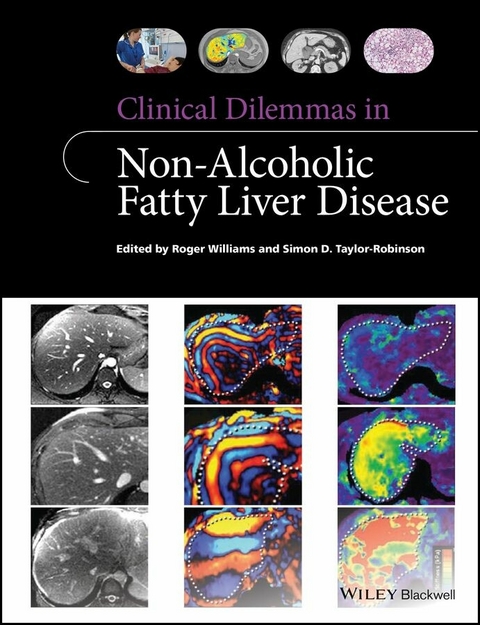
Clinical Dilemmas in Non-Alcoholic Fatty Liver Disease (eBook)
John Wiley & Sons (Verlag)
978-1-118-92495-2 (ISBN)
Clinical Dilemmas in Non-Alcoholic Fatty Liver Disease offers hepatologists practical, up-to-date and expert guidance on the most topical dilemmas, difficulties and areas of controversy/difficulty surrounding this ever-increasing area of liver disease they face in daily practice.
Roger Williams and Simon Taylor-Robinson, two of Europe's leading hepatologists, have recruited leading figures from across the world to assist them, resulting in a truly international approach. Each chapter covers a specific area of difficulty, containing clear learning points and providing evidence-based expert guidance on the latest hot topics in clinical management such as:
- Is NAFLD different in absence of Metabolic Syndrome?
- Are the pros outweighed by the cons of obtaining a liver biopsy?
- Is progression to cirrhosis more likely in children with NAFLD?
- What are the dangers as well as the true benefits of bariatric surgery?
- How is it best to use antifibrotic agents in clinical practice?
Clinical Dilemmas in Non-Alcoholic Fatty Liver Disease provides the answers to the questions and challenges that clinicians face every day in this area. It is essential reading for hepatologists of all levels and researchers in hepatology, as well as all those involved in the care of patients with NAFLD, including gastroenterologists, pathologists and specialist hepatology nurses.
Clinical Dilemmas in Non-Alcoholic Fatty Liver Disease offers hepatologists practical, up-to-date and expert guidance on the most topical dilemmas, difficulties and areas of controversy/difficulty surrounding this ever-increasing area of liver disease they face in daily practice. Roger Williams and Simon Taylor-Robinson, two of Europe s leading hepatologists, have recruited leading figures from across the world to assist them, resulting in a truly international approach. Each chapter covers a specific area of difficulty, containing clear learning points and providing evidence-based expert guidance on the latest hot topics in clinical management such as: Is NAFLD different in absence of Metabolic Syndrome? Are the pros outweighed by the cons of obtaining a liver biopsy? Is progression to cirrhosis more likely in children with NAFLD? What are the dangers as well as the true benefits of bariatric surgery? How is it best to use antifibrotic agents in clinical practice? Clinical Dilemmas in Non-Alcoholic Fatty Liver Disease provides the answers to the questions and challenges that clinicians face every day in this area. It is essential reading for hepatologists of all levels and researchers in hepatology, as well as all those involved in the care of patients with NAFLD, including gastroenterologists, pathologists and specialist hepatology nurses.
Professor Roger Williams CBE, runs the Institute of Hepatology at UCL, and is a twice former president of EASL. He has authored an incredible 2100 journal articles. Despite advancing years, he is still actively involved in clinical research -- 340 articles in the past ten years, and analysis by ISI shows him to be one of the most influential researchers in his field. The award of a CBE for services to medicine recognised his major contribution to the study of liver disorders over 25 years including leading the team who performed the first ever UK liver transplant. He also performed George Best's controversial liver transplant in 2002. Prof Williams has had many awards, medals, honorary fellowships, and in 2006 was included by HRH The Queen in a celebration at Buckingham Palace to honour those who continue to contribute to public service beyond the age of 65yrs. He was made a Fellow of King's College London in 1992 and an Honorary Fellowship from UCL was conferred on him in 2008, in recognition of his distinguished career and outstanding service to UCL. Professor Simon Taylor-Robinson joined the Department of Medicine at Imperial College London in 1997, having previously been Senior Registrar in Gastroenterology and Hepatology at Hammersmith Hospital. He was awarded the Sir Francis Avery Jones Gold Medal by the British Society of Gastroenterology in 1999 and the Young Investigator Award of the Liver Section of the European Gastroenterology Association in 1997. He is currently Director of the Imperial Clinical Research Facility at St Mary's Hospital, London.
List of contributors vii
Preface ix
Part I: Nature of the condition
1 Non-alcoholic fatty liver disease: Hype or harm? 3
Stephen H. Caldwell and Curtis K. Argo
2 NAFLD: A worldwide problem 8
Joanna K. Dowman, Geoffrey C. Farrell, and Philip Newsome
3 Is insulin resistance the principal cause of NAFLD? 15
Ian F. Godsland, Sanjeev Mehta, Shareen Forbes, Fabian Meienberg, Michael Yee, Simon D. Taylor-Robinson, and Desmond G. Johnston
4 Paediatric NAFLD: A distinct disease with the propensity for progressive fibrosis 29
Emer Fitzpatrick and Anil Dhawan
5 Non-alcoholic fatty liver disease (NAFLD) as cause of cryptogenic cirrhosis 36
Jay H. Lefkowitch
6 Is NAFLD different in absence of metabolic syndrome? 44
Yusuf Yilmaz
7 Occurrence of noncirrhotic HCC in NAFLD 50
Dawn M. Torres and Stephen A. Harrison
Part II: Factors in Disease Progression
8 Fibrosis progression: Putative mechanisms and molecular pathways 61
Wing-Kin Syn and Anna Mae Diehl
9 When is it NAFLD and when is it ALD?: Can the histologic evaluation of a liver biopsy guide the clinical evaluation? 72
Elizabeth M. Brunt and David E. Kleiner
10 Of men and microbes: Role of the intestinal microbiome in non-alcoholic fatty liver disease 82
Muhammad Bilal Siddiqui, Mohammed Shadab Siddiqui, and Arun J. Sanyal
11 Can genetic influence in non-alcoholic fatty liver disease be ignored? 91
Yang-Lin Liu, Christopher P. Day, and Quentin M. Anstee
12 Is there a mechanistic link between hepatic steatosis and cardiac rather than liver events? 103
Soo Lim
Part III: Diagnosis and Scoring
13 How to best diagnose NAFLD/NASH? 113
Vlad Ratziu
14 The clinical utility of noninvasive blood tests and elastography 124
Emmanuel A. Tsochatzis and Massimo Pinzani
15 Are the guidelines--AASLD, IASL, EASL, and BSG--of help in the management of patients with NAFLD? 131
Cristina Margini and Jean-François Dufour
16 Imaging methods for screening of hepatic steatosis 138
Hero K. Hussain
17 Are the advantages of obtaining a liver biopsy outweighed by the disadvantages? 152
Jeremy F. L. Cobbold and Simon D. Taylor-Robinson
18 Screening for NAFLD in high-risk populations 161
Nader Lessan
Part IV: Value of treatment measures
19 Defining the role of metabolic physician 173
Nicholas Finer
20 Should physicians be prescribing or patients self-medicating with orlistat, vitamin E, vitamin D, insulin sensitizers, pentoxifylline, or coffee? 182
Haripriya Maddur and Brent A. Neuschwander-Tetri
21 Effects of treatment of NAFLD on the metabolic syndrome 189
Hannele Yki-Järvinen
22 What are the dangers as well as the true benefits of bariatric surgery? 196
Andrew Jenkinson
23 Liver transplantation: What can it offer? 203
Roger Williams
Part V: What does the future hold?
24 Molecular antagonists, leptin or other hormones in supplementing environmental factors? 211
Jonathan M. Hazlehurst and Jeremy W. Tomlinson
25 What is the role of antifibrotic therapies in the current and future management of NAFLD? 218
Natasha McDonald and Jonathan Fallowfield
26 Developmental programming of non-alcoholic fatty liver disease 226
Jiawei Li, Paul Cordero, and Jude A. Oben
Index 232
1
Non-alcoholic fatty liver disease: Hype or harm?
Stephen H. Caldwell and Curtis K. Argo
Division of Gastroenterology and Hepatology, University of Virginia, Charlottesville, VA, USA
LEARNING POINTS
- Non-alcoholic fatty liver (NAFL) often presents the clinician with a conundrum in deciding the significance of the problem.
- It is now widely recognized that non-alcoholic steatohepatitis (NASH) can progress to advanced liver disease evident as cirrhosis with all of its attendant complications including portal hypertension and hepatocellular cancer, and sometimes this progression is associated with the perplexing loss of histological hallmarks of the antecedent process of steatohepatitis.
- The challenge to clinicians is to discern NASH from the relatively more stable forms of fatty liver, which we prefer to call non-NASH fatty liver (NNFL).
- Therapy of NASH is evolving and aside from common conservative measures like exercise and diet treatment is likely to involve drug therapy with potential side effects. Thus refining the prognosis and discerning harm from hype will be increasingly important.
- Additional areas of special need for further study include what is sometimes referred to as “BASH,” which indicates the presence of metabolic risks such as obesity and insulin resistance and the use of ethanol above safe levels but below levels at which the risk of alcoholic steatohepatitis (ASH) rises steeply.
Few potentially fatal diseases have ever been referred to as “trash” in a serious and critical treatise on the topic [1] or have been specifically the subject of an unsuccessful legal action aimed at shutting down a particular form of animal-derived food production (Caldwell S, personal experience) or have at one time been, rather accurately, referred to as “big” and “little” varieties to indicate early recognized variability in severity from mild and essentially inconsequential to potentially fatal (McCullough AJ, personal communication). However, all of these attributes are true of non-alcoholic fatty liver disease (NAFLD) and its potentially more severe subset non-alcoholic steatohepatitis (NASH).
In many ways, NASH remains a very challenging disorder over 30 years after pathologist Jurgen Ludwig first coined the term “NASH” for a “hitherto unnamed” form of steatohepatitis [2], and in doing so, he and his colleagues ushered in the modern era of clinical and basic research into the various forms of nonalcohol-related fatty liver—a field that has grown from a few published papers per year to many publications per week or month. On a practical level, much of the persistent challenge hinges on questions about the natural history and prognosis of fatty liver when it is encountered in a given individual—currently an almost daily occurrence in many clinics whether on its own or in combination with other liver disorders. The patient usually presents with asymptomatic, mild to moderate range of abnormal liver enzymes, negative additional diagnostic testing, and fatty changes noted on diagnostic ultrasound. This raises a frequent clinical question: is fatty liver a benign physiological finding (possibly an ancient adaptation to feast or famine, where nowadays feast exceeds famine), is it a disease warranting liver biopsy (with inherent risk) and directed intervention, or is it an epiphenomenon of a metabolic disorder encompassing diabetes mellitus, vascular disease, and cancer risks with clinical consequences that supersede the significance of the fatty liver [3]? All of these posits have some truth in NAFLD/NASH and constitute the pressing clinical challenge to discern hype and harm.
“Big” NASH and “little” NASH are now somewhat forgotten terms used casually in the discussion of early natural history studies, which indicated a dichotomy in the clinical course: long-term stability of the liver in many patients and progression to cirrhosis and liver-related mortality in a smaller but substantial fraction [4]. Since those early days, the nomenclature has obviously evolved with recognition of potentially progressive “big” NASH, characterized by cellular injury and fibrosis, as a subset of the more global term, NAFLD, which indicates liver fat exceeding 5–10% triglyceride by weight. Subsequently, long-term natural history studies of NAFLD have consistently demonstrated this dichotomous natural history: non-NASH fatty liver tends to be stable over years with low liver-related mortality, while NASH carries a significant, tangible risk of progression to cirrhosis and associated liver-related mortality [5–8]. Most of these studies have focused on mortality rather than morbidity, and overall mortality is clearly dominated by cardiovascular disease and nonliver malignancy. These findings suggest that the emphasis on the liver disease itself may be somewhat misplaced. However, this overlooks the fact that a substantial number of patients, especially those with histological NASH will progress to cirrhosis and suffer many of the typical cirrhosis-related complications. Moreover, the development of cirrhosis and coexisting vascular disease or neoplasm significantly complicates the management of either condition. Thus, directing specific therapy at the liver is appropriate in some patients, but careful patient selection is essential, and unless a therapy is very safe and inexpensive (such as diet and exercise), many NAFLD patients warrant only conservative management. Riskier interventions should be directed at those with histological NASH especially with more advanced fibrosis stages.
Is steatosis ever physiologically adaptive? To some extent it can be viewed as such under certain circumstances [9]. This is most evident in certain species of migratory Palmipedes spp. (geese and ducks) where the development of steatosis is a normal premigratory process and presumably provides a source of energy during the long flight with little calorie intake. This process was recognized long ago, and for thousands of years, “foie gras” production has hinged on it. However, our own work in cooperation with several individuals in France demonstrated that the Palmipedes develop only non-NASH fatty liver. Hence, the effort by People for the Ethical Treatment of Animals (PETA) to block foie gras production in the United States—on the grounds that the meat represented a disease state—failed due to the absence of NASH. No doubt, the grounds for the attempted legal action were the result of some of the media publicity that has surrounded NAFLD.
On the other hand, humans with histological NASH are at risk for progression of fibrosis through stages to cirrhosis. Serial biopsy studies suggest that this is a slow, steady march when it occurs [10]. However, it remains unclear whether or not the progression is uniform over time, and it is conceivable that NASH progression may occur in subclinical “fits and starts” with peaks and troughs of disease activity rather than by a slow, steady process. It has also been shown that some patients with non-NASH fatty liver may transition to histological NASH [11]. Presumably, changes in activity, diet, or weight with resultant worsening insulin resistance may trigger such a transition. Once cirrhosis develops in patients with NASH, complications of portal hypertension develop at a steady rate but somewhat slower than that seen with cirrhosis due to hepatitis C [12]. Patients are also at significantly increased risk of hepatocellular cancer usually, but perhaps not always, in the setting of coexisting cirrhosis [13].
Adding to the clinical diagnostic challenge, when cirrhosis develops in NASH, steatosis, a hallmark of NASH, tends to diminish significantly, sometimes leaving a picture of “cryptogenic cirrhosis,” especially in patients without a confirmed antecedent diagnosis of NASH [14–16]. Such patients often present with minor findings, such as asymptomatic and previously unexplained thrombocytopenia, often labeled in prior encounters as idiopathic thrombocytopenia purpura (“ITP”) or with cirrhosis, incidentally discovered at the time of elective surgery, especially for suspected or confirmed gallbladder disease. The mechanisms underlying diminished liver fat remain uncertain but may involve altered insulin exposure through changes in blood flow or repopulation of the liver from stem cells with altered physiology and fat metabolic capacity. Clearly, there are also other causes of cryptogenic cirrhosis, including silent autoimmune hepatitis, occult ethanol abuse, or as yet unrecognized viral infection, but NASH appears to be the leading etiology in many areas of the world [17].
Although it is well established that NAFLD has a largely dichotomous natural history, based on initial histology (NASH vs. non-NASH fatty liver), it is perplexing that certain aspects of NASH histology remain challenging. While there are a number of characteristic histological findings, the key features that usually are used to define NASH are steatosis, inflammation, cellular ballooning, and fibrosis; the first three of these parameters define the commonly utilized NAFLD activity score (NAS) [18, 19]. Perhaps not surprisingly, histological fibrosis appears to be a reliable finding with low interobserver variation rates and a reliable indicator of prognosis. However, agreement between scoring systems and individual parameters remains a potentially significant problem that can muddy clinical...
| Erscheint lt. Verlag | 16.2.2016 |
|---|---|
| Reihe/Serie | Clinical Dilemmas |
| Clinical Dilemmas | Clinical Dilemmas (UK) |
| Sprache | englisch |
| Themenwelt | Medizin / Pharmazie ► Allgemeines / Lexika |
| Medizinische Fachgebiete ► Innere Medizin ► Gastroenterologie | |
| Medizinische Fachgebiete ► Innere Medizin ► Hepatologie | |
| Schlagworte | Fatty Liver Disease • Gastroenterologie • Gastroenterologie u. Hepatologie • Gastroenterology & Hepatology • Hepatologie • hepatology • liver disease • liver inflammation • Medical Science • Medizin • Metabolic disease • NAFLD • Nash • Non-alcoholic fatty liver disease • Non-alcoholic steatohepatitis • Stoffwechselkrankheit • Stoffwechselkrankheiten |
| ISBN-10 | 1-118-92495-9 / 1118924959 |
| ISBN-13 | 978-1-118-92495-2 / 9781118924952 |
| Informationen gemäß Produktsicherheitsverordnung (GPSR) | |
| Haben Sie eine Frage zum Produkt? |
 EPUB (Adobe DRM)
Kopierschutz: Adobe-DRM
Adobe-DRM ist ein Kopierschutz, der das eBook vor Mißbrauch schützen soll. Dabei wird das eBook bereits beim Download auf Ihre persönliche Adobe-ID autorisiert. Lesen können Sie das eBook dann nur auf den Geräten, welche ebenfalls auf Ihre Adobe-ID registriert sind.
Details zum Adobe-DRM
Dateiformat: EPUB (Electronic Publication)
EPUB ist ein offener Standard für eBooks und eignet sich besonders zur Darstellung von Belletristik und Sachbüchern. Der Fließtext wird dynamisch an die Display- und Schriftgröße angepasst. Auch für mobile Lesegeräte ist EPUB daher gut geeignet.
Systemvoraussetzungen:
PC/Mac: Mit einem PC oder Mac können Sie dieses eBook lesen. Sie benötigen eine
eReader: Dieses eBook kann mit (fast) allen eBook-Readern gelesen werden. Mit dem amazon-Kindle ist es aber nicht kompatibel.
Smartphone/Tablet: Egal ob Apple oder Android, dieses eBook können Sie lesen. Sie benötigen eine
Geräteliste und zusätzliche Hinweise
Buying eBooks from abroad
For tax law reasons we can sell eBooks just within Germany and Switzerland. Regrettably we cannot fulfill eBook-orders from other countries.
aus dem Bereich