


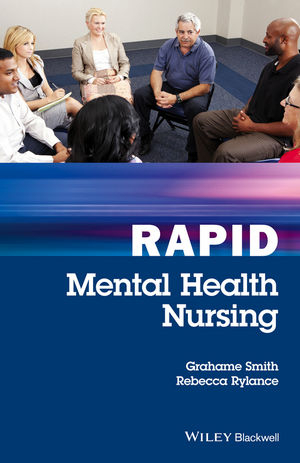
Rapid Mental Health Nursing (eBook)
John Wiley & Sons (Verlag)
978-1-119-04503-8 (ISBN)
A concise, pocket-sized, A-Z rapid reference handbook on all the essential areas of mental health nursing, aimed at nursing students and newly qualified practitioners.
- Covers a broad range of mental health disorders, approaches interventions and conditions
- Easy to locate practical information quickly in a pocket sized, rapid reference format
- The topics and structure are mapped on to the NMC's (2010) Standards for Pre-registration Nursing Education and their required essential skills and knowledge.
A concise, pocket-sized, A-Z rapid reference handbook on all the essential areas of mental health nursing, aimed at nursing students and newly qualified practitioners. Covers a broad range of mental health disorders, approaches interventions and conditions Easy to locate practical information quickly in a pocket sized, rapid reference format The topics and structure are mapped on to the NMC s (2010) Standards for Pre-registration Nursing Education and their required essential skills and knowledge.
Grahame Smith is Principal Lecturer and Subject Head (Allied Health) at Liverpool John Moores University, UK. Rebecca Rylance is Senior Lecturer in Mental Health Nursing at Liverpool John Moores University, UK.
Introduction viii
Essential skills and knowledge
Assessment 3
Care planning 5
Clinical decision-making 8
Clinical observations 10
Clinical risk in mental health 12
Communication 14
Diagnosis and classification 17
Documentation 19
Early intervention services 21
Electroconvulsive therapy 24
Elimination 25
Infection control 27
Leadership 29
Lifelong learning 31
Managing aggression and violence 34
Managing people 36
Managing risk 39
Medication 41
Medicines management 44
Mental health law 46
Nutrition and fluid management 50
Organising care 52
Physical well-being 54
Psychiatric examination 57
Psychological interventions 59
Psychological therapies 61
Recovery 64
Reflection 66
Research 68
Suicide and self-harm 71
Therapeutic relationships 74
Time management 76
Values-based practice 78
Conditions
Acute confusional state 85
Alcohol misuse 87
Anxiety and related conditions 89
Bipolar affective disorder 91
Child and adolescent mental health 92
Dementia 95
Depression 97
Disorders associated with pregnancy 99
Drug misuse 102
Eating disorders 104
Functional disorders in older adults 106
Learning disabilities in mental health 108
Neuropsychiatry 110
Personality disorders 112
Schizophrenia 114
Sexual disorders 117
Sleep disorders 119
Trauma and other stress-related conditions 122
Unresolved grief 124
Specific issues
Asylum seekers and refugees 131
Culture and ethnicity 132
Homelessness 133
Older adults 134
Safeguarding vulnerable adults 135
Sexual abuse 137
Sexuality and gender 138
Spirituality and religion 140
Appendices 141
Revision questions 150
Glossary 162
References, further reading and useful resources 168
Index 179
Essential skills and knowledge
Assessment
Background
Assessment is a fundamental part of mental health nursing practice; it establishes an understanding of the service user’s situation through a process of asking questions. Assessment is not a one-off, it is an ongoing process which is built on partnership working, starting with a service user’s admission to mental health services and continuing until they are discharged. Information gathered from the initial assessment process is the first step in planning and delivering care across services to ensure that the care delivered is effective and based upon the service user’s needs.
Assessment can be broadly divided into two categories or methods:
- formal assessment, including checklists, questionnaires, rating scales, tools, and structured interviews;
- informal assessment, when information is collected through less formal and planned methods, such as day-to-day observations and interactions.
Both methods provide the mental health nurse with valuable information, and both methods should have equal weight; however, formal assessment tends to be viewed as more objective and value-free. Sometimes this can lead to information gathered through formal assessment methods having more weight than informally gathered information. The strength of using both methods is that information can be triangulated in way that captures the whole clinical picture rather than just part of the picture.
Assessment information should describe the service user’s situation, both generally and specifically; it should also identify the degree to which any identified problem has impacted, and is impacting upon, the service user’s ability to function. To elicit this information the nurse should use:
- open questions to scope the broad issues;
- more probing questions to identify the specific issues;
- closed questions to confirm their understanding of the specific issues is correct.
Professional skills
Mental health nurses should be able to:
- undertake nursing assessments that are comprehensive, systematic and holistic;
- utilise assessment information to plan, deliver and evaluate care;
- work in partnership with the service user, their carers and their families throughout the assessment to negotiate goals and develop a personalised plan of care.
Types of assessment
Mental health nursing assessments should be holistic and, as such, during the assessment process the nurse should gather a wide range of information about the following:
- physical health and functioning;
- psychological functioning;
- social functioning;
- spiritual needs.
A variety of assessment tools should be used to gather specific information about:
- risk;
- history;
- symptoms;
- social functioning;
- quality of life.
Assessment tools
Specific assessment tools used in mental health nursing include:
- Brief Psychiatric Rating Scale (http://www.public-health.uiowa.edu/icmha/outreach/documents/bprs_expanded.pdf);
- Beck Depression Inventory (http://mhinnovation.net/sites/default/files/downloads/innovation/research/bdi%20with%20interpretation.pdf);
- Positive and Negative Syndrome Scale (http://egret.psychol.cam.ac.uk/medicine/scales/panss.pdf);
- Beliefs About Voices Questionnaire (http://www.hearingvoices.org.uk/pdf/bavqr.pdf);
- Rosenberg Self-Esteem Scale (http://www.yorku.ca/rokada/psyctest/rosenbrg.pdf);
- Health of the Nation Outcome Scales (http://amhocn.org/static/files/assets/2ad72217/honos_glossary.pdf);
- Camberwell Assessment of Need (http://www.researchintorecovery.com/files/cansas-p.pdf);
- Social Functioning Scale (https://mh4ot.files.wordpress.com/2012/05/social-functioning-scale.pdf);
- Quality of Life Scale (http://www.mentalhealth.com/qol/imhqolscale.pdf);
- Patient Health Questionnaire (http://phqscreeners.com/pdfs/02_phq-9/english.pdf).
Assessment skills
The therapeutic relationship should drive the assessment process which should be person centred, collaborative and underpinned by the use of effective communication skills such as questioning, active listening, clarifying and summarising. The skills required of mental health nurses are to:
- interview — ask questions about behaviours and symptoms;
- observe — record what they see;
- measure — rate the severity of behaviours and symptoms.
Mental health nurses should utilise all three strategies. It is also important to focus on what the service user can do rather than what they cannot do; this strengths-based approach underpins the recovery process.
Assessment and care delivery
Assessment information is used to inform the delivery of care. It assists the mental health nurse and the service user in partnership to identify what the issues are and what needs to be addressed. The next step after assessment is to consider what the partnership is trying to achieve, and what change the partnership would like to take place and by when. After this step the partnership can consider what interventions would be the most useful, and it is at this stage that the relevant clinical guidelines need to be taken into consideration. The final step is to review the process — were the goals achieved? If not why not? Is there another approach that could be considered? Overall the process should look like this:
- assessment;
- care planning and goal setting;
- care delivery;
- evaluation.
Care planning
Background
Care planning follows on from the previous section on assessment. Care planning is concerned with the practice of planning care with a service user in order to meet their individual health and well-being needs. Traditionally, a nurse would assess a service user’s needs, identify their problems, plan care and evaluate the success of the plan. However, there has recently been a significant shift within mental health services to refocus the clinical language to that of goal identification instead of problem identification. When goals have been identified (utilising a strength-based approach) a collaborative plan of care is developed to help the service user achieve their goals. Regular evaluation, preferably with the service user and their family as well as the clinical team, will ensure that the care plan is effective and also responsive to any changes.
The Care Programme Approach (CPA; The Care Programme Approach Association 2008) is the key framework which informs the care-planning process in mental health in the UK. The CPA aims to ensure that people have access to services to meet their diverse needs, choices and preferences. Only through collaboration with the service user, their carer, the CPA coordinator, and health and social care professionals can an appropriate plan of care be devised. A useful document that describes effective collaboration is Ten Essential Shared Capabilities (DoH 2004), which lists the key principles for inclusive practice for nurses across health and community settings:
- working in partnership;
- respecting diversity;
- practising ethically;
- challenging inequality;
- promoting recovery;
- identifying needs and strengths;
- providing service-user-centred care;
- making a difference;
- promoting safety and positive risk taking;
- personal development and learning.
Professional skills
Mental health nurses should:
- actively empower service users and carers to be involved in the care-planning process;
- understand the public health dimension of planning and delivering care;
- ensure a service users physical, social, economic, psychological and spiritual needs are addressed when planning and delivering care;
- ensure that care planning and delivery is person centred, collaborative, evidence-based and framed by the relevant ethical and legal frameworks.
Partnership
It is vital that nurses work in partnership with people experiencing mental health issues and empower them to make decisions about their care. By utilising a recovery-focused approach, nurses can support a service user to achieve well-being and recovery. Therefore, it is important for mental health nurses to assess each service user’s needs holistically, facilitate goal setting, devise a care plan collaboratively and then evaluate it regularly. In the UK, the NMC’s professional code of conduct (Nursing & Midwifery Council 2015) is central to the nursing process.
Nursing models
The body of knowledge for nursing is supported by a number of nursing models that are highly abstract and broad in nature; however they provide a structured way to make sense of the care planning and care-delivery process. Nursing knowledge can be categorised in the following four ways (Carper 1978):
- empiric — explaining and predicting;
- aesthetic — particular and unique to the situation;
- personal — interpersonal;
- ethical...
| Erscheint lt. Verlag | 3.2.2016 |
|---|---|
| Reihe/Serie | Rapid |
| Rapid | Rapid |
| Sprache | englisch |
| Themenwelt | Pflege ► Fachpflege ► Neurologie / Psychiatrie |
| Schlagworte | Abuse • Acute Confusional States • Aggression • Alcohol misuse • antidepressants • Antipsychotics • Anxiety • Assessment • asylum seekers • Bereavement • Bipolar Affective • Care • Children Adolescent • classification • Clinical • clinical observations • cognitive behavioural • Communication • consent • Counselling • Decision Making • dementia • Depression • Diagnosis • discharge planning • disorders • documentation • drug misuse • Eating Disorders • Einführungen in die Krankenpflege • Einführungen in die Krankenpflege • Electroconvulsive Therapy • elimination • Empathy • evidence-based practice • Family • Fluid • Functional disorders • Gender • Generalised • Gesundheits- u. Sozialwesen • Grief • Group • Health & Social Care • homeless • Human Rights Act • Infection control • Interventions • interviewing • Introductions to Nursing • Krankenpflege • Krankenpflege i. d. Psychologie • Leadership • Learning Disabilities • Lifelong Learning • medication • medicines management • mental capacity • Mental Health • mental health law • Mental Health Nursing • Mindfulness • Neuropsychiatry • nursing • Nutrition • obsessive-compulsive • Older adults • Panic • Personality • Phobias • Pregnancy • professional standards • Psychiatric • Psychische Gesundheit • Psychodynamic • Psychological • Psychology • Recovery • reflection • Refugees • Religion • Research • Risk • Schizophrenia • Self-Harm • sexual • Sexuality • Sleep • Solution Focused • Spirituality • Stress • Suicide • therapeutic relationships • therapies • therapy • Time Management • values-based practice • Violence • Wellbeing |
| ISBN-10 | 1-119-04503-7 / 1119045037 |
| ISBN-13 | 978-1-119-04503-8 / 9781119045038 |
| Informationen gemäß Produktsicherheitsverordnung (GPSR) | |
| Haben Sie eine Frage zum Produkt? |
 EPUB (Adobe DRM)
Kopierschutz: Adobe-DRM
Adobe-DRM ist ein Kopierschutz, der das eBook vor Mißbrauch schützen soll. Dabei wird das eBook bereits beim Download auf Ihre persönliche Adobe-ID autorisiert. Lesen können Sie das eBook dann nur auf den Geräten, welche ebenfalls auf Ihre Adobe-ID registriert sind.
Details zum Adobe-DRM
Dateiformat: EPUB (Electronic Publication)
EPUB ist ein offener Standard für eBooks und eignet sich besonders zur Darstellung von Belletristik und Sachbüchern. Der Fließtext wird dynamisch an die Display- und Schriftgröße angepasst. Auch für mobile Lesegeräte ist EPUB daher gut geeignet.
Systemvoraussetzungen:
PC/Mac: Mit einem PC oder Mac können Sie dieses eBook lesen. Sie benötigen eine
eReader: Dieses eBook kann mit (fast) allen eBook-Readern gelesen werden. Mit dem amazon-Kindle ist es aber nicht kompatibel.
Smartphone/Tablet: Egal ob Apple oder Android, dieses eBook können Sie lesen. Sie benötigen eine
Geräteliste und zusätzliche Hinweise
Buying eBooks from abroad
For tax law reasons we can sell eBooks just within Germany and Switzerland. Regrettably we cannot fulfill eBook-orders from other countries.
aus dem Bereich


