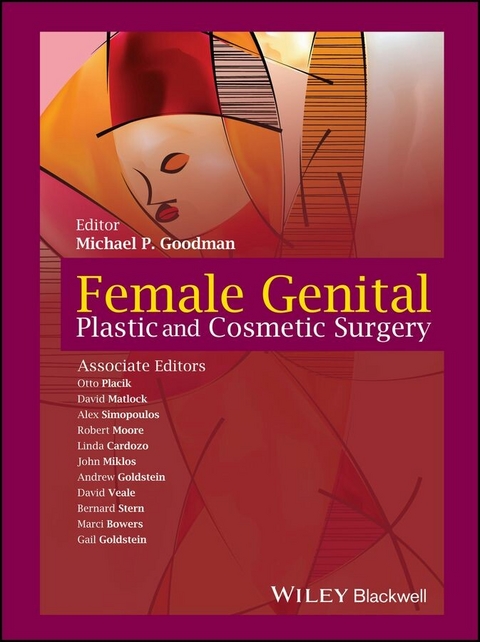
Female Genital Plastic and Cosmetic Surgery (eBook)
John Wiley & Sons (Verlag)
978-1-118-84848-7 (ISBN)
Female genital plastic surgery has become an increasingly sought-after option for women seeking “improvement” in genital appearance, relief from discomfort, and increased sexual pleasure. These surgeries are a combination of gynecologic, plastic, and cosmetic procedures. Every year sees a higher demand for physicians properly trained and able to perform them.
This unique text from the acknowledged experts in the field covers;
- the anatomy of the area
- the specific surgical procedures and all their variations
- patients' rationales for surgery
- training guidelines and ethical issues
- outcome statistics
- sexual issues
- patient selection
- potential risks and complications.
Examining the issues from individual patient's perspectives, it is written in an academic but easy-to-read style with understandable and unambiguous drawings and photographs. It contains a step-by-step surgical approach, how to best select the right surgical candidates, how to treat this select group of patients, the sexual issues involved, how to individualize techniques for each specific patient, how to deal with criticism from colleagues or journalists, psychosexual issues, and patient protection.
Michael P Goodman, MD, FACOG, Medical Director, Caring For Women Wellness Center, Davis, CA, USA.
Female genital plastic surgery has become an increasingly sought-after option for women seeking 'improvement' in genital appearance, relief from discomfort, and increased sexual pleasure. These surgeries are a combination of gynecologic, plastic, and cosmetic procedures. Every year sees a higher demand for physicians properly trained and able to perform them. This unique text from the acknowledged experts in the field covers; the anatomy of the area the specific surgical procedures and all their variations patients' rationales for surgery training guidelines and ethical issues outcome statistics sexual issues patient selection potential risks and complications. Examining the issues from individual patient's perspectives, it is written in an academic but easy-to-read style with understandable and unambiguous drawings and photographs. It contains a step-by-step surgical approach, how to best select the right surgical candidates, how to treat this select group of patients, the sexual issues involved, how to individualize techniques for each specific patient, how to deal with criticism from colleagues or journalists, psychosexual issues, and patient protection.
Michael P Goodman, MD, FACOG, Medical Director, Caring For Women Wellness Center, Davis, CA, USA.
List of contributors, vi
Preface, vii
Acknowledgments, viii
1 Introduction, 1
Michael P. Goodman
2 Genital plastics: the history of development, 3
Michael P. Goodman
3 Anatomic considerations, 9
Orawee Chinthakanan, Robert D. Moore, and John R. Miklos
4 Definitions, 25
Michael P. Goodman
5 Philosophy, rationale, and patient selection, 31
Michael P. Goodman
6 Ethical considerations of female genital plastic cosmetic surgery, 39
Andrew T. Goldstein and Sarah L. Jutrzonka
7 Patient protection and pre-operative assessment, 45
Michael P. Goodman
8 Surgical procedures I: vulva and mons pubis, 51
Michael P. Goodman, with contributions from David Matlock, Alex Simopoulos, Bernard H. Stern, and Otto J. Placik
9 Surgical procedures II: perineoplasty, vaginoplasty, colpoperineoplasty ("vaginal rejuvenation"), 88
Robert D. Moore, John R. Miklos, and Orawee Chinthakanan
10 The biomechanics and physiology of clitoral and vaginally activated orgasm: impact of vaginal tightening operations, 102
Michael P. Goodman
11 The G-spot, 108
Dudley Robinson and Linda Cardozo
12 Post-operative care, 112
Michael P. Goodman
13 Aesthetic male-to-female transsexual surgery, 120
Marci Bowers
14 Anesthetic choices and office-based surgery, 131
Michael P. Goodman
15 Non-surgical cosmetic vulvovaginal procedures, 138
Gustavo Leibaschoff and Pablo Gonzalez Isaza
16 Surgical risks and untoward outcomes, 154
Otto J. Placik
17 Revisions and re-operations, 186
Michael P. Goodman
18 Psychosexual issues, 200
Michael P. Goodman
19 Outcomes, 206
Michael P. Goodman
20 Pearls for practice, 212
Michael P. Goodman
21 Standards of care, 215
Michael P. Goodman
Index, 222
CHAPTER 2
Genital plastics: the history of development
Michael P. Goodman
Caring for Women Wellness Center, Davis, CA, USA
With a contribution from David Matlock
The only reason some people get lost in thought is because it’s unfamiliar territory.
Paul Fix
Documented since the time of the pharaohs in ancient Egypt, women throughout history have modified their genitalia via adornments, devices, colorations, bleaches, and reductive and expansive techniques.
Although gynecologic surgeons have for years performed surgical procedures resulting in alterations in genital size, appearance, and function (repairs after obstetrical delivery, perineorrhaphy, anterior/posterior colporrhaphy, intersex and transsexual surgical procedures), in addition to reductions for pediatric labial hypertrophy, Honore and O’Hara in 1978, Hodgekinson and Hait in 1984, and Chavis, LaFeria, and Niccolini in 1989 were the first to discuss genital surgical alterations performed for aesthetic and/or sexual reasons (see references 2–4 in Chapter 1).
Traditionally taught in OB/GYN residencies as surgical procedures designed for symptomatic pelvic floor herniations of bladder, urethra, rectum, or peritoneal cavity, but never proposed as a sexual-enhancing surgical procedure, traditional anterior and posterior “repairs” (colporrhaphies) are being adapted to improve sexual function by strengthening the pelvic floor and tightening the vaginal barrel to produce greater friction and vaginal wall pressure. This “shifting” of indications and modification of traditional gynecologic surgery primarily for reasons of enhancement of sexual function has not been without controversy, as gynecologic academic organizations such as the American Congress of Obstetricians and Gynecologists (ACOG) have officially decried this representation [1].
In step with ACOG, the Society of Obstetricians and Gynaecologists of Canada (SOGC) published its Policy Statement No. 300, December 2013 [2], in which they opine that the literature “does not support non-medically indicated female cosmetic surgery procedures considering the available evidence of efficacy and safety.” This document appears to be a modification of the ACOG Opinion No. 378, September 2007, referenced above and, as was the ACOG opinion, was written by non-community academics, few if any of whom have any experience in the field of genital plastics or the benefit of consultation with or study of women seeking genital cosmetic care.
The same SOGC document advises practitioners in Canada that “Physicians who choose to undertake cosmetic procedures to the vagina and vulva should be appropriately trained in the gynaecologic and/or plastic surgery aspects of cosmetic surgery of the lower genital tract.”
Although multiple articles describing vulvar labiaplasty technique, along with small retrospective case series, are available in the literature from the late 1980s onward (3–15), it was not until the early twenty-first century that procedures designed specifically for reduction of labial and clitoral hood size, narrowing of the hymenal aperture, and increasing vaginal wall pressure by surgical narrowing of the vagina were widely publicized in the lay press and online. As an extension of “women’s liberation” and the owning of her own sexuality, and with the advent of social sharing sites, more vulvar visibility secondary to various depilation techniques (Figure 2.1), and wishing to improve one’s self-image to “feel more comfortable in her own skin,” women in increasing numbers are seeking vulvar and vaginal aesthetic and plastic modifications.
Figure 2.1 Visibility and “cushioning” of vulvar structures. Source: Michael P. Goodman. Reproduced with permission.
While no “official” statistics on the varied FGPS procedures are kept by either the American Academy of Cosmetic Surgeons, the British Association of Aesthetic Plastic Surgeons, or the American Society of Plastic Surgeons (ASPS), the ASPS did note a 30% increase in “VRJ” procedures between 2005 and 2006 (793 to 1,030) but did not keep statistics beyond 2006 (16). The American Society for Aesthetic Plastic Surgery (ASAPS) kept demographic data for “VRJ” procedures in 2007 and found that of 4,505 procedures noted, 38.1% were in the 19–34 age group, 54.4% age 35–50, 2.4% 18 and under, and 5.1% 51 and older (17). According to the ASAPS 2012 statistics presented at their 2013 annual meeting, over 3,500 vaginal rejuvenation (CP, VRJ, PP) procedures were performed, representing a 64% increase from 2011. Informal polls of high-volume genital plastic/cosmetic surgeons by the editors of the journal of the ASAPS, along with the increase in volume of liability actions referable to genital cosmetic surgery, suggest a continued rise in the public’s interest in these procedures. Although, in this author’s estimation, obstetrician-gynecologists perform a volume equal to that of plastic surgeons, gynecology specialty organizations have taken no interest in promoting these procedures in any way, including keeping statistics involving numbers performed annually by their members. I suspect both plastic surgery and OB/GYN societies would be surprised at the actual volume.
Mirzabeigi et al. in 2009 surveyed members of the ASPS via electronic mail (18); 750 surgeons responded (a 19.7% response rate.) Although selection bias very likely increased the rate, 51% of the sample currently offered labiaplasty, and responding members performed a total of 2,255 procedures in the previous 2 years (2007, 2008).
A major milestone in the development of surgical technique was reported in the 1998 article by Gary Alter, MD (8), describing the “modified V-wedge” procedure for reducing labial volume. Developed in response to the often poor cosmetic appearance and edge sensitivity noted by many patients receiving a linear resection-based labiaplasty performed with large-caliber suture and often a continuous running suture technique, Alter’s procedure, although requiring a longer learning curve and representing an increased risk of wound disruption, offered the promise of better cosmetic appearance and little risk of neurological alteration, a potential benefit not proven by prospective research.
Instruction in plastic tissue handling and suturing technique and the specific procedures of cosmetic labiaplasty and aesthetic hood reduction, as well as sexual pleasure-enhancing perineoplasty, is absent from virtually all OB/GYN residency programs. Cosmetic labiaplasty technique is taught in only a percentage of plastic surgery residencies (and pelvic floor surgery rarely taught). Due to the lack of training in academic centers, it was inevitable that community surgeons would respond to the emerging and burgeoning demand for cosmetic female genital procedures. Unfortunately, many gynecologists, by virtue of being vaginal surgeons and having observed or performed a limited number of extirpative labial techniques (for in situ or invasive malignancies) in residency, feel that they are equipped to perform both labial reductive and vaginal floor-tightening procedures for reasons of enhancing sexual pleasure. Although gynecologists are trained in pelvic floor restoration, they are undereducated in the use of these surgical techniques specifically for sexual indications. The reality is that, in the absence of any meaningful instruction in careful plastic technique, or instruction in aesthetic labiaplasty or sexuality-oriented vaginoplasty/perineoplasty, general gynecologists, as well as a large percentage of plastic surgeons, are ill equipped to perform these procedures. Academic physicians, most recently Cheryl Iglesia, MD [19], who write editorials, “regulations,” and “practice advisories,” are also not specifically trained and/or experienced in these procedures and appear to shun what they do not understand.
In his own words, Dr. David Matlock, one of FGPS’s early pioneers, describes his seminal experience.
The history of the development of female genital plastic and cosmetic surgery
David Matlock
My path in FGPS started in 1996. In general, my interest in cosmetic surgery started in 1987 with the implementation of liposuction into my gynecology practice. The tumescent liposuction technique revolutionized liposuction and eventually was employed in other procedures including breast reductions performed via tumescent liposuction. During this time, I was also interested in the emerging trend of laser technologies for surgery. I took as many hands-on laser courses as available and read the latest textbooks. It wasn’t long before I had a desire to apply this cosmetic and laser knowledge to vaginal surgery. My goal at the time was to restore form, function, and appearance.
To formulate my knowledge base and surgical technique I reviewed research papers and pertinent chapters of Gray’s Anatomy, Te Linde’s Operative Gynecology, and Grabb and Smith’s Plastic Surgery. The objective was to extrapolate from scientific knowledge and formulate a procedure consistent with the goals of enhancing form, function, and aesthetic appearance. The vulvovaginal structures of young nulliparous patients in my practice served as a model to emulate in surgery. A big part of cosmetic surgery is restoring youth or creating a more youthful appearance. I took a common gynecologic...
| Erscheint lt. Verlag | 3.2.2016 |
|---|---|
| Mitarbeit |
Stellvertretende Herausgeber: Otto Placik, David Matlock, Alex Simopoulos, Robert Moore, Linda Cardozo, John Miklos, Andrew T. Goldstein, David Veale, Bernard Stern, Marci Bowers, Gail Goldstein |
| Sprache | englisch |
| Themenwelt | Medizinische Fachgebiete ► Chirurgie ► Ästhetische und Plastische Chirurgie |
| Medizin / Pharmazie ► Medizinische Fachgebiete ► Gynäkologie / Geburtshilfe | |
| Schlagworte | Colpoperineoplasty • cosmetic surgery • female genital plastic surgery • Gynäkologie • Gynäkologie u. Geburtshilfe • Gynäkologie • Gynäkologie u. Geburtshilfe • Medical Science • Medizin • Obstetrics & Gynecology • perineoplasty • Plastic & Reconstructive Surgery • Plastische Chirurgie • Plastische u. rekonstruierende Chirurgie • Vaginoplasty |
| ISBN-10 | 1-118-84848-9 / 1118848489 |
| ISBN-13 | 978-1-118-84848-7 / 9781118848487 |
| Informationen gemäß Produktsicherheitsverordnung (GPSR) | |
| Haben Sie eine Frage zum Produkt? |
 EPUB (Adobe DRM)
Kopierschutz: Adobe-DRM
Adobe-DRM ist ein Kopierschutz, der das eBook vor Mißbrauch schützen soll. Dabei wird das eBook bereits beim Download auf Ihre persönliche Adobe-ID autorisiert. Lesen können Sie das eBook dann nur auf den Geräten, welche ebenfalls auf Ihre Adobe-ID registriert sind.
Details zum Adobe-DRM
Dateiformat: EPUB (Electronic Publication)
EPUB ist ein offener Standard für eBooks und eignet sich besonders zur Darstellung von Belletristik und Sachbüchern. Der Fließtext wird dynamisch an die Display- und Schriftgröße angepasst. Auch für mobile Lesegeräte ist EPUB daher gut geeignet.
Systemvoraussetzungen:
PC/Mac: Mit einem PC oder Mac können Sie dieses eBook lesen. Sie benötigen eine
eReader: Dieses eBook kann mit (fast) allen eBook-Readern gelesen werden. Mit dem amazon-Kindle ist es aber nicht kompatibel.
Smartphone/Tablet: Egal ob Apple oder Android, dieses eBook können Sie lesen. Sie benötigen eine
Geräteliste und zusätzliche Hinweise
Buying eBooks from abroad
For tax law reasons we can sell eBooks just within Germany and Switzerland. Regrettably we cannot fulfill eBook-orders from other countries.
aus dem Bereich