


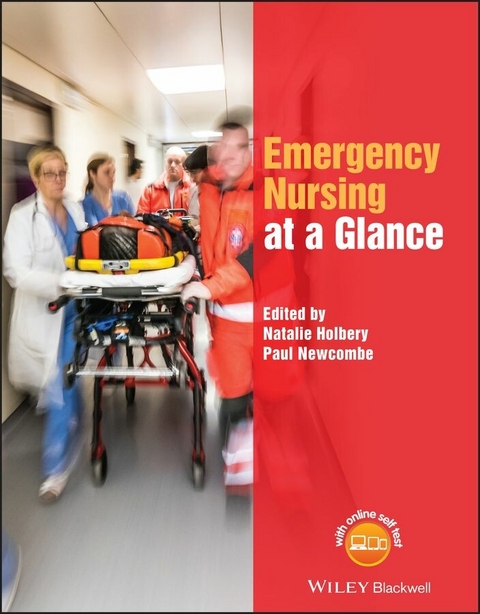
Emergency Nursing at a Glance (eBook)
184 Seiten
Wiley-Blackwell (Verlag)
9781118867662 (ISBN)
From the publishers of the market-leading at a Glance series comes a wide-ranging and succinct overview of the key concepts of emergency care. Emergency Nursing at a Glance uses the unique and highly visual at a Glance format to convey vital information quickly and efficiently, ensuring that nursing students have access to all the important topics they need for an emergency care placement. This highly visual, easy-to-read guide is the ideal companion for anyone entering fields involving urgent or unscheduled care.
•Includes all aspects of emergency care, including trauma, minor injury, triage processes, patient assessment, common emergency presentations, as well as legal, ethical and professional issues.
•Covers care of adults, children, and those with learning disabilities and mental health conditions
•Presented in the bestselling at a Glance format, with superb illustrations and a concise approach
Emergency Nursing at a Glance is an invaluable resource for nursing students, newly qualified nurses and other healthcare professionals working in emergency departments, urgent care centres, minor injury units and walk-in centres.
Natalie Holbery, Lecturer/Practitioner Emergency Care, St George's University Hospital NHS Foundation Trust, Kingston University and St George's, University of London
Paul Newcombe, Associate Professor, Kingston University and St George's, University of London
Natalie Holbery, Lecturer/Practitioner Emergency Care, St George's University Hospital NHS Foundation Trust, Kingston University and St George's, University of London Paul Newcombe, Associate Professor, Kingston University and St George's, University of London
Emergency Nursing at a Glance 3
Contents 7
Contributors 9
Preface 10
Acknowledgements 10
About the companion website 11
Part 1 Initial patient assessment 13
1 The context of emergency nursing 14
2 Pre-hospital care 16
3 Triage 18
4 The ‘ABCDE’ approach 20
5 Track and trigger systems 22
6 Pain 24
Part 2 Airway and breathing 27
7 Airway assessment and management 28
8 Assessment of breathing 30
9 Oxygen therapy 32
10 Respiratory conditions 34
Part 3 Circulation 37
11 Assessment of circulation 38
12 Circulation interventions 40
13 Shock 42
14 12-lead electrocardiogram (ECG) 44
15 Cardiac arrhythmias 46
16 Acute coronary syndromes (ACS) 48
17 Heart failure 50
18 Advanced life support (ALS) 52
Part 4 Disability 55
19 Assessment of neurological function 56
20 The unconscious patient 58
21 Stroke 60
22 Seizures 62
23 Headache 64
Part 5 Emergency presentations and conditions 67
24 Abdominal pain 68
25 Gastrointestinal bleed 70
26 Genitourinary conditions 72
27 Acute kidney injury (AKI) 74
28 Diabetic emergencies 76
29 Obstetrics and gynaecology 78
Part 6 Poisoning and overdose 83
30 Poisoning: Assessment and management 84
31 Poisoning: Prescription and non-prescription drugs 86
32 Poisoning: Other substances 88
33 Alcohol misuse 90
Part 7 Infectious diseases 93
34 Infectious diseases 94
35 Notifiable diseases 96
36 Sexually transmitted infections (STI) 98
Part 8 Vulnerable patient groups 101
37 Domestic abuse 102
38 Sexual assault 104
39 The mental health patient in the emergency department (ED) 106
40 Risk assessment, self-harm and suicide 108
41 Common mental health problems 110
42 The patient with dementia 112
43 The patient with an intellectual disability 114
Part 9 Children in the emergency department 117
44 Children in the emergency department (ED) 118
45 Safeguarding children 120
46 Recognising the sick child 122
47 Common illnesses in children 124
48 Paediatric advanced life support 126
Part 10 Minor injuries and conditions 129
49 Minor injuries in children 130
50 Lower limb injuries 132
51 Upper limb injuries 134
52 Wounds 136
53 Eye conditions 138
54 Ear, nose and throat conditions 140
Part 11 Major Trauma 143
55 Trauma in context 144
56 Primary survey 146
57 Head and spinal injury 148
58 Chest trauma 150
59 Limb injuries 152
60 Abdominal and pelvic trauma 154
61 Massive haemorrhage 156
62 Burns 158
63 Trauma: Special circumstances 160
64 Trauma in children 162
65 Major incident 164
Part 12 Patient transfer and end of life care 167
66 Patient transfer 168
67 End of life care 170
Further reading/references 173
Index 177
EULA 183
This is an excellent resource for emergency nurses of all levels. It highlights common presentations to the emergency department (ED) from wounds to poisoning to cardiac arrests....It should be mandatory reading for all nurses starting a career in the ED (Nursing Standard- Sept 2016)
| Erscheint lt. Verlag | 25.1.2016 |
|---|---|
| Reihe/Serie | At a Glance (Nursing and Healthcare) |
| Wiley Series on Cognitive Dynamic Systems | Wiley Series on Cognitive Dynamic Systems |
| Sprache | englisch |
| Themenwelt | Medizin / Pharmazie ► Pflege ► Fachpflege |
| Schlagworte | Acute, Critical & Emergency Care • Care • Common • Einführungen in die Krankenpflege • Einführungen in die Krankenpflege • Emergency • Emergency Medicine & Trauma • Ethical • Injury • Intensivpflege • Intensiv- u. Notfallpflege • Introductions to Nursing • Krankenpflege • legal • Medical Science • Medizin • minor injury • Notfallmedizin • Notfallmedizin u. Traumatologie • Notfallpflege • nursing • patient assessment • Presentations • Professional • Trauma • triage processes • unscheduled • urgent • Walk-In |
| ISBN-13 | 9781118867662 / 9781118867662 |
| Informationen gemäß Produktsicherheitsverordnung (GPSR) | |
| Haben Sie eine Frage zum Produkt? |
 PDF (Adobe DRM)
Kopierschutz: Adobe-DRM
Adobe-DRM ist ein Kopierschutz, der das eBook vor Mißbrauch schützen soll. Dabei wird das eBook bereits beim Download auf Ihre persönliche Adobe-ID autorisiert. Lesen können Sie das eBook dann nur auf den Geräten, welche ebenfalls auf Ihre Adobe-ID registriert sind.
Details zum Adobe-DRM
Dateiformat: PDF (Portable Document Format)
Mit einem festen Seitenlayout eignet sich die PDF besonders für Fachbücher mit Spalten, Tabellen und Abbildungen. Eine PDF kann auf fast allen Geräten angezeigt werden, ist aber für kleine Displays (Smartphone, eReader) nur eingeschränkt geeignet.
Systemvoraussetzungen:
PC/Mac: Mit einem PC oder Mac können Sie dieses eBook lesen. Sie benötigen eine
eReader: Dieses eBook kann mit (fast) allen eBook-Readern gelesen werden. Mit dem amazon-Kindle ist es aber nicht kompatibel.
Smartphone/Tablet: Egal ob Apple oder Android, dieses eBook können Sie lesen. Sie benötigen eine
Geräteliste und zusätzliche Hinweise
Buying eBooks from abroad
For tax law reasons we can sell eBooks just within Germany and Switzerland. Regrettably we cannot fulfill eBook-orders from other countries.


