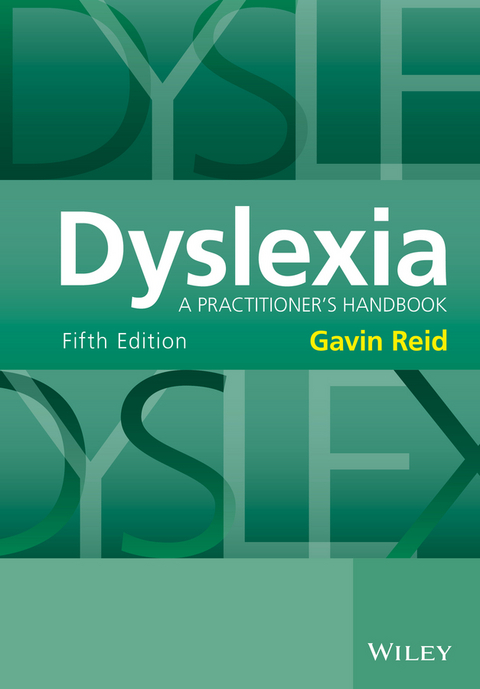
Dyslexia (eBook)
John Wiley & Sons (Verlag)
978-1-118-98011-8 (ISBN)
Newly updated, Gavin Reid's best-selling handbook remains an essential resource for those helping dyslexic individuals of all ages, from preschoolers to adults in the workplace.
- Combines theoretical explanations, the latest research, and practical solutions with a focus on inclusion and meeting the individual's needs
- New and expanded coverage includes: multilingualism; the use of technology; co-existing conditions such as dyspraxia, dyscalculia, and ADHD; and positive dyslexia
- Assembles the latest policies and best practices for dyslexia from around the world, and makes current debates regarding education and literacy accessible to trainees and practitioners
Gavin Reid is an experienced teacher, psychologist and author, and the owner/director of Dr Gavin Reid Education Consultants Ltd. He was formerly Senior Lecturer in the Department of Educational Studies at the University of Edinburgh, UK, and Visiting Professor in the Department of Education and Counseling Psychology and Special Education at the University of British Columbia in Vancouver, Canada. He is a director of the Red Rose School in Lancashire, UK, and a director of Global Educational Consultancies (GEC) based in Cairo, Egypt. He is chair of the BDA accreditation board, an ambassador for the Helen Arkell Dyslexia Centre and a consultant to Institute for Child Education and Psychology Europe (ICEPE). He is the author and editor of 27 books, and has lectured to thousands of parents and professionals in 70 countries. His work has been recognized with several educational awards, many of his books are used as course texts throughout the UK and in other countries, and they have been translated into Italian, French, Polish and Croatian.
Newly updated, Gavin Reid's best-selling handbook remains an essential resource for those helping dyslexic individuals of all ages, from preschoolers to adults in the workplace. Combines theoretical explanations, the latest research, and practical solutions with a focus on inclusion and meeting the individual's needs New and expanded coverage includes: multilingualism; the use of technology; co-existing conditions such as dyspraxia, dyscalculia, and ADHD; and positive dyslexia Assembles the latest policies and best practices for dyslexia from around the world, and makes current debates regarding education and literacy accessible to trainees and practitioners
Gavin Reid is an experienced teacher, psychologist and author, and the owner/director of Dr Gavin Reid Education Consultants Ltd. He was formerly Senior Lecturer in the Department of Educational Studies at the University of Edinburgh, UK, and Visiting Professor in the Department of Education and Counseling Psychology and Special Education at the University of British Columbia in Vancouver, Canada. He is a director of the Red Rose School in Lancashire, UK, and a director of Global Educational Consultancies (GEC) based in Cairo, Egypt. He is chair of the BDA accreditation board, an ambassador for the Helen Arkell Dyslexia Centre and a consultant to Institute for Child Education and Psychology Europe (ICEPE). He is the author and editor of 27 books, and has lectured to thousands of parents and professionals in 70 countries. His work has been recognized with several educational awards, many of his books are used as course texts throughout the UK and in other countries, and they have been translated into Italian, French, Polish and Croatian.
Dyslexia 3
Contents 7
About the Author 16
Other Books by Gavin Reid 18
Foreword 20
Preface 23
Chapter 1 Defining Dyslexia 27
Defining Dyslexia 28
Purpose of Definitions 30
How Should We Define Dyslexia? 31
Definitions 33
Barriers to Implementing Policy 37
Rose Review and Dyslexia 37
Education for Learners with Dyslexia 38
Different Perspectives and Agenda 40
Points for Reflection 41
Chapter 2 Explaining Dyslexia: The Range of Research 43
Causal Modelling Framework 44
Causal Modelling Framework: An Explanation 44
Genetic Factors 45
Neurobiological Factors 46
Visual and Temporal Processing 46
Magnocellular Visual System 46
Procedural Timing 48
Hemispheric Symmetry 49
Processing Speed 50
Phonological Processing 51
Phonological Awareness and Multisensory Programmes 51
Morphological Processing 52
Glue Ear 53
Cognitive Skills 55
Metacognition 55
Environmental Factors 55
Additional Language Learning 56
Dyslexia in Different Orthographies 57
Self-disclosure in Adults 59
Points for Reflection 60
Chapter 3 Assessment: Issues and Considerations 61
The Context 61
Assessment Aims 63
Discrepancy Criteria 63
Listening Comprehension 64
Componential Model of Reading 64
Curriculum Focus 65
Why an Assessment? 66
How? The Assessment Process 66
Effect of an Assessment 68
Assessment—Points to Consider 68
Some Other Considerations 68
Self?concept 68
The Role of Parents 70
Assessment and Inclusion 72
The Bilingual Learner 72
Points for Reflection 73
Chapter 4 Identifying Needs 74
The Context 74
Information Processing 75
Factors That Can Prompt Concern 76
Pre?school 76
School Age 76
After Around 2 Years at School 77
Upper Primary 77
Secondary 77
Further and Higher Education 77
Workplace 78
Linking Assessment with Intervention and Support 78
Key Aspects of an IEP 78
The Overlap 79
Assessing Performances 79
Criteria: Summary 80
Whose Responsibility? 83
Early Identification 83
Models of Identification 85
Expert/Intervention—Attainment 85
Discrepancy Model 85
Policy Model 87
Stage Process Model 88
Curriculum?focused Model 89
Barriers to Learning 89
Whole-School Involvement 90
Early Warning Signs 90
Assessment/Consultancy with Management Team 90
Monitoring/Review Meeting 91
Points for Reflection 91
Chapter 5 Assessment: Approaches and Resources 92
The Use of Tests—Points to Ponder 93
Assessment and Information Processing 93
Cognitive Measures 94
Assessment of Processing Skills 95
Comprehensive Test of Phonological Processing (CTOPP-2) 96
Woodcock Reading Mastery Tests 97
Gray Oral Reading Tests (GORT-5) 97
Standardised/Psychometric Criteria 97
Standardisation 98
Psychometric 99
Wechsler Individual Achievement Test (WIAT-II and III) 100
Comment 100
Phonological Representation and Assessment 101
Screening 102
Curriculum Assessment 105
Miscue Analysis 106
Assessment in Context 107
Assessment for Learning 108
Principles of Formative Assessment in Practice 109
Metacognitive Assessment 109
Assisted Assessment 110
Multiple Intelligences Approaches 111
A Components Approach 112
Observational Assessment 114
Observational Framework 114
Attention 115
Organisation 115
Sequencing 115
Interaction 115
Language 115
Comprehension 116
Reading 116
Visual 116
Auditory 116
Motivation/Initiative 116
Self?concept 117
Relaxation 117
Learning Preferences 117
Learning Context 118
Systematic Observation 118
Summary 119
Points for Reflection 120
Chapter 6 Reading—Social, Cultural and Government Perspectives 121
The Social Context for Literacy 121
Literacy and Culture 121
Defining Literacy 122
Critical Literacy 124
Engaging the Reader through Critical Literacy 125
Challenging Assumptions 127
Government Initiatives 128
Literacy Standards and International Comparisons 130
PISA Study 132
Literacy Initiatives 132
Points for Reflection 133
Chapter 7 The Acquisition of Literacy 134
What is Reading? 134
Factors to Consider 135
Phonological Awareness 135
The Alphabetic System—Ehri 136
Reading as a Process 136
Reading Skills 137
Reading Practice 138
Developing Reading Skills 138
Key Factors 138
The Development of Reading 140
Developing Print Awareness 140
Visual Aspects 141
Role of Phonological Information 142
Phonological Representations and Dyslexia 142
Stages of Reading Development 143
Logographic Stage 143
Alphabetic Stage 143
Orthographic Stage 144
Limitations of the Stage Model of Reading 145
Reading and Memory 146
Relationship Between Phonology and Orthography 146
Dyslexia and Different Orthographies 147
Points for Reflection 148
Chapter 8 Reading Models and Methods 149
Bottom-Up and Top-Down Models 149
Connectionist Models 151
Balance Model of Reading 152
Method of Teaching Reading 153
Phonic Model 153
Look?and?Say Model 155
Language Experience Models 156
Developing Reading Skills 157
Teaching Reading—the Debate 158
Balanced Approach 160
Reading Interventions 161
Methodological Issues in Reading Intervention Research 163
Factors to Consider in Developing and Using Reading Approaches 164
The Literacy Experience 167
Framework for Teaching 168
Summary 169
Points for Reflection 170
Chapter 9 The Acquisition of Literacy: Spelling 171
Why is Spelling Difficult? 171
Systems Involved in Spelling 172
Phonological Systems 172
Spelling and Speech 173
Visual Systems 173
Homophones 174
Spelling Skills 174
Spelling Development 175
Spelling Policy 176
Spelling Strategies 176
Word Lists 176
Visual Strategies 177
Simultaneous Oral Spelling 178
Language Experience Approaches 179
Cued Spelling 180
Paired Spelling 181
Spelling Materials 182
The ACE Spelling Dictionary 182
Catchwords 182
Photocopiable Resources 182
Points for Reflection 183
Chapter 10 Expressive Writing 184
The Importance of Writing 184
Relationship Between Writing and Spelling 185
Expressive Writing: The Process 186
Cognitive Skills Associated with Writing 186
Writing in the Curriculum 187
Developing Metacognitive Skills through Writing 188
Metacognitive Strategies for Writing 189
Strategies for Writing 191
My Favourite Things 191
Motivation and Writing 192
Planning 193
Pre-writing Framework 193
Ideas/Detail 193
Organisation 194
Voice 194
Word Choice 194
Sentence Fluency 194
Conventions 195
Presentation 195
Developing Ideas 195
Handwriting 197
Handwriting – Some Points to Consider 197
Dysgraphia 198
Summary 198
Points for Reflection 199
Chapter 11 Teaching Approaches: Points to Consider 200
Overview of Approaches 201
The Context 202
Assessment and the Curriculum 203
The Learner 204
Programmes and Approaches—Some Considerations 205
Automaticity, Overlearning and Structure 205
Structure 206
Overlearning 208
Principles 209
Issues 209
Points for Reflection 212
Chapter 12 Supporting Literacy: Individualised Programmes 214
Criteria for Selection 215
Individualised Programmes 215
Orton–Gillingham (OG) 218
The Hickey Multisensory Language Course 220
Bangor Dyslexia Teaching System 221
Letterland 223
Reading Recovery 224
Identification 226
Evaluation of Reading Recovery 226
Toe by Toe: Multisensory Manual for Teachers and Parents 228
Alternative Approaches 229
Dietary Approaches 230
Exercise and Movement 231
The Inhibition of Primitive Reflexes 232
Educational Kinesiology 233
Comment on Alternative Interventions 233
Comment—Issues to Consider 235
Points for Reflection 236
Chapter 13 Supporting Literacy: Approaches and Strategies 237
Phonics Instructional Approaches 237
Jolly Phonics 239
Ann Arbor Publications 240
Interactive Literacy Games 240
Visual Stress 240
Smart Kids 241
Language Experience 241
Other Support Approaches 242
THRASS 242
Units of Sound 243
TextHelp 243
Inspiration 243
Phonological Approaches 244
Sound Linkage 244
Phonological Awareness Procedure 245
Phonic Code Cracker 245
High-Interest Books—History 245
Barrington Stoke (www.barringtonstoke.com) 246
Start to Finish Books 246
Differentiated Texts 247
Visual Factors 247
The Use of Visual Skills 249
Motor Aspects 250
Assisted Learning 251
Paired?reading 251
Evaluation of Paired?Reading as a Strategy 253
Comment 254
Summary 255
Points for Reflection 256
Chapter 14 Supporting Learning 257
Effective Learning 257
Key Points about Learning 259
The Learning Process 259
Realising Potential 262
Zone of Proximal Development 263
Developing Learning Skills 263
Learning Strategies 264
Multiple Intelligences 267
Study Skills 270
Set Goals 272
Feedback 272
Memory—Some Strategies 273
The Role of Self-esteem 275
Creativity and the ‘Gifted’ Dyslexic Student 275
Summary 276
Points for Reflection 277
Chapter 15 Inclusion: Curriculum Access 278
The Context 278
Responding to the Diverse Needs of Students 280
The Challenges 281
Individual Needs and Meeting the Needs of All 282
Meeting Curriculum Objectives 283
Index for Inclusion 283
Tensions and Contradictions 285
Assessment, Need and Accountability 286
Removing Barriers to Achievement 287
Interventions and Inclusion 287
The Debate 287
Implications 289
Making the School Inclusive 290
The Index for Inclusion Network 291
Equity 291
Principles of Inclusion 292
An Inclusive School 294
Healthy Schools 294
Supporting Inclusion 295
Staff Support and Training 296
Student Advocacy 298
Self?advocacy: Challenge or Threat? 298
Dyslexia and Self-advocacy 299
Staff Support 300
Key Factors 301
Points for Reflection 301
Chapter 16 Inclusion in Secondary Education: Accessing the Curriculum 302
Responsibility 303
Features of Secondary Schools 303
Differentiation and Curricular Development 306
Differentiation and Assessment 307
Subject Areas 307
Mathematics 307
Music 308
Science Subjects 311
Physics 313
English 314
Essay and Report Writing 316
Additional Language Learning 317
Social Subjects 319
Multiple Intelligences in Secondary Schools 320
Physical Education 321
Staff Development 322
Challenges: Key Areas 323
Points for Reflection 325
Chapter 17 Inclusion: Further and Higher Education and the Workplace 326
Further and Higher Education 327
Identification and Assessment 327
Assessment: The Context 328
Assessment: The Process 328
Factors to Consider 330
Assessment: The Effect 331
Feedback 332
Experience of Further and Higher Education 333
Models of Supports 334
Self?disclosure 335
Study Skills Models 336
Perceptions of Support 337
Coping Strategies 338
Self?esteem 339
The Workplace 339
Concluding Comment 341
Points for Reflection 342
Chapter 18 The Role of Parents 343
Parental Concerns 344
Focusing on Positives 345
Parental Support 346
Parents’ Challenges 348
Frustration 348
Trust 348
Understanding 349
Emotional Aspects 349
Parents as Partners 350
Points for Reflection 350
Chapter 19 Multilingualism: Challenges and Responses 351
Background and Context 351
Cultural Factors 352
Identification 353
Culture-fair Assessment 356
Teaching 357
Key Principles 358
Metacognitive Awareness/Schema 359
Concluding Points 360
Points for Reflection 360
Chapter 20 The Overlap—Dyslexia: Attention, Coordination, Auditory Processing and Numeracy 361
Introduction 361
The Overlap Dilemma 362
Attention Issues 363
Discrete Syndrome? 363
Framework for Attention Difficulties 364
Neurological Level 364
Cognitive Level 365
Classroom Factors 365
Identifying and Defining Attention Difficulties 366
Criteria 366
Intervention 368
ADHD and Creativity 371
Coordination, Movement and Handwriting 372
Intervention Strategies—15 Tasks to Try 373
Handwriting 374
Dysgraphia characteristics 374
Handwriting—Some Points to Consider 375
Dysgraphia Strategies 375
Early Intervention 376
Auditory Processing 377
Diagnosis and Overlap 377
Management of APD 378
Intervention 378
Treatments 379
Auditory Training 380
Home or School—Transitioning to Different Environments 380
Difficulty with Numbers 380
Introduction and Definition 380
Definitions 381
Reading in Mathematics 382
Diagnosing Dyscalculia 382
Intervention 383
Points for Reflection 385
Chapter 21 The Use of Computers and Technology 386
Introduction 386
iPads 387
Dyslexia Toolkit 387
Other Issues 388
Approaches Using New Technology 389
Resources—Computer Programs 390
British Dyslexia Association New Technologies Committee (BDA NTC) 391
Comment 392
Points for Reflection 392
Chapter 22 Positive Dyslexia 393
The Background 393
Five Key Factors 394
Recognising the Need to Boost Self?esteem 395
How Dyslexia Affects Children’s Learning 396
Metacognition 396
Encourage Creativity 397
Provide Feedback to Students About Their Own Personal Progress 397
Encourage Self-assessment 397
Develop Student Responsibility 398
Enhancing Creativity 398
Concluding Comment 400
Points for Reflection 400
Appendix 1 Some Popular Tests for Dyslexia that Can Be Used by Teachers 401
Test of Phonological Awareness, Second Edition: Plus (TOPA-2+) (2004) 401
Comprehensive Test of Phonological Processing, Second Edition (CTOPP-2) (2013) 401
Launch Into Reading Success—Test of Phonological Awareness (1997) 402
GORT-5: Gray Oral Reading Tests, Fifth Edition (2012) 402
TOWRE-2—Test of Word Reading Efficiency, Second Edition (2012) 403
WIST (Word Identification and Spelling Test) (2004) 403
DIBELS 404
Bangor Dyslexia Screening Test 404
Dyslexia Screening Test—Junior (DST-J) (2004) 405
Dyslexia Screening Test—Secondary (DST-S) (2004) 405
Dyslexia Screener (2004) 406
Cognitive Profiling System (CoPS) Version 5.1 (2010) 407
Special Needs Assessment Profile 407
WIAT-II UK for Teachers (2006) 408
Wechsler Individual Achievement Test (WIAT-II) (UK Norms and III US and Canada Norms Only) 408
Phonological Assessment Battery Revised (PhAB-2 ) 409
HAST-2 Helen Arkell Spelling Test 409
Wide Range Achievement Test (WRAT 4) 410
Wide Range Assessment of Memory and Learning, Second Edition (WRAML-2) (2003) 410
Test of Auditory Processing Skills—3 (TAPS-3) 410
Appendix 2 Further Contacts 411
International 411
North and South America and Canada 411
Australia and New Zealand 413
Europe 413
Middle East 414
Asia 415
Africa 415
Other Websites 416
Organisations 417
Articles and Reviews About Dyslexia 418
Literacy 419
References 420
Index 462
EULA 505
| Erscheint lt. Verlag | 21.1.2016 |
|---|---|
| Sprache | englisch |
| Themenwelt | Geisteswissenschaften |
| Medizin / Pharmazie ► Gesundheitsfachberufe ► Logopädie | |
| Sozialwissenschaften ► Pädagogik ► Sonder-, Heil- und Förderpädagogik | |
| Schlagworte | ADHD • Bildungswesen • CAPD • Developmental Disorders • Dyscalculia • dysgraphia • Dyslexie • Dyspraxia • Education • Educational & School Psychology • educational psychologists • Educational Psychology • Entwicklungsstörungen • Entwicklungsstörungen • Erziehungs- u. Schulpsychologie • learning differences • learning difficulties • Learning Disabilities • Legasthenie • Lesefähigkeit u. Dyslexie • Lesefähigkeit u. Dyslexie • Literacy • positive dyslexia • Psychologie • Psychology • Reading & Dyslexia • supporting literacy • supportive learning |
| ISBN-10 | 1-118-98011-5 / 1118980115 |
| ISBN-13 | 978-1-118-98011-8 / 9781118980118 |
| Informationen gemäß Produktsicherheitsverordnung (GPSR) | |
| Haben Sie eine Frage zum Produkt? |
 PDF (Adobe DRM)
Kopierschutz: Adobe-DRM
Adobe-DRM ist ein Kopierschutz, der das eBook vor Mißbrauch schützen soll. Dabei wird das eBook bereits beim Download auf Ihre persönliche Adobe-ID autorisiert. Lesen können Sie das eBook dann nur auf den Geräten, welche ebenfalls auf Ihre Adobe-ID registriert sind.
Details zum Adobe-DRM
Dateiformat: PDF (Portable Document Format)
Mit einem festen Seitenlayout eignet sich die PDF besonders für Fachbücher mit Spalten, Tabellen und Abbildungen. Eine PDF kann auf fast allen Geräten angezeigt werden, ist aber für kleine Displays (Smartphone, eReader) nur eingeschränkt geeignet.
Systemvoraussetzungen:
PC/Mac: Mit einem PC oder Mac können Sie dieses eBook lesen. Sie benötigen eine
eReader: Dieses eBook kann mit (fast) allen eBook-Readern gelesen werden. Mit dem amazon-Kindle ist es aber nicht kompatibel.
Smartphone/Tablet: Egal ob Apple oder Android, dieses eBook können Sie lesen. Sie benötigen eine
Geräteliste und zusätzliche Hinweise
Buying eBooks from abroad
For tax law reasons we can sell eBooks just within Germany and Switzerland. Regrettably we cannot fulfill eBook-orders from other countries.
aus dem Bereich