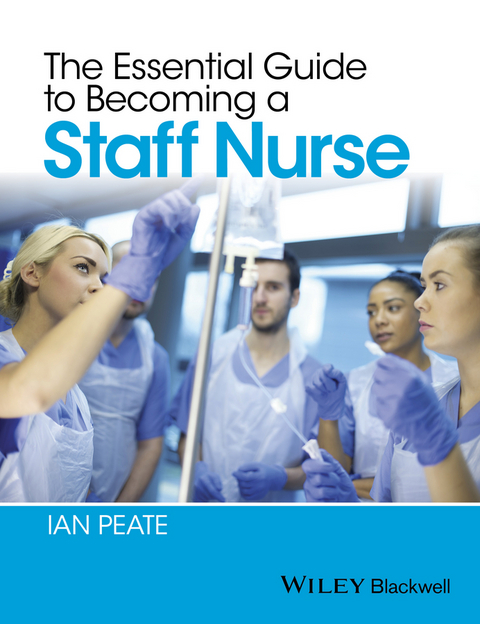

Written specifically for graduating students and newly registered nurses, this essential handbook will help you navigate the transition from student to registered practitioner. Providing you with the key knowledge to help consolidate your degree course, The Essential Guide to Becoming a Staff Nurse will enable you to become an autonomous and accountable practitioner.
Covering everything the newly registered nurse needs to know, this handy book explores:
- How to get the job you want
- The role and function of the staff nurse
- Accountability and delegation
- Working with patients and their families
- Becoming a manager
- Continuing professional and personal development
With activities, practical hints and tips throughout, this accessible aide-memoire will provide indispensable support for newly registered nurses in all fields.
Ian Peate is Professor of Nursing & Head of School at the School of Health Studies in Gibraltar. He is Editor in Chief of the British Journal of Nursing, and an Independent Consultant.
About the Author vii
Acknowledgements ix
Preface xi
1 Getting the job you want 1
2 Crossing the threshold: the role and function of the staff nurse 21
3 Support systems and preceptorship 42
4 Accountability and delegation 58
5 Using the evidence 74
6 Working with patients and their families 89
7 New ways of working: advancing nursing practice 107
8 Becoming a manager 125
9 Continuing professional and personal development 147
10 Teaching, learning and assessing 168
Index 185
Chapter 1
Getting the job you want
Aim
The aim of this chapter is to help you get the job you want.
Objectives
By the end of this chapter you will be able to:
- 1. Give some consideration to your future career prospects
- 2. Have further understanding of your role as a staff nurse
- 3. Read a job description critically
- 4. Put together your curriculum vitae (CV)
- 5. Understand how to complete an application for a job
- 6. Prepare for interview
Introduction
CONGRATULATIONS STAFF NURSE! Well done, you did it! Three years of hard labour, blood, sweat and for sure plenty of tears, and your name now appears on the professional register. OK, enough of the celebrations; it is time to get that job you really want.
In some areas jobs are hard to find and the competition can be stiff. You have to stand out above the crowd but you will need more than your good looks, wit and humour. The way to get the job that you want is to prepare, prepare and prepare; oh, and did I say prepare?
This opening chapter will consider the role of the staff nurse and some of the issues that can impact on the nurse's role and function. It is essential that you give serious consideration to where you want to be in 5 years' time (a common question used at interviews); so you must have an understanding of the various career options available to you. This chapter cannot do this for you; you have to do this but, be bold, think wide and far. Your registration is in effect your passport to the rest of the word – the world really is your oyster.
Application by curriculum vitae (CV) is becoming more popular; the chapter provides pointers on CVs. You must not forget however that the completion of a standard application form (electronic or hand written) is still very much used, particularly in the NHS.
There are sections in the chapter that help you read and understand a job description, encouraging you to look at it in a critical light. When you have considered your career trajectory, you have critically analysed the job description, tailored your CV to reflect the person specification and completed the application and have been invited for interview; at this point you really do have to talk the talk and walk the walk. There are hints and tips towards the end of the chapter that will help you prepare for interview.
The role of the staff nurse
Over the years the role of the staff nurse (the registered nurse) has changed and will continue to change and evolve. The changes are often the result of professional, statutory requirements as well as the demands made by the public on nurses and health services. Nurses are members of the multidisciplinary team, often acting as a pivot, the coordinator of care, particularly in the health care setting. The team will have common goals but each with their own different roles to perform. The Royal College of Nursing, RCN (2013) has defined various roles within what it calls the nursing family (see table 1.1).
Table 1.1 The nursing team – roles
| Registered nurses | Assistant practitioners | Health care assistants |
|
|
|
Source: Adapted from Royal College of Nursing (2003, 2013) and Skills for Health (2010).
The multidisciplinary/inter-relational working arrangements of the various members of the nursing team can be found in figure 1.1.
Figure 1.1 The inter-relational aspects of the various members of the nursing team.
Source: Adapted from Royal College of Nursing (2013).
The Health and Social Care Act 2012
This Act has introduced changes for the delivery of health and social care and has been hailed at the biggest changes to the NHS since the system was set up in 1948. A summary of some aspects of the Act is detailed in table 1.2. The Health and Social Care Act (the Act) is divided into 12 parts and is only relevant to England.
Table 1.2 A summary of some aspects of the 2012 Health and Social Care Act
|
When the Act was introduced, primary care trusts and strategic health authorities were abolished as part of the radical restructuring of the health service; new health and well-being boards have been established with the aim of improving integration between the NHS and local authority services. Clinical commissioning groups have taken over commissioning from primary care trusts and are working with the new NHS Commissioning Board. Monitor, a new regulator has been established to regulate providers of NHS services in the interests of patients and to prevent anticompetitive behaviour. The voices of those who use services have been strengthened with the setting up of a new national body, HealthWatch, and local HealthWatch organisations. Public Health England, a new body, is leading on public health nationally and local authorities do this at a local level.
These changes to the provision have had significant impact on the ways in which nurses work as well as on whom they work with. Having insight and being able to demonstrate this insight can help you at interview as you will be expected to be able to show an understanding of how the NHS is run and how the nurse contributes to its success.
Being up to date and demonstrating this at interview means not only being on top of contemporary practice issues but also having an all-round understanding of the politics of health and social care. You will only be able to confidently state facts with regard to how the provision of care is delivered at micro and macro levels and what has an impact on this if you have done your homework.
Things to consider
Take some time and think about the people who may be interviewing you for this your dream job. They are more than likely highly educated and in positions of seniority; they have seen so many changes over the years in many forms. They have seen changes made to the roles and function of nurses, they are looking for someone who knows what contemporary nursing is all about and they want you to be able to tell them what the drivers are behind role change. Do your homework and dig deep; be ready to discuss the politics behind the role.
The job description
A staff nurse's job is a staff nurse's job anywhere – wrong, and this is why it is essential that you are critical of the job description. At first glance according to Tremayne (2009) all jobs seem to offer the same things – excitement, challenge and flexibility. This is done in order to try and make their job stand out.
During your nursing studies you will have been asked as a senior student in your academic work to ‘critically analyse’. The skills that you have developed during your studies will now come into play with regard to the job description.
Critical analysis does not mean being negative; it requires you to be objective with regard to the job...
| Erscheint lt. Verlag | 19.1.2016 |
|---|---|
| Sprache | englisch |
| Themenwelt | Medizin / Pharmazie ► Pflege |
| Schlagworte | accountable • Advancing • Ausbildung u. Perspektiven i. d. Krankenpflege • Autonomous • CPD • development</p> • Einführungen in die Krankenpflege • Einführungen in die Krankenpflege • Introductions to Nursing • Krankenpflege • Leadership Management • <p>Policy • Nurse • nursing • Nursing Education & Professional Development • practice transition • Practitioner • professional qualified staff • Student |
| ISBN-13 | 9781118812280 / 9781118812280 |
| Informationen gemäß Produktsicherheitsverordnung (GPSR) | |
| Haben Sie eine Frage zum Produkt? |
 EPUB (Adobe DRM)
Kopierschutz: Adobe-DRM
Adobe-DRM ist ein Kopierschutz, der das eBook vor Mißbrauch schützen soll. Dabei wird das eBook bereits beim Download auf Ihre persönliche Adobe-ID autorisiert. Lesen können Sie das eBook dann nur auf den Geräten, welche ebenfalls auf Ihre Adobe-ID registriert sind.
Details zum Adobe-DRM
Dateiformat: EPUB (Electronic Publication)
EPUB ist ein offener Standard für eBooks und eignet sich besonders zur Darstellung von Belletristik und Sachbüchern. Der Fließtext wird dynamisch an die Display- und Schriftgröße angepasst. Auch für mobile Lesegeräte ist EPUB daher gut geeignet.
Systemvoraussetzungen:
PC/Mac: Mit einem PC oder Mac können Sie dieses eBook lesen. Sie benötigen eine
eReader: Dieses eBook kann mit (fast) allen eBook-Readern gelesen werden. Mit dem amazon-Kindle ist es aber nicht kompatibel.
Smartphone/Tablet: Egal ob Apple oder Android, dieses eBook können Sie lesen. Sie benötigen eine
Geräteliste und zusätzliche Hinweise
Buying eBooks from abroad
For tax law reasons we can sell eBooks just within Germany and Switzerland. Regrettably we cannot fulfill eBook-orders from other countries.
aus dem Bereich