


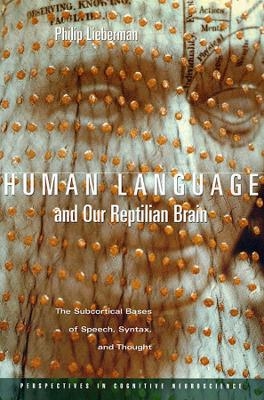
Human Language and Our Reptilian Brain
The Subcortical Bases of Speech, Syntax, and Thought
Seiten
2002
Harvard University Press (Verlag)
978-0-674-00793-2 (ISBN)
Harvard University Press (Verlag)
978-0-674-00793-2 (ISBN)
A prominent neuroscientist argues that human language—though more sophisticated than all other forms of animal communication—is not a qualitatively different ability from all forms of animal communication, it does not require a quantum evolutionary leap to be explained, and it is not unified in a single “language instinct.”
This book is an entry into the fierce current debate among psycholinguists, neuroscientists, and evolutionary theorists about the nature and origins of human language. A prominent neuroscientist here takes up the Darwinian case, using data seldom considered by psycholinguists and neurolinguists to argue that human language--though more sophisticated than all other forms of animal communication--is not a qualitatively different ability from all forms of animal communication, does not require a quantum evolutionary leap to explain it, and is not unified in a single "language instinct."
Using clinical evidence from speech-impaired patients, functional neuroimaging, and evolutionary biology to make his case, Philip Lieberman contends that human language is not a single separate module but a functional neurological system made up of many separate abilities. Language remains as it began, Lieberman argues: a device for coping with the world. But in a blow to human narcissism, he makes the case that this most remarkable human ability is a by-product of our remote reptilian ancestors' abilities to dodge hazards, seize opportunities, and live to see another day.
This book is an entry into the fierce current debate among psycholinguists, neuroscientists, and evolutionary theorists about the nature and origins of human language. A prominent neuroscientist here takes up the Darwinian case, using data seldom considered by psycholinguists and neurolinguists to argue that human language--though more sophisticated than all other forms of animal communication--is not a qualitatively different ability from all forms of animal communication, does not require a quantum evolutionary leap to explain it, and is not unified in a single "language instinct."
Using clinical evidence from speech-impaired patients, functional neuroimaging, and evolutionary biology to make his case, Philip Lieberman contends that human language is not a single separate module but a functional neurological system made up of many separate abilities. Language remains as it began, Lieberman argues: a device for coping with the world. But in a blow to human narcissism, he makes the case that this most remarkable human ability is a by-product of our remote reptilian ancestors' abilities to dodge hazards, seize opportunities, and live to see another day.
Philip Lieberman is Fred M. Seed Professor of Cognitive and Linguistic Sciences and Professor of Anthropology at Brown University.
Introduction 1. Functional Neural System 2. Speech Production and Perception 3. The Lexicon and Working Memory 4. The Subcortical Basal Ganglia 5. The Evolution of the Functional Language System 6. Commentary Notes Reference Index
| Erscheint lt. Verlag | 30.6.2002 |
|---|---|
| Reihe/Serie | Perspectives in Cognitive Neuroscience |
| Zusatzinfo | 6 halftones, 9 line illustrations |
| Verlagsort | Cambridge, Mass |
| Sprache | englisch |
| Maße | 156 x 241 mm |
| Gewicht | 354 g |
| Themenwelt | Geisteswissenschaften ► Psychologie ► Allgemeine Psychologie |
| Geisteswissenschaften ► Psychologie ► Biopsychologie / Neurowissenschaften | |
| Geisteswissenschaften ► Sprach- / Literaturwissenschaft ► Sprachwissenschaft | |
| Medizin / Pharmazie ► Medizinische Fachgebiete ► Neurologie | |
| ISBN-10 | 0-674-00793-X / 067400793X |
| ISBN-13 | 978-0-674-00793-2 / 9780674007932 |
| Zustand | Neuware |
| Informationen gemäß Produktsicherheitsverordnung (GPSR) | |
| Haben Sie eine Frage zum Produkt? |
Mehr entdecken
aus dem Bereich



aus dem Bereich
Paket bestehend aus »Das Patienten-Manual« und »Das Trainer-Manual«
Buch | Softcover (2025)
Schattauer (Verlag)
CHF 125,95


