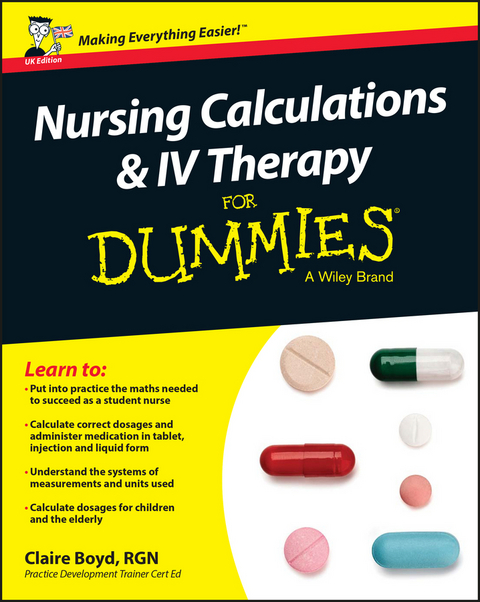
Nursing Calculations and IV Therapy For Dummies, UK Edition (eBook)
John Wiley & Sons (Verlag)
978-1-119-11440-6 (ISBN)
Is the maths behind the medicine making you maudlin over taking your Nursing Calculations test? You've come to the right place! Written by a nurse with countless hours of experience-and who trains other nurses every day-this plain-English, no-nonsense guide to nursing calculations and IV therapy makes it easier to come to grips with the numbers and formulas you'll encounter on the day of the exam-and in the field,
Many students and practising nurses struggle with mathematics, Luckily, this friendly guide is here to take the intimidation out of the subject, arming you with the knowledge and know-how you need to take the exam with confidence and to achieve the best score possible, From fractions, percentages, and proportions to pills, fluids, and prescriptions, Nursing Calculations & IV Therapy For Dummies UK edition offers detailed advice and instruction on everything you need to know to pass the exam with flying colours,
- Hundreds of practise questions help you learn and revise
- Clear explanations and lack of jargon make learning easy
- Observation charts and extra content are available for download upon purchase
- Combines nursing calculations and IV therapy to offer excellent value
Whether you're a student revising for the Nursing Calculations test, a newly qualified nurse looking to brush up on your maths skills, or a member of a medical staff who's been asked to take on nursing duties, this friendly and accessible guide makes maths less menacing,
Claire Boyd is a practice development trainer with the NHS and specialises in giving nurses the skills and self-belief to progress their careers, Her expertise is combined with a friendly approach to make learning both fast and fun,
The fast and easy way to pass the Nursing Calculations test Is the maths behind the medicine making you maudlin over taking your Nursing Calculations test? You've come to the right place! Written by a nurse with countless hours of experience and who trains other nurses every day this plain-English, no-nonsense guide to nursing calculations and IV therapy makes it easier to come to grips with the numbers and formulas you'll encounter on the day of the exam and in the field. Many students and practising nurses struggle with mathematics. Luckily, this friendly guide is here to take the intimidation out of the subject, arming you with the knowledge and know-how you need to take the exam with confidence and to achieve the best score possible. From fractions, percentages, and proportions to pills, fluids, and prescriptions, Nursing Calculations & IV Therapy For Dummies UK edition offers detailed advice and instruction on everything you need to know to pass the exam with flying colours. Hundreds of practise questions help you learn and revise Clear explanations and lack of jargon make learning easy Observation charts and extra content are available for download upon purchase Combines nursing calculations and IV therapy to offer excellent value Whether you're a student revising for the Nursing Calculations test, a newly qualified nurse looking to brush up on your maths skills, or a member of a medical staff who's been asked to take on nursing duties, this friendly and accessible guide makes maths less menacing.
Claire Boyd is a practice development trainer with the NHS and specialises in giving nurses the skills and self-belief to progress their careers. Her expertise is combined with a friendly approach to make learning both fast and fun.
Introduction 1
Part I: Getting Started with Nursing Calculations and IV Therapy 5
Chapter 1: Getting the Lowdown on Nursing Calculations and IV Therapy 7
Chapter 2: It's about Units, Innit! The Metric System of Measurement 19
Chapter 3: Making a Point: Fractions and Decimals 33
Chapter 4: Ordering Parts with Percentages, Averages and Ratios 45
Chapter 5: Making Sense of Moles and Solution Concentrates 59
Chapter 6: Administering Drugs Accurately and Safely 69
Part II: Working Out Tablet and Liquid Dosages 89
Chapter 7: Measuring the Important Vital Signs 91
Chapter 8: Sorting Out Medication Dosages 111
Chapter 9: Making Out the Make-Up of Pills 127
Chapter 10: Keeping Up to Scratch on Injections 137
Chapter 11: Comprehending Diagnostic Blood Tests: Venepuncture 155
Chapter 12: Using Advanced Formulae 169
Chapter 13: Monitoring Patients for Adverse Reactions 179
Part III: Figuring Out Infusion Rates for IV Therapy 197
Chapter 14: Water, Water, Everywhere! Looking at IV Fluids 199
Chapter 15: Discussing Drips and Drops: IV Therapy 221
Chapter 16: Round Peg in a Square Hole: Getting Drugs and Fluids
into the Body 239
Chapter 17: Administering Blood Components 259
Chapter 18: Reducing Infections and Needle Injuries 271
Chapter 19: Checking for IV Therapy Complications 285
Chapter 20: Meeting Sister Morphine: The Poppy and Pain Management 301
Part IV: Testing Your Calculations and IV Knowledge 311
Chapter 21: 101 Questions to Test Your IV Therapy Knowledge 313
Chapter 22: 101 Answers to the IV Therapy Questions 321
Part V: The Part of Tens 341
Chapter 23: Ten Tips for Administering IV Drugs Safely 343
Chapter 24: Ten Useful Drug-Administration Formulae 349
Chapter 25: Ten Key Points When Administering Medication 355
Index 359
Chapter 1
Getting the Lowdown on Nursing Calculations and IV Therapy
In This Chapter
Understanding the basic maths required for healthcare
Knowing IV therapy and its correct administration
Being clear on complications
Intravenous (IV) therapy is one of the most common clinical skills that healthcare professionals perform. It includes administering IV drugs, fluid replacement (including blood and blood products), cytotoxic therapy (chemotherapy) and parenteral nutrition (which doesn’t mean your mum and dad providing a hot meal when you pop home to get your washing done (!) but feeding ‘not via the alimentary canal’). Intravenous therapy can also take the form of administering emergency fluids and medications, such as when individuals have sustained huge blood loss, and/or to convert heart arrhythmias back to sinus rhythm.
In this chapter, I describe how this book takes you through the whole IV process – showing you how to walk before you can run. I help you get to grips with the mathematics and formulae necessary to work out the amounts of drugs or fluids to administer through the main routes, including oral, and translating doctors’ written instructions (which can be tricky at the best of times!).
This book also describes the types of IV therapy and how they can relate to patients’ blood tests obtained by venepuncture (flip to Chapter 11 for more) as well as their medical condition. I explore methods of getting the medications into the IV route as well as looking at the legal and professional aspects of IV therapy and complications associated with specific routes of administration.
Whatever your reason for entering healthcare, you share a common goal with all nurses and other healthcare professionals. You want to make your sick patients better, keep your healthy patients healthy and provide high-quality care to people, including those at their end-of-life journey.
This aim is encompassed within the culture of ‘compassionate care’ – known as the 6 Cs:
- Care
- Compassion
- Competence
- Communication
- Courage
- Commitment
Practices can, of course, vary among hospitals and clinical areas. Adhere to your own employer’s policies and procedures at all times and document all your actions.
Increasing Your Confidence in Healthcare-Related Maths
The Nursing and Midwifery Council (www.nmc.org.uk) specifically states that to become a registered nurse, you need to be competent in calculations that involve the following: ‘tablets and capsules, liquid medicines, injections, intravenous infusions including unit dose, sub- and multiple unit dose, complex calculation and SI conversion’ – quite a mouthful, but not as scary as it sounds.
For this reason, nursing students, midwives, assistant practitioners and any healthcare professionals involved in the administration of medicines undergo vigorous calculations testing throughout their training, in order to be able to perform drug calculations accurately.
As a healthcare care professional, when you want to administer IV drugs you attend a study session to discover the requirements of IV therapy. Usually before attending the session, you undertake a higher-level maths test in order to prove your maths competence. Many individuals like to revise a few of the basics, before progressing to the higher-level maths.
The wise saying (by the poet John Donne if you want to impress your friends!) goes that ‘no man is an island’. In the healthcare environment, this quote indicates that a patient isn’t just a physiological medical condition, but a living, breathing being with many elements (the biopsychosocial approach to care). In short, care isn’t just about working out the drug dosage to administer to the patient, to relieve the biological element of her needs; care involves treating the patient holistically.
Beginning with the basics
Much of the maths you need to become conversant with in the healthcare setting involve fractions, decimals and percentages.
Fractions
Like contestants on The Voice, fractions come in four forms (that’s got you thinking, hasn’t it!):
- Common fractions (also known as vulgar fractions): For example, 1 tablet needs to be cut into two, equates to 1 tablet ÷ 2 = ½.
- Decimal fractions: For example, when needing 0.45 ml (sometimes appears as mL) from 1 ml of liquid medication, 1 is the whole decimal number and 0.45 is a fraction of this whole number (being less than half).
- Percentage fractions: For example, administering a 1-litre (1,000-ml) bag of 5% glucose equates to 5 parts of glucose per every 100 parts of fluid.
- Ratio: For example, 25 patients are on ward 9B, 10 are being transferred to other wards today, with 5 of the 25 patients being discharged home, equals 25:10:5 or 5:2:1.
Decimals
Decimal numbers are built on the metric system, describing tenths, hundredths and thousandths of a number. For example, 1.25 is equal to one whole unit, plus a fraction of one (25 hundredths).
Some calculations require a conversion from the older imperial system of measurement into the metric system. An example is weighing scales showing stones and pounds instead of kilograms. In such cases, you need to know the conversion factors, such as 1 kilogram = 2.2 pounds. Chapter 8 shows how to conduct these conversions.
Chapter 2 covers the metric units and system and Chapter 3 takes you through your fractions and decimals basics.
Percentages
A percentage is a common way of expressing an amount relating to a whole. In healthcare you need to know information such as how much of a drug is in a solution, such as 0.9% sodium chloride in 1 litre of fluid (Chapter 5 has all the gen on solution concentrates).
You work this amount out as follows: (0.9 ÷ 100) × 1,000 ml = 9 grams. You now know that 9 grams of sodium chloride are in a 1-litre bag of fluid.
Chapter 4 takes you through your percentages calculations, as well as other basics, such as averages and ratios.
Choosing to Use Bundles
Often you’re required to work with quite complicated and complex mathematics in order to administer the correct amount of medication to the patient.
One method that can help with this task is the bundle system (which is where you break down the numbers into smaller units).
Imagine that 10 milligrams of a drug is presented as 5 millilitres. The patient is prescribed 2.5 milligrams of the drug and you need to find out how much this amount equates to in millilitres. You do so simply by breaking down the dose into smaller units:
- 10 mg = 5 ml
- 5 mg = 2.5 ml
- 2.5 ml = 1.25 ml
Therefore, the patient requires 1.25 millilitres of the drug.
(By the way, this example is also an example of the useful examples I provide throughout this book – as examples!)
Working out the tablet/capsule drug dosages
When a patient is prescribed, say, 300 milligrams of a medication presented as 300 milligrams per tablet, you know to administer one tablet. Simple. Sometimes, however, the maths can get a little more complicated, which is where the formula method or approach comes in useful.
Here’s one useful formula that you encounter throughout this book:
What you want ÷ what you’ve got
In other words, the prescribed amount divided by how the drug is presented in its packaging.
A patient requires 45 milligrams (that’s what you want) of a drug presented as 135 milligrams per tablet (that’s what you’ve got). Therefore, you use the above formula:
45 ÷ 135 = 0.33 mg, which equates to one third of the tablet
You can reverse-check this answer by multiplying 45 by 3 = 135 milligrams.
Chapter 8 takes you through the safety precautions of administering medications, because you’d never break a tablet into a third – the resulting tablet part may not be an accurate third. Plus, Chapter 9 discusses the process by which pills work in the body when taken orally.
Calculating liquid drug dosages
Liquid medications, including those required for injection (see Chapter 10), are presented in liquid format (or need to be reconstituted in liquid). You measure them into a pot, oral syringe or injectable syringe, using the same formula as for tablets and capsules (see the preceding section), but you have to add the extra aspect of ‘volume’. So the formula becomes:
(What you want ÷ What you’ve got) × Volume
For a prescribed dose of 250 milligrams of amoxicillin, from an ampoule containing 125 milligrams in 5 millilitres, you add the numbers into this formula:
(250 mg ÷ 125 mg) × 5 ml = 10 ml
In order to work out these drug dosages, good practice is to get someone to check your answer independently where possible and to use a calculator for the more complex calculations.
Chapter 8 goes through the common oral and injectable formulae for working out drug dosages, and Chapter 12 looks at the more advanced ones.
Monitoring...
| Erscheint lt. Verlag | 21.12.2015 |
|---|---|
| Sprache | englisch |
| Themenwelt | Medizin / Pharmazie ► Medizinische Fachgebiete |
| Medizin / Pharmazie ► Pflege ► Ausbildung / Prüfung | |
| Schlagworte | Allgemeine u. Innere Medizin • Claire Boyd • General & Internal Medicine • guide to nursing calculations • IV Therapy • maths behind the medicine • Medical Science • Medizin • newly qualified nurse • nurses struggle with mathematics • Nursing Calculations • Nursing Calculations & IV Therapy For Dummies • nursing calculations and IV therapy • Nursing Calculations test • nursing duties • practising nurse • revising for the nursing calculations test • sitting for your Nursing Calculations test • struggle with mathematics • student revising for the nursing calculations test |
| ISBN-10 | 1-119-11440-3 / 1119114403 |
| ISBN-13 | 978-1-119-11440-6 / 9781119114406 |
| Informationen gemäß Produktsicherheitsverordnung (GPSR) | |
| Haben Sie eine Frage zum Produkt? |
 EPUB (Adobe DRM)
Kopierschutz: Adobe-DRM
Adobe-DRM ist ein Kopierschutz, der das eBook vor Mißbrauch schützen soll. Dabei wird das eBook bereits beim Download auf Ihre persönliche Adobe-ID autorisiert. Lesen können Sie das eBook dann nur auf den Geräten, welche ebenfalls auf Ihre Adobe-ID registriert sind.
Details zum Adobe-DRM
Dateiformat: EPUB (Electronic Publication)
EPUB ist ein offener Standard für eBooks und eignet sich besonders zur Darstellung von Belletristik und Sachbüchern. Der Fließtext wird dynamisch an die Display- und Schriftgröße angepasst. Auch für mobile Lesegeräte ist EPUB daher gut geeignet.
Systemvoraussetzungen:
PC/Mac: Mit einem PC oder Mac können Sie dieses eBook lesen. Sie benötigen eine
eReader: Dieses eBook kann mit (fast) allen eBook-Readern gelesen werden. Mit dem amazon-Kindle ist es aber nicht kompatibel.
Smartphone/Tablet: Egal ob Apple oder Android, dieses eBook können Sie lesen. Sie benötigen eine
Geräteliste und zusätzliche Hinweise
Buying eBooks from abroad
For tax law reasons we can sell eBooks just within Germany and Switzerland. Regrettably we cannot fulfill eBook-orders from other countries.
aus dem Bereich