


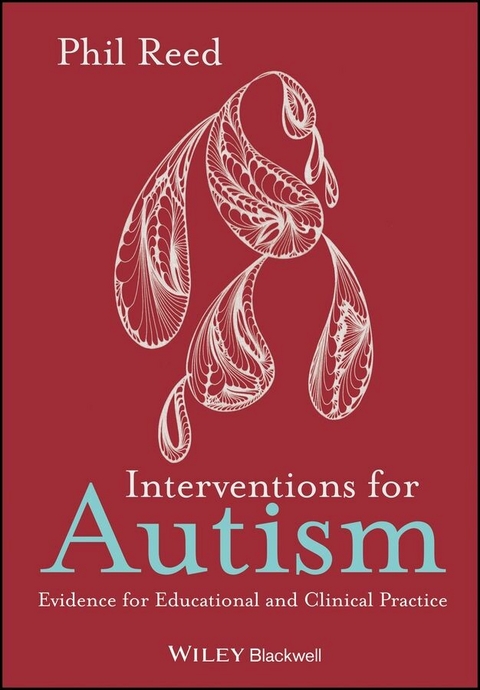
Interventions for Autism (eBook)
John Wiley & Sons (Verlag)
978-1-118-60207-2 (ISBN)
- Reformulates new research data on interventions for ASD into guidance for professionals, drawing on the author’s in-depth academic knowledge and practical experience
- Offers a comprehensive review of up-to-date evidence on effectiveness across a wide range of interventions for ASD
- Focuses on environmental factors in understanding ASD rather than outdated ‘deficit’ approaches, and discusses key issues in education provision such as inclusion
Phil Reed is Professor of Psychology at Swansea University, UK. A leading authority on Autism Spectrum Disorder (ASD), he edited the book Behavioral Theories and Interventions for Autism (2009) and has published more than 190 papers on ASD, behaviour analysis, learning and memory, and schizophrenia. Professor Reed has served on the editorial boards of several journals in his field, and has also held posts in the UK's Department for Education (Special Educational Needs), the Department of Health, and was a member of the Children in Wales Policy Council.
Providing a vital link between theory and practice, this unique volume translates the latest research data on the effectiveness of interventions for Autism Spectrum Disorder (ASD) into practical guidance for education professionals working with ASD pupils. Reformulates new research data on interventions for ASD into guidance for professionals, drawing on the author s in-depth academic knowledge and practical experience Offers a comprehensive review of up-to-date evidence on effectiveness across a wide range of interventions for ASD Focuses on environmental factors in understanding ASD rather than outdated deficit approaches, and discusses key issues in education provision such as inclusion
Phil Reed is Professor of Psychology at Swansea University, UK. A leading authority on Autism Spectrum Disorder (ASD), he edited the book Behavioral Theories and Interventions for Autism (2009) and has published more than 190 papers on ASD, behaviour analysis, learning and memory, and schizophrenia. Professor Reed has served on the editorial boards of several journals in his field, and has also held posts in the UK's Department for Education (Special Educational Needs), the Department of Health, and was a member of the Children in Wales Policy Council.
Acknowledgements viii
1 Autism Spectrum Disorders - What is the Problem? 1
2 Autism Spectrum Disorders 22
3 The Relationship of Theory and Interventions for ASD 44
4 Behavioural Approaches to ASD 63
5 Evaluation of Comprehensive Behavioural Interventions 88
6 Child Predictors for Comprehensive Behavioural Intervention Outcomes 113
7 Teaching Environment Modification Techniques 133
8 Developmental and Parent?]Mediated Treatment Models 154
9 Outcome?]Effectiveness for Developmental and Parent?-Mediated Treatment Models 175
10 Sensory and Physical Stimulation Treatments 201
11 Eclectic Interventions 223
12 Inclusive or Special Education 261
13 Interventions - What is Known about What Works? 282
References 301
Index 351
1
Autism Spectrum Disorders – What is the Problem?
The quest for the ‘holy grail’ of developing effective interventions to help people who have Autism Spectrum Disorders (ASD) has brought forth the usual clutch of quacks, charlatans and self-publicists, but mingled with the money-seeking snake-oil sellers are highly committed and professional practitioners and researchers, whose efforts have produced important innovations in the treatment of ASD. The many debates that have been produced in this quest for interventions have generated much heat, some little light, certainly much controversy and a great deal of confusion regarding what interventions are actually effective. The current work aims to untangle some of the mass of data regarding interventions for ASD and to provide some suggestions about the circumstances under which particular approaches may offer some help to the key people involved; that is, those affected by ASD, both directly themselves and through their close connection to somebody who is directly affected.
Autism Spectrum Disorders
The precise definition of ASD is and has been, in flux for 50 or more years. Recently, the diagnostic criteria for labelling the disorder have undergone yet another shift, from those contained in the previous Diagnostic and Statistical Manual (DSM) IV-TR, to those outlined in the new DSM-5. The nature of these criteria and some of the implications of these changes, will be discussed in Chapter 2, but it is safe to assert that ASD presents a range of complex and interacting behaviours and deficits that appear early in a person’s development and persist, sometimes in differing forms, throughout that person’s life impacting a wide range of their functioning. These characteristics mark out ASD from other more specific forms of psychological problems associated with childhood and make complex any intervention.
These issues will be covered later in terms of developing a characterization of the nature of ASD that presents for treatment (see Chapter 3), but, at this point, it is worth noting a few salient generalizations about the condition. For many, it is the types and quality of social and emotional interactions engaged in by people with ASD, as well as behavioural inflexibility and highly focused attention on aspects of their environment, that are central to its characterization. These key aspects of the disorder typically present together, making this a wide-ranging ‘syndrome’, with myriad potential causes – genetic, obstetric, physiological and even parenting. In itself, a disorder with multiple causations is often difficult to treat, but these primary problems are often connected with secondary or co-morbid problems for the individual with ASD, such as high levels of challenging behaviour, social isolation, anxiety and depression. The degree to which such secondary symptoms are present differs between each individual, both in the types of symptom present and also in their severity, making ASD a ‘spectrum’. Of course, these individual symptoms are not unique to ASD and it has been suggested that all share some of these ASD-typical traits – that is, there is a ‘broad autistic phenotype’ in the population. This may be true, but it is the presence of all problems together that characterize the disorder as ASD – a syndrome with a spectrum.
It is certainly the case that ASD cannot be recognized physically (despite some recent claims to contrary) and it is also true to say that ASD is found across the entire range of people in society. This consideration raises another issue: given this broad range of people with ASD and given the potential presence of these characteristics in us all, is it a problem to have ASD? This question touches on another, increasingly important, aspect of the theoretical discussion that it is important to raise early: that is, whether the ‘core’ elements of ASD are always to be regarded as ‘impairments’ that are in need of ‘treatment’. Indeed, some have even queried whether ASD should be ‘treated’ at all. It has been suggested that some of the behavioural and cognitive differences between people with and without ASD can sometimes confer an enhanced ability to the individual with ASD in some areas of performance (e.g. in terms of attention-based tasks requiring focus on detail) – albeit an ability at the expense of flexibility as circumstances change. However, it is equally important to note that there is by no means a consensus on this issue, either in the academic literature or among those individuals with an ASD themselves. The task of answering this question is made doubly difficult given the variation in behaviours and needs of people with ASD.
In framing a focused understanding of the scope of the present work, it may, thus, help to consider two questions related to these issues: (i) is having ASD a problem and (ii) if so, how and for whom? The first question is rather easier to answer from the perspective of a work on intervention, than from the perspective of a more theoretically based tome – quite simply, there are many, perhaps countless, individuals with ASD and their families who desperately need help – therefore, it is a problem for those people with ASD and for those people who their lives they touch, when it is a problem for them. To deny the existence of such a problem is wrongheaded and, to deny the treatment, is cruel, which is worse. As usual, there are very important provisos to add to this straightforward answer: not all people with ASD do require help and not all people with ASD require help with everything. Thus, interventions for ASD must be flexible enough to accommodate these considerations; that is to say, they must recognize that which was noted previously – that ASD is a spectrum and not a unitary disorder and that interventions will need to be tailored to suit different situations with different individuals. Together, these guiding tenets impact considerably on the focus to be taken regarding understanding the nature of ASD and the development of its interventions.
To answer the second question posed previously – ‘whose problem is ASD?’ – it can be said that it is not just a problem for the person with ASD, but it is a problem for and of, the community in which that person with ASD resides. The current text takes the view that an important contrast is made between the within-person disability model, which attempts to identify immutable causal structures within the person with ASD and a social-environmental approach, which suggest mutable functional connections between the person’s environment and their behaviours (see Chapter 3). Far too much attention and too many resources have been placed on the former view at the expense of the latter, especially when it is seen that almost all scientifically supportable interventions stem from the latter conceptualization of ASD.
Treating ASD
If ASD is to be considered as a problem to be treated, then it is worth saying a few brief words about the nature of ‘treatment’. There are a vast range of interventions now championed as being effective for ASD and the current work surveys those on which significant serious research has been conducted. These will be described throughout the text, but it is taken as a truth that it is possible to say that there are some interventions that are better than others and also that it is not in anybody’s best interests to accept the claim that any intervention is good merely if is offered and conducted well (Jordan et al., 1998). Too many times has it been suggested at conferences and gatherings of professionals that anything goes in this field. A consequence of the assumed need for a clear evidence-base tilts the approach of this book toward adopting a ‘medical model’ of evidence assessment – an approach that has met with considerable success in other areas of treatment – hence, the use of the term ‘treatment’ interchangeably with ‘intervention’ and in preference to currently more trendy re-labelling of ‘treatment’.
With this belief, the current work will take as ‘treatments’ those interventions that have made it out of the laboratory. This focus has the result of acting rather like a filter, determining which, out of the many potential interventions, will be discussed. Many interventions that have been developed purely in the laboratory, on the basis of particular theories, will not be addressed and neither will those that have been developed on the whim of individual practitioners. However, there are still many intervention programmes that pass this filter. Some of the history of interventions is presented in Chapter 3, where it can be seen that interventions for ASD have a longer history than might be expected. However, from the early 1970s onwards, larger numbers of interventions have emerged. For example, although Applied Behaviour Analysis (ABA) programmes (e.g. Lovaas, 1987; see Chapter 4) are often commented upon in the scientific and popular literature, approaches such as the Treatment and Education of Autistic and Related Communication Handicapped Children (Schopler & Reichler, 1971) and the Denver Health Sciences Programme (Rogers et al., 1986), emerged at least as early as ABA and the last few years have seen the development and proliferation of many more interventions for ASD. Many of these treatment types are mentioned in Figure 1.1, which...
| Erscheint lt. Verlag | 21.12.2015 |
|---|---|
| Sprache | englisch |
| Themenwelt | Geisteswissenschaften ► Psychologie ► Entwicklungspsychologie |
| Geisteswissenschaften ► Psychologie ► Klinische Psychologie | |
| Medizin / Pharmazie ► Medizinische Fachgebiete ► Neurologie | |
| Sozialwissenschaften ► Pädagogik ► Sonder-, Heil- und Förderpädagogik | |
| Schlagworte | ASD • autism spectrum disorders • Autismus • Developmental Psychology • Education • Educational & School Psychology • educational provision • Erziehungs- u. Schulpsychologie • Inclusion • Psychologie • Psychology |
| ISBN-10 | 1-118-60207-2 / 1118602072 |
| ISBN-13 | 978-1-118-60207-2 / 9781118602072 |
| Informationen gemäß Produktsicherheitsverordnung (GPSR) | |
| Haben Sie eine Frage zum Produkt? |
 EPUB (Adobe DRM)
Kopierschutz: Adobe-DRM
Adobe-DRM ist ein Kopierschutz, der das eBook vor Mißbrauch schützen soll. Dabei wird das eBook bereits beim Download auf Ihre persönliche Adobe-ID autorisiert. Lesen können Sie das eBook dann nur auf den Geräten, welche ebenfalls auf Ihre Adobe-ID registriert sind.
Details zum Adobe-DRM
Dateiformat: EPUB (Electronic Publication)
EPUB ist ein offener Standard für eBooks und eignet sich besonders zur Darstellung von Belletristik und Sachbüchern. Der Fließtext wird dynamisch an die Display- und Schriftgröße angepasst. Auch für mobile Lesegeräte ist EPUB daher gut geeignet.
Systemvoraussetzungen:
PC/Mac: Mit einem PC oder Mac können Sie dieses eBook lesen. Sie benötigen eine
eReader: Dieses eBook kann mit (fast) allen eBook-Readern gelesen werden. Mit dem amazon-Kindle ist es aber nicht kompatibel.
Smartphone/Tablet: Egal ob Apple oder Android, dieses eBook können Sie lesen. Sie benötigen eine
Geräteliste und zusätzliche Hinweise
Buying eBooks from abroad
For tax law reasons we can sell eBooks just within Germany and Switzerland. Regrettably we cannot fulfill eBook-orders from other countries.
aus dem Bereich


