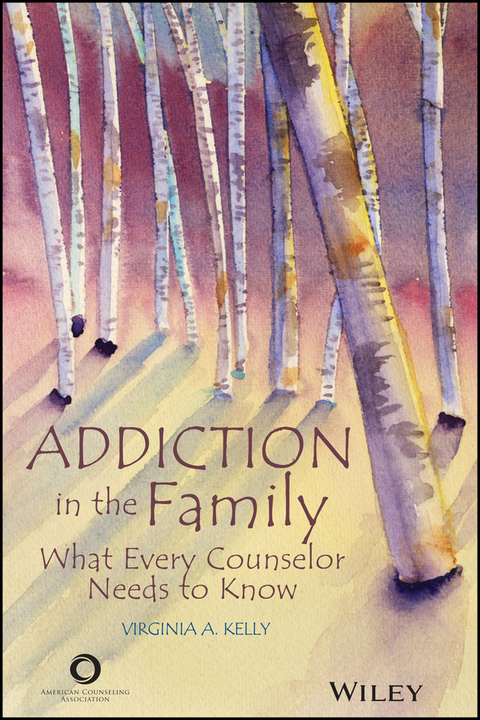
Addiction in the Family (eBook)
John Wiley & Sons (Verlag)
978-1-119-09828-7 (ISBN)
This book identifies and addresses potential clinical issues for clients who have family members struggling with addiction, and offers concrete strategies for treatment, Viewing addiction as a family disease, Dr, Kelly explores the complex challenges faced by family members, examines the ways in which substance use disorders affect family dynamics, and discusses behaviors that help sustain recovery and create and maintain healthy relationships,
A brief history of substance abuse is provided, as are the primary models of addiction and family theory, Chapters on codependency and the emotional, relational, and behavioral consequences of living with a family member with a substance use disorder follow, The universality of substance abuse is then examined along with specific ethnic and cultural differences, Family support group treatment options complete the text, Case conceptualization exercises that contain reflections, implications for the counselor, and discussion questions for application of the material are interspersed throughout the book to link theory to practice,
*Requests for digital versions from the ACA can be found on wiley,com,
*To request print copies, please visit the ACA website here,
*Reproduction requests for material from books published by ACA should be directed to permissions@counseling,org,
Virginia Kelly, PhD, is an associate professor in the Department of Counselor Education at Fairfield University in Fairfield, Connecticut,
This book identifies and addresses potential clinical issues for clients who have family members struggling with addiction, and offers concrete strategies for treatment. Viewing addiction as a family disease, Dr. Kelly explores the complex challenges faced by family members, examines the ways in which substance use disorders affect family dynamics, and discusses behaviors that help sustain recovery and create and maintain healthy relationships. A brief history of substance abuse is provided, as are the primary models of addiction and family theory. Chapters on codependency and the emotional, relational, and behavioral consequences of living with a family member with a substance use disorder follow. The universality of substance abuse is then examined along with specific ethnic and cultural differences. Family support group treatment options complete the text. Case conceptualization exercises that contain reflections, implications for the counselor, and discussion questions for application of the material are interspersed throughout the book to link theory to practice. *Requests for digital versions from the ACA can be found on wiley.com *To request print copies, please visit the ACA website https://imis.counseling.org/store/ *Reproduction requests for material from books published by ACA should be directed to publications@counseling.org
Virginia Kelly, PhD, is an associate professor in the Depart-ment of Counselor Education at Fairfield University in Fairfield, Connecticut.
Preface vii
About the Author ix
Acknowledgments xi
Introduction xiii
Chapter 1 Substance Abuse and SUD: History and Defi nition 1
Chapter 2 Etiological Models of SUD 7
Chapter 3 Commonly Abused Substances 11
Chapter 4 Family Theory 21
Chapter 5 Developmental Theory 47
Chapter 6 Codependency 59
Chapter 7 Emotional Consequences of Living With a Person With an SUD 69
Chapter 8 Relational Consequences of Living With a Person With an SUD 103
Chapter 9 Behavioral Consequences of Living With a Person With an SUD 121
Chapter 10 Multicultural Considerations 127
Chapter 11 Treating Clients Living With a Person With an SUD 137
Conclusion 159
References 161
Index 179
"Virginia Kelly combines clinical wisdom and research expertise in this comprehensive text. Plentiful case studies bring each chapter to life as Dr. Kelly translates the principles of family and addictions counseling into concrete, clear terms. This text offers an outstanding foundation for counselors seeking to understand the intersection of addiction and family system processes, and is also a must-read for students aiming to specialize in the area of family counseling."
--Trevor J. Buser, PhD,Editor, Journal of Addictions & Offender Counseling
"Addiction in the Family is a comprehensive overview of systemic theoretical underpinnings and clinical application of addictions counseling in a variety of treatment settings. Instructors and counselors alike will appreciate the diverse range of clients depicted in case studies throughout the text. Practical implications for counselors are provided, including explanations of how the material relates to recent neuroscientific findings. Beginning and experienced clinicians will also find it helpful that much of the information is easily adaptable for use in psychoeducation with clients."
--Leigh Falls Holman, PhD, President, International Association of Addiction and Offender Counselors
Chapter 1
Substance Abuse and SUD: History and Definition
Issues of substance abuse and addiction are not new. In fact, evidence suggests that humans have been using mind-altering substances since the beginning of time (Segal, 2014). However, national awareness of drug addiction as a potential problem emerged slowly. In the United States, the first drug identified as potentially harmful was opium. In response to an increase in the recreational use of opium in San Francisco, the city invoked the first law associated with drugs when it banned opium dens in 1875. This law eventually led to legislation, passed in 1906, requiring accurate labeling of patent medicines containing opium. Subsequently, in 1914, the Harrison Narcotic Act was passed, prohibiting the sale of large doses of opiates or cocaine, except by licensed physicians. This first step at governmental oversight seemed to have an influence on substance abuse, as the use of narcotics and cocaine decreased. In fact, in this spirit of temperance, the 18th Amendment to the Constitution, which prohibited the use of alcohol, was passed in 1919 and remained in effect until it was repealed in 1933 (Stevens & Smith, 2013).
Upon the repeal of Prohibition in the 1930s, drug education emerged as a concept for the first time, and schools began to incorporate educational programs designed to intervene in adolescent use of drugs and alcohol. However, despite these efforts, drinking and drug use increased. In the 1950s, the use of marijuana, amphetamines, and tranquilizers increased dramatically (Brown, 1981). The 1960s was seen as a time of tremendous social upheaval, and there was a perception of increased drug and alcohol use. However, despite this perception, a 1969 Gallup poll revealed that although 48% of American adults felt that drug use was a serious problem within their communities, only 4% had tried marijuana. It was in the 1970s that marijuana use dramatically increased. By 1973, 12% of American adults reported using marijuana, and by 1977, this percentage had doubled (Robison, 2002a).
By 1985, one third of American adults reported using marijuana, and the use of cocaine was on the rise. It was at this time that crack cocaine was introduced. In a 1986 Gallup poll, when asked what the most serious drug problem was within the United States, adults reported crack cocaine above heroin, marijuana, and alcohol. In response, President Ronald Reagan signed the Anti-Drug Abuse Act of 1986, thus declaring the nation's war on drugs, and Nancy Reagan began the “Just Say No” campaign (Robison, 2002b). The 1986 bill imposed mandatory minimum sentences for the possession of controlled substances in an effort to deter the sale and use of the newly introduced synthetic drugs, including crack cocaine. As funding for this initiative became available, programs began to emerge in response to Reagan's call for action. Perhaps the most widely publicized and used of these was the Drug Abuse Resistance Education (DARE) program, which was introduced in schools across the country. DARE and other programs initiated in the 1980s generally included an educational component designed to teach children about the various substances that were being abused along with activities designed to bolster adolescents' refusal skills.
The 1990s was marked by the first reported decrease in drug use since the 1960s. Although 34% of American reported having used marijuana, the 1999 Gallup youth survey showed a decrease in adolescents' trial use of all controlled substances. However, at the same time, club drugs and methamphetamines (often referred to as crystal meth or meth) began to emerge. During the 1990s, drugs like Ecstasy (a designer club drug) were new and perceived as harmless by adolescents. Given the addictive qualities of methamphetamines, the use of such synthetic drugs began to increase. Finally, in the later 1990s, an increase in the use of heroin was seen, as opiate-based prescription drugs hit the market for the treatment of pain (Robison, 2002b).
The United Nations Office on Drugs and Crime (UNODC) released a report in 2008 outlining the trends in drug usage between the years of 2000 and 2008. During that period, the United States saw a marked increase in the use of illicit drugs from 11% of the adult population in 2000 to 15% in 2008. Specifically, there was a moderate increase in the use of Ecstasy-type and other synthetic drugs and a significant increase in the use of marijuana, hashish, and pain relievers (UNODC, 2008).
Since 2008, the use of heroin has increased; in addition, the face of heroin users has changed over the decades. Whereas the typical heroin user in the 1960s was found to be male and young, with a mean age of 16.5, the heroin addict of today tends to be older, with a mean age of 22.9, and may be male or female. In addition, the use of heroin has moved from predominantly urban areas to the suburbs. Finally, research suggested that the road to heroin use was historically initiated by the use of other increasingly powerful substances. However, 75% of current heroin users report that their use of heroin was initiated by the use of prescription pain medications (Cicero, Ellis, Surratt, & Kurtz, 2014). This trend has been highlighted in current news stories across the country, as the use of heroin continues to rise and spread to communities where it was rarely seen in past decades (Svrluga, 2014).
Defining Substance Abuse and Addiction
In the fifth edition of the Diagnostic and Statistical Manual (DSM-5; American Psychiatric Association [APA], 2013), substance use disorder (SUD) combines the DSM-IV (APA, 2000) categories of substance abuse and substance dependence into a single disorder measured on a continuum from mild to severe. These changes were initiated in response to several concerns and questions raised regarding the criteria described in the DSM-IV. To be specific, the work group charged with developing the substance abuse and dependence-related diagnostic criteria for the DSM-5 conducted extensive research in the form of both literature reviews and empirical studies. Their findings, which were based on analyses of data accumulated from over 200,000 participants, led to the combining of abuse and dependence criteria into a single SUD. In addition, on the basis of their extensive analyses, the group recommended dropping legal problems and adding craving as criteria and moving gambling disorders to the chapter formerly reserved for substance-related disorders (Hasin et al., 2012).
Ultimately, according to the DSM-5, an SUD is described as a pattern of symptoms resulting from use of a substance that the individual continues to take despite the experience of negative consequences resulting directly from the substance use. SUD includes the following:
- intoxication;
- substance-induced bipolar and related disorders;
- substance-induced delirium;
- substance-induced depressive disorders, substance-induced anxiety disorders, substance-induced obsessive-compulsive and related disorders;
- substance-induced mental disorders, including substance-induced psychosis;
- substance-induced neurocognitive disorders;
- substance-induced sleep disorders;
- substance-induced sexual dysfunctions; and
- withdrawal.
According the DSM-5, SUD spans a wide variety of issues arising from substance use and covers 11 different criteria. An example of Alcohol Use Disorder follows:
- A. A problematic pattern of alcohol use leading to clinically significant impairment or distress, as manifested by at least two of the following, occurring within a 12-month period.
- Alcohol is often taken in larger amounts or over a longer period than was intended.
- There is a persistent desire or unsuccessful efforts to cut down or control alcohol use.
- A great deal of time is spent in activities necessary to obtain alcohol, use alcohol, or recover from its effects.
- Craving, or a strong desire to use alcohol.
- Recurrent alcohol use resulting in a failure to fulfill major role obligations at work, school, or home.
- Continued alcohol use despite having persistent or recurrent social or interpersonal problems caused or exacerbated by the effects of alcohol.
- Important social, occupational, or recreational activities are given up or reduced because of alcohol use.
- Recurrent alcohol use in situations in which it is physically hazardous.
- Alcohol use is continued despite knowledge of having a persistent or recurrent physical or psychological problem that is likely to have been caused or exacerbated by alcohol.
- Tolerance, as defined by either of the following:
- A need for markedly increased amounts of alcohol to achieve intoxication or desired effect.
- A markedly diminished effect with continued use of the same amount of alcohol.
- Withdrawal, as manifested by either of the following:
- The characteristic withdrawal syndrome for alcohol (refer to Criteria A and B of the criteria set for alcohol withdrawal, pp. 499–500).
- Alcohol (or a closely related substance, such as a benzodiazepine) is taken to relieve or avoid withdrawal symptoms.
Note. From the Diagnostic and Statistical Manual of Mental Disorders, Fifth Edition (pp. 490–491), by American Psychiatric Association, 2013, Arlington, VA: American Psychiatric Association. Copyright 2013 by American Psychiatric Association. Reprinted with permission. All Rights Reserved.
The...
| Erscheint lt. Verlag | 11.12.2015 |
|---|---|
| Sprache | englisch |
| Themenwelt | Geisteswissenschaften ► Psychologie ► Familien- / Systemische Therapie |
| Geisteswissenschaften ► Psychologie ► Persönlichkeitsstörungen | |
| Medizin / Pharmazie ► Gesundheitsfachberufe | |
| Medizin / Pharmazie ► Medizinische Fachgebiete ► Psychiatrie / Psychotherapie | |
| Medizin / Pharmazie ► Medizinische Fachgebiete ► Suchtkrankheiten | |
| Schlagworte | acknowledgments • Codependency • commonly abused substances • Couples & Family Clinical Psychology • Developmental Theory • etiological models • Index • introduction xidefi nition • Klinische Psychologie / Familien u. Paare • multicultural considerations • preface • Psychologie • Psychology • relational consequences • substance abuse • Sud |
| ISBN-10 | 1-119-09828-9 / 1119098289 |
| ISBN-13 | 978-1-119-09828-7 / 9781119098287 |
| Informationen gemäß Produktsicherheitsverordnung (GPSR) | |
| Haben Sie eine Frage zum Produkt? |
 EPUB (Ohne DRM)
Digital Rights Management: ohne DRM
Dieses eBook enthält kein DRM oder Kopierschutz. Eine Weitergabe an Dritte ist jedoch rechtlich nicht zulässig, weil Sie beim Kauf nur die Rechte an der persönlichen Nutzung erwerben.
Dateiformat: EPUB (Electronic Publication)
EPUB ist ein offener Standard für eBooks und eignet sich besonders zur Darstellung von Belletristik und Sachbüchern. Der Fließtext wird dynamisch an die Display- und Schriftgröße angepasst. Auch für mobile Lesegeräte ist EPUB daher gut geeignet.
Systemvoraussetzungen:
PC/Mac: Mit einem PC oder Mac können Sie dieses eBook lesen. Sie benötigen dafür die kostenlose Software Adobe Digital Editions.
eReader: Dieses eBook kann mit (fast) allen eBook-Readern gelesen werden. Mit dem amazon-Kindle ist es aber nicht kompatibel.
Smartphone/Tablet: Egal ob Apple oder Android, dieses eBook können Sie lesen. Sie benötigen dafür eine kostenlose App.
Geräteliste und zusätzliche Hinweise
Buying eBooks from abroad
For tax law reasons we can sell eBooks just within Germany and Switzerland. Regrettably we cannot fulfill eBook-orders from other countries.
aus dem Bereich