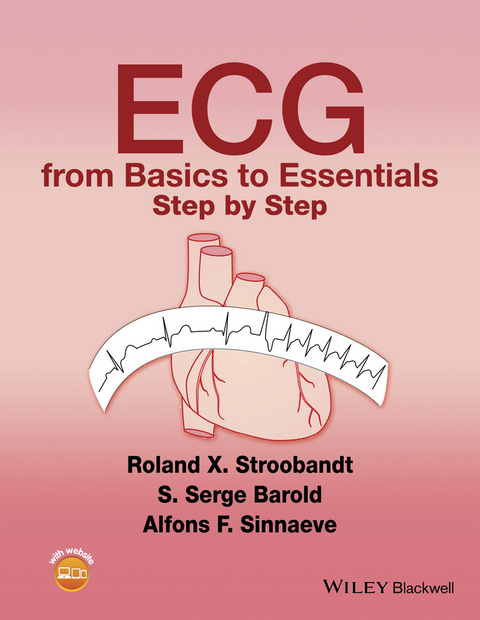
ECG from Basics to Essentials (eBook)
John Wiley & Sons (Verlag)
978-1-119-06642-2 (ISBN)
- Step-by-step graphics and short, bite-sized explanations
- Covers all major cardiac abnormalities including hypertrophy, arrhythmias, conduction blocks, and pre-excitation syndromes
- Begins with a section on physiology of the heart and the basic set up of ECG recording
- Features top tips on what to look for, complete with illustrated examples
- Supported by a companion website featuring additional practice tracings
Roland X. Stroobandt MD, PhD, FHRS
Professor of Medicine
Ghent University Hospital
Ghent, Belgium
S. Serge Barold, MD, FRACP, FACP, FACC, FESC, FHRS
The Department of Medicine, University of Rochester School of Medicine and Dentistry, Rochester, NY, USA
Alfons F. Sinnaeve ing., MSc
Professor Emeritus of Electronic Engineering
Technical University KUL-Vives, Department of Electronics
Oostende, Belgium
Roland X. Stroobandt MD, PhD, FHRS Professor of Medicine Ghent University Hospital Ghent, Belgium S. Serge Barold, MD, FRACP, FACP, FACC, FESC, FHRS The Department of Medicine, University of Rochester School of Medicine and Dentistry, Rochester, NY, USA Alfons F. Sinnaeve ing., MSc Professor Emeritus of Electronic Engineering Technical University KUL-Vives, Department of Electronics Oostende, Belgium
Preface, vi
About the companion website, vii
1 Anatomy and Basic Physiology, 1
2 ECG Recording and ECG Leads, 21
3 The Normal ECG and the Frontal Plane QRS Axis, 53
4 The Components of the ECG Waves and Intervals, 73
5 P waves and Atrial Abnormalities, 85
6 Chamber Enlargement and Hypertrophy, 99
7 Intraventricular Conduction Defects, 105
8 Coronary Artery Disease and Acute Coronary Syndromes, 123
9 Acute Pericarditis, 187
10 The ECG in Extracardiac Disease, 193
11 Sinus Node Dysfunction, 203
12 Premature Ventricular Complexes (PVC), 217
13 Atrioventricular Block, 227
14 Atrial Rhythm Disorders, 243
15 Ventricular Tachycardias, 279
16 Ventricular Fibrillation and Ventricular Flutter, 305
17 Preexcitation and Wolff -Parkinson-White Syndrome (WPW), 311
18 Electrolyte Abnormalities, 327
19 Electrophysiologic Concepts, 333
20 Antiarrhythmic Drugs, 351
21 Pacemakers and their ECGs, 359
22 Errors in Electrocardiography Monitoring, Computerized ECG, Other Sites of ECG Recording, 391
23 How to Read an ECG, 407
Index, 425
CHAPTER 1
ANATOMY AND BASIC PHYSIOLOGY
- What is an ECG?
- Blood circulation – the heart in action
- The conduction system of the heart
- Myocardial electrophysiology
- About cardiac cells
- Depolarization of a myocardial fiber
- Distribution of current in myocardium
- Recording a voltage by external electrodes
- The resultant heart vector during ventricular depolarization
The ECG provides information on:
- the heart rate or cardiac rhythm
- position of the heart inside the body
- the thickness of the heart muscle or dilatation of heart cavities
- origin and propagation of the electrical activity and its possible aberrations
- cardiac rhythm disorders due to congenital anomalies of the heart
- injuries due to insufficient blood supply (ischemia, infarction, ...)
- malfunction of the heart due to electrolyte disturbances or drugs
History
The Dutch physiologist Willem Einthoven was one of the pioneers of electrocardiography and developer of the first useful string galvonometer. He labelled the various parts of the electrocardiogram using P, Q, R, S and T in a classic article published in 1903. Professor Einthoven received the Nobel prize for medicine in 1924.
The heart is a muscle consisting of four hollow chambers. It is a double pump: the left part works at a higher pressure, while the right part works on a lower pressure.
The right heart pumps blood into the pulmonary circulation (i.e. the lungs). The left heart drives blood through the systemic circulation (i.e. the rest of the body).
The right atrium (RA) receives deoxygenated blood from the body via two large veins, the superior and the inferior vena cava, and from the heart itself by way of the coronary sinus. The blood is transferred to the right ventricle (RV) via the tricuspid valve (TV). The right ventricle then pumps the deoxy- genated blood via the pulmonary valve (PV) to the lungs where it releases excess carbon dioxide and picks up new oxygen.
The left atrium (LA) accepts the newly oxygenated blood from the lungs via the pulmonary veins and delivers it to the left ventricle (LV) through the mitral valve (MV). The oxygenated blood is pumped by the left ventricle through the aortic valve (AoV) into the aorta (Ao), the largest artery in the body.
The blood flowing into the aorta is further distributed throughout the body where it releases oxygen to the cells and collects carbon dioxide from them.
The contractions of the various parts of the heart have to be carefully synchronized. It is the prime function of the electrical conduction system to ensure this synchronization. The atria should contract first to fill the ventricles before the ventricles pump the blood in the circulation.
- The excitation starts in the sinus node consisting of special pacemaker cells. The electrical impulses spread over the right and left atria.
- The AV node is normally the only electrical connection between the atria and the ventricles. The impulses slow down as they travel through the AV node to reach the bundle of His.
- The bundle of His, the distal part of the AV junction, conducts the impulses rapidly to the bundle branches.
- The fast conducting right and left bundle branches subdivide into smaller and smaller branches, the smallest ones connec- ting to the Purkinje fibers.
- The Purkinje fibers spread out all over the ventricles beneath the endocardium and they bring the electrical impulses very fast to the myocardial cells.
All in all it takes the electrical impulses less than 200 ms to travel from the sinus node to the myocardial cells in the ventricles.
Cardiac muscle cells are more or less cylindrical. At their ends they may partially divide into two or more branches, connecting with the branches of adjacent cells and forming an anastomosing network of cells called a syncytium. At the interconnections between cells there are specialized membranes (intercalated disks) with a very low electrical resistance.
These “gap-junctions” allow a very rapid conduction from one cell to another.
In the resting state, a high concentration of positively charged sodium ions (Na+) is present outside the cell while a high concentration of positive potassium ions (K+) and a mixture of the large negatively charged ions (PO4---, SO4--, Prot--) are found inside the cell.
There is a continuous leakage of the small ions decreasing the resting membrane potential. Consequently other processes have to restore the phenomenon. The Na+/K+ pump, located in the cell membrane, maintains the negative resting potential inside the cell by bringing K+ into the cell while taking Na+ out of the cell. This process requires energy and therefore it uses adenosine triphosphate (ATP). The pump can be blocked by digitalis. If the Na+/K+ pump is inhibited, Na+ ions are still removed from the inside by the Na+/Ca++exchange process. This process increases the intracellular Ca++ and ameliorates the contractility of the muscle cells.
An external negative electric impulse that converts the outside of a myocardial cell from positive to negative, makes the membrane permeable to Na+. The influx of Na+ ions makes the inside of the cellless negative. When the membrane voltage reaches a certain value(called the threshold), some fast sodium channels in the membraneopen momentarily, resulting in a sudden larger influx of Na+.Consequently, a part of the cell depolarizes, i.e. its exterior becomesnegative with respect to its interior that becomes positive.Due to the difference in concentration of the Na+ ions, a local ioniccurrent arises between the depolarized part of the cell and its stillresting part. These local electric currents give rise to a depolarizationfront that moves on until the whole cell becomes depolarized.
As soon as the depolarization starts, K+ ions flow out from the cell trying to restore the initial resting potential. In the meantime, some Ca++ ions flow inwards through slow calcium channels. At first, these ion movements and the decreasing Na+ influx nearly balance each other resulting in a slowly varying membrane potential. Next the Ca++ channels are inhibited as are the Na+ channels while the open K+ channels together with the Na+/K+ pump repolarize the cell. Again local currents are generated and a repolarization front propagates until the whole cell is repolarized.
The cells of the sinus node and the AV junction do not have fast sodium channels. Instead they have slow calcium channels and potassium channels that open when the membrane potential is depolarized to about −50 mV.
The major determinant for the diastolic depolarization is the so-called “funny current” If. This particularly unusual current consists of an influx of a mix of sodium and potassium ions that makes the inside of the cells more positive.
When the action potential reaches a threshold potential (about −50/−40mV), a faster depolarization by the Ca++ ions starts the systolic phase. As soon as the action potential becomes positive, some potassium channels open and the resulting outflux of K+ ions repolarizes the cells. The moment the repolarization reaches its most negative potential (−60/−70mV), the funny current starts again and the whole cycle starts all over.
Spontaneous depolarization may be modulated by changing the slope of the spontaneous depolarization (mostly by influencing the If channels). The slope is controlled by the autonomic nervous system.
Increase in sympathetic activity and administration of catecholamines (epinephrine, norepinephrine, dopamine) increases the slope of the phase 4 depolarization. This results in a higher firing rate of the pacemaker cells and a shorter cardiac cycle. Administration of certain drugs decreases the slope of the phase 4 depolarization, reducing the firing rate and lengthening the cardiac cycle.
Spontaneous depolarization is not only present in the sinoatrial node (SAN) but, to a lesser extent, also in the other parts of the conduction system. The intrinsic pacemaker activity of the secondary pacemakers situated in the atrioventricular junction and the His-Purkinje system is normally quiescent by a mechanism termed overdrive suppression. If the sinus node (SAN) becomes depressed, or its action potentials fail to reach secondary pace-makers, a slower rhythm takes over.
Overdrive suppression occurs when cells with a higher intrinsic rate (e.g. the dominant pacemaker) continually depolarize or overdrive potential automatic foci with a lower intrinsic rate thereby suppressing their emergence.
Should the highest pacemaking center fail, a lower automatic focus previously inactive because of overdrive suppression emerges or “escapes” from the next highest level.
The new site becomes the dominant pacemaker at its inherent rate and in turn suppresses all automatic foci below it.
A depolarization front can propagate through the fibers of the heart muscle in the same way as the depolarization front moves...
| Erscheint lt. Verlag | 25.11.2015 |
|---|---|
| Sprache | englisch |
| Themenwelt | Medizin / Pharmazie ► Allgemeines / Lexika |
| Medizinische Fachgebiete ► Innere Medizin ► Kardiologie / Angiologie | |
| Medizin / Pharmazie ► Medizinische Fachgebiete ► Radiologie / Bildgebende Verfahren | |
| Schlagworte | Alfons F. Sinnaeve • Arrhythmias • Cardiac Disorders • Cardiac Pacemakers and Resynchronisation: Step by Step • Cardiology • Cardiovascular Disease • Conduction blocks • ECGs from Basics to Essentials Step by Step • EKG • Electrical activity • ELECTROCARDIOGRAPH • electrophysiology • Elektrophysiologie • Hypertrophy • Implantable Cardioverter Defibrillators Step by Step • Kardiovaskuläre Erkrankungen • Kardiovaskuläre Erkrankungen • medical education • Medical Science • Medizin • Medizinstudium • Normal electrical pattern • Physiology • Pre-excitation syndromes • Roland X. Stroobandt • S. Serge Barold • Tracing interpretation |
| ISBN-10 | 1-119-06642-5 / 1119066425 |
| ISBN-13 | 978-1-119-06642-2 / 9781119066422 |
| Informationen gemäß Produktsicherheitsverordnung (GPSR) | |
| Haben Sie eine Frage zum Produkt? |
 EPUB (Adobe DRM)
Kopierschutz: Adobe-DRM
Adobe-DRM ist ein Kopierschutz, der das eBook vor Mißbrauch schützen soll. Dabei wird das eBook bereits beim Download auf Ihre persönliche Adobe-ID autorisiert. Lesen können Sie das eBook dann nur auf den Geräten, welche ebenfalls auf Ihre Adobe-ID registriert sind.
Details zum Adobe-DRM
Dateiformat: EPUB (Electronic Publication)
EPUB ist ein offener Standard für eBooks und eignet sich besonders zur Darstellung von Belletristik und Sachbüchern. Der Fließtext wird dynamisch an die Display- und Schriftgröße angepasst. Auch für mobile Lesegeräte ist EPUB daher gut geeignet.
Systemvoraussetzungen:
PC/Mac: Mit einem PC oder Mac können Sie dieses eBook lesen. Sie benötigen eine
eReader: Dieses eBook kann mit (fast) allen eBook-Readern gelesen werden. Mit dem amazon-Kindle ist es aber nicht kompatibel.
Smartphone/Tablet: Egal ob Apple oder Android, dieses eBook können Sie lesen. Sie benötigen eine
Geräteliste und zusätzliche Hinweise
Buying eBooks from abroad
For tax law reasons we can sell eBooks just within Germany and Switzerland. Regrettably we cannot fulfill eBook-orders from other countries.
aus dem Bereich