Principles of Veterinary Parasitology (eBook)
John Wiley & Sons (Verlag)
978-1-118-97743-9 (ISBN)
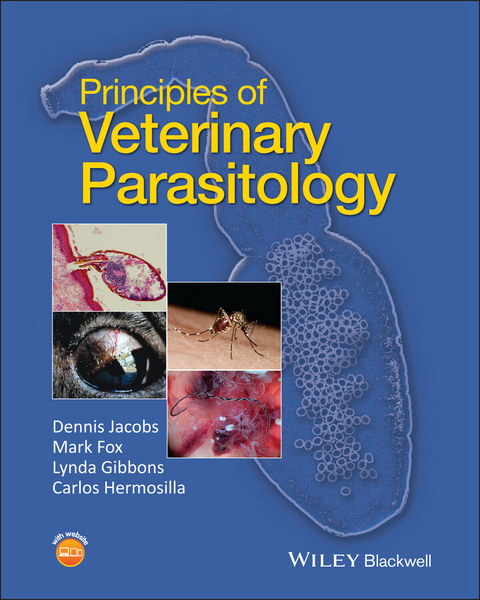
Principles of Veterinary Parasitology is a student-friendly introduction to veterinary parasitology. Written primarily to meet the immediate needs of veterinary students, this textbook outlines the essential parasitological knowledge needed to underpin clinical practice. Conceptual relationships between parasitic organisms, their biology and the diseases they cause are clearly illustrated. Help boxes and practical tips are included throughout alongside a wealth of colour photographs, drawings and life-cycle diagrams. Organised taxonomically with additional host-orientated chapters and focussing on parasites that commonly cause animal or zoonotic disease, welfare problems or economic losses, students worldwide will benefit from this straightforward and easy to comprehend introduction to veterinary parasitology.
KEY FEATURES
- An easy to navigate textbook, providing information essential for clinical studies
- Full colour throughout, with photographs, diagrams, life-cycles and help boxes for visual learners
- A companion website including a pronunciation guide, self-assessment questions and further reading lists
This book is accompaines by a companion website:
WWW.wiley.com/go/jacobs/principles-veterinay-parasitology
The website includes:
- Glossary
- Parasites listed by host and body system
- Pronunciation guide
- Parasite recogonition: flease, flies,worms and worm eggs
- Revision questions and answers
- Further reading list: books, articles and websites
- Powerpoint files of all diagrame for downloading
ABOUT THE AUTHORS
Dennis Jacobs, BVMS, PhD, FHEA, DipEVPC, FRCPath, FRVCS, Emeritus Professor, The Royal Veterinary College, London
After graduating from the Glasgow Veterinary School and a short period in the pharmaceutical industry, he devoted his professional career to teaching and research. He has served as Vice-President of the World Association for the Advancement of Veterinary Parasitology and Secretary of the European Veterinary Parasitology College.
Mark Fox, BVetMed, PhD, FHEA, DipEVPC, MRCVS, Professor of Veterinary Parasitology, The Royal Veterinary College, London
He has over thirty years' experience of teaching and research in the veterinary parasitology field, having graduated from The Royal Veterinary College and spent a period in small animal practice. His current research interests focus on the epidemiology of parasite infections in both domestic and wild animals. He was awarded the William Hunting medal in recognition of avian coccidiosis research.
Lynda Gibbons, BSc, PhD, CBiol, FSB, Attached Senior Scientist, The Royal Veterinary College, London
Having studied at Leicester University and the London School of Hygiene and Tropical Medicine, she became Head of Animal Helminthology Biosystematics at the CABI Institute of Parasitology. She is a recipient of the Elsdon-Dew medal (Parasitological Society of Southern Africa) and the Betts Prize (The Royal Veterinary College).
Carlos Hermosilla, DrMedVet, DipEVPC, DrHabiI, DVM, Professor, Justus-Liebig-Universität Giessen
Having gained a veterinary degree from the University Austral of Chile, and doctorates from Justus-Liebig-Universität in Germany, he worked as Senior Lecturer in Veterinary Parasitology at The Royal Veterinary College, London, before returning to the Institute of Parasitology in Giessen as Professor to continue his enthusiasm for teaching and research. He is also visiting professor at the University Austral of Chile.
Principles of Veterinary Parasitology Principles of Veterinary Parasitology is a student-friendly introduction to veterinary parasitology. Written primarily to meet the immediate needs of veterinary students, this textbook outlines the essential parasitological knowledge needed to underpin clinical practice. Conceptual relationships between parasitic organisms, their biology and the diseases they cause are clearly illustrated. Help boxes and practical tips are included throughout alongside a wealth of colour photographs, drawings and life-cycle diagrams. Organised taxonomically with additional host-orientated chapters and focussing on parasites that commonly cause animal or zoonotic disease, welfare problems or economic losses, students worldwide will benefit from this straightforward and easy to comprehend introduction to veterinary parasitology. KEY FEATURESAn easy to navigate textbook, providing information essential for clinical studiesFull colour throughout, with photographs, diagrams, life-cycles and help boxes for visual learnersA companion website including a pronunciation guide, self-assessment questions and further reading listsThis book is accompaines by a companion website:WWW.wiley.com/go/jacobs/principles-veterinay-parasitologyThe website includes:GlossaryParasites listed by host and body systemPronunciation guideParasite recogonition: flease, flies,worms and worm eggsRevision questions and answersFurther reading list: books, articles and websitesPowerpoint files of all diagrame for downloading
ABOUT THE AUTHORS Dennis Jacobs, BVMS, PhD, FHEA, DipEVPC, FRCPath, FRVCS, Emeritus Professor, The Royal Veterinary College, London After graduating from the Glasgow Veterinary School and a short period in the pharmaceutical industry, he devoted his professional career to teaching and research. He has served as Vice-President of the World Association for the Advancement of Veterinary Parasitology and Secretary of the European Veterinary Parasitology College. Mark Fox, BVetMed, PhD, FHEA, DipEVPC, MRCVS, Professor of Veterinary Parasitology, The Royal Veterinary College, London He has over thirty years' experience of teaching and research in the veterinary parasitology field, having graduated from The Royal Veterinary College and spent a period in small animal practice. His current research interests focus on the epidemiology of parasite infections in both domestic and wild animals. He was awarded the William Hunting medal in recognition of avian coccidiosis research. Lynda Gibbons, BSc, PhD, CBiol, FSB, Attached Senior Scientist, The Royal Veterinary College, London Having studied at Leicester University and the London School of Hygiene and Tropical Medicine, she became Head of Animal Helminthology Biosystematics at the CABI Institute of Parasitology. She is a recipient of the Elsdon-Dew medal (Parasitological Society of Southern Africa) and the Betts Prize (The Royal Veterinary College). Carlos Hermosilla, DrMedVet, DipEVPC, DrHabiI, DVM, Professor, Justus-Liebig-Universität Giessen Having gained a veterinary degree from the University Austral of Chile, and doctorates from Justus-Liebig-Universität in Germany, he worked as Senior Lecturer in Veterinary Parasitology at The Royal Veterinary College, London, before returning to the Institute of Parasitology in Giessen as Professor to continue his enthusiasm for teaching and research. He is also visiting professor at the University Austral of Chile.
Principles of Veterinary Parasitology 3
Contents 7
About the Authors 11
Foreword 12
Preface 13
Acknowledgements 14
List of abbreviations 16
About the companion website 17
Chapter 1: Veterinary Parasitology: basic concepts 19
1.1 Introduction 19
1.1.1 What is Veterinary Parasitology? 20
1.2 Parasitism and parasites 20
1.2.1 Parasitism 20
1.2.2 Classification 21
1.3 Host–parasite interactions 24
1.3.1 Host defences 24
1.3.2 Parasite evasion of immunity 27
1.4 Parasitic disease 28
1.4.1 The host–parasite balance 28
1.4.2 Why parasites are important 28
1.4.3 Pathogenic mechanisms 29
1.5 Diagnostic techniques 30
1.5.1 Direct detection methods 30
1.5.2 Indirect detection methods 31
1.5.3 Limitations 34
1.6 Treatment and control 34
1.6.1 Key concepts 34
1.6.2 Chemotherapy 35
1.6.3 Resistance to parasiticides 36
1.6.4 Integrated parasite management 37
1.6.5 Vaccination 37
1.6.6 A lternative technologies 39
1.6.7 Concluding remarks 41
CHAPTER 2: Arthropods part 1: introduction and insects 43
2.1 Introduction 43
2.2 Insects 44
2.2.1 Key concepts 44
2.2.2 Fleas (Siphonaptera) 50
2.2.3 Lice (Phthiraptera) 54
2.2.4 Bugs (Hemiptera) 57
2.2.5 Biting and nuisance flies (Diptera) 58
2.2.6 Myiasis-producing dipterans 66
Chapter 3: Arthropods part 2: ticks, mites and ectoparasiticides 75
3.1 Introduction 75
3.2 Ticks 75
3.2.1 Key concepts 75
3.2.2 Hard ticks (Ixodidae) 80
3.2.3 Soft ticks (Argasidae) 83
3.3 Mange mites 83
3.3.1 Key concepts 84
3.3.2 Subsurface mites 84
3.3.3 Surface mites 87
3.4 Other arthropods 92
3.5 Ectoparasiticides 93
3.5.1 Key concepts 93
3.5.2 Some important ectoparasiticides 95
3.5.3 Insect growth regulators 97
3.5.4 Problems with ectoparasiticides 97
Chapter 4: Protozoa (single-celled parasites) 99
4.1 Introduction 99
4.2 Key concepts 100
4.2.1 Classification 100
4.2.2 Locomotion 100
4.2.3 Nutrition 102
4.2.4 Transmission 102
4.2.5 Reproduction 102
4.3 Ciliates 102
4.4 Amoebae 103
4.5 Flagellates 104
4.5.1 Haemoflagellates 104
4.5.2 Other flagellates 108
4.6 Coccidia 112
4.6.1 General characteristics 112
4.6.2 Eimeria 113
4.6.3 Coccidiosis 116
4.7 Tissue cyst-forming coccidia 117
4.7.1 Sarcocystis 118
4.7.2 Besnoitia 120
4.7.3 Toxoplasma 121
4.7.4 Neospora 124
4.8 Blood-borne apicomplexans 125
4.8.1 Babesia 126
4.8.2 Theileria 130
4.9 Cryptosporidia 131
4.9.1 Cryptosporidium parvum 131
4.9.2 Avian cryptosporidiosis 132
4.10 Antiprotozoal drugs 133
4.10.1 Key concepts 133
4.10.2 Anticoccidial drugs 133
Chapter 5: Platyhelminthes (‘flatworms’) 135
5.1 Introduction 135
5.2 Cestodes 136
5.2.1 Key concepts 136
5.3 Cyclophyllidean tapeworms 137
5.3.1 Cyclophyllidean life-cycle 137
5.3.2 Metacestodes 139
5.3.3 Taenia 140
5.3.4 Echinococcus 144
5.3.5 Other cyclophyllidean tapeworms 148
5.4 Pseudophyllidean tapeworms 151
5.4.1 Pseudophyllidean life-cycle 151
5.4.2 Important pseudophyllideans 151
5.5 Cestocidal drugs 153
5.5.1 Praziquantel 153
5.6 Trematodes 153
5.6.1 Digenean trematodes 154
5.6.2 Fasciola 156
5.6.3 Other digenean trematodes 160
5.7 Flukicidal drugs 163
5.7.1 Benzimidazoles 164
5.7.2 Salicylanilides 164
Chapter 6: Nematoda (‘roundworms’) part 1: concepts and bursate nematodes 165
6.1 Introduction 165
6.2 Key concepts 165
6.2.1 Recognition features 166
6.2.2 General biology 170
6.3 Bursate nematodes 171
6.3.1 Bursate superfamilies 171
6.3.2 Trichostrongyloidea 177
6.3.3 Strongyloidea 182
6.3.4 Ancylostomatoidea (hookworms) 189
6.3.5 Metastrongyloidea (lungworms) 191
Chapter 7: Nematoda (‘roundworms’) part 2: nonbursate nematodes and anthelmintics 199
7.1 Nonbursate nematodes 199
7.1.1 Nonbursate superfamilies 200
7.1.2 Rhabditoidea 200
7.1.3 Ascaridoidea (ascarids) 202
7.1.4 Oxyuroidea (pinworms) 210
7.1.5 Spiruroidea and Filarioidea 211
7.2 Other parasitic worms 223
7.2.1 Acanthocephala 223
7.2.2 Leeches 224
7.3 A Anthelmintics 225
7.3.1 Levamisole group 225
7.3.2 Macrocyclic lactones 226
7.3.3 Benzimidazoles 227
7.3.4 Newer chemical groups 229
Chapter 8: Clinical parasitology: farm animals 231
8.1 Introduction 231
8.2 Ruminants 231
8.2.1 Digestive system 232
8.2.2 Respiratory system 243
8.2.3 Cardiovascular system 246
8.2.4 Integument 248
8.2.5 Other body systems 253
8.3 Pigs (swine) 255
8.3.1 Internal organs 256
8.3.2 Integument 258
8.4 Poultry 259
8.4.1 Internal organs 260
8.4.2 Integument 264
Chapter 9: Clinical parasitology: companion animals and veterinary public health 267
9.1 Equine parasitology 267
9.1.1 Digestive system 267
9.1.2 Respiratory and circulatory systems 272
9.1.3 Integument 273
9.1.4 Other body systems 278
9.2 Small animal parasitology 279
9.2.1 Digestive system 279
9.2.2 Respiratory and circulatory systems 282
9.2.3 Integument 286
9.2.4 Other body systems 291
9.3 Veterinary public health 292
9.3.1 Food-borne zoonoses 292
9.3.2 Environmental zoonoses 296
References 303
Index 305
This is one of the most complete and easy to read books on veterinary parasitology that I have reviewed. The authors have captured and distilled the important information that is available about parasites. They have succeeded in providing current information without succumbing to irrelevant detail. Their goal of stimulating readers to further investigate and challenge themselves has been met. (Dennis French, Doody's Review Service)
Principles of Veterinary Parasitology is an excellent textbook for parasitology courses in veterinary and veterinary technology curricula because it emphasizes common elements of parasite groups, followed by descriptions of the most common and important group members. The authors have done an outstanding job of discussing characteristics to unite aspects of parasite infection that students can use to create a framework for understanding the individual species they will encounter in clinical training and practice. The book has a student-friendly layout with attractive and useful illustrations. Color-coded boxes provide additional information and tips for learning material. (JAVMA, March 2016)
The text is well supported by an excellent andextensive image library that has had numerous contributors fromall over the world, and a large number of equally excellent handdrawn illustrations. (Veterinary Parasitology, April 2016)
The four authors bring their substantial experience in parasitology but also in teaching which makes this book much less off-putting than the usual parasitology directories. Numerous pictures and drawings help one to understand the anatomy and the cycles of the parasites. The accompanying website contains the glossary but also guidance on the pronunciation of the exotic names of those creatures and also ways to identify them. (Vet Nurses Today, January 2016)
"This textbook has been written primarily to meet the immediate needs of veterinary students, outlining the essential parasitological knowledge needed to underpin clinical practice, but I feel that is a great text for any veterinarian or veterinary nurse that has an interest in parasitology and I have enjoyed reading it" NZ Vet Nurses Association, June 2017
| Erscheint lt. Verlag | 28.9.2015 |
|---|---|
| Sprache | englisch |
| Themenwelt | Medizin / Pharmazie |
| Veterinärmedizin ► Klinische Fächer ► Parasitologie | |
| Schlagworte | Parasitologie • Veterinärmedizin • Veterinärmedizin / Mikrobiologie,Parasitologie,Infektionen,Immunologie • Veterinärmedizin • Veterinärmedizin / Mikrobiologie,Parasitologie,Infektionen,Immunologie • Veterinary Medicine • Veterinary Microbiology, Parasitology,Infectious Diseases & Immunology |
| ISBN-10 | 1-118-97743-2 / 1118977432 |
| ISBN-13 | 978-1-118-97743-9 / 9781118977439 |
| Informationen gemäß Produktsicherheitsverordnung (GPSR) | |
| Haben Sie eine Frage zum Produkt? |
 PDF (Adobe DRM)
Kopierschutz: Adobe-DRM
Adobe-DRM ist ein Kopierschutz, der das eBook vor Mißbrauch schützen soll. Dabei wird das eBook bereits beim Download auf Ihre persönliche Adobe-ID autorisiert. Lesen können Sie das eBook dann nur auf den Geräten, welche ebenfalls auf Ihre Adobe-ID registriert sind.
Details zum Adobe-DRM
Dateiformat: PDF (Portable Document Format)
Mit einem festen Seitenlayout eignet sich die PDF besonders für Fachbücher mit Spalten, Tabellen und Abbildungen. Eine PDF kann auf fast allen Geräten angezeigt werden, ist aber für kleine Displays (Smartphone, eReader) nur eingeschränkt geeignet.
Systemvoraussetzungen:
PC/Mac: Mit einem PC oder Mac können Sie dieses eBook lesen. Sie benötigen eine
eReader: Dieses eBook kann mit (fast) allen eBook-Readern gelesen werden. Mit dem amazon-Kindle ist es aber nicht kompatibel.
Smartphone/Tablet: Egal ob Apple oder Android, dieses eBook können Sie lesen. Sie benötigen eine
Geräteliste und zusätzliche Hinweise
Buying eBooks from abroad
For tax law reasons we can sell eBooks just within Germany and Switzerland. Regrettably we cannot fulfill eBook-orders from other countries.
aus dem Bereich