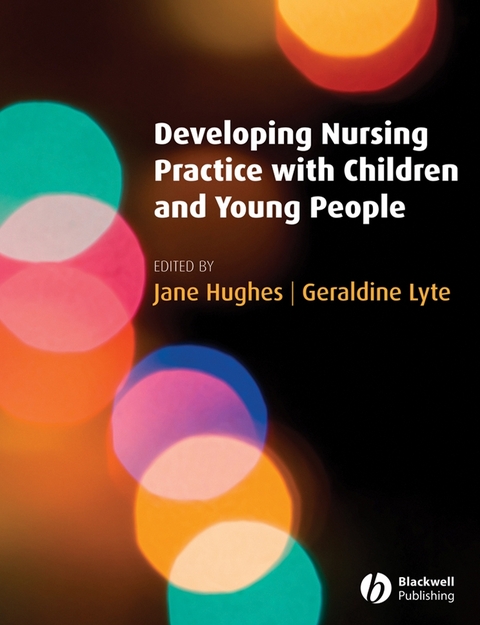
Developing Nursing Practice with Children and Young People (eBook)
John Wiley & Sons (Verlag)
978-1-119-10232-8 (ISBN)
Geraldine Lyte and Jane Hughes are both Lecturers in Child Nursing at the School of Nursing, Midwifery & Health Visiting, University of Manchester
Developing Nursing Practice with Children and Young People explores the context of children s nursing in light of recent policy changes, and looks at contemporary issues and emerging roles within the field. Divided into four parts, Part One focuses on the emergence of children s nursing in healthcare, detailing events and developments that have shaped the role of children s nurses. Part Two examines many aspects of practice for registered practitioners in nursing, ranging from acute care settings to children s nurses developing roles in primary care, mental health and with children and young people with special health and social needs. Part Three then provides a detailed analysis of advanced practice in children s nursing. The advanced skills portfolio is presented in depth, augmented by exemplars of a number of advanced practice roles which have already been established. Finally, Part Four builds on the previous three parts by offering several case studies from practice - including accounts from children, young people and families, as well as assistant practitioners and student nurses. The text concludes by focusing on the longer term scope for children s nurses.
Geraldine Lyte and Jane Hughes are both Lecturers in Child Nursing at the School of Nursing, Midwifery & Health Visiting, University of Manchester
Part One: Becoming a children's nurse- an exploration of
developing scope and practice.
Chapter 1: The emergence of the 21st century Children's
and Young People's Nurse.
Chapter Two: The changing educational landscape of
children's and young people's nursing.
Chapter Three: An international comparison of children's
and young people's nursing roles.
Part Two: The Registered Practitioner in Nursing- scope of
Practice.
Chapter Four: the newly qualified practitioner in acute
settings.
Chapter Five: The newly qualified practitioner in primary
care.
Chapter Six: The Public Health Practitioner.
Chapter Seven: The Children and Young peoples Mental Health
Practitioner.
Chapter Eight: The Practitioner working with Children and Young
People with Disabilities.
Chapter Nine: Safeguarding and supporting children & young
people and their families.
Part three - Advancing Nursing Roles in Children and
young people's Nursing.
Chapter Ten: The Advanced Practitioner in emergency and acute
assessment units.
Chapter Eleven: Advancing Nursing Roles and interdisciplinary
working: more examples from practice.
Chapter Twelve: Careers in Research and Education.
Chapter Thirteen: Looking to the Future
?This well-written book provides a comprehensive assessment of
nursing roles in children's nursing and other issues impacting
these roles in today's healthcare systems.? (Doody?s, 2009)
Chapter 1
The Emergence of the 21st Century Children’s Nurse
Jeremy Jolley
Introduction
You will be reading this book because you are interested in current issues in children’s nursing. Perhaps you wish to keep up to date with issues in nursing practice or perhaps you are learning how to be a children’s nurse. In any case, your key orientation is likely to be your practice in a range of health care settings with children and young people (CYP), their families and others who are important to them. Why start this book with an account of the history of children’s nursing? Answering this question is based on an appreciation that children’s nursing is more than a job, it is a profession. As professional people, nurses have a sense of responsibility for their discipline because in a real sense it belongs to them. This includes how the discipline is developing, progressing and moving forward. Nurses increasingly direct their practice, for example, through analysis and application of the best available evidence and by developing and changing practice to maximise the quality of care which they and others deliver.
What is children’s nursing?
Following on from this, children’s nursing is a professional activity which is focused on the delivery of care to CYP with a range of health care needs. It embraces the inclusion and involvement of families and significant others in that care, according to the needs and wishes of the CYP concerned. Childhood spans the most important period in our lives, incorporating birth and those babies born prematurely, infancy, being a toddler and then a young child, older children, early adolescence and the transition of young people into adulthood.
Children’s nurses provide health care to CYP at home, at school, in primary care settings and in hospitals. Their practice is based on wide ranging skills and knowledge such as managing psychological as well as physical trauma, spirituality and care of the dying, and the science of maintaining body systems to sustain life. Children’s nurses also work with adults in family units and other carer settings and of course in collaboration with other disciplines. The role of a children’s nurse, as it lies in juxtaposition between parent/carer and child, is one that is ancient in its history, professional in its continuous search for better care, and privileged beyond measure.
Why history?
Children’s nursing today encompasses a modern, caring discipline which embraces technical and scientific knowledge. It is also a discipline which has a long and interesting history, practiced over the centuries by women and men, by the rich and the poor and by the educated and uneducated (Evans 2004, Wyman 1984). It is important to have some appreciation of this colourful history because children’s nurses can learn much that is useful today from the knowledge of good and poor practices recorded in history. In order to improve or develop children’s nursing, for example, understanding from where it has come is as important as what is happening currently. It places today’s practice into perspective and can even help to determine ways in which current practice can be improved. It can help you develop a plan for how you wish to develop children’s nursing in your own lifetime. Perhaps, at no other time in modern history have we needed knowledge of the history of nursing as much as we do today. This chapter will aim to put the rest of the book into perspective for you.
Child health care before 1852
The nursing care of children has taken place in every age and in every society (Cunningham 1995). For as long as there have been children there have been those who have been ill and who have been injured. It would be incorrect to assume that the care of children is necessarily better today than it was in the past. Instead, you might question notions of an increasing degree of human civilisation, of children having a harder time than today, and of historical cruelty (Jolley 2006b). Some authors have argued that the care of children has consistently improved as civilisation has developed (e.g. Aries 1962, DeMause 1974); however, it is important to consider the evidence carefully before accepting this argument (Jolley 2006b). On the other hand, the presence of war and famine in our own time offer testament to the way in which children are not always seen as a priority. Overall though, there is overwhelming evidence from history that parents and others tried hard to keep their children in good health (Hardyment 1995).
Little is known of nursing that must have taken place before Britain’s medieval period. Nurses and those who cared for sick children rarely kept records of the activities and most of the documentation if any were lost. Some records remain from the great centres of civilisation in Greece (ca. 400 years BC), the Egyptian civilisation from the time of the Pharaohs and from the ancient Arabian and Chinese literature (till 1931). It may be surmised however, that much of the great wisdom of the past is lost to us. We do know that the ancient Greek and Arabic texts (written by people such as Hippocrates and Rhazes) were still being used in the 16th century (till 1931, Ellis 2001). Some of the contemporary medical texts in this period still remain today, thanks to the fact that printing had become available. Nevertheless it should not be assumed that these early authors were ‘doctors’ and that they therefore belong to the history of medicine. Thomas Phaer’s text of 1545 is as much about nursing as it is about medicine (Bowers 1999, Jolley 2006a). Perhaps, it is only from the 18th and 19th centuries that medicine and nursing begin to be considered separate disciplines as we know them today.
Monastic and religious nursing orders
Many of us are familiar with the ruined monasteries and abbeys in the British towns and countryside. From the 4th and 5th centuries until the dissolution of the monasteries by Henry VIII, some of these large institutions provided a degree of nursing for the traveller and for those in the local community (Evans 2004). Baly (1995) pointed out that some of the religious orders such as those of St. Benedict and St. Augustine tended to provide a service to the community, while others such as the Carthusians and Cistercians were more enclosed. A number of these orders provided a service to specific groups of people, for example, the St. Antonines provided care to the mentally ill (Mackintosh 1997). However, there is little evidence of the provision of children’s nursing by the monasteries and it is therefore likely that most of the care they provided was to adult travellers and to pilgrims.
There were also military orders which came about at the time of the Crusades. One of these orders, the Knights of St. John of Jerusalem provided hospital care. The ruins of their hospitals can still be found today in Malta and in Rhodes (Baly 1995). Again, however, most of their patients would have been travellers and there is very little indication that they provided care to sick children. The Knights of St. John of Jerusalem live on in the UK today as the St. John’s Ambulance Brigade and members wear the badge of the order (a Maltese Cross) on their uniform.
So it can be surmised that the monastic movement did not make a sizable contribution to the history of children’s nursing. There existed no institutionalised discipline that focused its work on the needs of sick children. Of course, one should not conclude from this that children did not receive nursing and medical treatment. Instead, that medical and nursing knowledge which existed at the time is likely to have been common knowledge and delivered by the child’s family. What advice that was available would probably have been acquired from local people, those with experience of the particular disorder and, where such contacts existed, from those who were better educated. In this way, nursing knowledge was much more a part of the common understanding than is the case today.
Families consequently provided the main care and treatment for sick children. They would have known how to do this and would not necessarily have been dependent on people with greater knowledge. Today, families still provide much of the health care required by their CYP but they have a range of expert care providers available such as those found in today’s hospitals. This notion of expert is quite modern. Experts can, of course, be very useful but their introduction into society has removed a significant part of the traditional role of the family particularly in health care and education.
It is also interesting that it was largely men who worked as nurses in the monastic and military models of health care that were prevalent until the dissolution of the monasteries in the reign of Henry VIII.
With the passing of the monastic movement, health care was largely un-institutionalised and became the responsibility of the individual family. On the whole, general hospitals did not begin to develop until the 18th century (Evans 2004) and these did relatively little work with children. However, the general hospitals of the 18th and 19th centuries were working to a very different model and were institutional in the separation of Medicine and Nursing. In the days of the monasteries, the distinction between care and treatment had been relatively indistinct. In the mid-19th century, however, Florence Nightingale built on separate models of nursing and medicine at a time when roles of men and women...
| Erscheint lt. Verlag | 8.9.2015 |
|---|---|
| Sprache | englisch |
| Themenwelt | Medizin / Pharmazie ► Pflege ► Kinderkrankenpflege |
| Schlagworte | Aspects • changes • Childrens • Contemporary • ConText • Emergence • examines • Field • focuses • Healthcare • Krankenpflege • Krankenpflege in der Pädiatrie u. Neonatologie • Krankenpflege in der Pädiatrie u. Neonatologie • light • nurses • nursing • Nursing Children & Young People • nursing practice • Nursing Special Topics • One • Part • People • Policy • Practice • Practitioners • registered • Role • Spezialthemen Krankenpflege • two |
| ISBN-10 | 1-119-10232-4 / 1119102324 |
| ISBN-13 | 978-1-119-10232-8 / 9781119102328 |
| Informationen gemäß Produktsicherheitsverordnung (GPSR) | |
| Haben Sie eine Frage zum Produkt? |
 EPUB (Adobe DRM)
Kopierschutz: Adobe-DRM
Adobe-DRM ist ein Kopierschutz, der das eBook vor Mißbrauch schützen soll. Dabei wird das eBook bereits beim Download auf Ihre persönliche Adobe-ID autorisiert. Lesen können Sie das eBook dann nur auf den Geräten, welche ebenfalls auf Ihre Adobe-ID registriert sind.
Details zum Adobe-DRM
Dateiformat: EPUB (Electronic Publication)
EPUB ist ein offener Standard für eBooks und eignet sich besonders zur Darstellung von Belletristik und Sachbüchern. Der Fließtext wird dynamisch an die Display- und Schriftgröße angepasst. Auch für mobile Lesegeräte ist EPUB daher gut geeignet.
Systemvoraussetzungen:
PC/Mac: Mit einem PC oder Mac können Sie dieses eBook lesen. Sie benötigen eine
eReader: Dieses eBook kann mit (fast) allen eBook-Readern gelesen werden. Mit dem amazon-Kindle ist es aber nicht kompatibel.
Smartphone/Tablet: Egal ob Apple oder Android, dieses eBook können Sie lesen. Sie benötigen eine
Geräteliste und zusätzliche Hinweise
Buying eBooks from abroad
For tax law reasons we can sell eBooks just within Germany and Switzerland. Regrettably we cannot fulfill eBook-orders from other countries.
aus dem Bereich