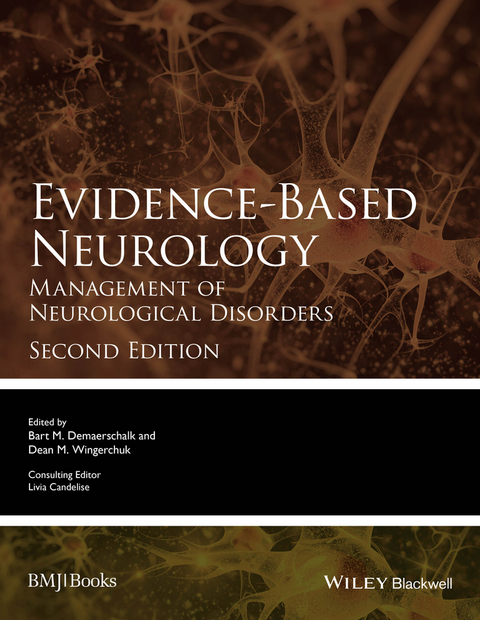
Evidence-Based Neurology (eBook)
John Wiley & Sons (Verlag)
978-1-119-06733-7 (ISBN)
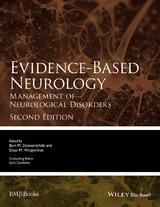
- fills the gap between guidelines and primary studies as well as between primary and secondary scientific medical literature
- summarizes the most recent and important findings on treatments for neurological patients
- measures the benefit and, when applicable, the risk of harm inherent in specific neurological interventions
- now includes new non-clinical topics of interest to neurologists such as education and research
Bart M, Demaerschalk, MD, MSc, FRCP(C), Professor of Neurology, Department of Neurology, Mayo Clinic, College of Medicine, Phoenix, AZ, USA
Dean M, Wingerchuk, MD, MSc, FRCP(C), Professor of Neurology, Department of Neurology, Mayo Clinic College of Medicine, Scottsdale, AZ, USA
From an expert editor team drawn from the Cochrane Neurological Network, Evidence-Based Neurology provides specialists and those in training with the skills and knowledge to apply evidence-based practice in the clinical setting. fills the gap between guidelines and primary studies as well as between primary and secondary scientific medical literature summarizes the most recent and important findings on treatments for neurological patients measures the benefit and, when applicable, the risk of harm inherent in specific neurological interventions now includes new non-clinical topics of interest to neurologists such as education and research
Bart M. Demaerschalk, MD, MSc, FRCP(C), Professor of Neurology, Department of Neurology, Mayo Clinic, College of Medicine, Phoenix, AZ, USA Dean M. Wingerchuk, MD, MSc, FRCP(C), Professor of Neurology, Department of Neurology, Mayo Clinic College of Medicine, Scottsdale, AZ, USA
Contributors vii
Part 1 Evidence-based neurology: introduction
1 Evidence-based neurology in health education 3
Lawrence Korngut, Miguel Bussière and Bart M. Demaerschalk
2 Evidence-based medicine in health research 9
Dean M. Wingerchuk
3 Evidence and ethics 13
Joseph L. Verheijde
Part 2 Evidence-based neurology in the hospital
4 Thunderclap headache 23
Jonathan H. Smith and Todd J. Schwedt
5 Coma 33
Bappaditya Ray and Salah G. Keyrouz
6 Acute ischemic stroke and transient ischemic attack 53
Maria I. Aguilar
7 Spinal cord compression 67
Naresh P. Patel, Christopher A. Payne and Bhavesh M. Patel
8 Delirium 75
William D. Freeman
9 Status epilepticus 81
Kameshwar Prasad, Manya Prasad, Sridharan Ramaratnam and Anthony G. Marson
10 Raised intracranial pressure 87
William David Freeman
11 Traumatic brain injury 93
Miguel Arango, Walter Videtta and Corina Puppo
12 Myasthenia gravis 107
Brent P. Goodman
13 Acute visual loss 113
Byron Roderick Spencer
14 Secondary prevention of stroke 119
Gord Gubitz
Part 3 Evidence-based neurology in the clinic
15 Central nervous system infections 131
Gloria von Geldern and Avindra Nath
16 Evidence-based neuro-oncology 143
Michael G. Hart and Robin Grant
17 Epilepsy 153
Sridharan Ramaratnam and Anthony G. Marson
18 Cognitive disorders: mild cognitive impairment and Alzheimer's disease 173
Charlene H. Snyder, Bryan K. Woodruff and Richard J. Caselli
19 Evidence-based treatment of Parkinson's disease 191
Nicholas D. Child and Bryan T. Klassen
20 Therapies for multiple sclerosis 209
Greg Thaera and Dean M. Wingerchuk
21 Amyotrophic lateral sclerosis 219
Cumara B. O'Carroll, Amelia K. Adcock and Bart M. Demaerschalk
22 Peripheral nerve disorders 235
Jennifer A. Tracy and P. James B. Dyck
23 Critical illness neuromyopathy 243
Brent P. Goodman and Andrea J. Boon
24 Muscle disorders 249
Amelia K. Adcock, Cumara B. O'Carroll and Bart M. Demaerschalk
25 Sleep disorders 257
Joyce K. Lee-Iannotti
26 Acute migraine attacks 267
E. Anne MacGregor, Rashmi B. Halker and Bert B. Vargas
27 Therapy of vestibular disorders nystagmus and cerebellar ataxia 279
Michael Strupp and Thomas Brandt
28 Neuro-ophthalmology 291
Martin Sutton-Brown and Jason J. S. Barton
29 Therapeutic connection in neurorehabilitation: theory evidence and practice 303
Nicola M. Kayes, Kathryn M. McPherson and Paula Kersten
Part 4 Telemedicine feature
30 Evidence-based teleneurology practice 321
William D. Freeman, Kevin M. Barrett, Kenneth A Vatz and Bart M. Demaerschalk
Index 325
Chapter 1
Evidence-based neurology in health education
Lawrence Korngut1, Miguel Bussière2 and Bart M. Demaerschalk3
1Calgary ALS and Motor Neuron Disease Clinic, Clinical Neurosciences, South Health Campus, Calgary, AB, Canada
2Neurology and Interventional Neuroradiology, Division of Neurology, Grey Nuns Hospital, Edmonton, AB, Canada
3Department of Neurology, Mayo Clinic, Phoenix, AZ, USA
Introduction
Clinical neurology trainees undergo a lengthy and complex process requiring integration of many fundamental skills that coalesce into sound diagnosis and decision making. Beyond the core knowledge of anatomy, physiology, biochemistry, pathology, and the medical sciences, there is an essential requirement for the clinical student, in the arena of evidence-based clinical practice, to acquire skills and expertise in the principles and practice of critical appraisal and to have a working knowledge of the best evidence from the diverse multiple subspecialties that comprise neurology today. Maintaining competence in the current best evidence over a neurologist's career is essential to making accurate diagnoses, providing high-quality neurological care, and selecting appropriate tests and therapies.
Developing the skills necessary for critical appraisal is a difficult process, particularly when competing with the rigorous demands of a residency training program. An evidence-based curriculum in neurology education provides the opportunity for teaching the fundamentals of critical appraisal and engaging in discussion of current clinical questions, hot topics, and continued controversies. Fostering an understanding of what comprises an appropriately comprehensive rigorous literature search, the levels of evidence, the different types of studies, and the methodologies are difficult to consolidate outside of a formalized curriculum or graduate-level training in evidence-based medicine, health research methodology, and clinical epidemiology.
In this chapter, we discuss the development of an evidence-based neurology (EBN) curriculum in health education.
Objectives
Teaching and acquisition of critical appraisal skills is the primary objective of an evidence-based clinical practice curriculum. Fundamental critical appraisal skills include the following: awareness of a clinical knowledge gap, formulation of answerable questions based on clinical uncertainty, performance of a literature search, identification of the highest quality evidence from the search yield, and critical appraisal of the studies to address the original clinical question. Students should become familiar with the different classifications of clinical studies (e.g. prognosis, diagnosis, therapy or harm) and the main methodological and statistical questions that must be addressed in each type of study. The students should also be able to determine whether or not the study findings are worth considering given the methodological quality of the study and its generalizability in reference to the patient population in question.
Students should develop an understanding of both the importance and the limitations of clinical evidence. Emphasis should remain on high-quality patient care and the use of the current best evidence to guide clinical practice within the context of the patient's wishes and the clinician's judgment and reasoning. It must be emphasized that lack of evidence for efficacy does not necessarily mean lack of benefit with treatment, and vice versa for lack of evidence against certain therapies or diagnostic tests.
As a result of the evidence-based medicine, curriculum knowledge about best current evidence practices is accumulated and stored for future use. Owing to the discussion of common clinical scenarios and review of the relevant best evidence, the students develop a working knowledge of the current evidence (Table 1.1).
Table 1.1 Objectives of evidence-based neurology curriculum
|
The following sections describe an example of an EBN curriculum based on two longstanding, mature, and successful programs targeting clinical neurology residents: the EBN curriculum from the Western University (WU) in London, Canada [1–4]; and the Mayo Clinic Evidence-Based Clinical Practice, Research, Informatics, and Training (MERIT) Curriculum, Mayo Clinic, Phoenix, AZ [5, 6]. Another third valuable resource designed to help educators teach students of neurology to understand and use evidence-based medicine is the web-based American Academy of Neurology (AAN) Evidence-Based Medicine Curriculum [7].
Topic selection
Generating the clinical questions
Once annually EBN curriculum facilitators survey all neurology students and faculty members to generate a list of neurological questions for potential review. These clinical questions are then rank ordered by the trainees and facilitators according to multiple factors including clinical importance, relevance, frequency of occurrence, and interest. The most highly ranked questions are reviewed in the upcoming year. The topics are screened to ensure that they are congruent with the educational recommendations of the training program (post-graduate education committee): Royal College of Physicians and Surgeons of Canada Advisory Committee and/or Accreditation Council for Graduate Medical Education – Neurology Residency and American Board of Psychiatry and Neurology [1–6].
Preparing for the tutorial session
Students each select one or two clinical questions per academic year and prepare their critically appraised topic for general discussion with the group. For each clinical topic, a clinical scenario and a focused clinical question are formulated. A focused clinical question should include considerations of the specific patient group, the intervention or exposure, the method of comparison, and the outcome measures. The acronym PICO can serve as a helpful reminder [8] (Table 1.2).
Table 1.2 PICO acronym [8]
| Patient or population |
| Intervention, prognostic factor or exposure |
| Comparison intervention |
| Outcome to measure or achieve |
For a given clinical question, the presenting trainee performs a literature search and identifies studies representing the highest level of evidence [9]. Expert librarians and informatics specialists can be called upon to assist in efficient and comprehensive literature searching. Studies are evaluated according to the generally accepted hierarchy of clinical evidence. High-quality meta-analyses, systematic reviews, and randomized clinic trials are preferred over observational studies and case reports. One to four studies are selected for critical appraisal and discussion. A summary of this information is prepared in advance of the discussion in the form of a critically appraised topic (CAT) as described later. One week prior to the session, the presenting trainee circulates copies of the clinical scenario, focusing clinical question, search strategy, and articles for review to the participants. The pre-tutorial process is supervised by one of the facilitators. The faculty often provides instruction and advice on the search strategy and reasons for inclusion or exclusion of studies. Trainees are introduced to different search engines (e.g. PubMed [10], SUMSearch [11], Cochrane Library [12]). Discussions on Medical Subject Headings (MeSH headings), keywords, and their uses are helpful.
Flexibility is available to adjust the clinical topics to suit the needs and training level of the trainees. Semi-annual meetings of the curriculum trainees and facilitators allow for appropriate curriculum content changes and adjustment of group discussion objectives to cover specific epidemiological or biostatistical topics.
Tutorial
Each tutorial session focuses on a trainee presenting one clinical question. The session begins with a 5-min description of the clinical scenario and focused clinical question. This is followed by a 10-min presentation of the background topic including clinical information about the condition, treatment, or diagnostic test. The trainee then presents and discusses the search strategy for 5 min.
The following 45 min is dedicated to critical appraisal of the evidence.
The study type is identified (e.g. prognosis, diagnosis, therapy, or harm), and the appropriate rating scale or worksheet is utilized to assist the presenting trainee and faculty members guide the group through the...
| Erscheint lt. Verlag | 8.9.2015 |
|---|---|
| Reihe/Serie | Evidence-Based Medicine |
| Evidence-Based Medicine | Evidence-Based Medicine |
| Mitarbeit |
Berater: Livia Candelise |
| Sprache | englisch |
| Themenwelt | Medizin / Pharmazie ► Medizinische Fachgebiete ► Neurologie |
| Schlagworte | Cochrane Neurological NetworkEvidence-Based NeurologyClinical Evidence-based medicineNeurologyMethodologyNeurologistsBart DemaerschalkDean WingerchukLivia CandeliseEvidenceEthicsThunderclap headacheCritical Illness NeuromyopathyAcute Visual lossMyasthenia GravisTraumatic Brain InjuryRaised Intracranial PressureStatus EpilepticusDeliriumSpinal Cord CompressionAcute Ischemic StrokeTransient Ischemic AttackComaNeurorehabilitationNeuro-OphthalmologyVestibular disordersnystagmusHeadache DisordersSleep DisordersM • Medical Science • Medizin • Neurologie • Neurology |
| ISBN-10 | 1-119-06733-2 / 1119067332 |
| ISBN-13 | 978-1-119-06733-7 / 9781119067337 |
| Informationen gemäß Produktsicherheitsverordnung (GPSR) | |
| Haben Sie eine Frage zum Produkt? |
 EPUB (Adobe DRM)
Kopierschutz: Adobe-DRM
Adobe-DRM ist ein Kopierschutz, der das eBook vor Mißbrauch schützen soll. Dabei wird das eBook bereits beim Download auf Ihre persönliche Adobe-ID autorisiert. Lesen können Sie das eBook dann nur auf den Geräten, welche ebenfalls auf Ihre Adobe-ID registriert sind.
Details zum Adobe-DRM
Dateiformat: EPUB (Electronic Publication)
EPUB ist ein offener Standard für eBooks und eignet sich besonders zur Darstellung von Belletristik und Sachbüchern. Der Fließtext wird dynamisch an die Display- und Schriftgröße angepasst. Auch für mobile Lesegeräte ist EPUB daher gut geeignet.
Systemvoraussetzungen:
PC/Mac: Mit einem PC oder Mac können Sie dieses eBook lesen. Sie benötigen eine
eReader: Dieses eBook kann mit (fast) allen eBook-Readern gelesen werden. Mit dem amazon-Kindle ist es aber nicht kompatibel.
Smartphone/Tablet: Egal ob Apple oder Android, dieses eBook können Sie lesen. Sie benötigen eine
Geräteliste und zusätzliche Hinweise
Buying eBooks from abroad
For tax law reasons we can sell eBooks just within Germany and Switzerland. Regrettably we cannot fulfill eBook-orders from other countries.
aus dem Bereich