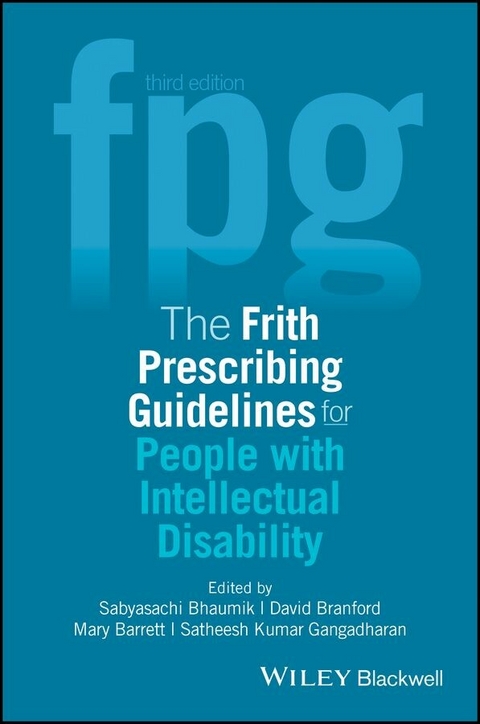
The Frith Prescribing Guidelines for People with Intellectual Disability (eBook)
John Wiley & Sons (Verlag)
978-1-118-89717-1 (ISBN)
The Frith Prescribing Guidelines for People with Intellectual Disability provides comprehensive guidance on prescribing for patients with intellectual disability, as well as general information on the clinical care of this important population.
The guidelines have been conceived and developed by clinicians working in intellectual disability services. They are based on both the latest evidence and expert opinion to provide a consensus approach to prescribing as part of a holistic package of care, and include numerous case examples and scenarios. New to this edition are improved coverage of children and the role of primary care teams.
The Frith Prescribing Guidelines for People with Intellectual Disability, Third Edition, is a practical guide for busy clinicians, as well as a valuable reference for all primary and secondary health care professionals caring for people with intellectual disability.
Sabyasachi Bhaumik, Honorary Chair, University of Leicester, and Consultant Psychiatrist, Leicestershire Partnership NHS Trust, Leicester, UK
David Branford, Pharmacist Expert in the fields of intellectual disabilities and mental health
Mary Barrett, Consultant Psychiatrist for Adults with Learning Disabilities and Named Doctor for Safeguarding Adults, Leicestershire Partnership NHS Trust, Leicester, UK, and East Midlands Training Programme Director for Psychiatry of Intellectual Disability
Satheesh Kumar Gangadharan, Medical Director and Consultant Psychiatrist, Leicestershire Partnership NHS Trust, Leicester, UK
The Frith Prescribing Guidelines for People with Intellectual Disability provides comprehensive guidance on prescribing for patients with intellectual disability, as well as general information on the clinical care of this important population. The guidelines have been conceived and developed by clinicians working in intellectual disability services. They are based on both the latest evidence and expert opinion to provide a consensus approach to prescribing as part of a holistic package of care, and include numerous case examples and scenarios. New to this edition are improved coverage of children and the role of primary care teams. The Frith Prescribing Guidelines for People with Intellectual Disability, Third Edition, is a practical guide for busy clinicians, as well as a valuable reference for all primary and secondary health care professionals caring for people with intellectual disability.
Sabyasachi Bhaumik, Honorary Chair, University of Leicester, and Consultant Psychiatrist, Leicestershire Partnership NHS Trust, Leicester, UK David Branford, Pharmacist Expert in the fields of intellectual disabilities and mental health Mary Barrett, Consultant Psychiatrist for Adults with Learning Disabilities and Named Doctor for Safeguarding Adults, Leicestershire Partnership NHS Trust, Leicester, UK, and East Midlands Training Programme Director for Psychiatry of Intellectual Disability Satheesh Kumar Gangadharan, Medical Director and Consultant Psychiatrist, Leicestershire Partnership NHS Trust, Leicester, UK
List of contributors vii
Foreword xi
Preface xiii
Acknowledgements xv
1 Intellectual Disability 1
David Branford and Sabyasachi Bhaumik
2 Prescribing Practice 11
David Branford and Sabyasachi Bhaumik
3 Physical and Health Monitoring 21
David Branford and Sabyasachi Bhaumik
4 Epilepsy 31
Reza Kiani
5 Dementia in People with Intellectual Disability 63
Satheesh Kumar Gangadharan and Amala Jesu
6 Eating and Drinking Difficulties 77
Jenny Worsfold, Nicky Calow and David Branford
7 Sleep Disorders 95
Reza Kiani
8 Women's Health Issues 107
Nyunt Nyunt Tin and Julia Middleton
9 Sexual Offending 117
John Devapriam, Pancho Ghatak, Sabyasachi Bhaumik, David Branford, Mary Barrett and Sayeed Khan
10 Autism Spectrum Disorders 125
Mary Barrett and Elspeth Bradley
11 Attention Deficit Hyperactivity Disorder 135
Karen Bretherton
12 Aggressive Behaviour 147
David Branford and Sabyasachi Bhaumik
13 Self?]Injurious Behaviour 153
Asit Biswas and Sabyasachi Bhaumik
14 Anxiety Disorders 161
Avinash Hiremath, Sabyasachi Bhaumik and Khalid Nawab
15 Depression 169
Avinash Hiremath, Shweta Gangavati and Mary Barrett
16 Bipolar Affective Disorder 179
Desari Mohan Michael, David Branford and Mary Barrett
17 Schizophrenia 193
Avinash Hiremath, Amala Jesu and Saduf Riaz
18 Alcohol Use Disorders 203
Helen Miller
19 Personality Disorders 215
Regi Alexander and Sabyasachi Bhaumik
20 Discussion Case Studies with Suggested Answers 225
Appendix: Summary of Syndromes Mentioned in the Guidelines 241
Index 000
CHAPTER 1
Intellectual Disability
David Branford1 & Sabyasachi Bhaumik2,3
1English Pharmacy Board, Royal Pharmaceutical Society, London, UK
2Leicestershire Partnership NHS Trust, Leicester, UK
3Department of Health Sciences, University of Leicester, Leicester, UK
Whatever term is chosen for this condition, it eventually becomes perceived as an insult.
Wikipedia
Throughout time, many terms have been used to describe the condition now we currently call intellectual disability (ID). Wikipedia describes the evolution of these many terms, including mental retardation (United States) and mental handicap (United Kingdom) and how each, in turn, becomes incorporated into normal language in a derogatory way.
There is a general consensus on the concept of ID. It requires the presence of three criteria based on the definition derived after extensive consultation in the United States (Luckasson et al., 1992 ). These criteria have been carried forwards in DSM-5.
The American Psychiatric Association (APA) diagnostic criteria for ID (DSM-5 criteria) are as follows:
- Deficits in general mental abilities.
- Impairment in adaptive functioning for individual’s age and sociocultural background, which may include communication, social skills, person independence and school or work functioning.
- All symptoms must have an onset during the developmental period.
Significant intellectual impairment is usually defined as an intelligence quotient (IQ) more than 2 standard deviations below the general population mean (originally fixed at 100). This is an IQ below 70 on recognised IQ tests. Two per cent of the population have an IQ below this level. Significant deficits in social functioning are commonly measured using well-known scales such as the Vineland Adaptive Behaviour Scales (VABS) or the Adaptive Behaviour Assessment System (ABAS II). These assess communication, daily living skills and socialisation; the VABS also assesses motor skills.
The term ‘ID’ is used in this text synonymously with learning disability (the common terminology currently used in clinical practice in the United Kingdom), mental retardation (used in ICD-10 and DSM-IV) and mental handicap (used in the United Kingdom until 1994). A decision to use ID was based upon this being currently the most widely recognised and acceptable term for an international readership.
The 11th revision of ICD is underway and the WHO has established several working groups to contribute to the beta phase of the 11th revision. At this stage, the proposal is for changing the name of the disorder from ‘mental retardation’ to ‘disorders of intellectual development’.
The term ‘learning difficulty’, first proposed by the Warnock Committee, is a much broader category than ID. This is the term used in the UK educational system. Learning difficulties include speech and language impairments; learning problems arising from sensory impairments, physical disabilities, medical problems or behaviour difficulties; and specific learning problems such as dyslexia. ID is associated with global impairment of intellectual and adaptive functioning and is assessed using intellectual criteria; learning difficulty is assessed by educational criteria. The measures for the latter are mostly proxy measures of learning achievement (rather than the learning process itself) such as memory recall, reading, number and problem solving. It is estimated that about one in five children has a learning difficulty at some time during the course of life, and one in six children has a learning difficulty at any one time. These guidelines refer to adults with ID and learning difficulties will not be considered further.
Prevalence
The prevalence of ID depends on the cut-off point used for the definition of ID (Table 1.1) and the methodology used to measure it. Studies that have screened whole populations tend to find a higher prevalence (around 6 per 1000 population) than those that include only those known to services, the administrative prevalence. It is estimated that the prevalence is increasing at a rate of 1% a year.
Table 1.1 Administrative prevalence of ID in the UK.
| Severity of ID | IQ | Prevalence per 1000 population |
| Mild | 50–69 | 30 |
| Moderate | 35–49 | } 3 |
| Severe | 20–34 | } |
| Profound | <20 | 0.5 |
Aetiology
Biological, environmental and social factors may contribute to the development of ID. A large number of different aetiological processes may be involved; these are usually complex and often not completely understood. Biological factors are present in about 67–75% of people with ID, the majority operating before birth (Table 1.2). The two most common genetic causes are Down syndrome and Fragile X syndrome. In a third of people with ID, no primary diagnosis can be made.
Table 1.2 Biological factors that may cause ID.
| Period of origin | Nature of disorder | Common examples |
| Prenatal period | Genetic disorders Chromosome aberrations Single gene mutations Microdeletions | Down syndrome (trisomy 21) Tuberous sclerosis, phenylketonuria, mucopolysaccharidoses, fragile X syndrome Prader–Willi syndrome, Williams syndrome |
| Congenital malformations Central nervous system malformations Multiple malformation syndromes | Neural tube defects Cornelia de Lange syndrome |
| Exposure Maternal infections Teratogens Toxaemia, placental insufficiency Severe malnutrition Trauma Iatrogenic | Congenital rubella, HIV Foetal alcohol syndrome Prematurity Intra-uterine growth retardation Physical injury Radiation, medications |
| Perinatal period | Infections Delivery Other causes | TORCH infections: toxoplasmosis, hepatitis B, syphilis, herpes zoster, rubella, cytomegalovirus, herpes simplex Anoxic brain damage Hyperbilirubinaemia |
| Postnatal period | Infections Metabolic Endocrine Cerebrovascular Toxins Trauma Neoplasms Psychosocial factors | Encephalitis Hypoglycaemia Hypothyroidism (cretinism) Thrombo-embolic phenomena Lead poisoning Head injury Meningioma, craniopharyngioma Understimulation |
| Any | Untraceable or unknown |
How common are health needs in people with ID?
- People with ID have significantly more health problems than the general population.
- People with ID have a shorter life expectancy and increased risk of early death when compared to the general population.
- All-cause mortality rates among people with moderate to severe ID are three times higher than in the general population, with mortality being particularly high for young adults, women and people with Down syndrome.
- The prevalence of psychiatric disorders is 36% among children with ID, compared to 8% among children without ID.
- The prevalence of psychiatric disorders is also significantly higher among adults with ID when compared to general population rates.
- Around 50% of adults have a major psychiatric or behaviour problem requiring specialist help.
- Twenty-five per cent of adults with ID have active epilepsy, at least 33% have a sensory impairment, and around 40% have associated major physical disabilities of mobility and incontinence.
- Fifty to ninety per cent of people with ID have communication difficulties; a lack of supported communication may compound their problems in receiving the healthcare that they need.
The substantial health needs of this population are often overlooked and unmet, something that has been highlighted by reports including ‘Treat Me Right!’ (MENCAP), ‘Death by Indifference’ (MENCAP) and ‘Equal Treatment: Closing the Gap’ (DRC). Sometimes, this reaches the level of national outrage, as with the mistreatment of people with ID at the inpatient assessment facility Winterbourne View, near Bristol in the United Kingdom, which was shut down and where a number of staff were prosecuted.
How do psychiatric and behavioural problems present in ID?
Both the diagnosis and treatment of psychiatric and behavioural problems in people with ID may need a different approach from that in the general population. Although there are guidelines to assist practitioners in prescribing medications for mental health problems in the wider population, the Frith Guidelines are the first to address the specific issues relating to the pharmacological...
| Erscheint lt. Verlag | 11.9.2015 |
|---|---|
| Sprache | englisch |
| Themenwelt | Medizin / Pharmazie ► Gesundheitsfachberufe |
| Medizin / Pharmazie ► Medizinische Fachgebiete ► Psychiatrie / Psychotherapie | |
| Medizin / Pharmazie ► Pflege | |
| Schlagworte | Approach • Arzneimittelverschreibung • Care • Clinical • Clinicians • Comprehensive • Consensus • Disability • Evidence • Expert Opinion • Frith • Geistige Behinderung • General • Guidelines • important • Information • Intellectual • Intellectual Disability Nursing • Krankenpflege • Krankenpflege bei geistigen Störungen • Krankenpflege bei geistigen Störungen • Latest • Medical Science • Medizin • nursing • Part • patients • People • Pharmacy • Pharmazie • Population • Prescribing • provides • Psychiatrie • Psychiatry |
| ISBN-10 | 1-118-89717-X / 111889717X |
| ISBN-13 | 978-1-118-89717-1 / 9781118897171 |
| Informationen gemäß Produktsicherheitsverordnung (GPSR) | |
| Haben Sie eine Frage zum Produkt? |
 EPUB (Adobe DRM)
Kopierschutz: Adobe-DRM
Adobe-DRM ist ein Kopierschutz, der das eBook vor Mißbrauch schützen soll. Dabei wird das eBook bereits beim Download auf Ihre persönliche Adobe-ID autorisiert. Lesen können Sie das eBook dann nur auf den Geräten, welche ebenfalls auf Ihre Adobe-ID registriert sind.
Details zum Adobe-DRM
Dateiformat: EPUB (Electronic Publication)
EPUB ist ein offener Standard für eBooks und eignet sich besonders zur Darstellung von Belletristik und Sachbüchern. Der Fließtext wird dynamisch an die Display- und Schriftgröße angepasst. Auch für mobile Lesegeräte ist EPUB daher gut geeignet.
Systemvoraussetzungen:
PC/Mac: Mit einem PC oder Mac können Sie dieses eBook lesen. Sie benötigen eine
eReader: Dieses eBook kann mit (fast) allen eBook-Readern gelesen werden. Mit dem amazon-Kindle ist es aber nicht kompatibel.
Smartphone/Tablet: Egal ob Apple oder Android, dieses eBook können Sie lesen. Sie benötigen eine
Geräteliste und zusätzliche Hinweise
Buying eBooks from abroad
For tax law reasons we can sell eBooks just within Germany and Switzerland. Regrettably we cannot fulfill eBook-orders from other countries.
aus dem Bereich