Post Registration Qualifications for Dental Care Professionals (eBook)
John Wiley & Sons (Verlag)
978-1-118-71110-1 (ISBN)
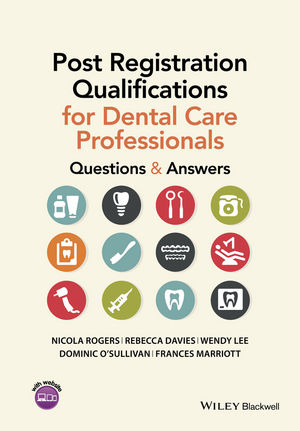
Post Registration Qualifications for Dental Care Professionals: Questions and Answers is a comprehensive revision aid for dental nurses seeking to gain post-registration certification for professional development.
- Chapters cover qualifications in special care dental nursing, oral health education, dental sedation nursing, dental implant nursing, dental radiography and orthodontic dental nursing
- Questions are accompanied by clear explanations of the correct answers, reflecting the latest standards and practices
- Supported by a companion website which features sample questions mirroring each exam format
- An essential resource for dental care professionals who are looking to further advance their careers
Nicola Rogers is a Dental Nursing Tutor at the Bristol Dental Hospital, Bristol, UK. She is the author of Basic Guide to Dental Sedation Nursing (Wiley-Blackwell, 2011).
Rebecca Davies is a Consultant and Honorary Senior Lecturer in Dental and Maxillofacial Radiology at the School of Oral and Dental Sciences, Bristol Dental Hospital, Bristol, UK.
Wendy Lee is a DCP Tutor and Orthodontic Therapist at the Bristol Dental Hospital, Bristol, UK.
Dominic O'Sullivan is a Professor in Restorative Dentistry at the School of Oral and Dental Sciences, Bristol Dental Hospital, Bristol, UK.
Frances Marriott is joint Director of Focus Oral Health CIC in Plymouth, UK providing an oral health education and information service for inter-professional and community audiences.
Post Registration Qualifications for Dental Care Professionals: Questions and Answers is a comprehensive revision aid for dental nurses seeking to gain post-registration certification for professional development. Chapters cover qualifications in special care dental nursing, oral health education, dental sedation nursing, dental implant nursing, dental radiography and orthodontic dental nursing Questions are accompanied by clear explanations of the correct answers, reflecting the latest standards and practices Supported by a companion website which features sample questions mirroring each exam format An essential resource for dental care professionals who are looking to further advance their careers
Nicola Rogers is a Dental Nursing Tutor at the Bristol Dental Hospital, Bristol, UK. She is the author of Basic Guide to Dental Sedation Nursing (Wiley-Blackwell, 2011). Rebecca Davies is a Consultant and Honorary Senior Lecturer in Dental and Maxillofacial Radiology at the School of Oral and Dental Sciences, Bristol Dental Hospital, Bristol, UK. Wendy Lee is a DCP Tutor and Orthodontic Therapist at the Bristol Dental Hospital, Bristol, UK. Dominic O'Sullivan is a Professor in Restorative Dentistry at the School of Oral and Dental Sciences, Bristol Dental Hospital, Bristol, UK. Frances Marriott is joint Director of Focus Oral Health CIC in Plymouth, UK providing an oral health education and information service for inter-professional and community audiences.
How to use this book vii
Acknowledgements ix
About the companion website xi
1 Special care dental nursing 1
2 Oral health education 59
3 Dental sedation nursing 134
4 Dental implant nursing, 260
5 Dental radiography 315
6 Orthodontic dental nursing 443
Chapter 1
Special care dental nursing
CHAPTER CONTENTS
- SECTION I Questions: Disability awareness
- SECTION II Questions: Facilitating access
- SECTION III Questions: Communication
- SECTION IV Questions: Diversity of need
- SECTION V Questions: Preparing for patient visit
- SECTION VI Questions: Patient care during treatment
- SECTION VII Questions: Pain and anxiety management
- SECTION VIII Questions: Promoting good oral health
- SECTION I Answers: Disability awareness
- SECTION III Answers: Communication
- SECTION IV Answers: Diversity of need
- SECTION V Answers: Preparing for patient visit
- SECTION VI Answers: Patient care during treatment
- SECTION VII Answers: Pain and anxiety management
- SECTION VIII Answers: Promoting good oral health
SECTION I Questions: Disability awareness
LEARNING OUTCOMES
At the end of this section, you should be able to identify any gaps in knowledge associated with the following:
- Impairment and disability
- Related legislation and guidelines – consent
- Barriers to access
Impairment and disability
- 1. Define the term ‘Impairment’.
- 2. Define the term ‘Disability’.
- 3. Disability can be listed under four main classifications. What are these?
- 4. Give an example of an impairment for each of the four classifications of disability.
- 5. What is meant by the Social Model of Disability?
- 6. What is meant by the Medical Model of Disability?
Related legislation and guidelines – consent
- 1. State three key legislative Acts which help inform the delivery of Special Care Dentistry.
- 2. In 2011, the ‘Public Sector Equality Duty’ became part of the Equality Act. State one action the amendment required that public organisations need to take.
- 3. State three ‘dentally related’ documents which help inform delivery of oral health care for people with disabilities.
- 4. In relation to Health and Social Care, a new Act was introduced in 2012 – what was it called?
- 5. When determining a new way of working or a new policy in healthcare provision, what is an EIA?
- 6. From date of diagnosis, progressive conditions such as HIV, Cancer and Multiple Sclerosis are covered by which key disability related legislation?
- 7. In relation to obtaining consent in England and Wales, what do the letters MCA stand for?
- 8. When did the MCA come into force?
- 9. In relation to obtaining consent in Scotland, which Act is involved?
- 10. When did this Act come into force?
- 11. A person who supports another person (who lacks capacity and has no appropriate family or friends to consult) to make decisions is called an IMCA? What does this stand for?
- 12. State two types of situation when the services of an IMCA may be necessary.
- 13. Another form of advocacy support is via an IMHA – what do these letters stand for?
- 14. To protect a vulnerable person from harm, DoLS may be implemented – what is this?
- 15. State three ways in which the 'principles' of informed consent can be implemented.
Barriers to access
- 1. State two ways patient general anxiety may be triggered/increased in the dental waiting room.
- 2. State three ‘physical’ environmental barriers to access dental care.
- 3. State three ‘organisational’ barriers to access dental care.
- 4. State three ‘social’ barriers to access dental care.
- 5. State two ‘cultural’ barriers to access dental care.
- 6. State three ‘medical’ barriers in relation to patient care and management.
- 7. State three ‘communication’ barriers in relation to patient care and management.
SECTION II Questions: Facilitating access
LEARNING OUTCOMES
At the end of this section, you should be able to identify any gaps in knowledge associated with the following:
- Providing special care dentistry
- Reasonable adjustments
- Oral health screening
Providing special care dentistry
- 1. What is Special Care Dentistry?
- 2. Describe three ‘community’ providers of Special Care Dentistry.
- 3. State three dental specialties that may be found in the Hospital setting.
- 4. Describe the purpose of a mobile dental unit.
- 5. State four ways that provision of a dental service in a mobile dental unit may differ from working in a fixed clinic?
Reasonable adjustments
- 1. Describe four examples of environmental ‘reasonable adjustments’ for gaining access to the dental clinical setting.
- 2. Describe four examples of environmental ‘reasonable adjustments’ upon entering the dental clinical setting.
- 3. State three considerations in relation to seating arrangements in the waiting room.
- 4. Give an example of a ‘reasonable adjustment’ in relation to information provision.
- 5. How can a patient who needs help to complete their medical history be supported?
- 6. Give an example of ‘inclusive’ language to replace the statement ‘disabled toilet’.
- 7. 'Disability etiquette' is important. Give an example of steps to take when meeting a person who is a wheelchair user.
- 8. Give an example of considerations to take when meeting a person who requires help with navigation.
Oral health screening
- 1. Oral health screenings are carried out by Community Dental Services. What is the correct name for this work?
- 2. Give two advantages of carrying out oral health screenings.
- 3. Give three disadvantages of carrying out oral health screenings.
- 4. State five considerations during the initial planning of an oral health screening.
- 5. State three considerations required on arriving at the venue on day of oral health screening.
- 6. State six items required for carrying out an oral health screening.
- 7. State three considerations required for after an oral health screening has been carried out.
SECTION III Questions: Communication
LEARNING OUTCOMES
At the end of this section, you should be able to identify any gaps in knowledge associated with:
- Pre-visit information – supporting patient and carer
- Sensory impairment
- Alternative communication
Pre-visit...
| Erscheint lt. Verlag | 11.9.2015 |
|---|---|
| Sprache | englisch |
| Themenwelt | Medizin / Pharmazie ► Allgemeines / Lexika |
| Medizin / Pharmazie ► Gesundheitsfachberufe | |
| Medizin / Pharmazie ► Studium | |
| Medizin / Pharmazie ► Zahnmedizin | |
| Schlagworte | Community Dentistry & Public Health • Dental Nursing • dentistry • Einführung i. d. Zahnmedizin • Einführung i. d. Zahnmedizin • Introductions to Dentistry • <p>Dental nursing, dental post-registration, dental certification, dental professional development, special care dental nursing, oral health education, dental sedation nursing, dental implant nursing, dental radiography, orthodontic dental nursing</p> • Praxis der Zahnarzthelferin • Zahnheilkunde • Zahnheilkunde u. Gesundheitswesen • Zahnmedizin |
| ISBN-10 | 1-118-71110-6 / 1118711106 |
| ISBN-13 | 978-1-118-71110-1 / 9781118711101 |
| Informationen gemäß Produktsicherheitsverordnung (GPSR) | |
| Haben Sie eine Frage zum Produkt? |
 EPUB (Adobe DRM)
Kopierschutz: Adobe-DRM
Adobe-DRM ist ein Kopierschutz, der das eBook vor Mißbrauch schützen soll. Dabei wird das eBook bereits beim Download auf Ihre persönliche Adobe-ID autorisiert. Lesen können Sie das eBook dann nur auf den Geräten, welche ebenfalls auf Ihre Adobe-ID registriert sind.
Details zum Adobe-DRM
Dateiformat: EPUB (Electronic Publication)
EPUB ist ein offener Standard für eBooks und eignet sich besonders zur Darstellung von Belletristik und Sachbüchern. Der Fließtext wird dynamisch an die Display- und Schriftgröße angepasst. Auch für mobile Lesegeräte ist EPUB daher gut geeignet.
Systemvoraussetzungen:
PC/Mac: Mit einem PC oder Mac können Sie dieses eBook lesen. Sie benötigen eine
eReader: Dieses eBook kann mit (fast) allen eBook-Readern gelesen werden. Mit dem amazon-Kindle ist es aber nicht kompatibel.
Smartphone/Tablet: Egal ob Apple oder Android, dieses eBook können Sie lesen. Sie benötigen eine
Geräteliste und zusätzliche Hinweise
Buying eBooks from abroad
For tax law reasons we can sell eBooks just within Germany and Switzerland. Regrettably we cannot fulfill eBook-orders from other countries.
aus dem Bereich