


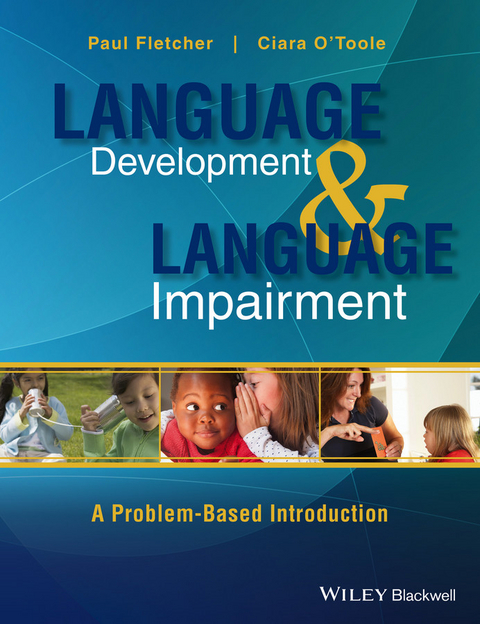
Language Development and Language Impairment (eBook)

- Focuses for the most part on the pre-school years, the period during which the foundations for language development are laid
- Uses a problem-based approach, designed to motivate students to find the information they need to identify and explore learning issues that a particular speech or language issue raises
- Examines the development of a child's phonological system, the growth of vocabulary, the development of grammar, and issues related to conversational and narrative competence
- Integrates information on typical and atypical language development
Paul Fletcher is Emeritus Professor, Department of Speech and Hearing Sciences, University College Cork,
Ireland, where he was previously Professor. He has also held professorships at the University of Hong Kong and Reading University.
Ciara O'Toole is Lecturer in Speech and Language Therapy at the Department of Speech and Hearing Sciences, University College Cork, Ireland. Her teaching and research interests are in the area of pediatric communication development and disorders. She has a particular interest in bilingual language acquisition.
Paul Fletcher is Emeritus Professor, Department of Speech and Hearing Sciences, University College Cork, Ireland, where he was previously Professor. He has also held professorships at the University of Hong Kong and Reading University. Ciara O'Toole is Lecturer in Speech and Language Therapy at the Department of Speech and Hearing Sciences, University College Cork, Ireland. Her teaching and research interests are in the area of pediatric communication development and disorders. She has a particular interest in bilingual language acquisition.
Companion Website vii
Preface ix
1 Overview 1
1.1 The Effects of Preschool Language Impairment 1
1.2 The Ambient Language 3
1.3 Typical Language Development 9
1.4 Atypical Language Development 21
2 The First Year of Life 33
2.1 Introduction 33
2.2 Social Development and Language Learning 35
2.3 Cognitive Development and Language Development 53
2.4 Speech Production in Infancy 61
2.5 Speech Perception in Infancy 71
2.6 Further Problems 80
3 Sounds 91
3.1 The Learning Task 91
3.2 The Role of Perception 94
3.3 The Production of Vowels 102
3.4 The Production of Consonants 114
3.5 Further Problems 127
4 Words 133
4.1 Early Vocabulary Development 133
4.2 Learning to Label: First Steps 138
4.3 Building a Lexicon 148
4.4 Lexical Growth and Individual Differences 152
4.5 Beyond Nouns 157
4.6 A Bridge to Syntax 163
4.7 Further Problems 166
5 Combining Words 175
5.1 Introduction 175
5.2 Transcribing and Analyzing Language Samples 177
5.3 Verb Forms 193
5.4 Interrogatives: Asking Questions 201
5.5 Complex Sentences 212
5.6 Further Problems 223
6 Beyond the Sentence 229
6.1 Introduction 229
6.2 Early Pragmatic Competence 231
6.3 Discourse Skills 1: Conversations 235
6.4 Discourse Skills 2: Telling Stories 250
6.5 Presupposition 256
6.6 Pragmatic Language Difficulties: Implications for Treatment 258
6.7 Further Problems 261
Appendix 1: The International Phonetic Alphabet 269
Appendix 2: Reliability and Validity 271
Appendix 3: Sensitivity and Specificity 275
Appendix 4: Techniques for Exploring Speech Perception in Infants 277
Appendix 5: Grammatical Analysis Using the LARSP Profile 279
Index 291
"This publication meets the specific needs of speech and language therapy students by integrating language impairment and language development throughout the text...the text will be of use to student clinicians throughout their course and to qualified clinicians as they develop their paediatric practice, as well as to those in related areas. From the outset, readers are presented with knowledge and theories in an applied context, rather than being required to make the leap of application alone...an excellent resource for all involved with teaching and learning in this area." - Lorette Porter, First Language, 2017
"...merits a place on a list of core texts. Its structure, focus and emphasis on self-directed learning resonate well with the competencies required of autonomous professionals and make it a valuable addition to the resources available to further our understanding of the skills and competencies of young children as they navigate the world of language and communication." - the Journal of Clinical Language Studies
1
Overview
Learning Areas
- The educational and social effects of language impairment.
- The child’s language environment:
- Learning more than one language
- Accents and dialects of English.
- Typical language development:
- Variation in rate of language development
- External factors influencing variation
- Intrinsic factors influencing variation.
- Speech and language impairment:
- Speech and language impairment associated with identifiable conditions
- Speech and language problems whose causes remain unexplained.
1.1 The Effects of Preschool Language Impairment
The ability to speak and understand is something we take completely for granted. Conversing with friends or partners, listening to the radio, talking on the phone, or telling stories to the children at bedtime are no more remarkable or reflected on than walking or eating, for most of us. We have engaged in these various linguistic activities for a long time – a good part of the competence that underpins our linguistic ability was in place by 5 years of age. After a few short years of childhood, at the time of school entry, each of us had a vocabulary of several thousand words. We could pronounce most of these accurately. We were able to organize words into coherent sentences, and deploy these sentences in conversations with parents, grandparents, siblings, and others, at the same time understanding what our interlocutors were saying to us. We were ready at that point to begin the long educational haul into literacy and numeracy, the skills on which full participation in our culture depends. And as we stepped outside the family unit into the wider society for the first time, we were able to use the language we had learned to make friends in school, and later in life to embark on relationships. What we learn about language in that first five years of our lives is an indispensable foundation for social well-being and educational progress. And for the vast majority it is acquired effortlessly. But if the process of language learning is constrained or restricted in any way in the preschool years, and delay or impairment results, the effects on educational advancement, and on socialization in childhood and beyond, can be severely inhibiting on life chances.
Research points to the continuing influence of slow or atypical oral language development on educational attainment, and on social facility. A long-term UK study of a group of children identified with language difficulties at the age of 4;0 years makes this clear. (The usual way of indicating age in the child population is illustrated here, by separating months from years with a semicolon.) Bishop and Edmundson (1987) identified a group of 87 4 year olds in the north-east of England who were language-impaired, and tested them on a range of linguistic abilities. The same children were retested 18 months later. At age 4, the children were classified as having impaired speech and language skills and normal nonverbal intelligence (the group with specific language impairment (SLI) – see Section 1.4) or having impaired speech and language skills, with verbal IQ at least two standard deviations below the mean (general delay group). The language impairment in 37% of the children had resolved when they were retested at age 5;6. These children were then studied again as teenagers, when 71 of the original group were contacted (Stothard et al., 1998). Children whose language problems had apparently resolved (at 5;6) did not differ from their peers on tests of vocabulary and language comprehension. Where they performed less well, however, was on tests of phonological processing and literacy skill. Those children who had continued to show significant language difficulties at the age of 5;6 in the original study had significant impairments in all aspects of spoken and written language functioning as adolescents. This was also true of children classified as having a general delay. These children fell further and further behind their peers in the development of their vocabularies over time.
It is apparent from these results that early language impairment can have serious long-term consequences educationally. Language impairment can also impact socially, with affected individuals prone to having poorer social skills and more limited peer relationships than their age-matched classmates in primary schools (Fujiki, Brinton, and Todd, 1996). Children with language impairment may also be at some risk of psychological problems: Snowling et al. (2006) reported on the rate of psychosocial difficulties in the sample identified by Bishop and Edmundson. They found that children whose language delay had resolved by 5;6 years tended to be free of problems. But for those whose language difficulties persisted through the school years, there was a raised incidence of attentional and social difficulties, associated with distinct language profiles. Attention problems were associated with a profile of expressive language difficulties; social difficulties were found in children with receptive and expressive language difficulties; and the group of children with both attention and social difficulties had low IQ as well as global language difficulties. Similarly, a follow-up study in early adult life of 17 individuals, who had been identified with a severe receptive language disorder in childhood, showed persisting language and literacy problems along with significant social difficulties and increased risk of psychiatric disorder, compared to controls (Clegg et al., 2005; see also St. Clair et al., 2011). At the extreme, limitations in language ability may be at least part of the reason young men find themselves in court or in prison. Bryan (2004) found that there was a much higher than expected prevalence of low linguistic ability in a cohort of young offenders in the United Kingdom. In a further study, of juvenile offenders (15–17 year olds; Bryan, Freer, and Furlong, 2007), 46–67% scored within the poor or very poor categories on sub-tests of the Test of Adult and Adolescent Language (TOAL-3; Hammill et al., 1994), as compared with 9% of the typical adolescent population. And of 100 young offenders completing custodial sentences in Victoria, Australia, 46 were classified as language-impaired (Snow and Powell, 2011).
These long-term educational and psychosocial consequences of preschool language impairment enjoin us to look more closely at the process of language development in typically developing (TD) children, and at the factors that can inhibit that development in their peers with language impairment, in the important period between birth and the age of 5. The last four decades have seen a burgeoning of research interest in children’s language learning and there is no shortage of material to draw on in relation to typical or atypical development. In this volume we examine preschool language impairment in the light of typical language development, from an avowedly linguistic perspective. Children’s language impairment is a topic that is rightly of interest to a number of disciplines besides linguistics, but we take the view here that it is linguistic description that is crucial in providing us with the basic anatomy of children’s language behavior.
Throughout this text, we use typical language development in English as the standard against which the limitations of the child with language impairment are measured. The performance of TD children is taken as the benchmark against which the performance of the child with an impairment is assessed. Given that more than 90% of the world’s children learn the speech and language (or languages) of their environment successfully by the time they go to school, there are two obvious questions to ask. How different from the linguistic progress of TD young children is that of individuals who are impaired? And what is it about children with language impairment that prevents them from making a success of language acquisition in the same time frame as the vast majority of their peers? We address these issues throughout the book. We begin, however, with some general considerations: about the environment in which children learn to speak; about variation in the rate of development in TD children; and about conditions with which speech and language impairments are associated.
1.2 The Ambient Language
Children learn to speak in a language community in a particular location, and in a specific social milieu. These contexts impact on the child in some ways that are obvious – children growing up in England learn English, children growing up in Norway learn Norwegian. But there can be more subtle effects of the linguistic environment. To take one example, the linguistic settings in which children find themselves may be more complex than those of us raised in monolingual environments may realize. Ireland is a country in which Irish is one of the official languages but where the majority of the population speak English – perhaps only 4% of the population use Irish regularly in daily life. As part of a government effort to maintain the Irish language, there are officially designated areas each referred to as a Gaeltacht in which Irish is the dominant language spoken – in these enclaves up to two-thirds of the population are Irish speakers. As well as receiving support for the maintenance of the Irish language, these areas also receive...
| Erscheint lt. Verlag | 17.8.2015 |
|---|---|
| Sprache | englisch |
| Themenwelt | Geisteswissenschaften ► Psychologie |
| Geisteswissenschaften ► Sprach- / Literaturwissenschaft ► Sprachwissenschaft | |
| Medizin / Pharmazie ► Allgemeines / Lexika | |
| Schlagworte | Language Acquisition & Development • Language development, language impairment, speech-language pathology, speech-language therapy, speech and hearing sciences, childhood language developmental disorders • Linguistics • Psychologie • Psychology • Speech Science • Spracherwerb, Entwicklung der Sprachfähigkeit • Spracherwerb, Entwicklung der Sprachfähigkeit • Sprachwissenschaften • Sprechwissenschaft |
| ISBN-13 | 9781119134565 / 9781119134565 |
| Informationen gemäß Produktsicherheitsverordnung (GPSR) | |
| Haben Sie eine Frage zum Produkt? |
 EPUB (Adobe DRM)
Kopierschutz: Adobe-DRM
Adobe-DRM ist ein Kopierschutz, der das eBook vor Mißbrauch schützen soll. Dabei wird das eBook bereits beim Download auf Ihre persönliche Adobe-ID autorisiert. Lesen können Sie das eBook dann nur auf den Geräten, welche ebenfalls auf Ihre Adobe-ID registriert sind.
Details zum Adobe-DRM
Dateiformat: EPUB (Electronic Publication)
EPUB ist ein offener Standard für eBooks und eignet sich besonders zur Darstellung von Belletristik und Sachbüchern. Der Fließtext wird dynamisch an die Display- und Schriftgröße angepasst. Auch für mobile Lesegeräte ist EPUB daher gut geeignet.
Systemvoraussetzungen:
PC/Mac: Mit einem PC oder Mac können Sie dieses eBook lesen. Sie benötigen eine
eReader: Dieses eBook kann mit (fast) allen eBook-Readern gelesen werden. Mit dem amazon-Kindle ist es aber nicht kompatibel.
Smartphone/Tablet: Egal ob Apple oder Android, dieses eBook können Sie lesen. Sie benötigen eine
Geräteliste und zusätzliche Hinweise
Buying eBooks from abroad
For tax law reasons we can sell eBooks just within Germany and Switzerland. Regrettably we cannot fulfill eBook-orders from other countries.
aus dem Bereich


