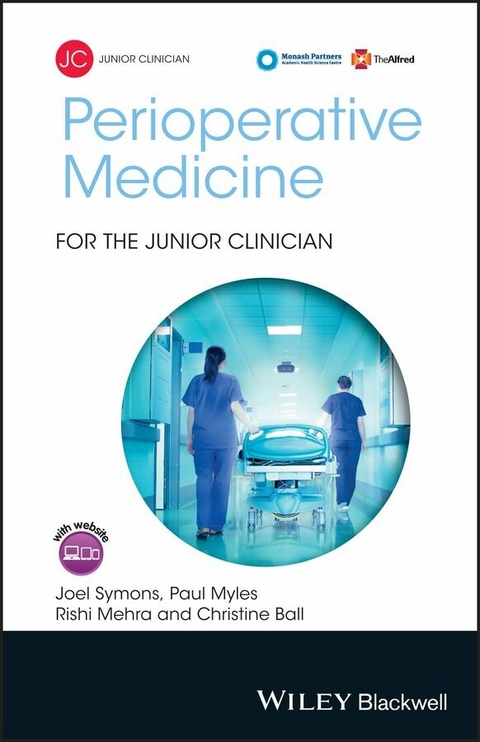
Perioperative Medicine for the Junior Clinician (eBook)
John Wiley & Sons (Verlag)
978-1-118-77911-8 (ISBN)
Perioperative Medicine for the Junior Clinician is the first easy-to-read resource, featuring a digital component, on how to manage a diverse range of patients in the perioperative period, providing up-to-date practical knowledge and advice from a broad range of medical specialists caring for surgical patients.
Perioperative Medicine for the Junior Clinician provides a guide to perioperative care, covering principles and practices of care; risk assessment; laboratory investigations; medication management; specific medical conditions and complications; postoperative care and pain management. It also features bite-size videos explaining the key concepts, as well as case studies, investigations and quizzes.
Ideal for final year medical students and junior clinicians, this digital and print resource will be an invaluable tool when working in this multidisciplinary, team-based specialty.
Perioperative Medicine for the Junior Clinician:
- Is based on a sell-out course run at the Alfred Hospital and Monash University in Melbourne, Australia
- Is a practical resource available in a flexible and portable content
- Features bite-size videos which further explain concepts in the written text, and clinically relevant case studies, all found on the companion website
- Is structured around guidelines and protocols
The video materials, case studies, self-assessment quizzes and fully explained answers can be viewed on the companion website at www.wiley.com/go/perioperativemed
Joel Symons Anaesthetist and Head of Perioperative Medicine Education, Department of Anaesthesia and Perioperative Medicine, The Alfred Hospital and Monash University, Melbourne, Victoria, Australia
Paul Myles is Director, Department of Anaesthesia and Perioperative Medicine,
The Alfred Hospital and Monash University, Melbourne, Victoria, Australia
Rishi Mehra is Anaesthetist and Senior Lecturer, Department of Anaesthesia and Perioperative Medicine,
The Alfred Hospital and Monash University, Melbourne, Victoria, Australia
Christine Ball is Anaesthetist and Adjunct Senior Lecturer, Department of Anaesthesia and Perioperative Medicine, The Alfred Hospital and Monash University, Melbourne, Victoria, Australia
Perioperative Medicine for the Junior Clinician is the first easy-to-read resource, featuring a digital component, on how to manage a diverse range of patients in the perioperative period, providing up-to-date practical knowledge and advice from a broad range of medical specialists caring for surgical patients. Perioperative Medicine for the Junior Clinician provides a guide to perioperative care, covering principles and practices of care; risk assessment; laboratory investigations; medication management; specific medical conditions and complications; postoperative care and pain management. It also features bite-size videos explaining the key concepts, as well as case studies, investigations and quizzes. Ideal for final year medical students and junior clinicians, this digital and print resource will be an invaluable tool when working in this multidisciplinary, team-based specialty. Perioperative Medicine for the Junior Clinician: Is based on a sell-out course run at the Alfred Hospital and Monash University in Melbourne, Australia Is a practical resource available in a flexible and portable content Features bite-size videos which further explain concepts in the written text, and clinically relevant case studies, all found on the companion website Is structured around guidelines and protocols The video materials, case studies, self-assessment quizzes and fully explained answers can be viewed on the companion website at www.wiley.com/go/perioperativemed
Joel Symons Anaesthetist and Head of Perioperative Medicine Education, Department of Anaesthesia and Perioperative Medicine, The Alfred Hospital and Monash University, Melbourne, Victoria, Australia Paul Myles is Director, Department of Anaesthesia and Perioperative Medicine, The Alfred Hospital and Monash University, Melbourne, Victoria, Australia Rishi Mehra is Anaesthetist and Senior Lecturer, Department of Anaesthesia and Perioperative Medicine, The Alfred Hospital and Monash University, Melbourne, Victoria, Australia Christine Ball is Anaesthetist and Adjunct Senior Lecturer, Department of Anaesthesia and Perioperative Medicine, The Alfred Hospital and Monash University, Melbourne, Victoria, Australia
'Perioperative Medicine for the Junior Clinician is a succinct, high-yield entry point into perioperative health. Written primarily by Australian clinicians from a wide number of specialties and institutions, the book provides an overview of key topics in perioperative medicine. whether used as a primary text for medical students on their clinical anesthesia or surgery rotations, or for practicing clinicians as an on-the-fly reference, the book meets its proposed purpose of informing on the assessment of perioperative patient care issues and treatment....In summary, Perioperative Medicine for the Junior Clinician is a concise primer of perioperative medicine, and it provides a practical resource for many clinicians and allied health personnel who care for patients in the surgical pathway.' Anesthesia & Analgesia
'...the authors have achieved their aim of delivering an easy-to-read book, covering a diverse range of relevant and interesting topics. Important themes are well covered, and practical advice given with reference to evidence based guidelines and protocols. The chapters are interesting and contain plentiful figures and images to maintain engagement. The text is well-referenced throughout ... there is sufficient breadth to stimulate interest for more senior clinicians. This book will undoubtedly be a useful starting point for any clinician involved in perioperative care.' European Journal of Anaesthesiology (EJA)
1
The role of the perioperative medicine physician
Mike Grocott
University of Southampton, United Kingdom
The care of patients undergoing major surgery has evolved incrementally since anaesthesia revolutionised surgical care in the years following 1846. Whilst pharmacological and monitoring technologies have advanced, anaesthetists have remained predominantly focused on the operating room environment and have in general resisted moves outside this ‘comfort zone’. Surgeons have been the principal care deliverers around the time of surgery. In the last two decades, this has begun to change, with a shift towards an expanded role in perioperative care for the anaesthetist. In parallel, physicians have become more interested in improving the perioperative care of some groups of patients. For example, the engagement of geriatricians in the care of patients undergoing hip fracture surgery has led to the concept of the ‘ortho-geriatrician'. Meanwhile, manpower issues in surgical specialties have created pressure for many surgeons to concentrate on operating time, over and above other elements of the care of surgical patients. As a consequence, new labels have developed including perioperative medicine (1994), the perioperative physician (1996) and most recently the perioperative surgical home (2011).
So what has driven the increased focus on perioperative care? Primarily, there has been recognition of unmet need. With growth in the volume and scope of major surgery has come an epidemic of postoperative harm. This is an inevitable consequence of more adventurous, technically challenging surgery in an ageing population with multiple co-morbidities [1]. The global volume of major surgery is approaching 250 million cases per year. Short-term (hospital/30-day) mortality following major surgery, even in the developed world, may approach 4% and morbidity is more frequent by an order of magnitude [2,3]. Furthermore, the substantial impact of short-term postoperative morbidity on subsequent long-term survival is increasingly recognised as an important healthcare challenge [3]. Taken with the growing literature describing interventions that affect postoperative outcome [4], this suggests a significant burden of avoidable harm.
The scope of perioperative medicine
This spans the period from the moment that surgery is first contemplated through to complete recovery. The role of the perioperative physician includes preoperative risk evaluation, collaborative (shared) decision making [5], optimisation of all aspects of physiological function prior to surgery, individualised ‘goal-directed' best intraoperative care, delivering the appropriate level of postoperative care and rehabilitation to normal function [4]. The preoperative period offers a unique opportunity to invest in improving physiological function in a short defined period of time, for example through physical prehabilitation, in patients who are likely to be highly motivated in the face of an imminent threat. Furthermore, the patient–perioperative physician interaction may be one of very few contacts that an individual patient has with medical professionals and offers an opportunity for general health messaging as well as implementation of primary and secondary prevention strategies.
In the post ‘evidence-based medicine' era, the focus of medical practice will increasingly move towards personalised/stratified/precision medicine [6]. The technology available to quantify and classify perioperative risk is becoming increasingly sophisticated. In the future, this process is likely to involve a combination of clinical risk scores, objective evaluation of physiological reserve (e.g. cardiopulmonary exercise testing) and the use of specific plasma biomarkers, interpreted in the context of the patient's genotype (+/− epigenetic processes). Perioperative decision making will involve expertise in interpreting such data coupled with understanding of the planned operative procedure and a high degree of competence in collaborative decision making [5]. Improving the quality of decision making through the use of decision aids has been shown to reduce patient choices for discretionary surgery [7] and is likely to have a similar effect across all types of surgery. In the context of an extraordinarily high incidence of surgery during the final months of life [8], such an approach is likely to be beneficial for the quality of life of patients and their carers, as well as for an overburdened healthcare system.
The scope of decision making will include consideration of the extent of surgery, use of adjunctive therapies, and modification of pre-, intra- and postoperative care. Patients with limited physiological reserve may be prescribed general (prehabilitation) or specific (e.g. inspiratory muscle training) preoperative interventions. Intraoperative care may be focused on monitoring and interventions to address particular risks such as cardiac, pulmonary or cognitive dysfunction. The location and intensity of postoperative care will be based on the risk of harm assessed prior to surgery, modified by the response to the physiological challenge of surgery.
Postoperative intensive care has always been made available to patients requiring specific organ support. Increasingly, patients at elevated risk are being offered an enhanced level of postoperative care and monitoring to ensure early rapid and effective response to developing complications and avoid ‘failure to rescue'.
Clinical data
The effective use of clinical data will be critical in the development of high-quality perioperative care and making best use of such data will be an important part of the perioperative physician's role [9]. National audit data have highlighted stark differences in quality of care and outcome for specific patient groups, most notably those undergoing emergency procedures such as hip fracture and emergency laparotomy surgery [10]. Systematic audit and quality improvement will serve to ‘level the playing field' for patients undergoing diverse types of surgery. The data collected will also contribute to the development of increasingly sophisticated clinical risk tools that will, in turn, facilitate the delivery of precision medicine for this patient group.
The future
It is likely that in many contexts, anaesthetists will take the lead as perioperative physicians, due to their unique combination of competencies and experience. However, the role of the perioperative physician should be competency based and collaborative, and physicians and surgeons will also be involved in leading perioperative care. Irrespective of issues around professional identity, the primary aim of all perioperative physicians should be to improve the quantity and quality of life for patients undergoing major surgery. This will be best achieved by working closely with patients, surgeons and the extended perioperative care team to choose and deliver perioperative care of the highest quality through the interpretation of clinical evidence in the context of an individual patient's life and wishes [11].
References
- 1. Weiser TG, Regenbogen SE, Thompson KD, et al. An estimation of the global volume of surgery: a modelling strategy based on available data. Lancet, 2008;372:139–144. doi:10.1016/S0140-6736(08)60878-8
- 2. Pearse RM, Moreno RP, Bauer P, et al. Mortality after surgery in Europe: a 7 day cohort study. Lancet, 2012;380(9847):1059–1065. doi:10.1016/S0140-6736(12)61148-9
- 3. Khuri SF, Henderson WG, DePalma RG, et al. Determinants of long-term survival after major surgery and the adverse effect of postoperative complications. Annals of Surgery, 2005;242(3):326–341; discussion 41–43. doi:10.1097/01.sla.0000179621.33268.83
- 4. Pearse RM, Holt PJ, Grocott MP. Managing perioperative risk in patients undergoing elective non-cardiac surgery. BMJ. 2011;343:d5759. doi:10.1136/bmj.d5759
- 5. Glance LG, Osler TM, Neuman MD. Redesigning surgical decision making for high-risk patients. New England Journal of Medicine, 2014;370(15):1379–1381. doi:10.1056/NEJMp1315538
- 6. Mirnezami R, Nicholson J, Darzi A. Preparing for precision medicine. New England Journal of Medicine, 2012;366(6):489–491. doi:10.1056/NEJMp1114866
- 7. Stacey D, Bennett CL, Barry MJ, et al. Decision aids for people facing health treatment or screening decisions. Cochrane Database of Systematic Reviews, 2011;10:CD001431. doi:10.1002/14651858.CD001431.pub3
- 8. Kwok AC, Semel ME, Lipsitz SR, et al. The intensity and variation of surgical care at the end of life: a retrospective cohort study. Lancet, 2011;378(9800):1408–1413. doi:10.1016/S0140-6736(11)61268-3
- 9. White SM, Griffiths R, Holloway J, Shannon A. Anaesthesia for proximal femoral fracture in the UK: first report from the NHS Hip Fracture Anaesthesia Network. Anaesthesia, 2010;65(3):243–248. doi:10.1111/j.1365-2044.2009.06208.x
- 10. Grocott MP. Improving outcomes after surgery. BMJ, 2009;339:b5173. doi:10.1136/bmj.b5173
- 11. Grocott MP, Pearse RM. Perioperative medicine: the future of anaesthesia? British Journal of Anaesthesia,...
| Erscheint lt. Verlag | 7.8.2015 |
|---|---|
| Sprache | englisch |
| Themenwelt | Medizin / Pharmazie ► Allgemeines / Lexika |
| Medizin / Pharmazie ► Gesundheitsfachberufe | |
| Medizin / Pharmazie ► Medizinische Fachgebiete ► Anästhesie | |
| Medizin / Pharmazie ► Medizinische Fachgebiete ► Chirurgie | |
| Schlagworte | Allg. Chirurgie • Anästhesie • Anästhesie • anesthesia • Chirurgie • general surgery • medical education • Medical Science • Medizin • Medizinstudium • perioperative medicine junior clinician doctor digital surgical caring practical principles practice risk laboratory medication management conditions complications medical postoperative pain videos investigations quizzes student Alfred Hospital Monash University Melbourne Australia |
| ISBN-10 | 1-118-77911-8 / 1118779118 |
| ISBN-13 | 978-1-118-77911-8 / 9781118779118 |
| Informationen gemäß Produktsicherheitsverordnung (GPSR) | |
| Haben Sie eine Frage zum Produkt? |
 EPUB (Adobe DRM)
Kopierschutz: Adobe-DRM
Adobe-DRM ist ein Kopierschutz, der das eBook vor Mißbrauch schützen soll. Dabei wird das eBook bereits beim Download auf Ihre persönliche Adobe-ID autorisiert. Lesen können Sie das eBook dann nur auf den Geräten, welche ebenfalls auf Ihre Adobe-ID registriert sind.
Details zum Adobe-DRM
Dateiformat: EPUB (Electronic Publication)
EPUB ist ein offener Standard für eBooks und eignet sich besonders zur Darstellung von Belletristik und Sachbüchern. Der Fließtext wird dynamisch an die Display- und Schriftgröße angepasst. Auch für mobile Lesegeräte ist EPUB daher gut geeignet.
Systemvoraussetzungen:
PC/Mac: Mit einem PC oder Mac können Sie dieses eBook lesen. Sie benötigen eine
eReader: Dieses eBook kann mit (fast) allen eBook-Readern gelesen werden. Mit dem amazon-Kindle ist es aber nicht kompatibel.
Smartphone/Tablet: Egal ob Apple oder Android, dieses eBook können Sie lesen. Sie benötigen eine
Geräteliste und zusätzliche Hinweise
Buying eBooks from abroad
For tax law reasons we can sell eBooks just within Germany and Switzerland. Regrettably we cannot fulfill eBook-orders from other countries.
aus dem Bereich