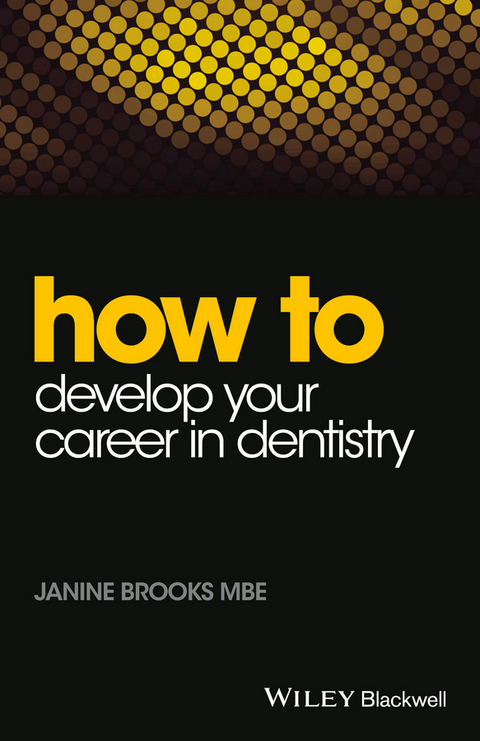
How to Develop Your Career in Dentistry (eBook)
John Wiley & Sons (Verlag)
978-1-118-91379-6 (ISBN)
- Includes case studies of career trajectories across the full range of dental professions in the UK
- Advocates a portfolio approach to career development, illustrating the benefits of working in a matrix as opposed to climbing a ladder
- Showcases the opportunities inherent in specific areas of dentistry, what they can offer and what is required to successfully take advantage of them
- Written by one of the UK’s leading dental experts who has over 30 years in the profession, working on the local and national scale
Janine Brooks is a dentist with over 30 years of experience. Her current roles include, Associate Postgraduate Dental Dean at Health Education Thames Valley and Wessex, Lead Clinical Tutor at the University of Bristol, Visiting Lecturer at the University of Birmingham, Educational Inspector for the General Dental Council, Non-Executive Director of CDS CIC, a community dentistry social enterprise, CEO of Dentalia Coaching and Training Consultancy, and Director of the Dental Coaching Academy. Serving previously as Associate Director (Dentistry) for the National Clinical Assessment Service, Dr Brooks was awarded an MBE for services to Dentistry in 2007.
This innovative new book offers a user-friendly guide to securing a successful, varied, and fulfilling career in dentistry. Includes case studies of career trajectories across the full range of dental professions in the UK Advocates a portfolio approach to career development, illustrating the benefits of working in a matrix as opposed to climbing a ladder Showcases the opportunities inherent in specific areas of dentistry, what they can offer and what is required to successfully take advantage of them Written by one of the UK s leading dental experts who has over 30 years in the profession, working on the local and national scale
Janine Brooks is a dentist with over 30 years of experience. Her current roles include, Associate Postgraduate Dental Dean at Health Education Thames Valley and Wessex, Lead Clinical Tutor at the University of Bristol, Visiting Lecturer at the University of Birmingham, Educational Inspector for the General Dental Council, Non-Executive Director of CDS CIC, a community dentistry social enterprise, CEO of Dentalia Coaching and Training Consultancy, and Director of the Dental Coaching Academy. Serving previously as Associate Director (Dentistry) for the National Clinical Assessment Service, Dr Brooks was awarded an MBE for services to Dentistry in 2007.
Foreword ix
Acknowledgements xi
Chapter 1 Introduction 1
The National Health Service 6
Career 8
Portfoliocareer 13
Working paradigms 15
Planning your career 18
Being a dental professional 20
Workforce and workforce planning 23
Bibliography 25
Chapter 2 Demography and society in the United Kingdom 28
Demography - general 29
Population size 30
Population age 30
General health 33
Oral health 35
Health of dentists 42
Dental care professionals 44
Working patterns 45
Impact on dental professionals 46
Technology rising 48
Retirement 51
Bibliography 55
Chapter 3 Dental opportunities 57
Is the dental workforce today the workforce we will need in 10-20 years and beyond? 57
How can I develop a portfolio career? 58
Dental careers -variety and opportunity 63
Useful organisations 96
Bibliography 97
Chapter 4 Coaching and mentoring 99
Coaching 100
Mentoring 104
Career planning 110
Personal development 113
Useful organisations 116
Bibliography 116
Chapter 5 Case studies of dental professionals 118
Mrs Janet Clarke MBE 121
Miss Bal Chana 123
Dr Shazad Khan Malik 125
Dr Emma Worrell 126
Mrs Sophie Noske 128
Professor Ros Keeton 130
Dr Derek Richards 132
Professor Deborah White 134
ReenaPatel 136
Mrs Penny McWilliams 138
Short biographies 139
Conclusion 149
Chapter 6 Networking and networks 150
How do you network? 152
What networking should not be 155
Where can you network? 155
Types of network 156
Electronic networks 157
Network map 158
Curriculum vitae 160
Bibliography 166
Chapter 7 Training and qualifications 167
Credit accumulation transfer schemes 168
Clinical programmes 169
Nonclinical programmes 170
Financial investment 178
Other sources of information about courses 179
Useful organisations and networks 179
Case studies 179
How to develop experience 183
Professional associations and other useful addresses 185
Bibliography 185
Index 187
Chapter 1
Introduction
Top Tip: Don't be afraid to tack – take the nonlinear path
Janine Brooks
Welcome to my book on How to Develop your Career in Dentistry. I hope you find it interesting and useful. I hope it makes you think about your career and encourages you to dip your toes into an exciting world of diversity and opportunity.
The approach I want to take is that our careers can be multistranded: I'm calling that having a ‘portfolio career’. In addition, I want to get you to think about the context in which we provide dentistry, our Society. Chapter 2 covers changes happening within society that will impact on dental professionals and the career choices they make. These include changes to retirement and pensions, as well as demographic changes, particularly in health and longevity, both of our patients and of us dental professionals. Chapter 3 discusses dental opportunities; here I will be giving you a taster of the many roles and responsibilities that dental professionals take on. Chapter 4 is about mentoring and coaching, both of which I feel are essential support for dental professionals seeking development and career enhancement. Chapter 5 I have dedicated to case studies. I have been fortunate in persuading a number of dental professionals to share their career stories with me and to allow me to include them in this book. I feel this is the heart of the book, as it showcases the breadth and depth of dental professionals' talents. Chapter 6 covers networking and networks: again, in my opinion, essential to a successful career. Finally, Chapter 7 discusses training and the qualifications you may want to think about when enriching your career and expanding what you do. Throughout the book, I have sprinkled Top Tips – both my own and those of other professionals. Feel free to give them a go. They may not all work for you, but some will. I have also sprinkled Career Highlights from a number of contributors throughout the chapters. To me, they demonstrate that dentistry is very rewarding and that, even if we struggle and find the demands of others a challenge, there is plenty of light and plenty of rewards to keep us going.
The self is not something ready made, but something in continuous formation, through choice of action.
Dewey (1916)
I really like this quote from Dewey. When he wrote it, he was thinking about reflection, but I feel it is very relevant to making choices and building a career. Opportunities may arise unexpectedly and unplanned, and often from the strangest direction, but it is our choice what action we take – no one else's. Take control, be the architect of your career. This may mean taking a few ‘risks’, maybe doing something for free. Make it part of your plan to be more opportunistic. If you learn to translate what you see, hear and do into your career, you might be surprised by the shape it takes on.
Career Highlight: Voluntary work abroad
Reena Patel
Another important aspect of the Dewey quote for me is the word ‘continuous’. Our careers should be continuous, growing, expanding, evolving, not static or stale. In dentistry, we are fortunate in being part of a profession that has a rich diversity of jobs and roles. I'm not saying it's easy, I'm not saying there won't be strong competition for some of the jobs you want, but you worked hard to enter the profession – that you need to work hard to build your career should not be a surprise.
Our career takes up a large proportion of our middle life – that's the life between leaving school (largely childhood) and retiring (largely older age). It obviously varies from person to person, but as a very rough estimate you will spend a minimum of 2775 full days (24 hours of each day – no sleeping) or 66 600 hours working. That will hold if the following are true:
- You leave school at 18 years.
- You spend 5 years training in your primary qualification.
- You retire at 60 years of age.
- You work 5 days a week, and take no time off for your family.
- You take 6 weeks' annual leave each year.
- You are sick for 5 days each year.
As you can see, this is a very rough estimate, based on variables that have considerable range. If you start work earlier, have less training time, retire earlier or later, work part time or take time off to raise your family, have less annual leave and are particularly healthy then you will spend even longer in your career. It's very likely most people reading this book will not retire at 60 years of age.
The real point I'm making here is that you will spend a considerable amount of your life working in your career. I guess that doesn't come as a surprise. What might, though, is exactly how much time it is. Until you really think about it, you probably just consider it ‘a lot’. So, if you are going to spend ‘a lot’ of your life tending to your career then the least you can do for yourself is make choices that you will enjoy and find fulfilling and satisfying. The good news is that the profession of dentistry can offer exactly that, plus a good remuneration – maybe not the best, but good nonetheless. Of course, you may be looking for a career where you do very little, make loads of money and have lots of spare time. If you are, then stop reading this book immediately: dentistry is not for you. Look for something else. Please don't ask my advice on what that something else might be: I hate being bored.
Career Highlight: The launch of the Evidence-Based Dentistry journal
Derek Richards
Just before I get into the meat of careers in dentistry and developing your dental career, I want to take a few words to consider where dentistry has come from and our origins as dental professionals. Don't worry, this is not an essay on history, just some interesting context. I think it can be useful to look back and consider where dentistry and dental professionals have come from before we look forward to the careers of the future. Dentistry has a very long history: the practice of dentistry much more so than the professions. All aspects are fascinating and serve to underline what is an amazing career for those who choose it.
There are a number of books and authors in this field far better equipped than I to paint and illustrate this history. In particular, I would direct you to the excellent articles and publications of Professor Stanley Gelbier, a tireless and exceptionally knowledgeable dental historian. I wish to use our history to put our careers in dentistry into context, so I will only whet your appetite, and signpost your way should you wish to delve more deeply.
A good place to begin would be to define dentistry. Some early cultures mutilated their teeth: whether as decoration or to denote religious status or perhaps to intimidate others is uncertain. Whatever the true purpose, someone will have worked on these teeth: Is that dentistry? We know the Egyptians practised dentistry: the Ptolemic temple at Kom Ombo (north of Aswan), the temple of Sobek and Horus, has a huge wall with wonderful carvings depicting surgical instruments, including forceps (Figure 1.1).
Figure 1.1 Kom Ombo wall, north of Aswan, showing 2000-year-old surgical instruments. Taken by the author in February 2012.
In the British Isles, those who would eventually become the dentists we know today were once part of the Guild of Barber-Surgeons, created in 1540. Most of those who engaged in ‘dentistry’ in the 16th century identified themselves with the barber surgeons rather than the physicians; that is why dentists in the UK have historically referred to themselves as ‘Mister’ or ‘Miss’ rather than as ‘Doctor’. Dentistry did not generally take the same path outside of Britain. The Guild broke apart in 1745, when the Surgeons' Company was formed; that company later dissolved in 1796 and then reformed as the Royal College of Surgeons of England in 1800. The barbers, dentists and ‘operators for the teeth’ took a different path, although a few barbers and tooth-drawers went with the Royal College. Eventually, the term ‘dentist’ became the accepted and acceptable term by which to encompass all these previous descriptors.
Moving through the years, we come to the Dentist Act of 1878 and the first UK dental register of 1879. Dentists had previously been included in the medical register: the edition of 1783 included 18 (Bishop, 2014). In 1921, there was another Dentist Act. The Dental Board (UK) of the General Medical Council was established and its first Chairman, Sir Francis Dyke Acland, was appointed by the Privy Council. When the Board was established, there were 5831 names on the register. The first regulation of dentists was by the medical profession. This continued until 1956, when the General Dental Council (GDC) was established as a standalone regulator. The 70th and final session of the Dental Board was held on 9 May 1956 and the first meeting of the GDC took place later in the same year, both under the chairmanship of Sir Wilfred Fish. At that time, in 1956, there were 15 895 names on the dental register, all dentists, and the dental schools had an entry of 650 students each year. I am indebted to a little book I found on a visit to the bookshops of...
| Erscheint lt. Verlag | 6.8.2015 |
|---|---|
| Reihe/Serie | How To (Dentistry) |
| How To (Dentistry) | How To (Dentistry) |
| Sprache | englisch |
| Themenwelt | Medizin / Pharmazie ► Gesundheitsfachberufe |
| Medizin / Pharmazie ► Medizinische Fachgebiete | |
| Medizin / Pharmazie ► Zahnmedizin | |
| Schlagworte | Berufspraxis i. d. Zahnmedizin • Dental Hygiene & Therapy • Dental Professional Practice • dentistry • Dentistry Special Topics • <p>Dental science, career development, dental nursing, healthcare, healthcare professionals, dental school, healthcare policy, NHS, practitioners, dentists, dental care professionals, dental hygienists</p> • Spezialthemen Zahnmedizin • Zahnmedizin • Zahn- u. Mundhygiene u. Therapie |
| ISBN-10 | 1-118-91379-5 / 1118913795 |
| ISBN-13 | 978-1-118-91379-6 / 9781118913796 |
| Informationen gemäß Produktsicherheitsverordnung (GPSR) | |
| Haben Sie eine Frage zum Produkt? |
 EPUB (Adobe DRM)
Kopierschutz: Adobe-DRM
Adobe-DRM ist ein Kopierschutz, der das eBook vor Mißbrauch schützen soll. Dabei wird das eBook bereits beim Download auf Ihre persönliche Adobe-ID autorisiert. Lesen können Sie das eBook dann nur auf den Geräten, welche ebenfalls auf Ihre Adobe-ID registriert sind.
Details zum Adobe-DRM
Dateiformat: EPUB (Electronic Publication)
EPUB ist ein offener Standard für eBooks und eignet sich besonders zur Darstellung von Belletristik und Sachbüchern. Der Fließtext wird dynamisch an die Display- und Schriftgröße angepasst. Auch für mobile Lesegeräte ist EPUB daher gut geeignet.
Systemvoraussetzungen:
PC/Mac: Mit einem PC oder Mac können Sie dieses eBook lesen. Sie benötigen eine
eReader: Dieses eBook kann mit (fast) allen eBook-Readern gelesen werden. Mit dem amazon-Kindle ist es aber nicht kompatibel.
Smartphone/Tablet: Egal ob Apple oder Android, dieses eBook können Sie lesen. Sie benötigen eine
Geräteliste und zusätzliche Hinweise
Buying eBooks from abroad
For tax law reasons we can sell eBooks just within Germany and Switzerland. Regrettably we cannot fulfill eBook-orders from other countries.
aus dem Bereich