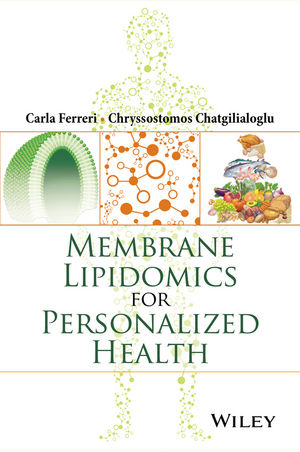
Membrane Lipidomics for Personalized Health (eBook)
John Wiley & Sons (Verlag)
978-1-118-68275-3 (ISBN)
Carla Ferreri Consiglio Nazionale delle Ricerche, Institute of Organic Synthesis and Photoreactivity, Italy Chryssostomos Chatgilialoglu National Center for Scientific Research "Demokritos", Institute of Nanoscience and Nanotechnology, Greece
1
Membranes for Life and Life for Membranes
1.1 CELL MEMBRANES: THE ROLE OF FATTY ACIDS AND THE EXCLUSION OF TRANS ISOMERS
The cell membrane represents the fundamental structure and organizational element in the cells of living organisms. In fact, no cell can exist without the membrane; actually, cell reproduction and multiplication, such as in cancerogenesis, implies formation of membranes [1]. The complex mixture of lipids in an overall fluid state, where proteins and other molecules such as cholesterol are immersed, identifies the cell space and its boundary with the extracellular environment, but its behavior is not like that of a wall. Instead, this is the structure through which all communications and exchanges useful to cell life occur, and in the twenty-first century it represents the most direct and innovative site for correlation with the health condition.
The fundamental unit of the membrane assembly is the phospholipid molecule, with a characteristic structure that is defined as amphipatic. This means that in the same molecule two different parts coexist: the hydrophilic and the hydrophobic parts. The hydrophobic part cannot stay in contact with water, the biological solvent, since it is impossible to establish any type of interaction (the so-called hydrogen bonding). Therefore, the hydrophobic effect occurs, which leads to the perfect separation of the water molecules and the hydrophobic components in two phases, as is observed between oil and water. In phospholipids the hydrophilic part is called the “head” and the hydrophobic part is called the “tail”; as the structure shown in Figure 1.1 indicates, the hydrophobic part is made of long fatty acid chains (generally with hydrocarbon chains containing from 12 up to 26 carbon atoms), with and without double bonds, whereas the hydrophilic part is a polar residue, sometimes charged (e.g., in phosphatidyl choline). The coexistence of these two parts with opposite interactivity with water drives the specific organization called double layer, as represented in Figure 1.1: the arrangement is obtained by two molecules that are placed one in front of the other, and their polar parts are disposed outward facing water.
Figure 1.1 The membrane structure made of a double layer of phospholipids, and the fatty acid chains that form the hydrophobic layer
The double layer can expand until a critical number of molecules are assembled, at the so-called critical aggregation concentration (CAC) that causes the two extremities of the double layer to become close to each other and form a round sphere, with water in its interior. In this way “compartmentalization” occurs, which allows the organization of cellular life to be exploited. In natural membranes cholesterol is the other important lipid component forming part of the layer, with the general effect of modulating the fluidity property of this aggregation. This is not the place to go into a deeper description of the numerous factors influencing membrane formation and its properties, which are better described elsewhere [2–6]. However, it is worth recalling that, as water is the most important element for life, hydrophobicity is the complementary property needed for life organization, which in fact induces compartimentalization. Indeed, the presence of the aqueous and lipid compartments plays a fundamental role in the distribution of the various biological elements, from small molecules to macromolecules, according to their partition coefficient, thus determining their different concentrations, inside and outside cells, by which physical and chemical interactions are established.
The primary function of membranes is to compartimentalize molecules but not to separate them; therefore the regulation of membrane permeability and fluidity properties is studied for understanding the subsequent events of diffusion, exchange, and signaling [7].
In this book we will not study the contribution from the “head” in depth, which is not insignificant, in explaining lipid diversity. In Figure 1.2 the variation of the phospholipid molecules is shown as different tails and heads. As an example, it is worth citing the effects of inositol lipids, which are present in small quantities in membranes; however, they participate in cell signaling associated with growth and immune processes, as well as in programmed cell death, and the transport of chemicals into and out of cells. The protein receptors, after activation, can induce the breakage of inositol lipids into pieces and the phosphate-containing head group (phosphatidylinositol 3-phosphate, PtdIns3P or PI3P) released into the cells’ interior binds to other proteins, propagating the signal, while the remaining lipid tail is involved in other kinds of binding to proteins, completing the activation process. Glycolipids are also involved in other important signaling processes, such as insulin response, and help the docking of viral proteins (such as HIV virus) or toxins (e.g., cholerae and tetanus toxins) to membranes. They are found in the outward-facing part of the membrane bilayer, and in red blood cells their presence determines the combination of the AB0 blood group a person has. Obviously the distinction of properties and functions of lipids by the polar heads can be deepened by reading several papers on this topic [8, 9].
Figure 1.2 Details of the phospholipid molecule with variation of fatty acid tails and polar heads. In the box the structure of sphyngomielin is displayed
In this book we focus readers’ attention on the hydrophobic tails of the phospholipids composed of fatty acids. This subject will be developed to demonstrate how important these constituents are for health, specifically connecting molecular and nutritional contributions. As shown in Figure 1.2, the fatty acid structures are linked with their carboxylic acid function to the positions C1 and C2 of the l-glycerol moiety of phospholipids. l-glycerol is one of the isomeric forms; therefore it is worth mentioning that nature chose one enantiomer in a similar way as it chose the l-form of amino acids.
The fatty acid chains display a high degree of diversity concerning the carbon atom number (chain length) and the presence of unsaturations (double bonds): (i) the chain can contain from 11 to 25 CH2 groups plus the carboxylic group (COOH), which is numbered as Carbon-1, and (ii) some of these CH2 groups can be substituted by CH groups for double bond function in unsaturated lipids. These could appear as small variations, but it is not so. The variability of physical, chemical, and biochemical properties due to chain length and number of unsaturations can be relevant for the effects on membrane fluidity and permeability, as well on its functions.
In Figure 1.3 the main structures and names of the naturally occurring fatty acids in eukaryotic membranes are shown. The trivial names indicate the natural sources where they were first discovered. For the nomenclature, the numbering of the carbon atom chain and indication of the double bonds represent a useful way, together with the specification of the position and geometry of the double bonds, when present.
Figure 1.3 List of main saturated and unsaturated fatty acids, with their melting points, trivial nomenclature, and numerical annotation (number of C atoms : number of double bonds)
For example, the nomenclature of 12 : 0 or C12 : 0 indicates a fatty acid with carbon atom chain of 12 and no (0) unsaturation, which belongs to the family of saturated fatty acids (SFA, lauric acid). Conversely, 9cis-18 : 1 indicates an 18-carbon atom chain with one double bond in the C9 position with the cis geometrical configuration (starting the numbering from the C1 of the chain), belonging to the family of monounsaturated fatty acids (MUFAs). The positions of the double bond are also described with the notation delta Δ followed by the number of the double bond along the chain. For example, in Figure 1.3 oleic acid has the double bond in the Δ. The 18 : 2 notation corresponds to molecules with two double bonds, and the various structures with more than one double bond belong to the family of polyunsaturated fatty acids (PUFAs). A unifying nomenclature has also been proposed, but the trivial names are still very prevalent. The carboxylic group can be found in the form of carboxylic ester, such as in triglycerides (the C(O)OH group is connected with the OH group of l-glycerol, forming an ester function: C(O)O-glycerol). The carbon atom chain with only CH2 groups (i.e., numeric notation C12 : 0) is present in the saturated fatty acid family. The most abundant SFA in the eukaryotic cell membranes is palmitic acid C16 : 0. In unsaturated fatty acids a carbon atom is connected with another carbon atom by two bonds instead of one, so that in place of two CH2 groups there is a >CH=CH< functionality, which is in fact the carbon–carbon double bond (Figure 1.4).
Figure 1.4 A representative region of the carbon atom chain in the saturated fatty acids (left, –CH2–CH2– groups), in the cis unsaturated fatty acids (center, with the cis >CH=CH< functionality), and in the trans unsaturated fatty acids
As shown in Figure 1.3,...
| Erscheint lt. Verlag | 2.7.2015 |
|---|---|
| Sprache | englisch |
| Themenwelt | Medizin / Pharmazie ► Gesundheitsfachberufe ► Diätassistenz / Ernährungsberatung |
| Studium ► 1. Studienabschnitt (Vorklinik) ► Physiologie | |
| Naturwissenschaften ► Biologie ► Biochemie | |
| Naturwissenschaften ► Chemie ► Organische Chemie | |
| Technik | |
| Schlagworte | Biochemie • Biochemie u. Chemische Biologie • Biochemistry (Chemical Biology) • Chemie • Chemistry • Chryssostomos Chatgilialoglu • Ernährung • Ernährung • Food Science & Technology • Gesundheits- u. Sozialwesen • Health & Social Care • Lebensmittelforschung u. -technologie • lipidomic diagnostics • lipidomic nutraceutical strategies • lipidomic nutrition • lipidomic nutrition strategies • Lipidomics • Lipidstoffwechsel • membrane lipidomic diagnostics • Membrane Lipidomics • Membrane Lipidomics for Personalized Health Care • Metabolism & Biochemistry of Nutrition • Nutraceuticals • nutraceutical strategies • Nutrition • Personalized Health Care • Stoffwechsel • Stoffwechsel u. Biochemie der Ernährung • Stoffwechsel u. Biochemie der Ernährung |
| ISBN-10 | 1-118-68275-0 / 1118682750 |
| ISBN-13 | 978-1-118-68275-3 / 9781118682753 |
| Informationen gemäß Produktsicherheitsverordnung (GPSR) | |
| Haben Sie eine Frage zum Produkt? |
 EPUB (Adobe DRM)
Kopierschutz: Adobe-DRM
Adobe-DRM ist ein Kopierschutz, der das eBook vor Mißbrauch schützen soll. Dabei wird das eBook bereits beim Download auf Ihre persönliche Adobe-ID autorisiert. Lesen können Sie das eBook dann nur auf den Geräten, welche ebenfalls auf Ihre Adobe-ID registriert sind.
Details zum Adobe-DRM
Dateiformat: EPUB (Electronic Publication)
EPUB ist ein offener Standard für eBooks und eignet sich besonders zur Darstellung von Belletristik und Sachbüchern. Der Fließtext wird dynamisch an die Display- und Schriftgröße angepasst. Auch für mobile Lesegeräte ist EPUB daher gut geeignet.
Systemvoraussetzungen:
PC/Mac: Mit einem PC oder Mac können Sie dieses eBook lesen. Sie benötigen eine
eReader: Dieses eBook kann mit (fast) allen eBook-Readern gelesen werden. Mit dem amazon-Kindle ist es aber nicht kompatibel.
Smartphone/Tablet: Egal ob Apple oder Android, dieses eBook können Sie lesen. Sie benötigen eine
Geräteliste und zusätzliche Hinweise
Buying eBooks from abroad
For tax law reasons we can sell eBooks just within Germany and Switzerland. Regrettably we cannot fulfill eBook-orders from other countries.
aus dem Bereich