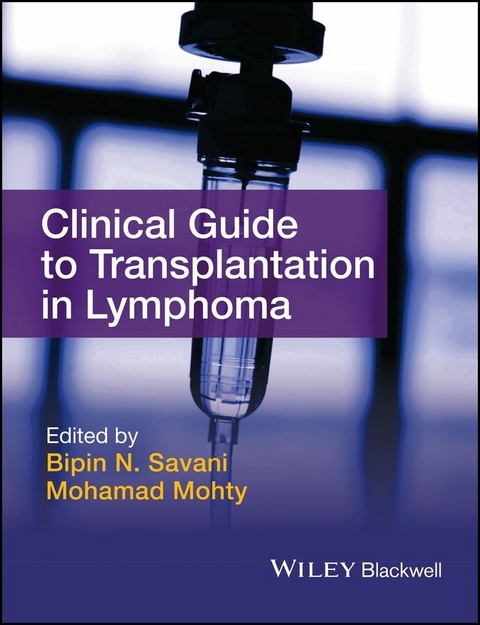
Clinical Guide to Transplantation in Lymphoma (eBook)
288 Seiten
Wiley-Blackwell (Verlag)
978-1-118-86327-5 (ISBN)
- Provides practical management guidance on how to integrate, transplantation and novel therapies in patients with lymphoid malignancies
- Covers an overview of transplantation in lymphoma, and management of the lymphoid malignancies
- Discusses organizational aspects of transplant patients and managing a transplant program
- Appendices provide practical quick-reference information on follow-up after autologous and allogenic stem cell transplantation in lymphoma
Bipin N Savani, MD
Professor of Medicine
Director, Long Term Transplant Clinic
Division of Hematology/Oncology
Vanderbilt Ingram Cancer Center
Vanderbilt University Medical Center
Nashville, TN, USA
Dr Savani's area of specialization is in the treatment of hematological malignancies and stem cell transplantation, and his primary field of research is in the long-term follow-up after transplantation, including regimen-related toxicity/ supportive care, and outcomes analysis of transplant recipients. Dr Savani has published over 175 peer reviewed articles, reviews, book chapters, editorials, perspectives and commentaries in the field of hematological malignances and stem cell transplantation. He is Associate Editor of the journal 'Bone Marrow Transplantation' (official journal of the European Group for Blood and Marrow Transplantation- EBMT) and serves as an editorial advisory board member for several journals including Biology of Blood and Marrow Transplantation (official journal of the American Society of Blood and Marrow Transplantation. Dr Savani is currently Co-Chair of the steering committee on clinical practice guidelines and former vice-chair of the committee on evidence-based reviews for the American Society of Blood and Marrow Transplantation (ASBMT). He also serves as Co-Chair for the Late Effects & Quality of Life Working Committee (LEWC) and Advisory Committee Members at Large North America, Center for International Blood and Marrow Transplant research (CIBMTR).
Mohamad Mohty, MD, PhD
Professor
Head, Clinical Hematology and cellular therapy department
Université Pierre & Marie Curie
Hospital Saint Antoine
INSERM, U938
Paris, France
Mohamad Mohty is Professor of Hematology and head of the Hematology and cellular therapy Department at the Saint-Antoine Hospital and University Pierre & Marie Curie (Paris, France). Professor Mohty obtained his medical degree from the University of Montpellier, France, and his PhD from the University of Marseille, France. Before moving to Paris, he was head of the Transplant Program at the University-Hospital of Nantes, France. He also undertook post-doctoral work at the Hematology Department, Imperial College, Hammersmith Hospital, London, UK. Professor Mohty's is also currently head of a translational research team (INSERM team N°7) at the Saint-Antoine Research centre in Paris and his research is focused on the pathophysiology of graft-vs-host disease and the immunobiology of normal and pathological antigen-presenting cells, especially the impact of novel immunomodulatory agents such as IMiDs and hypomethylating agents. He has a special clinical focus on the development of reduced-toxicity conditioning regimens, immunotherapy and different aspects of therapy of leukemia and multiple myeloma.
Professor Mohty is president of the European Group for Blood and Marrow Transplantation (EBMT). He serves on the board of the EBMT, and the 'Intergroupe Francophone du Myelome' (IFM). He is a member of the American Society of Hematology, American Society for Clinical Oncology, American Society for Blood and Marrow Transplantation, European Hematology Association, International Society for Experimental Hematology, and EBMT.
Professor Mohty has published more than 280 peer-reviewed articles in the field of stem cell transplantation, leukemia and myeloma, in different hematology and immunology journals. He serves as an Editor-in-Chief for Bone marrow Transplantation and Associate Editor for Leukemia, European Journal of Haematology and Blood Cancer Journal, as a member of the editorial board of Haematologica, and as a regular reviewer in different immunology, hematology, and cancer journals such as Blood and The Lancet.
Bipin N. Savani is Professor of Medicine and Director, Long Term Transplant Clinic, Division of Hematology/Oncology at Vanderbilt Ingram Cancer Center, Vanderbilt University Medical Center Nashville, TN, USA Mohamad Mohty is Head, Clinical Hematology and Cellular Therapy Department at Université Pierre & Marie Curie, Hospital Saint Antoine, INSERM, U938, Paris, France
Sir William Osler is reputed to have said, "Listen to the patient and he will give you the answer." Had he been alive now and practicing transplantation for lymphoma, he could have well said "Read the Clinical Guide to Transplantation in Lymphoma and it will give you the answer." These reviewers are very impressed by the breadth and scope of this book edited by Drs. Bipin Savani and Mohamed Mohty, ably aided by an array of expert contributors from all over the world.
Clinical Guide to Transplantation in Lymphoma is extremely easy to read and very well written. In this era of
exponential information growth this book is surprisingly current, with the latest references. It has an ambitious scope, setting out to cover all aspects of transplantation in lymphoma and managing to meet that expectation.
Chapters are laid out in logical sequence divided into 2 sections. Section 1 is particularly interesting and has
chapters on the historical perspective of transplantation for lymphoma, transplant data collection and reporting, and analytical methods. The remainder of section 1 describes the general principles of transplantation in lymphomas, addressing issues such as mobilization, preparative regimens, and management of the early, late, and long-term issues arising after transplantation. Some chapters include transplantation for lymphoma in children, adults, and young adolescents; pretransplant evaluation; preparative regimens for autologous and allogeneic transplants; stem cell mobilization and stem cell source; post-transplant follow-up for autologous
and allogeneic transplant, and a novel chapter, "First 100 Days of the Autologous Hematopoietic Stem Cell Transplantation Process in Lymphoma." The chapters in section 1 are broadly applicable and would prove invaluable to trainees pursuing fellowships in hematopoietic cell transplantation.
Section 2 is laid out as a chapter by chapter discussion of various lymphoma histologies and the applicability of hematopoietic cell transplantation in each. One can return to some of these chapters again and again because all common and most rare lymphoma subtypes (including HIV-associated lymphoma) are discussed in excellent detail. We found each one of these chapters to be remarkably up to date. In a field such ashematopoietic cell transplantation,where there is considerable ambiguity and few randomized studies, the authors and editors have maintained a neutral and unbiased tone,discussing the available data andguidelines exhaustively.
Very few similar textbooks focus on transplantation in a disease group. Clinical Guide to Transplantation in Lymphoma is concise enough, practical, and clinically oriented to be considered a practical manual but at the same time manages to be comprehensive. Some unique features in this book are the numerous excellent graphs and tables and the discussion of case studies and clinical guidelines (United States and European) wherever applicable. We found very few typographic errors. For future editions we recommend at least 1 chapter devoted to the emerging field of cellular immunotherapy.
The editors and the contributors need to be congratulated for an encyclopedic work that still manages to be a ready reference guide. This book will be used extensively and should be in the library of every transplanter.We hope it runs into many future editions and becomes the authoritative textbook for transplantation in lymphoma. (Yogesh Jethava, Parameswaran Hari, University of Arkansas for Medical Science, Biology of Blood and Marrow Transplantation, Nov 2015)
Introduction
Bipin N. Savani, MD
Professor of Medicine
Director, Long Term Transplant Clinic
Division of Hematology/Oncology
Vanderbilt Ingram Cancer Center
Vanderbilt University Medical Center
Nashville, TN, USA
Professor Mohamad Mohty, MD, PhD
Head, Clinical Hematology and Cellular Therapy Department
Université Pierre et Marie Curie
Hôpital Saint Antoine
INSERM, U938
Paris, France
Lymphoid malignancies are leading causes of cancer with an estimated 100,000 cases projected in the United States in 2014, comprising non-Hodgkin lymphoma (NHL), 70,800; Hodgkin lymphoma (HL), 9190; and chronic lymphocytic leukemia (CLL), 15,720. Although 5-year survival of lymphoid malignancies has improved significantly in the last three decades, it is estimated to account for 25,000 deaths in the United States in 2014 (NHL, 18,990; HL, 1180; CLL, 4600) [1]. This highlights the need for an improvement in upfront and salvage therapy for lymphomas.
Hematopoietic stem cell transplantation (HSCT) provides curative therapy for a variety of diseases. Over the past several decades, significant advances have been made in the field of HSCT and it has now become an integral part of treatment for a variety of lymphoid malignancies. Advances in transplantation technology and supportive care have resulted in a significant decrease in transplant-related mortality and relapse rate.
Since the first three cases of successful HSCT in 1968, the number of HSCTs performed annually has increased steadily over the past 30 years [2–6]. It is estimated that by 2015 more than 100,000 patients will receive HSCT (combined allogeneic and autologous) annually worldwide, and numbers are increasing rapidly. We celebrated the one millionth transplant in 2013! With continued improvement in HSCT outcome, the indications for HSCT continue to grow. Furthermore, the sources of stem cells and the number of suitable matches are expanding. At the same time, modified transplantation regimens have facilitated safer procedures despite the increase in patient age and comorbidities. These new findings show that HSCT is more accessible for patients previously not considered good candidates.
Thanks to the advent of reduced-intensity conditioning (RIC) regimens and improvements in supportive care, we now have the ability to safely perform transplantations in older patients and those with comorbid illnesses. In some centers, it is not uncommon to perform autologous or even allogeneic stem cell transplants in patients as old as 75 years. Long-term studies suggest that average health-related quality of life and functional status among survivors, including older patients, recover within a couple of years to pretransplant levels.
In this era, a stem cell source can be found for virtually all patients who have an indication to receive allogeneic HSCT. Since 2006, more allogeneic HSCT procedures have been performed using alternative donor stem cell sources, such as volunteer unrelated donor or cord blood, than related donors [2]. RIC haploidentical related donor or cord blood transplantation has emerged as an alternative for those patients who do not have matched related donor or unrelated donor and the outcome of these types of transplantation are expected to be better than chemotherapy alone or even better than autologous HSCT for selected indications.
Because of the availability of novel substances and treatment strategies, the standard of care in many lymphoid malignancies has changed dramatically. These new approaches include new monoclonal antibodies, immunomodulatory agents, substances interfering with the B-cell receptor signaling pathway, and novel cellular therapies [7]. The choice of HSCT versus a novel agent is one that must be gauged on a patient-by-patient basis.
A very exciting new active immunotherapy strategy is chimeric antigen receptor (CAR) T-cell therapy. CAR technology has recently emerged as a novel and promising approach for specifically targeting malignant cells with precisely engineered T cells. Several clinical trials have reported impressive results with anti-CD19 CAR T cells in both CLL and acute lymphoblastic leukemia and have been investigated in other malignancies [8–10]. Recent data from the National Cancer Institute showed that the infusion of donor-derived allogeneic anti-CD19 CAR T cells caused regression of highly treatment-resistant B-cell malignancies after allogeneic HSCT (anti-CD19 CAR T-cell donor lymphocyte infusion or DLI). Results showed that infusions were not associated with graft-versus-host disease (GVHD) [11]. Relapse of malignancy is a leading cause of death in patients undergoing allogeneic HSCT. B-cell malignancies persisting despite allogeneic HSCT are often treated with unmanipulated DLI. However, DLI has inconsistent efficacy and is associated with significant morbidity and mortality from GVHD. Allogeneic anti-CD19 CAR T cells have significant anti-malignancy activity when administered without prior chemotherapy [11].
As there are no direct comparisons between HSCT and novel agents, general evidence-based recommendations are very difficult to make at this point. Instead, we need to understand the limitations of each approach, and carefully weigh the chances and risks of each procedure on a case-by-case basis. In general, the availability of treatments, their expected benefit and side effects, and individual treatment histories and pretransplant characteristics as determined by the variety of risk score systems need to be taken into consideration.
However, as the success of HSCT is highly dependent on the remission state at the time of HSCT, it seems very desirable to focus on achieving control of the disease first. This can be facilitated by novel substances. As they are well tolerated and show only moderate toxicities, they seem a good option as a bridge until HSCT, and maybe even to postpone HSCT to a later point in the disease. How these substances should be best combined, if there is the option to completely eliminate the chemotherapy backbone from induction or second-line treatment, and whether they will have an effect on graft-versus-lymphoma and immunomodulation is the major focus of ongoing preclinical and clinical studies.
Indeed, the use of HSCT continues to grow each year in the United States, Europe, and around the world. In parallel with advances in other cancer treatments, HSCT has evolved rapidly in the past two decades in ways that may be unfamiliar to those who learned about transplant earlier in their careers. Nevertheless, continued underutilization of transplantation in patients who might otherwise benefit suggests that many of the improvements in the field may not be well known among referring providers.
This book is therefore timely and at the same time unique: the first clinical guide to transplantation in lymphoma in the novel therapeutic era. We have assembled what must be the definitive text on this subject and have called upon more than 50 specialists to contribute to this authoritative volume. This book presents the most current knowledge about how to integrate transplantation and novel therapies in patients with lymphoid malignancies. Section 1 sets the stage, with an overview of transplantation in lymphoma including a historical perspective, role of lymphoma working committees, current use of transplantation in children and adults, the variety of conditioning regimens for autologous and allogeneic HSCT, pretransplant evaluation, stem cell mobilization, donor search for patients needing allogeneic HSCT, and management of long-term complications after HSCT for lymphomas and follow-up. Section 2 is devoted to the management of lymphoid malignancies, focusing on standard of care transplant management, timing and preparation of patients for transplantation, management of post- transplant relapses and, most importantly, discussion of novel therapies and their integration in transplantation for lymphomas. These contributions from acknowledged experts in the field from Europe and the United States cover the organizational aspects of transplant patients. Finally, the appendices are a source of practical information that clinicians will find extremely helpful in the management of lymphoma patients.
Declaration of commercial interest
The authors declare no conflict of interest.
References
- 1 Siegel R, Ma J, Zou Z, Jemal A. Cancer statistics, 2014. CA Cancer J Clin 2014;64:9–29.
- 2 Pasquini MC, Wang Z. Current use and outcome of hematopoietic stem cell transplantation: CIBMTR Summary Slides, 2013. Available at http://www.cibmtr.org
- 3 Passweg JR, Baldomero H, Peters C et al. Hematopoietic SCT in Europe: data and trends in 2012 with special consideration of pediatric transplantation. Bone Marrow Transplant 2014;49:744–50.
- 4 Passweg JR, Baldomero H, Bregni M et al. Hematopoietic SCT in Europe: data and trends in 2011. Bone Marrow Transplant 2013;48:1161–7.
- 5 Passweg JR, Baldomero H, Gratwohl A et al. The EBMT activity survey: 1990–2010. Bone Marrow Transplant 2012;47:906–23.
- 6 Thomas ED. A history of bone marrow transplantation. In: Appelbaum FR, Forman SJ, Negrin RS, Blume KG, eds. Thomas’ Hematopoietic Cell Transplantation. Chichester, UK: Wiley-Blackwell, 2009:3–7.
- 7 Byrd JC, Jones JJ, Woyach JA, Johnson AJ, Flynn JM. Entering...
| Erscheint lt. Verlag | 26.6.2015 |
|---|---|
| Sprache | englisch |
| Themenwelt | Medizin / Pharmazie ► Medizinische Fachgebiete ► Chirurgie |
| Medizinische Fachgebiete ► Innere Medizin ► Hämatologie | |
| Medizin / Pharmazie ► Medizinische Fachgebiete ► Onkologie | |
| Schlagworte | Hämatologie • Hematology • Medical oncology • Medical Science • Medizin • medizinische Onkologie • Transplantation • Transplantationen • transplantation in lymphomatransplantation and novel therapieslymphoid malignancieslymphoma working committeesconditioning regimenspre-transplant evaluationstem cell mobilizationsdonor searchAllo-HSCTAuto-HSCTmanagement of long term complications after HSCT for lymphomaspost- transplant relapsesautologous stem cell transplantationallogenic stem cell transplantation |
| ISBN-10 | 1-118-86327-5 / 1118863275 |
| ISBN-13 | 978-1-118-86327-5 / 9781118863275 |
| Informationen gemäß Produktsicherheitsverordnung (GPSR) | |
| Haben Sie eine Frage zum Produkt? |
 EPUB (Adobe DRM)
Kopierschutz: Adobe-DRM
Adobe-DRM ist ein Kopierschutz, der das eBook vor Mißbrauch schützen soll. Dabei wird das eBook bereits beim Download auf Ihre persönliche Adobe-ID autorisiert. Lesen können Sie das eBook dann nur auf den Geräten, welche ebenfalls auf Ihre Adobe-ID registriert sind.
Details zum Adobe-DRM
Dateiformat: EPUB (Electronic Publication)
EPUB ist ein offener Standard für eBooks und eignet sich besonders zur Darstellung von Belletristik und Sachbüchern. Der Fließtext wird dynamisch an die Display- und Schriftgröße angepasst. Auch für mobile Lesegeräte ist EPUB daher gut geeignet.
Systemvoraussetzungen:
PC/Mac: Mit einem PC oder Mac können Sie dieses eBook lesen. Sie benötigen eine
eReader: Dieses eBook kann mit (fast) allen eBook-Readern gelesen werden. Mit dem amazon-Kindle ist es aber nicht kompatibel.
Smartphone/Tablet: Egal ob Apple oder Android, dieses eBook können Sie lesen. Sie benötigen eine
Geräteliste und zusätzliche Hinweise
Buying eBooks from abroad
For tax law reasons we can sell eBooks just within Germany and Switzerland. Regrettably we cannot fulfill eBook-orders from other countries.
aus dem Bereich