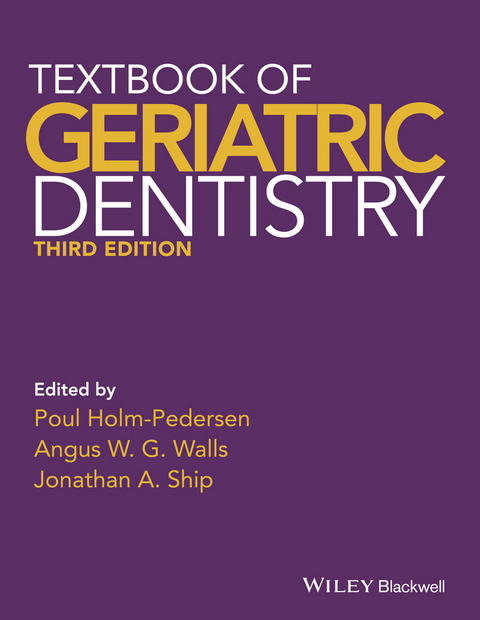
Textbook of Geriatric Dentistry (eBook)
John Wiley & Sons (Verlag)
978-1-118-90834-1 (ISBN)
Textbook of Geriatric Dentistry, Third Edition provides a comprehensive review of the aging process and its relevance to oral health and dentistry. Now in full colour, this third edition has been fully revised and updated with new material encompassing recent research and clinical developments within geriatric dentistry. Written in a clear and accessible style, this is an essential guide to geriatric dental practice for undergraduate and postgraduate dentistry students and practicing clinicians alike.
Key features include:
- Contributions from an international group of expert authors
- Comprehensive coverage of oral healthcare issues in the older adult, from demographics and physiology through to nutrition and pharmacology
- Provides both foundational knowledge and a guide to clinical management
- New chapters including material on orofacial pain, quality of life and treatment planning
Poul Holm-Pedersen is Emeritus Professor at the Department of Odontology, University of Copenhagen, Denmark
Angus Walls is Director of the Edinburgh Postgraduate Dental Institute, University of Edinburgh, UKJonathan Ship was formerly Professor of Oral and Maxillofacial Pathology, Radiology and Medicine at the Bluestone Center for Clinical Research, New York University (NYU) College of Dentistry, USA
Textbook of Geriatric Dentistry, Third Edition provides a comprehensive review of the aging process and its relevance to oral health and dentistry. Now in full colour, this third edition has been fully revised and updated with new material encompassing recent research and clinical developments within geriatric dentistry. Written in a clear and accessible style, this is an essential guide to geriatric dental practice for undergraduate and postgraduate dentistry students and practicing clinicians alike. Key features include: Contributions from an international group of expert authors Comprehensive coverage of oral healthcare issues in the older adult, from demographics and physiology through to nutrition and pharmacology Provides both foundational knowledge and a guide to clinical management New chapters including material on orofacial pain, quality of life and treatment planning
Poul Holm-Pedersen is Emeritus Professor at the Department of Odontology, University of Copenhagen, Denmark Angus Walls is Director of the Edinburgh Postgraduate Dental Institute, University of Edinburgh, UK Jonathan Ship was formerly Professor of Oral and Maxillofacial Pathology, Radiology and Medicine at the Bluestone Center for Clinical Research, New York University (NYU) College of Dentistry, USA
Notes on contributors vii
PrefaceThird edition, 2015 xi
Preface Second edition, 1996 xiii
Preface First edition, 1986 xv
1 Demography - impact of an expanding elderly population 1
S. Jay Olshansky
2 Biological and physiological aspects of aging 7
João F. Passos and Thomas B.L. Kirkwood
3 Aging of bone and muscle 17
Arnold Kahn and Poul Holm-Pedersen
4 Sensory changes and communication in the practitioner-aged patient relationship 27
Kevin Kawamoto and H. Asuman Kiyak
5 Aging from a psychological perspective 39
Terry Fulmer, Sheryl Strasser and Toni C. Antonucci
6 The impact of social and environmental forces on aging 47
H. Asuman Kiyak and Nancy R. Hooyman
7 Clinical assessment of the elderly patient 61
Elisa M. Ghezzi, Douglas B. Berkey, Richard W. Besdine and Judith A. Jones
8 Medical issues in the dental care of older adults 81
Peter B. Lockhart and Scott Furney
9 Psychiatric disorders in old age - implications for the dental practitioner 103
Angela R. Kamer, Mony J. de Leon and Martin J Sadowski
10 Disability in old age - the relationship with oral health 119
Kirsten Avlund
11 Nutrition and oral health for the older person 131
Angus W. G. Walls
12 Pharmacology and aging 145
Elisa M. Chávez and Peter L. Jacobsen
13 Preventive oral health care for elderly people 155
J. H. Meurman
14 Treatment planning for the geriatric patient 165
Frederick Hains and Judith Jones
15 Caries in the older person 181
Angus W. G. Walls and David Ricketts
16 Pathology and treatment of diseases of the pulp 199
John Whitworth
17 Pathology and treatment of gingivitis and periodontitis in the aging individual 211
Poul Holm-Pedersen, Frauke Müller and Niklaus P. Lang
18 Pathology and treatment of oral mucosal diseases 225
Palle Holmstrup, Jesper Reibel and Ian C. Mackenzie
19 Salivary function and disorders in the older adult 245
Jonathan A. Ship
20 Oral and maxillofacial surgery for the geriatric patient 255
Michael Turner and Mark Greenwood
21 Orofacial pain in older adults 265
Dena J. Fischer and Joel B. Epstein
22 Concepts and techniques for oral rehabilitation measures in elderly patients 277
Niklaus P. Lang, Frauke Müller and J. Mark Thomason
23 Oral health-related quality of life 301
Finbarr Allen and Jimmy Steele
24 Influences on older adults' use of dental services 311
H. Asuman Kiyak
25 Oral health care programmes for homebound people, nursing home residents and elderly inpatients 323
Ronald L. Ettinger and Jane M. Chalmers
26 Clinical management of the cognitively impaired older adult and the terminally ill older patient 345
Jane M. Chalmers, Ronald L. Ettinger and Michael Wiseman
Index 361
Chapter 1
Demography – impact of an expanding elderly population
S. Jay Olshansky
School of Public Health, University of Illinois at Chicago, Chicago, IL, USA
Introduction
Scientists who study the demography of aging investigate trends in, and characteristics of, fertility, mortality and migration and how these components of population change influence, and are influenced by, the environments in which people live. This is a new area of scientific inquiry because aging, as a uniquely demographic phenomenon of populations, has been experienced on a large scale by only one species – humans – and even then only for the last century. Among the many social and economic changes that population aging has brought forth, one of the most important has been dramatic increases in the absolute number of people who live into older regions of the lifespan – a phenomenon that will accelerate in the coming decades.
It is important to understand the difference between population aging and individual aging. Individual aging refers to the biological changes that occur in our cells, tissues and organs with the passage of time, and it is measured demographically at the level of the individual by the duration of our lives. By contrast, population aging is characterized by shifts in the age structure of groups of people such that the relative proportion of older persons (often defined by those aged 65 and older) increases in relation to the number of people under the age of 65. The most common measures that are used to track changes in population aging across time or between population subgroups include the median age, expected remaining years of life (i.e. life expectancy) at middle and older ages and the percentage of the total population aged 65 and older.
Causes and consequences of population aging
For most of recorded history there has been a consistent (stable) pattern of fluctuating birth rates and death rates. Until about the middle of the 19th century, death rates had consistently fluctuated between peaks and troughs as a result of communicable diseases that periodically decimated populations, followed by times of relative stasis. Birth rates were extremely high during most of human history. On average, women gave birth to about seven babies during their reproductive years. Many of the children died in their first year of life from communicable diseases, but death rates were also extremely high throughout the age structure. In fact, the risk of death was so high at middle and younger ages that survival into older ages (beyond age 65) was a rare event by comparison to survival patterns observed today. Living into extreme old ages (ages 85 and older) was an extremely rare occurrence. Since birth rates have almost always exceeded death rates by a small margin throughout most of our history, the size of the human population has grown steadily for thousands of years.
If you were to count the number of people alive at all ages in a given year and plot them on a graph, what you would see is a characteristic age distribution that resembles the shape of a pyramid (see Figure 1.1). This is a common age pattern among humans and many other forms of life where there are a large number of young followed by progressively fewer middle aged and older members of the population. In a hypothetically closed population with no migration, the horizontal bars in the age pyramid reflect the number of people surviving to each age range from an original birth cohort based on prevailing death rates. However, in an open population with migration and changing vital rates (which reflect the true nature of living conditions), the age pyramid reflects historical patterns of fertility, mortality and migration. The age pyramid is what characterized the human age distribution throughout most of our history, but this changed rapidly during the 20th century.
Figure 1.1 Age pyramid for humans in Nigeria in the year 2000.
Source: United Nations, 2001.
During the last 100 years a combination of events led to dramatic changes in the stable patterns of birth rates and death rates that had likely existed for thousands of years. Advances in public health led to the availability of clean water and refrigeration, sewage disposal and improved living and working environments. These developments combined with modern medicine to significantly reduce the transmission of, and death rate from, air- and water-borne infectious diseases. Within a single generation the environmental conditions that permitted the easy transmission of diseases that killed infants and children and women during childbirth were profoundly altered. From a biological perspective, modifications of this magnitude and importance suggest that fundamental changes in the forces of natural selection operating on the human species had occurred.
As the risk of death at younger ages declined rapidly, the high birth rates that were needed to replace the children who died from infectious diseases began to subside. Since the decline in birth rates lagged behind the decline in death rates, the result was rapid population growth during the 20th century – from one billion in 1900 to more than 6.5 billion by the turn of the 21st century. The eventual transformation of birth rates and death rates to the lower levels now observed in most developed nations is what set the stage for the demographic phenomenon of population aging.
When death rates declined at younger ages, the base of the age pyramid expanded and its apex became smaller by comparison. When the apex of an age pyramid decreases relative to its base, it may be said that a population is becoming younger. Thus, the first demographic consequence of declining early-age mortality was a younger population. However, within a single generation those saved from dying at younger ages began to reach middle and older ages, thereby altering the population's age composition by increasing the size of the middle and apex of the age pyramid relative to its base (see Figure 1.2). When death rates at younger ages stabilize at extremely low levels, as they have in all countries with high life expectancies, the base of the age pyramid then becomes sensitive only to changes in birth rates. With a stable base and a growing middle and apex, a permanent shift in the age structure occurrs from its historical pyramid shape to that of a square-like or rectilinear form. Although temporary increases in birth rates (like those observed in the post-World War II era) can slow population aging and even temporarily reverse it, the new rectilinear age structure will eventually reassert itself as the children from the larger birth cohorts survive to older ages. The transformation from stable high birth and death rates to stable low birth and death rates has led to permanent changes in the age structure of the human species.
Figure 1.2 Age pyramid of the future with a shift in the historical pyramidal shape to that of a square-like or rectilinear form.
Source: United Nations, 2001.
The social, economic and health implications associated with population aging are profound. Consider an ongoing debate in the health and demographic sciences known as the compression versus expansion of morbidity hypotheses. When death rates decline at younger ages the proportion of each birth cohort surviving past ages 65 and 85 increases rapidly. By way of example, in France the proportion of the female birth cohort of 1900 that was expected to survive to ages 65 and 85 based on death rates in that year was 39% and 3.5%, respectively. By comparison, the female birth cohort of 2000 is expected to have 90% and 50% survive past ages 65 and 85, respectively. These unprecedented patterns of survival into older ages are now common throughout the nations of the developed world, and they have led scientists to track the health of these aging pioneers and how prospective changes in death rates at older ages might influence the future health of the older population.
One school of thought argues for what has come to be known as the compression of morbidity hypothesis. With this hypothesis it is suggested that lifestyle changes and advances in medicine will continue to reduce the risk of death from fatal diseases and simultaneously lead to a postponement in the onset and age progression of the nonfatal disabling diseases. The premise of this theory is that there is a fixed biological limit to life towards which populations are headed, and as improved lifestyles successfully postpone the onset and expression of fatal diseases and nonfatal but highly disabling diseases and disorders, more people will be pushed towards their biological ‘limit’ to life, and morbidity and disability will be compressed into a shorter duration of time before death.
A second school of thought proposes what has come to be known as the expansion of morbidity hypothesis. The proponents of this hypothesis maintain that the forces influencing the onset and age progression of nonfatal diseases associated with senescence are mostly independent of the forces influencing the risk of death from fatal diseases. If death rates from fatal diseases continue to decline, it is hypothesized that the saved population will be exposed to a longer duration of time during which the nonfatal but highly disabling diseases and disorders of senescence have the opportunity to be expressed. In other words, the extension of life resulting from continued progress made against fatal diseases is hypothesized to eventually prolong the period of...
| Erscheint lt. Verlag | 19.6.2015 |
|---|---|
| Sprache | englisch |
| Themenwelt | Medizin / Pharmazie ► Allgemeines / Lexika |
| Medizin / Pharmazie ► Gesundheitsfachberufe | |
| Medizin / Pharmazie ► Zahnmedizin | |
| Schlagworte | Alterszahnheilkunde • Berufspraxis i. d. Zahnmedizin • Dental Professional Practice • dentistry • Geriatric, dentistry, geriatric dentistry, aging, gerodontics, clinical management, quality of life, treatment planning, older adult, oral health • Gerodontology • Zahnheilkunde • Zahnmedizin |
| ISBN-10 | 1-118-90834-1 / 1118908341 |
| ISBN-13 | 978-1-118-90834-1 / 9781118908341 |
| Informationen gemäß Produktsicherheitsverordnung (GPSR) | |
| Haben Sie eine Frage zum Produkt? |
 EPUB (Adobe DRM)
Kopierschutz: Adobe-DRM
Adobe-DRM ist ein Kopierschutz, der das eBook vor Mißbrauch schützen soll. Dabei wird das eBook bereits beim Download auf Ihre persönliche Adobe-ID autorisiert. Lesen können Sie das eBook dann nur auf den Geräten, welche ebenfalls auf Ihre Adobe-ID registriert sind.
Details zum Adobe-DRM
Dateiformat: EPUB (Electronic Publication)
EPUB ist ein offener Standard für eBooks und eignet sich besonders zur Darstellung von Belletristik und Sachbüchern. Der Fließtext wird dynamisch an die Display- und Schriftgröße angepasst. Auch für mobile Lesegeräte ist EPUB daher gut geeignet.
Systemvoraussetzungen:
PC/Mac: Mit einem PC oder Mac können Sie dieses eBook lesen. Sie benötigen eine
eReader: Dieses eBook kann mit (fast) allen eBook-Readern gelesen werden. Mit dem amazon-Kindle ist es aber nicht kompatibel.
Smartphone/Tablet: Egal ob Apple oder Android, dieses eBook können Sie lesen. Sie benötigen eine
Geräteliste und zusätzliche Hinweise
Buying eBooks from abroad
For tax law reasons we can sell eBooks just within Germany and Switzerland. Regrettably we cannot fulfill eBook-orders from other countries.
aus dem Bereich