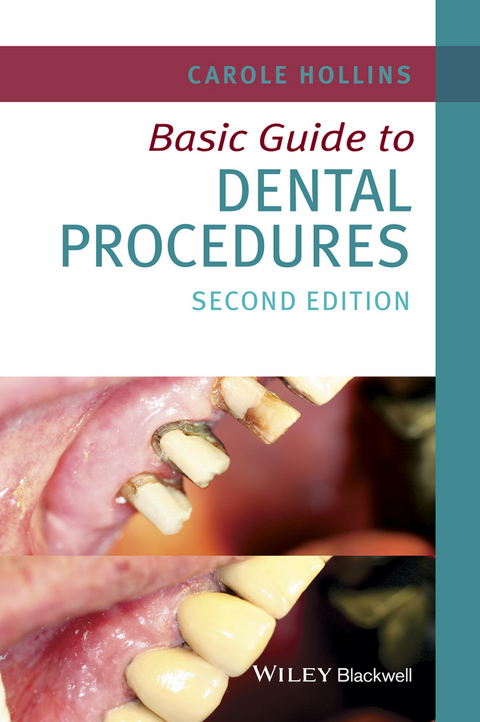
Basic Guide to Dental Procedures (eBook)
John Wiley & Sons (Verlag)
978-1-118-92457-0 (ISBN)
Basic Guide to Dental Procedures, Second Edition provides an essential introduction to the core preventative and restorative treatments routinely carried out in the modern dental practice. Written as a guide for the whole dental team, 'before and after' colour photographs enable the reader to understand and explain the procedures to their patient with confidence. Each section is clearly structured to cover the reasoning behind the treatment described, the relevant dental background, the basics of how each procedure is carried out and any necessary aftercare information.
Key features include:
- Colour photographs throughout combined with concise text to highlight the crucial points of each procedure
- Suitable for the whole dental team, from office support staff to the dentist explaining procedures to a patient
- Thoroughly updated and revised in line with the substantial changes to the role and professional obligations of the dental nurse, including a new chapter detailing extended duties
- The new images of tray set-ups means it is an ideal companion for trainee dental nurses studying for the NEBDN OSCE exam
Carole Hollins is a dental practitioner and member of the British Dental Association. She is a member of the Faculty of General Dental Practitioners and a former Chairman of the National Examining Board for Dental Nurses. Previous Chairman of both the National Certificate Committee and the Qualifications Council, Carole has been involved in the training and examining of dental nurses for over twenty years.
Basic Guide to Dental Procedures, Second Edition provides an essential introduction to the core preventative and restorative treatments routinely carried out in the modern dental practice. Written as a guide for the whole dental team, before and after colour photographs enable the reader to understand and explain the procedures to their patient with confidence. Each section is clearly structured to cover the reasoning behind the treatment described, the relevant dental background, the basics of how each procedure is carried out and any necessary aftercare information. Key features include: Colour photographs throughout combined with concise text to highlight the crucial points of each procedure Suitable for the whole dental team, from office support staff to the dentist explaining procedures to a patient Thoroughly updated and revised in line with the substantial changes to the role and professional obligations of the dental nurse, including a new chapter detailing extended duties The new images of tray set-ups means it is an ideal companion for trainee dental nurses studying for the NEBDN OSCE exam
Carole Hollins is a dental practitioner and member of the British Dental Association. She is a member of the Faculty of General Dental Practitioners and a former Chairman of the National Examining Board for Dental Nurses. Previous Chairman of both the National Certificate Committee and the Qualifications Council, Carole has been involved in the training and examining of dental nurses for over twenty years.
How to use this book vii
1 Preventive techniques 1
2 Oral hygiene instruction 6
3 Scaling and polishing 18
4 Diagnostic techniques 27
5 Tooth restoration with fillings 37
6 Tooth restoration with crowns, bridges, veneers or inlays 46
7 Tooth restoration with endodontic techniques 59
8 Tooth extraction 68
9 Tooth replacement with dentures 75
10 Tooth replacement with implants 85
11 Tooth alignment with orthodontic appliances 91
12 Tooth whitening 103
13 Extended duties of the dental nurse 110
Assessment sheet 154
Glossary of terms 157
Index 161
"That said, this book would be good to keep in the surgery as a handy 'go-to' resource, particularly in the early days of one's career." (Dental Nursing, 1 September 2015)
Chapter 2
Oral hygiene instruction
Reason for procedure
Oral hygiene instruction is given to patients to ensure that they are maximising their efforts to remove plaque from their teeth, to minimise the damage caused by periodontal disease and caries.
Dietary advice is also given to help patients avoid foods and drinks that are particularly damaging to their teeth – those high in refined sugars or those that are acidic.
When the advice is correctly followed on a regular basis, the patients can enjoy a well cared for and pain-free mouth, as well as avoiding the expense of reparative dental treatment.
The procedures discussed are:
- Use of disclosing agents
- Toothbrushing
- Interdental cleaning
Background information of procedure – disclosing agents
Disclosing agents are harmless vegetable dyes supplied in liquid or tablet form and in various colours, usually red or blue (Figure 2.1).
Figure 2.1 Disclosing tablets
They act by staining any plaque on the tooth surface to their own colour (Figure 2.2), thus making it far easier to show the presence and location of the plaque to the patient, as plaque is normally a creamy white colour and may be difficult to see otherwise (Figure 2.3).
Figure 2.2 Disclosed teeth showing the presence of plaque
Figure 2.3 Appearance of undisclosed gingival plaque
Once stained, suitable oral hygiene instruction can be given to remove the plaque effectively. The dyes do not stain the teeth themselves, nor any restorations.
Details of procedure – disclosing agents
The agents can initially be used at the practice by the oral health team so that the correct problem areas can be identified and suitable cleaning advice given. The patient can then use the agents at home to check their progress on a regular basis. The commonest agents used are disclosing tablets.
Technique:
- A protective bib is placed over the patients so that their clothing is not inadvertently marked
- The patients are given one disclosing tablet and asked to chew it for about 1 min
- After this time, they are asked to spit out the chewed tablet and saliva, but are instructed not to rinse their mouth out
- Using a patient-mirror, any stained plaque is pointed out by the oral health team and the worst areas noted (very often the gingival margins)
- Detailed advice is then given on how to improve their tooth brushing and cleaning techniques to eliminate the plaque from these areas
- The patients can follow these instructions immediately so that all the stained plaque is removed while under the supervision of the oral health team
- With the plaque easily visible due to the disclosing agent, the patients are able to see their own progress and develop the skill to maintain good oral hygiene
Background information of procedure – toothbrushing
Toothbrushing is the commonest method used by patients to remove plaque from the easily accessible flat surfaces of the teeth, but not from the interdental areas.
Many toothbrushing techniques have been suggested over the years – especially side to side brushing and rotary brushing – but the technique used is immaterial as long as the plaque is removed successfully without causing damage to the tooth surface. Disclosing agents can be used to determine the most successful method for a patient.
When performed thoroughly and to a consistently high standard, manual brushing should be just as effective as that completed with a good quality electric brush, but the latter takes the effort out of good brushing for those patients who lack the time and skill to perform manual brushing well.
When toothbrushing is combined with the application of a fluoridated toothpaste, the teeth and gums are cleaned free of plaque and the teeth are protected from dental caries by the action of fluoride on the enamel.
Details of procedure – toothbrushing
The aim of good toothbrushing is to remove plaque from the gingival margins and some stagnation areas, and to protect the tooth surface with a layer of fluoride.
Many toothpastes are available (fluoridated, tartar controlling, desensitising, whitening, etc. – Figure 2.4) and the oral health team will advise on the most suitable to be used in each case.
Figure 2.4 Examples of various toothpastes
Similarly, many toothbrush designs are available – both manual and electric – but as a general rule the head should be small to allow easier manouverability, and the bristles should be multitufted and made of medium nylon. Even so, some patients brush with such force that they actually saw into the necks of their teeth and produce abrasion cavities.
Technique:
- Identify those patients with regular residual plaque after toothbrushing
- Wet the patient's own brush and apply a small amount of toothpaste, then allow them to brush their teeth in their usual way and in their usual time
- Disclose the plaque to identify the areas of its continued accumulation
- Develop a more thorough brushing technique with the patient to remove all the plaque, particularly that which has accumulated at the gingival margins (Figure 2.5)
- This may involve a change of brush from manual to electric or vice versa, as well as a change of brushing technique by the patient
- Once an effective technique has been identified, a methodical approach is to be developed so that a routine brushing technique is carried out every day
- This tends to be more effective if the more difficult areas are tackled first, such as the lingual surfaces of the lower teeth
- The patient then brushes all the teeth in a systematic manner, starting in the same place and ending in the same place each time
- Advice can then be given on the frequency of brushing – usually twice daily as a minimum, but some patients may continue with a high sugar diet and need to brush after each meal
- Full dietary advice should also be discussed and ideally adjusted where necessary
- Toothbrushes should be replaced once the bristles start to splay, as they will not remove plaque effectively when worn down (Figure 2.6)
Figure 2.5 Tooth brushing the gingival margins
Figure 2.6 Comparison of new and worn toothbrush
Background information of procedure – interdental cleaning
The surfaces of the teeth that remain untouched by toothbrushing are the contact points, or interdental areas (Figure 2.7). Plaque accumulates here just as easily as the flat surfaces of the teeth, and even more so when restorations extend into the interdental areas as microscopically they provide more potential for stagnation areas to occur.
Figure 2.7 Contact points of the teeth
Although toothbrushes are too large to clean interdentally, other oral health products have been designed to do so:
- Tape or floss
- Manual interdental brushes
- Dental woodsticks
- Some specialised electric toothbrush heads
- Some mouthwashes
The first four are used to physically clean plaque from the interdental areas, while some mouthwashes can be vigorously rinsed and swished through the interdental areas by the patient to dislodge larger particles of debris.
A certain amount of manual dexterity is required by the patient to use dental tape or floss effectively, and a lack of dexterity is often the cause of patients abandoning the technique. Some products have been developed to help, whereby a fork design holds a small piece of tape or floss firmly while it is used with one hand to enter and clean the interdental areas (Figure 2.8). This removes the need by the patient for wrapping the tape around the fingers and holding it firmly while trying to access the interdental areas.
Figure 2.8 Interdental ‘flossettes’
Details of procedure – flossing
This is the technique used by the majority of patients who routinely clean interdentally, despite it being the most difficult to achieve.
Some tapes and flosses are waxed to assist easier entry into tight interdental areas, and others are impregnated with fluoride so that the interdental surfaces of the teeth are protected once accessed (Figure 2.9).
Figure 2.9 Examples of dental floss and tape products
Technique:
- Ideally the patient should carry out flossing with the aid of a mirror, in a well-lit room
- A piece of tape or floss (approximately 20 cm) is removed from the holder and wrapped around both index fingers,...
| Erscheint lt. Verlag | 18.6.2015 |
|---|---|
| Reihe/Serie | Basic Guide Dentistry Series |
| Basic Guide Dentistry Series | Basic Guide Dentistry Series |
| Sprache | englisch |
| Themenwelt | Medizin / Pharmazie ► Allgemeines / Lexika |
| Medizin / Pharmazie ► Gesundheitsfachberufe | |
| Medizin / Pharmazie ► Zahnmedizin | |
| Schlagworte | Berufspraxis i. d. Zahnmedizin • Dental Nursing • dental practice, patients, core procedures, restorative dentistry, preventative dentistry, dentist, dental nurse, dental receptionist, dental team • Dental Professional Practice • dentistry • Praxis der Zahnarzthelferin • Zahnmedizin |
| ISBN-10 | 1-118-92457-6 / 1118924576 |
| ISBN-13 | 978-1-118-92457-0 / 9781118924570 |
| Informationen gemäß Produktsicherheitsverordnung (GPSR) | |
| Haben Sie eine Frage zum Produkt? |
 EPUB (Adobe DRM)
Kopierschutz: Adobe-DRM
Adobe-DRM ist ein Kopierschutz, der das eBook vor Mißbrauch schützen soll. Dabei wird das eBook bereits beim Download auf Ihre persönliche Adobe-ID autorisiert. Lesen können Sie das eBook dann nur auf den Geräten, welche ebenfalls auf Ihre Adobe-ID registriert sind.
Details zum Adobe-DRM
Dateiformat: EPUB (Electronic Publication)
EPUB ist ein offener Standard für eBooks und eignet sich besonders zur Darstellung von Belletristik und Sachbüchern. Der Fließtext wird dynamisch an die Display- und Schriftgröße angepasst. Auch für mobile Lesegeräte ist EPUB daher gut geeignet.
Systemvoraussetzungen:
PC/Mac: Mit einem PC oder Mac können Sie dieses eBook lesen. Sie benötigen eine
eReader: Dieses eBook kann mit (fast) allen eBook-Readern gelesen werden. Mit dem amazon-Kindle ist es aber nicht kompatibel.
Smartphone/Tablet: Egal ob Apple oder Android, dieses eBook können Sie lesen. Sie benötigen eine
Geräteliste und zusätzliche Hinweise
Buying eBooks from abroad
For tax law reasons we can sell eBooks just within Germany and Switzerland. Regrettably we cannot fulfill eBook-orders from other countries.
aus dem Bereich