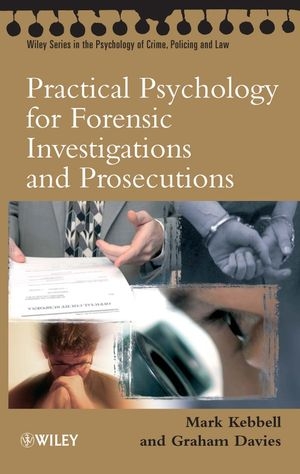
Practical Psychology for Forensic Investigations and Prosecutions (eBook)
John Wiley & Sons (Verlag)
978-1-119-16120-2 (ISBN)
Mark Kebbell is an associate professor at the James Cook University, Townsville, Australia. He co-wrote (with Graham Wagstaff) guidelines for police officers in England and Wales on the assessment of eyewitness evidence, and has published many journal articles.
Graham Davies is co-series editor with Ray Bull and a professor of psychology at the University of Leicester. He is co-editor of Applied Cognitive Psychology; amongst his numerous publications, and the most recent for Wiley, is Recovered Memories: Seeking the Middle Ground.
Mark Kebbell is an associate professor at the James Cook University, Townsville, Australia. He co-wrote (with Graham Wagstaff) guidelines for police officers in England and Wales on the assessment of eyewitness evidence, and has published many journal articles. Graham Davies is co-series editor with Ray Bull and a professor of psychology at the University of Leicester. He is co-editor of Applied Cognitive Psychology; amongst his numerous publications, and the most recent for Wiley, is Recovered Memories: Seeking the Middle Ground.
About the Editors.
About the Contributors.
Acknowledgements.
Preface.
Introduction (Graham Davies and Mark Kebbell).
1. Interviewing Victims of Crime, Including Children and People
with Intellectual Disabilities (Becky Milne and Ray
Bull).
2. Procedural Recommendations to Increase the Reliability of
Eyewitness Identifications (Jennifer Beaudry, Rod Lindsay and
Paul Dupuis).
3. Investigating Criminal Cases of Delayed Reports of Sexual
Abuse (Laurence Alison and Mark Kebbell).
4. Psychological Characteristics of Offenders (Kevin Howells
and Jacqueline Stacey).
5. Detecting Deception (Aldert Vrij).
6. Improving the Interviewing of Suspected Offenders (Mark
Kebbell and Emily Hurren).
7. Strategies for Preventing False Confessions and Their
Consequences (Deborah Davis and Richard Leo).
8. Offender Profiling: Limits and Potential (Laurence Alison
and Mark Kebbell).
9. Deciding to Prosecute (Elizabeth Gilchrist).
10. Preventing Withdrawal of Complaints and Psychological
Support for Victims (Graham Davies and Helen Westcott).
11. Communicating Risk to the Court (Don Grubin).
12. Future Directions for Applying Psychology to Forensic
Investigations and Prosecutions (Mark Kebbell and Graham
Davies).
Index.
About the Contributors
Laurence Alison is Professor of Forensic Psychology and Director of the Centre for Critical Incident Research at the University of Liverpool. His research interests include investigative decision making, police leadership and law enforcement personnel’s use of expert advice. He has published widely on these topics at an international level in a variety of academic and practitioner outlets. He has contributed advice to several major cases in the last 10 years, including rapes, murders, armed robberies and terrorist attacks. He has produced several books on profiling and investigation, most recently as editor of The Forensic Psychologist’s Casebook: Psychological Profiling and Criminal Investigation.
Jennifer Beaudry is a doctoral candidate at the Department of Psychology, Queen’s University under the supervision of Rod Lindsay. Before pursuing graduate studies at Queen’s University she worked as an emergency services child protection worker for the Sudbury Children’s Aid Society. Her main research interests are eyewitness identification evidence, radical lineup procedures and juror decision making. She has co-authored a chapter, entitled “Belief of Eyewitness Identification Evidence”, for the Handbook of Eyewitness Psychology: Memory for People. Her research has been presented at several international conferences, including the American Psychology-Law Society and the Society for Applied Research in Memory and Cognition. She currently holds a Canadian Graduate Scholarship from the Social Sciences and Humanities Research Council.
Ray Bull is Professor of Forensic Psychology and Director of Forensic Psychology at the University of Leicester. His main interests focus on investigative interviewing (e.g. of suspects and witnesses) and witness testimony (e.g. of children and voice identification). His major books include Investigative Interviewing: Psychology and Practice (with Milne), Handbook of Psychology in Legal Contexts (with Carson), Psychology and Law: Truthfulness, Accuracy and Credibility (with Memon and Vrij). He has co-authored numerous articles in research journals. He has been commissioned by government to co-author guidance documents on good practice in interviewing child witnesses, achieving best evidence from vulnerable witnesses and the taking of evidence on commission. He has written expert reports for many dozens of court cases (including Courts of Appeal) and has testified in criminal trials and civil hearings in a number of countries. He recently received the rare honour (for a “civilian”) of a Commendation from the London Metropolitan Police Service for his work on a particular case.
Deborah Davis is an Associate Professor in the Psychology Department of the University of Nevada-Reno. With regards to forensic psychology, her areas of expertise are witness memory, false confessions, issues of sexual consent, rules of evidence and jury research. She has also conducted a variety of research in the areas of social psychology of ageing, and attachment and relationship behaviors, and has written papers concerning research ethics. She was the editor of From the Mind’s Eye, a newsletter designed to report social science research on law and courtroom psychology. She has also been a member of the editorial boards for Representative Research in Social Psychology, the Journal of Experimental Social Psychology, and the Journal of Personality and Social Psychology.
Paul Dupuis is a Psychology Instructor at Red Deer College in Alberta, Canada. He obtained his PhD from Queen’s University. His research interests are in social psychology and eyewitness testimony. He has a particular interest in identification evidence and how lineups are constructed. He has published in this area including a study testing the influence of simultaneous face, body and sequential voice lineups (with Pryke, Lindsay and Dysart) and has demonstrated that multiple identifications (by the same witness) from independent lineups of different features are highly diagnostic of suspect guilt.
Elizabeth Gilchrist is Reader in Forensic Psychology and Director of Forensic Psychology at the University of Kent. Her research interests are in the area of domestic violence and the needs of vulnerable victims, and in criminal justice processes, particularly decision making and in the effectiveness of interventions in the domestic violence arena. Her recent work has included work with women and children who have experienced domestic violence, and a large national study on perpetrators and victim/survivors of domestic violence, which was funded by the Home Office. She is also working on an evaluation of a community-based intervention for domestic violence, funded by the local probation area, and an evaluation of support for victims of sexual offences, funded by the Home Office. She is currently involved in establishing research priorities for the parole board and is developing further work in the area of domestic violence and underlying neural mechanisms, exploring decision making within the parole board and the implications of intimate offending for future risk.
Don Grubin is Professor of Forensic Psychiatry at the University of Newcastle and Honoury Consultant Forensic Psychiatrist at 3 NNNs Trust, St Nicholas Hospital. His research interests are risk assessment and treatment of sex offenders, prison health screening and fitness to plead. His current work focuses on the use of polygraphy in the treatment and supervision of sex offenders and in the treatment of personality disordered prisoners and patients. He is also carrying out a study into the use of SSRI medication in the treatment of sex offenders.
Kevin Howells is Professor of Forensic Clinical Psychology at the University of Nottingham, Head of the Peaks Academic and Research Unit in Nottinghamshire Healthcare Trust and also a member of the Centre for Applied Psychological Research at the University of South Australia. He has been involved in assessment, treatment and research work with offenders in both the United Kingdom and Australia.
Emily Hurren is a PhD candidate within the School of Psychology at Griffith University. Her research interests include child maltreatment, the links between child maltreatment and juvenile offending, sex offending and improving police interviewing of suspected offenders to increase rates of confession. Most recently she has interviewed approximately 60 convicted sex offenders concerning their perceptions of how they were interviewed by the police and how police interviewing of suspects can be improved.
Richard Leo is an Associate Professor of Criminology, Law and Society and an Associate Professor of Psychology and Social Behavior at the University of California, Irvine. He is a leading international authority on police interrogation practices, Miranda requirements, coercive persuasion, false confessions and wrongful convictions. In the last decade, he has authored numerous publications on these subjects in a variety of leading social science journals and law reviews. He is also co-author (with Thomas) of The Miranda Debate: Law, Justice, and Policing and is the recipient of The Ruth Shonle Cavan Award from the American Society of Criminology, the Saleem Shah Career Achievement Award from the American Psychological Association and a Soros Senior Justice Fellowship from the Open Society Institute. He has lectured widely to police, judges, criminal defence attorneys, prosecutors and other professionals. He is currently completing a book on police interrogation and American justice for Harvard University Press.
Rod Lindsay is Professor of Psychology at Queen’s University. His main interests focus on eyewitness identification techniques (lineups and showups) and the credibility of witness testimony (e.g. of children). He is a co-editor of the 2006 two-volume Handbook of Eyewitness Psychology: Memory for Events and Handbook of Eyewitness Psychology: Memory for People (both with Ross, Read and Toglia). He has co-authored over 80 articles and book chapters and over 100 conference presentations, mostly on topics related to eyewitnesses. His publications include several articles in law journals and he was recently awarded a career achievement award from the Canadian Psychological Association for his Distinguished Contribution to the Application of Psychology. He participated in the sessions leading to the National Institute of Justice (US) publication Eyewitness Evidence: A Guide for Law Enforcement. He has participated extensively in the training of Canadian judges, prosecutors and law enforcement officers regarding issues of eyewitness accuracy and police procedures for obtaining and evaluating eyewitness evidence, particularly identification evidence. He has written expert reports for many court cases and has testified in criminal trials and civil hearings in a number of countries including consultation with prosecutors in the Rwandan war crimes trials.
Becky Milne is Principal Lecturer in Forensic Psychology at the Institute of Criminal Justice Studies of the University of Portsmouth. Her main interests focus on the cognitive interview, investigative interviewing (e.g. of suspects and witnesses), the investigation process and miscarriages of justice and the interviewing of vulnerable groups. She has written Investigative Interviewing: Psychology and Practice (with Bull). She has co-authored numerous articles in research journals and has been commissioned by the UK government to co-author guidance documents on achieving best...
| Erscheint lt. Verlag | 8.6.2015 |
|---|---|
| Reihe/Serie | Wiley Series in Psychology of Crime, Policing and Law |
| Wiley Series in The Psychology of Crime, Policing and Law | Wiley Series in The Psychology of Crime, Policing and Law |
| Sprache | englisch |
| Themenwelt | Geisteswissenschaften ► Psychologie |
| Studium ► 2. Studienabschnitt (Klinik) ► Rechtsmedizin | |
| Schlagworte | Approach • Book • Brings • different stages • Factors • Forensic • Forensic Psychology • Forensische Psychologie • heavily • holistic • Human • Human Factors • important • investigation • Investigations • Knowledge • major role • processes • Prosecution • Psychological • Psychologie • Psychology • Researchers • upon |
| ISBN-10 | 1-119-16120-7 / 1119161207 |
| ISBN-13 | 978-1-119-16120-2 / 9781119161202 |
| Informationen gemäß Produktsicherheitsverordnung (GPSR) | |
| Haben Sie eine Frage zum Produkt? |
 EPUB (Adobe DRM)
Kopierschutz: Adobe-DRM
Adobe-DRM ist ein Kopierschutz, der das eBook vor Mißbrauch schützen soll. Dabei wird das eBook bereits beim Download auf Ihre persönliche Adobe-ID autorisiert. Lesen können Sie das eBook dann nur auf den Geräten, welche ebenfalls auf Ihre Adobe-ID registriert sind.
Details zum Adobe-DRM
Dateiformat: EPUB (Electronic Publication)
EPUB ist ein offener Standard für eBooks und eignet sich besonders zur Darstellung von Belletristik und Sachbüchern. Der Fließtext wird dynamisch an die Display- und Schriftgröße angepasst. Auch für mobile Lesegeräte ist EPUB daher gut geeignet.
Systemvoraussetzungen:
PC/Mac: Mit einem PC oder Mac können Sie dieses eBook lesen. Sie benötigen eine
eReader: Dieses eBook kann mit (fast) allen eBook-Readern gelesen werden. Mit dem amazon-Kindle ist es aber nicht kompatibel.
Smartphone/Tablet: Egal ob Apple oder Android, dieses eBook können Sie lesen. Sie benötigen eine
Geräteliste und zusätzliche Hinweise
Buying eBooks from abroad
For tax law reasons we can sell eBooks just within Germany and Switzerland. Regrettably we cannot fulfill eBook-orders from other countries.
aus dem Bereich