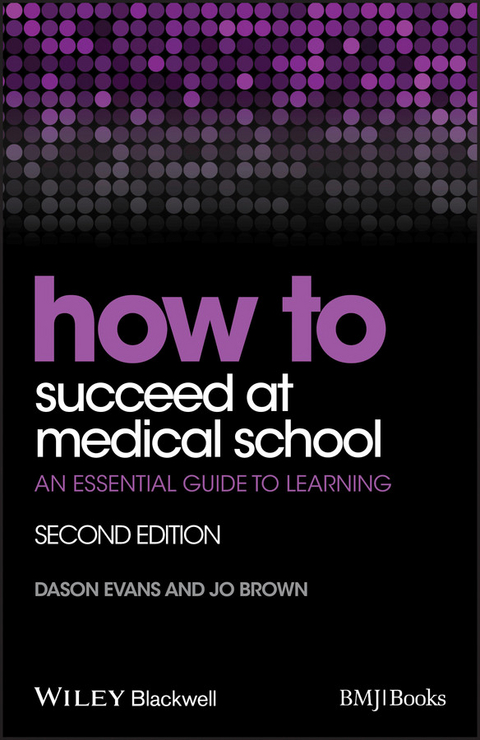
How to Succeed at Medical School (eBook)
John Wiley & Sons (Verlag)
978-1-118-70339-7 (ISBN)
Can you show your best abilities in the exams at the same time as learning to be a doctor?
Can you balance your studies with an enjoyable social life?
Can you develop your professionalism and manage your 'digital footprint'?
How to Succeed at Medical School will help you learn these vital skills, and much more.
Written by experienced medical school teachers and packed full of case studies, illustrations, quotes from other students, tip boxes, exercises, portfolios and learning techniques to help you communicate, study and revise - it's an essential resource to help you thrive at medical school.
This thoroughly updated second edition includes new chapters on Professionalism and Teaching, and provides invaluable insight into what to expect from the start of medical school right through to the start of your medical career.
Dr Dason Evans is Honorary Senior Lecturer in Medical Educationn, Barts and the London School of Medicine and Dentistry, Queen Mary, University of London, and Associate Specialist in Sexual Health, Courtyard Clinic, St Georges, University of London.
Dr Jo Brown is Reader in Medical Education and Head of Clinical Communication, St George's, University of London.
Dr Dason Evans is Honorary Senior Lecturer in Medical Educationn, Barts and the London School of Medicine and Dentistry, Queen Mary, University of London, and Associate Specialist in Sexual Health, Courtyard Clinic, St Georges, University of London. Dr Jo Brown is Reader in Medical Education and Head of Clinical Communication, St George's, University of London.
About the authors vii
Foreword to the first edition ix
Introduction 1
Chapter 1 What kind of learner are you? 5
Chapter 2 Learning knowledge 19
Chapter 3 Learning clinical skills 47
Chapter 4 Learning clinical communication skills 68
Chapter 5 Working in a group 100
Chapter 6 Developing your academic writing skills 117
Chapter 7 Portfolios and reflection 125
Chapter 8 Life-work balance 138
Chapter 9 Revision 151
Chapter 10 Exam technique: general rules 162
Chapter 11 Exam technique: specific examples 174
Chapter 12 Teaching, mentoring and coaching: helping others to learn and develop 203
Chapter 13 Professionalism: not as straightforward as you think 224
Chapter 14 Thinking ahead: student-selected components, careers and electives 242
Index 253
"This should be the gift of choice for any just entering medical school: it will pinpoint and help students overcome many potential barriers to success." (Midwest Book Review 2016)
Introduction
Who is this book for?
You may be reading this book because you are thinking of joining a medical course or because you are in the first few years of training. In this case, you will find this book particularly useful in helping you manage the transition to new ways of learning. Moreover, this book will be of interest to more senior students and may be of interest and relevance to students of other health professions and academics involved in their learning.
What is this book for?
Learning how to learn effectively and efficiently
During your years at medical school you will buy plenty of books. Almost all these books will cover what you need to know. This book is different, it concentrates on how to learn effectively and efficiently while at medical school and beyond. There is good evidence that helping students develop their awareness of how to learn and helping them develop a variety of learning techniques results in large improvements in performance.
Medical school is different
The learning environment at medical school is fundamentally different to secondary school or other university courses. You are expected to learn a huge amount of diverse information, ranging from Anatomy to Ethics, to become proficient in many new skills, ranging from taking blood to breaking bad news, and to be able to integrate skills with knowledge in order to work with a patient to make a diagnosis and management plan. You are expected to learn much of this without being specifically taught it. You are expected to be able to find out what you need to know and to learn it to an appropriate level, often with little support.
How will this book help you?
This book works on two levels. On the first level, it offers advice on how to learn most efficiently (study skills). This is divided up into four sections: Learning Knowledge, Learning Clinical and Communication Skills, Working in a Group and Exam Technique. On the second level, it aims to get you thinking about how you learn and when it might be best to use which study skills. This is embedded within these four sections and covered in more depth in four other sections: What Kind of Learner Are You?, Life-Work Balance, Revision and Thinking Ahead. By reading and working through this book you will gain not only a wider range of study skills, but also an awareness of when to use them in your learning.
What is in it?
An overview of the sections
The book starts with a chapter called What Kind of Learner are You?, which introduces a simple overview of learning style, helps you to think about what your preferred learning style is and how this might influence your learning. For example, you may be a perfectionist, wanting to understand the deepest nuances of everything that you learn—if this is the case, you may have trouble knowing at which point what you have learned is good enough and when to move on to the next thing to learn. By contrast, you might be a crammer, great at filling your head with facts for a few weeks before your exams, ready to forget shortly after—if this is the case, the volume of study may well overwhelm you, however good your short-term memory.
The chapter on Learning Knowledge covers how to make the most of lectures, including taking lecture notes; what sort of books to use and how to learn from them, through effective note taking, reviewing your learning and testing yourself, how to sift out the rubbish from the Internet and search effectively using IT, making the most of the library and how to find appropriate review articles from journals that give the most up to date view.
In the chapters on Learning Clinical Skills and Clinical Communication Skills, we offer guidance on how to be self-directed in learning these skills, how to make the most out of simulation and how to capitalise on the richness that learning with patients offers. We specifically cover the clinical learning environment, as many students find the clinical setting (hospital wards, general practice) a very different and unstructured environment to learn in, we discuss how to get the most from your clinical tutors and where some of the hidden learning opportunities are. The ward round as a learning opportunity gets a special mention. With respect to clinical communication skills, we present an evidence-based approach and advice on learning both in simulation and in the clinical environment: learning both by doing and also by watching others. New in the second edition, we highlight the role of empathy and the ways in which diversity affects our practice and include a new section on how to give information effectively. We discuss the essential nature of feedback, both how to give effective feedback and also how to receive it, and how to act on it. Finally, we cover the patient presentation, a common cause of anxiety among both medical students and their supervisors. Throughout both chapters, we make no apologies for repeatedly stressing the primacy of patient care.
Much of the learning in medical schools in the United Kingdom is through Working in a Group. Working and learning in a group is inescapable in medicine and this section starts with a discussion on the pros and cons of group work and how to get the best from it. It specifically discusses Problem-Based Learning (PBL) and its variants, informal learning groups and how to make interprofessional learning work.
Students at medical school often struggle with developing an Academic Writing style, referencing appropriately and concepts of plagiarism. We give an introduction to these areas in a dedicated chapter, which we hope will start you off with safe foundations.
Portfolios and Reflection are inescapable in undergraduate and postgraduate medical education, and the chapter on the subject provides a pragmatic overview on what portfolios are, how to make them work for you and demystifies some of the concepts of reflection.
For the rest of your life, there will be too much to do at work and too much to do at home. Balancing social and professional lives forms a recurring theme in research about stress in doctors. The chapter on Life–Work Balance provides some guidance into how to manage both a healthy social life and a healthy study life and, most importantly, will help you get into good habits right at the start of your professional career. Both time management and stress management are covered here.
The chapter on Revision builds on and summarises the principles from the previous ones, discussing how to manage the learning environment, prioritising, planning and timetabling and managing stress. This chapter, above all others, offers wholesome, sensible advice on how to manage the limited time running up to exams.
The chapters on Exam Technique cover generic advice about how to approach exams, lists the different kinds of assessments that you might face at medical school and then offers specific advice on how to make the most from each of these. It includes how to do your best in multiple-choice, extended matching question exams, data interpretation questions and how to survive the OSCE or clinical skills exam. We discuss coping mechanisms that do not work, alongside those that do and advice on how to manage exam stress. New in this edition is specific advice on the latest trend in assessment—the dreaded ‘Situational Judgement Test’ (SJT)—which should help you prepare effectively and recognise what the questions are actually looking for.
Increasingly, medical students are involved in formal and informal teaching of others. The new chapter on Teaching, Mentoring and Coaching helps guide you through this, linking clearly from the chapters on how students learn, in order to explain how you can help others learn.
In this second edition, we provide a new chapter on Professionalism. Professionalism is the very foundation of medical practice and this is mirrored throughout this book. Professionalism is not separate, but integrated within each chapter. Whether it be learning effectively, encouraging life-long learning, concepts of referencing and plagiarism or a strong emphasis on learning in order to provide excellent care for patients, rather than to pass exams, you will find little in this book that will not count towards your developing professionalism. What this chapter specifically covers is how to learn professionalism, how it is assessed and some of the dilemmas around professionalism, particularly the quagmire that is digital professionalism. We hope that this chapter will help you to review and actively manage your ‘digital footprint’. In addition, it may stimulate you to become involved with this emerging, rapidly changing field.
Finally, the chapter on Thinking Ahead: Selected Study Components, Careers and Electives offers some thoughts about longer term planning of learning—including which optional components of your course to choose, which electives to go on and some discussion on how to check out which career in medicine might be right for you.
How to use this book
This book has been written to provide a whole view, but each chapter has been designed to stand alone, with considerable cross referencing. Whether you prefer to start at the beginning and read start to finish or dip in and out, both approaches will work. We highly recommend that you read with some rough paper handy and actively engage with the few exercises that you will find in most...
| Erscheint lt. Verlag | 8.6.2015 |
|---|---|
| Reihe/Serie | HOW - How To |
| HOW - How To | How To |
| Sprache | englisch |
| Themenwelt | Medizin / Pharmazie ► Allgemeines / Lexika |
| Medizin / Pharmazie ► Medizinische Fachgebiete | |
| Medizin / Pharmazie ► Studium | |
| Sozialwissenschaften ► Pädagogik ► Erwachsenenbildung | |
| Schlagworte | Doctor • Exams • learning • Medical • medical education • Medical Professional Development • Medical Science • Medical Writing • Medicine • Medizin • Medizinstudium • Perspektiven in medizinischen Berufen • Professionalism • school • Social • Teaching • Verfassen medizinischer Texte |
| ISBN-10 | 1-118-70339-1 / 1118703391 |
| ISBN-13 | 978-1-118-70339-7 / 9781118703397 |
| Informationen gemäß Produktsicherheitsverordnung (GPSR) | |
| Haben Sie eine Frage zum Produkt? |
 EPUB (Adobe DRM)
Kopierschutz: Adobe-DRM
Adobe-DRM ist ein Kopierschutz, der das eBook vor Mißbrauch schützen soll. Dabei wird das eBook bereits beim Download auf Ihre persönliche Adobe-ID autorisiert. Lesen können Sie das eBook dann nur auf den Geräten, welche ebenfalls auf Ihre Adobe-ID registriert sind.
Details zum Adobe-DRM
Dateiformat: EPUB (Electronic Publication)
EPUB ist ein offener Standard für eBooks und eignet sich besonders zur Darstellung von Belletristik und Sachbüchern. Der Fließtext wird dynamisch an die Display- und Schriftgröße angepasst. Auch für mobile Lesegeräte ist EPUB daher gut geeignet.
Systemvoraussetzungen:
PC/Mac: Mit einem PC oder Mac können Sie dieses eBook lesen. Sie benötigen eine
eReader: Dieses eBook kann mit (fast) allen eBook-Readern gelesen werden. Mit dem amazon-Kindle ist es aber nicht kompatibel.
Smartphone/Tablet: Egal ob Apple oder Android, dieses eBook können Sie lesen. Sie benötigen eine
Geräteliste und zusätzliche Hinweise
Buying eBooks from abroad
For tax law reasons we can sell eBooks just within Germany and Switzerland. Regrettably we cannot fulfill eBook-orders from other countries.
aus dem Bereich