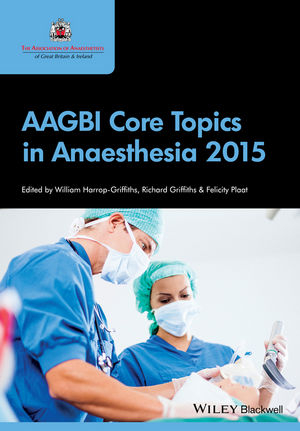
AAGBI Core Topics in Anaesthesia 2015 (eBook)
John Wiley & Sons (Verlag)
978-1-118-78086-2 (ISBN)
- Reviews latest developments in research and practice
- Clinically-oriented but rooted in basic science
- Concise and informative articles on key topics
- Road-tested through CPD roadshows
- Designed specifically for continuing medical education
William Harrop-Griffiths
Imperial College Healthcare NHS Trust
London, UK
Richard Griffiths
Peterborough & Stamford Hospitals NHS Trust
Peterborough, UK
Felicity Plaat
Imperial College Healthcare NHS Trust
London, UKBased on the Association of Anaesthetists of Great Britain & Ireland's (AAGBI) continuing education lecture series, this clinically-oriented book covers the latest developments in research and the clinical application of anesthesia and pain control. Reviews latest developments in research and practice Clinically-oriented but rooted in basic science Concise and informative articles on key topics Road-tested through CPD roadshows Designed specifically for continuing medical education
William Harrop-Griffiths, Imperial College Healthcare NHS Trust, London, UK Richard Griffiths, Peterborough & Stamford Hospitals NHS Trust, Peterborough, UK Felicity Plaat, Imperial College Healthcare NHS Trust, London, UK
List of Contributors, vii
Foreword, ix
1 Abnormalities of Coagulation and Obstetric Anaesthesia, 1
Hilary Swales
2 Acute Coronary Syndromes and Anaesthesia, 15
Yasir Parviz, Rachel Orme, Oliver Watson and Tim Chico
3 Acute Pain Management of Opioid-Tolerant Patients, 28
Mark Jackson
4 Echocardiography and Anaesthesia, 39
Jonathan H. Rosser and Nicholas J. Morgan-Hughes
5 Medico-Legal Aspects of Regional Anaesthesia, 54
William T. Frame
6 Peri-Operative Use of Beta-Blockers: Yes or No?, 65
Nanda Gopal Mandal
7 Transfusion Requirements and the Older Person, 80
Alexa Mannings and Iain Moppett
8 Organ Donation and the Anaesthetist, 91
Dale Gardiner, Neal Beckett, Paul Townsley and Helen Fenner
9 Postoperative Cognitive Dysfunction: Fact or Fiction?, 114
Irwin Foo
10 Pre-Operative Anaemia: Should We Worry?, 127
Robert Kong
CHAPTER 1
Abnormalities of Coagulation and Obstetric Anaesthesia
Hilary Swales
University Hospitals, Southampton, UK
Key points
- Abnormal coagulation is a relative contraindication to regional anaesthesia. The risk of neuraxial haematoma formation must be balanced against the risks of general anaesthesia in an obstetric patient – particularly in an emergency situation.
- A history or family history of abnormal bleeding or bruising should be sought from all women. Those with known haematological disorders require optimisation by haematologists and multidisciplinary management.
- The risks associated with epidural catheter insertion apply equally to catheter removal.
- The management of patients with abnormal coagulation should involve senior clinicians.
- If coagulation abnormalities are present, follow-up must be robust to ensure prompt detection and treatment of complications.
- Published guidelines outline the risks of regional techniques in the presence of specific coagulation abnormalities. Guidance for the use of regional techniques in relation to pharmacological thromboprophylaxis or treatment is available. For those with normal platelet function, regional techniques can be performed with platelets as low as 50 × 109 L−1.
Obstetric anaesthetists are frequently required to evaluate patients with coagulation abnormalities who require analgesia or anaesthesia. The management of these patients should be individualised according to the risks to the individual at that time. In addressing risks, those of general anaesthesia in the non-fasted patient should not be forgotten. It is not unusual for obstetric patients to present unexpectedly and out of hours, so optimisation of coagulation and the formulation of a management plan should be undertaken as early as possible in those with abnormalities of coagulation for any reason. There are several guidelines addressing the use of regional techniques in patients with abnormal coagulation. Since there is a shortage of good quality evidence, these are based largely on case reports and consensus of opinion and, perhaps unsurprisingly, vary widely on their recommendations. The experience of diagnostic lumbar puncture in coagulopathic haematology patients undergoing chemotherapy provides a useful source of data for obstetric patients [1]. The Association of Anaesthetists of Great Britain & Ireland (AAGBI), the Obstetric Anaesthetists' Association (OAA) and Regional Anaesthesia UK (RA-UK) have published a useful guideline that will be referred to in this article [2].
What are the risks?
During pregnancy, aortocaval compression can obstruct venous return, causing distension of the venous plexus within the epidural space and the development of venous collaterals. Venous distension is exacerbated during uterine contractions in labour and both epidural needle insertion and catheter placement are therefore not recommended during a contraction. During routine epidural or spinal anaesthesia, accidental puncture of these veins occurs in 1–18% of patients. If the patient is coagulopathic, the risks of needle or catheter trauma resulting in the development of a spinal or epidural haematoma, which can lead to spinal cord compression and permanent neurological damage if untreated, are increased. Such cases are rare in UK practice, most likely because of the caution exercised by clinicians in the use of regional techniques in patients with abnormal coagulation. The overall risk of the development of a clinically evident haematoma is low. The incidence after epidural techniques is estimated to be in the order of 1:150,000 after epidural placement and 1:220,000 after spinal injection in the general population [2]. It is likely that the incidence is even lower in the obstetric population. Vandermeulen et al. [3] reviewed 61 case reports of haematoma after regional techniques: 41 occurred in patients on heparin or those with abnormal haemostasis, but 15 occurred in patients without known coagulation abnormalities. The review suggested that removal of epidural catheters posed an equal risk to insertion [3]. When low-molecular weight heparin (LMWH) was introduced in the US, approximately 60 spinal haematomas were reported in a 5-year period: a much higher incidence than that reported in the UK and Europe at the time. This was thought to be due to the higher doses and more frequent dosing regime used in the US. The American Society of Regional Anesthesia produced guidelines that suggested a reduction in the dosage frequency in line with European practice, and the incidence then decreased. The use of the newer anticoagulant and antiplatelet drugs is still uncommon in the obstetric population.
One potential difficulty in obstetric practice lies in the early identification and management of epidural haematoma. Women are often discharged from hospital within 24–48 h of regional procedures into community settings. Women and their carers must be made aware that increasing numbness or back pain following regional blockade may indicate the development of a neurological emergency requiring early referral. Referral, imaging and surgery should occur within 18 h for a good chance of full return of neurological function. Any patient with known coagulation abnormalities who has a regional technique must be carefully followed up.
General anaesthesia for parturients with abnormal coagulation
The risks of general anaesthesia, especially in the emergency situation, should always be weighed against the risk of spinal haematoma formation, which can have catastrophic effects but is extremely rare. The reports from the Fourth National Audit Project (NAP4) and CEMACE (formerly CEMACH) highlight these risks. The overall risk of death in those having general anaesthesia for caesarean section was quoted in 2007 as being just over 1:25,000. In addition to the risk of hypoxia and pulmonary aspiration, the uterine relaxant effect of volatile anaesthetics increases the risk of obstetric haemorrhage. If practical, significant coagulopathies should be corrected before general anaesthesia to minimise airway bleeding and decrease the risk of significant surgical bleeding.
What are the causes of coagulation abnormalities in obstetric patients?
The physiological changes of pregnancy affect the coagulation and fibrinolytic systems. The levels of many of the clotting factors increase (in particular factors VII, VIII and fibrinogen) and those of anticoagulation factors decrease, causing augmented coagulation and decreased fibrinolysis. Thromboprophylaxis is increasingly being used in those with known risk factors for venous thrombo-embolism, and women with a history of venous thrombo-embolism are treated with higher doses of heparins. The use of LMWHs has decreased the incidence of heparin-induced thrombocytopaenia but, once given, the anticoagulant effects of LMWHs last longer than those of non-fractionated heparin, and are less easily reversed. This may be a problem if labour starts unexpectedly.
Coagulation disorders occurring during pregnancy and those relevant to pregnancy are summarised in Table 1.1.
Table 1.1 Coagulation abnormalities occurring during pregnancy
| Clotting factor abnormalities |
| Congenital coagulopathies | Von Willebrand's disease Haemophilia and specific factor deficiencies Rarer factor deficiencies |
| Specific obstetric-related coagulopathies | Pre-eclampsia Placental abruption Intra-uterine fetal death Amniotic fluid embolus Cholestasis Dilutional: major obstetric haemorrhage Sepsis |
| General causes | Anticoagulant therapy Disseminated intravascular coagulation Liver disease Vitamin K deficiency |
| Platelet abnormalities |
| Low platelet numbers | Gestational thrombocytopaenia Idiopathic thrombocytopaenic purpura HELLP syndrome Major obstetric haemorrhage |
| Poor platelet function | HELLP syndrome |
Congenital coagulopathies
Von Willebrand's disease
This is the commonest inherited bleeding disorder. It is found in about 1% of the UK population and has autosomal dominant inheritance, although there is a wide spectrum of severity. It is a disorder affecting the von Willebrand factor (vWF), which is a large protein that promotes platelet adhesion and forms part of the factor VIII complex. There are three types of this disease:
| Type 1: | Partial deficiency of vWF but the vWF present functions normally. During pregnancy, there is usually a significant increase in vWF, and levels are often up to the normal range in all but the most severe cases. |
| Type 2: | In this, there is a qualitative defect in vWF and little improvement during pregnancy. In some individuals termed type 2B, there is an associated thrombocytopaenia. |
| Type 3: | This is a severe bleeding disorder in which there is a complete absence of vWF and... |
| Erscheint lt. Verlag | 4.6.2015 |
|---|---|
| Sprache | englisch |
| Themenwelt | Medizin / Pharmazie ► Allgemeines / Lexika |
| Medizin / Pharmazie ► Gesundheitsfachberufe | |
| Medizin / Pharmazie ► Medizinische Fachgebiete ► Anästhesie | |
| Medizin / Pharmazie ► Pflege | |
| Schlagworte | Anästhesie • Anästhesie • anesthesia • Medical Science • Medizin • William Harrop-GriffithsRichard GriffithsFelicity PlaatAAGBI Core Topics in AnaesthesiaAnaesthesiaAAGBIAbnormalities of CoagulationObstetric AnaesthesiaAcute Coronary Syndromes and AnaesthesiaAcute Pain Management of Opioid Tolerant PatientsEchocardiographyMedico-legal AspectsRegional AnaesthesiaPeri-operative Use of Beta-blockersTransfusion RequirementsOlder PersonOrgan DonationPostoperative Cognitive DysfunctionPre-operative Anaemia |
| ISBN-10 | 1-118-78086-8 / 1118780868 |
| ISBN-13 | 978-1-118-78086-2 / 9781118780862 |
| Informationen gemäß Produktsicherheitsverordnung (GPSR) | |
| Haben Sie eine Frage zum Produkt? |
 EPUB (Adobe DRM)
Kopierschutz: Adobe-DRM
Adobe-DRM ist ein Kopierschutz, der das eBook vor Mißbrauch schützen soll. Dabei wird das eBook bereits beim Download auf Ihre persönliche Adobe-ID autorisiert. Lesen können Sie das eBook dann nur auf den Geräten, welche ebenfalls auf Ihre Adobe-ID registriert sind.
Details zum Adobe-DRM
Dateiformat: EPUB (Electronic Publication)
EPUB ist ein offener Standard für eBooks und eignet sich besonders zur Darstellung von Belletristik und Sachbüchern. Der Fließtext wird dynamisch an die Display- und Schriftgröße angepasst. Auch für mobile Lesegeräte ist EPUB daher gut geeignet.
Systemvoraussetzungen:
PC/Mac: Mit einem PC oder Mac können Sie dieses eBook lesen. Sie benötigen eine
eReader: Dieses eBook kann mit (fast) allen eBook-Readern gelesen werden. Mit dem amazon-Kindle ist es aber nicht kompatibel.
Smartphone/Tablet: Egal ob Apple oder Android, dieses eBook können Sie lesen. Sie benötigen eine
Geräteliste und zusätzliche Hinweise
Buying eBooks from abroad
For tax law reasons we can sell eBooks just within Germany and Switzerland. Regrettably we cannot fulfill eBook-orders from other countries.
aus dem Bereich