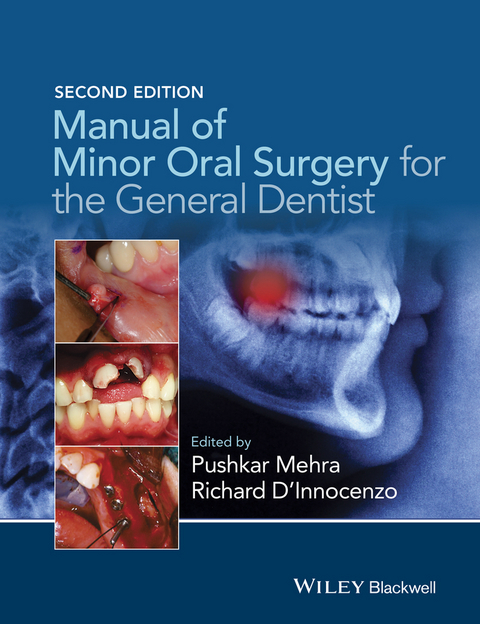
Manual of Minor Oral Surgery for the General Dentist (eBook)
John Wiley & Sons (Verlag)
978-1-118-93843-0 (ISBN)
The Manual of Minor Oral Surgery for the General Dentist, Second Edition continues the aim of providing clear and practical guidance to common surgical procedures encountered in general practice. Fully revised and updated with three additional chapters, the book approaches each procedure through detailed, step-by-step description and illustration. Ideal for general dental practitioners and students, the book is an indispensible tool for planning, performing, and evaluating a range of surgical procedures in day-to-day practice.
The Manual of Minor Oral Surgery for the General Dentist begins with an expanded chapter on patient evaluation and history taking and a new chapter on managing the patient with medical comorbidities. It also address infections and sedation besides procedural chapters on such topics as third molar extractions, preprosthetic surgery, surgical implantology, crown-lengthening, and biopsy of oral lesions.
Pushkar Mehra, BDS, DMD, is Chairman, Department of Oral and Maxillofacial Surgery and Associate Dean for Hospital Affairs, Boston University Henry M. Goldman School of Dental Medicine, and Chief of Service, Oral and Maxillofacial Surgery, Boston Medical Center. He is a Fellow of the American Association of Oral and Maxillofacial Surgeons and a Diplomate of the American Board of Oral and Maxillofacial Surgery.
Richard D'Innocenzo, DMD, MD, is Clinical Associate Professor and Director of Predoctoral Oral Surgery Education at Boston University Henry M. Goldman School of Dental Medicine, and Vice Chairman, Dentistry and Oral and Maxillofacial Surgery, Boston Medical Center. He is a Fellow of the American Association of Oral and Maxillofacial Surgeons and a Diplomate of the American Board of Oral and Maxillofacial Surgery.
Pushkar Mehra, BDS, DMD, is Chairman, Department of Oral and Maxillofacial Surgery and Associate Dean for Hospital Affairs, Boston University Henry M. Goldman School of Dental Medicine, and Chief of Service, Oral and Maxillofacial Surgery, Boston Medical Center. He is a Fellow of the American Association of Oral and Maxillofacial Surgeons and a Diplomate of the American Board of Oral and Maxillofacial Surgery. Richard D'Innocenzo, DMD, MD, is Clinical Associate Professor and Director of Predoctoral Oral Surgery Education at Boston University Henry M. Goldman School of Dental Medicine, and Vice Chairman, Dentistry and Oral and Maxillofacial Surgery, Boston Medical Center. He is a Fellow of the American Association of Oral and Maxillofacial Surgeons and a Diplomate of the American Board of Oral and Maxillofacial Surgery.
Contributors vii
Preface ix
1 Patient Evaluation and History Taking 1
Dale A. Baur Andrew Bushey and Diana Jee-Hyun Lyu
2 Management of the Patient with Medical Comorbidities 11
David W. Lui and David C. Stanton
3 Minimal Sedation for Oral Surgery and Other Dental Procedures 23
Kyle Kramer and Jeffrey Bennett
4 Surgical Extractions 37
Daniel Oreadi
5 Third Molar Extractions 55
George Blakey
6 Pre-prosthetic Oral Surgery 85
Antonia Kolokythas Jason Jamali and Michael Miloro
7 Evaluation and Biopsy Technique for Oral Lesions 103
Marianela Gonzalez Thomas C. Bourland and Cesar A. Guerrero
8 Surgical Implantology 113
Alfonso Caiazzo and Frederico Brugnami
9 Hard-Tissue Augmentation for Dental Implants 127
Pamela Hughes
10 Soft Tissue Surgery for Dental Implants 135
Hussam Batal
11 Surgical Crown Lengthening 165
Serge Dibart
12 Endodontic Periradicular Microsurgery 169
Louay Abrass
13 Dentoalveolar Trauma 225
Omar Abubaker and Din Lam
14 Orofacial Infections 237
Thomas R. Flynn
15 Complications of Dentoalveolar Surgery 265
Patrick J. Louis
Index 295
CHAPTER 1
Patient Evaluation and History Taking
Dale A. Baur, Andrew Bushey, and Diana Jee-Hyun Lyu
Department of Oral and Maxillofacial Surgery, Case Western Reserve University School of Dental Medicine and University Hospitals/Case Medical Center, Cleveland, OH, USA
Introduction
The initial physical examination and evaluation of a patient is a critical component in the provision of care prior to any surgical procedure. A thorough patient assessment, including a physical exam and medical history, is necessary prior to even simple surgical events. The information gathered during this encounter can provide the clinician with information necessary to make treatment modifications and assess and stratify risks and potential complications associated with the treatment. Disregarding the importance of this exam can result in serious morbidity and even death. Prior to initiating any surgical procedure, an accurate dental diagnosis must be formulated based on the patient’s chief complaint, history of present illness, a clinical dental examination, and appropriate and recent diagnostic imaging, such as a panoramic radiograph.
Medical history
The medical history of a patient is the most important information that a clinician can acquire and should be emphasized during the initial exam. With a thorough medical history, a skilled clinician can decide whether the patient is capable of undergoing a procedure and if any modifications should be made prior to the treatment. The dentist should be able to reliably predict how preexisting medical conditions might interfere with the patient’s ability to respond successfully to a surgical insult and subsequently heal. A careful and systematic approach must be used to evaluate all surgical patients. Only in this way can potential complications be managed or avoided. The medical history should be updated annually, but it should also be reviewed at each appointment to be assured there are no significant changes and/or additions.
A detailed questionnaire that covers all common medical problems aids in the collection of information to formulate the patient’s medical history (Figure 1.1). However, the dentist should review this questionnaire and ask focused questions as needed to clarify and expound on the past medical history. Any inconsistencies or discrepancies in the written or verbal history must be investigated. The dentist must formulate a thorough timeline of the patient’s medical history, surgical history, social history (smoking, drinking, and illicit drug habits), family history, current and previous medications, and allergies. If lingering questions remain after reviewing the history with the patient, consultation with the patient’s primary care physician should be considered. If the patient is unable to accurately review their medical history due to cognitive issues, then the caregiver and/or family must be prepared to provide the medical history. The use of any anticoagulants, corticosteroids, hypertension medication, and other medications should be thoroughly reviewed.1 Female patients should be asked whether there is any possibility that they are pregnant; if there is uncertainty, urine beta-HCG is easy to obtain to provide a definitive answer. Allergies that should be addressed are those to medications and other items used in a dental office, such as latex. The medical history should emphasize the major organ systems, specifically the cardiovascular system, central nervous system, pulmonary system, endocrine system, along with the hepatic and renal systems.
Figure 1.1 Medical history questionnaire.
Source: Reprinted with permission from OMS National Insurance Company.
Cardiovascular system
As our population ages, the dentist is likely to see more patients with some aspects of cardiovascular disease. Hypertension is very common, and many patients are undiagnosed. Current studies note that nearly one-third of the US population has hypertension—defined as a systolic blood pressure higher than 139 mmHg or a diastolic blood pressure higher than 89 mmHg. Another one-quarter of the U.S. population has prehypertension—defined by a systolic blood pressure between 120 and 139 mmHg and a diastolic blood pressure between 80 and 89 mmHg.2 For patients with a history of cardiovascular disease, vital signs should be monitored regularly during surgery (Table 1.1).
Table 1.1 Blood pressure classification
| BP Classification | Systolic BP (mmHg) | Diastolic BP (mmHg) |
| Normal | <120 | <80 |
| Prehypertensive | 120–139 | 80–89 |
| Stage 1 hypertension | 140–159 | 90–99 |
| Stage 2 hypertension | ≥160 | ≥100 |
Systolic and diastolic blood pressures taken at multiple times remain the best means to diagnose and classify hypertension. When the blood pressure reading is mild to moderately high, the patient should be referred to their primary care physician for evaluation and to initiate hypertensive therapy. The patient should be monitored on each subsequent visit before treatment. If needed, the dentist can consider using some type of anxiety control protocol. When severe hypertension exists, which is defined as systolic blood pressure greater than 200 mmHg or diastolic pressure above 110 mmHg,2 defer treatment and urgently refer the patient to their primary care physician or an emergency department.
Congestive heart failure (CHF) becomes more common with advanced age. This condition is typically characterized by dyspnea, orthopnea, fatigue, and lower extremity edema. Uncontrolled or new onset symptoms of CHF necessitate deferring surgical treatment until the patient has been medically optimized.
Coronary artery disease (CAD) also has an increasing prevalence as our population ages. Progressive narrowing of the coronary arteries leads to an imbalance in myocardial oxygen demand and supply. Oxygen demand can be further increased by exertion, stress, or anxiety during surgical procedures. When myocardial ischemic occurs, it can produce substernal chest pain, which may radiate to the arms, neck, or jaw. Other symptoms include diaphoresis, dyspnea, and nausea/vomiting. The dental practitioner is likely to see patients with a variety of presentations of CAD, including angina, history of myocardial infarction, coronary artery stent placement, coronary artery bypass grafting, etc. In these cases, the functional status of a patient is a very reliable predictor of risk for dentoalveolar surgery. The functional assessment of common daily activities is quantified in metabolic equivalents (METs). A MET is defined as the resting metabolic rate (the amount of oxygen consumed at rest) which is approximately 3.5 ml O2/kg/min. Therefore, an activity with 2 METS requires twice the resting metabolism (Table 1.2).3 Patients who are able to perform moderate activity (4 or more METs, e.g. walk around the block at 3–4 mph, light housework), are generally good candidates for dentoalveolar procedures without further cardiac work-up. Of course, any patient with signs of unstable CAD (new onset or altered frequency/intensity chest pain, decompensated CHF), elective surgery should be deferred until the patient is stabilized.
Table 1.2 Table of METS for daily activities*
| Activity | METS |
| Light intensity activities | <3 |
| Sleeping | 0.9 |
| Writing, desk work, typing | 1.8 |
| Light house chores (washing dishes, cooking, making the bed) | 2–2.5 |
| Walking 2.5 mph | 2.9 |
| Moderate intensity activities | 3–6 |
| Walking 3.0 mph | 3.3 |
| Bicycling <10 mph | 4.0 |
| Gardening and yard work | 3.5–4.4 |
| Vigorous intensity activities | >6 |
| Jogging | 8.8–11.2 |
| Basketball | 11.1 |
* A MET is defined as the resting metabolic rate (the amount of oxygen consumed at rest) which is approximately 3.5 ml O2/kg/min. Therefore, an activity with 2 METs requires twice the resting metabolism.
Dysrhythmias are often associated with CHF and CAD. Atrial fibrillation (AF) has become the default rhythm of the elderly, being the most common sustained arrhythmia. These patients are typically anticoagulated by a number of different medications. The dentist must be familiar with the medications as well as the mechanism of action. For minor procedures, anticoagulated patients often can be maintained on their anticoagulation protocol and undergo surgery without incident. Appropriate labs should be ordered as needed to check the anticoagulation status. However, if the dentist feels the anticoagulation protocol needs to be modified or discontinued prior to surgery, consultation with...
| Erscheint lt. Verlag | 18.5.2015 |
|---|---|
| Sprache | englisch |
| Themenwelt | Medizin / Pharmazie ► Gesundheitsfachberufe |
| Medizin / Pharmazie ► Medizinische Fachgebiete | |
| Medizin / Pharmazie ► Zahnmedizin | |
| Schlagworte | Crown Lengthening • dental infection • dental medical comorbidities • dentistry • Mund-, Kiefer- u. Gesichtschirurgie • Oral & Maxillofacial Surgery • Preprosthetic surgery • Surgical Implantology • third molar extraction • Zahnmedizin |
| ISBN-10 | 1-118-93843-7 / 1118938437 |
| ISBN-13 | 978-1-118-93843-0 / 9781118938430 |
| Informationen gemäß Produktsicherheitsverordnung (GPSR) | |
| Haben Sie eine Frage zum Produkt? |
 EPUB (Adobe DRM)
Kopierschutz: Adobe-DRM
Adobe-DRM ist ein Kopierschutz, der das eBook vor Mißbrauch schützen soll. Dabei wird das eBook bereits beim Download auf Ihre persönliche Adobe-ID autorisiert. Lesen können Sie das eBook dann nur auf den Geräten, welche ebenfalls auf Ihre Adobe-ID registriert sind.
Details zum Adobe-DRM
Dateiformat: EPUB (Electronic Publication)
EPUB ist ein offener Standard für eBooks und eignet sich besonders zur Darstellung von Belletristik und Sachbüchern. Der Fließtext wird dynamisch an die Display- und Schriftgröße angepasst. Auch für mobile Lesegeräte ist EPUB daher gut geeignet.
Systemvoraussetzungen:
PC/Mac: Mit einem PC oder Mac können Sie dieses eBook lesen. Sie benötigen eine
eReader: Dieses eBook kann mit (fast) allen eBook-Readern gelesen werden. Mit dem amazon-Kindle ist es aber nicht kompatibel.
Smartphone/Tablet: Egal ob Apple oder Android, dieses eBook können Sie lesen. Sie benötigen eine
Geräteliste und zusätzliche Hinweise
Buying eBooks from abroad
For tax law reasons we can sell eBooks just within Germany and Switzerland. Regrettably we cannot fulfill eBook-orders from other countries.
aus dem Bereich