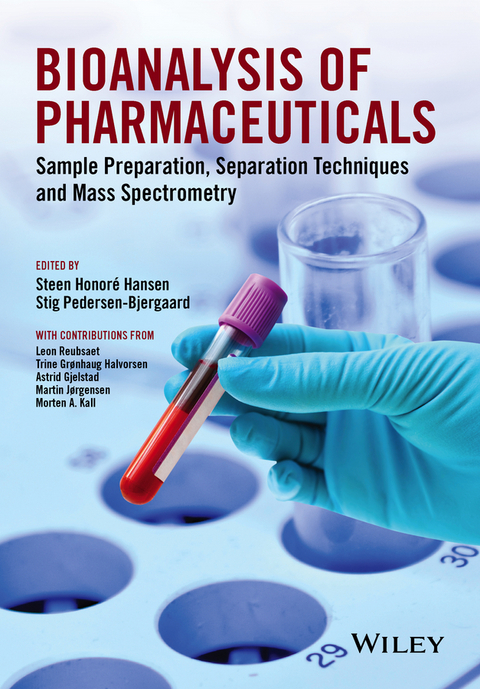
Bioanalysis of Pharmaceuticals (eBook)
John Wiley & Sons (Verlag)
978-1-118-71686-1 (ISBN)
Steen Honoré Hansen Department of Pharmacy, Faculty of Health and Medical Sciences, Copenhagen University, Denmark Stig Pedersen-Bjergaard School of Pharmacy, University of Oslo, Norway, and Department of Pharmacy, Faculty of Health and Medical Sciences, Copenhagen University, Denmark
Chapter 1
Introduction
Stig Pedersen-Bjergaard
School of Pharmacy, University of Oslo, Norway School of Pharmaceutical Sciences, University of Copenhagen, Denmark
Welcome to the field of bioanalysis! Through reading of this textbook, we hope you get fascinated by the world of bioanalysis, and also we hope that you learn to understand that bioanalysis is a highly important scientific discipline. In this chapter, five fundamental questions are raised and briefly discussed as an introduction to the textbook: (i) What is bioanalysis? (ii) What is the purpose of bioanalysis? (iii) Where is bioanalysis conducted? (iv) Why do you need theoretical understanding and skills in bioanalysis? And (v) how do you gain the understanding and the skills from reading this textbook?
1.1 What Is Bioanalysis?
In this textbook, we define bioanalysis as the chemical analysis of pharmaceutical substances in biological samples. The purpose of the chemical analysis is normally both to identify (identification) and to quantify (quantification) the pharmaceutical substance of interest in a given biological sample. This is performed by a bioanalytical chemist (scientist) using a bioanalytical method. The pharmaceutical substance of interest is often termed the analyte, and this term will be used throughout the textbook. Identification of the analyte implies that the exact chemical identity of the analyte is established unequivocally. Quantification of the analyte implies that the concentration of the analyte in the biological sample is measured. It is important to emphasize that quantification is associated with small inaccuracies, and the result is prone to errors. Thus, the quantitative data should be considered as an estimate of the true concentration. Based on theoretical and practical skills, and based on careful optimization and testing of the bioanalytical methods, the bioanalytical chemist tries to reduce the error level, providing concentration estimates that are very close to the true values.
Bioanalytical data are highly important in many aspects. As an example, a patient serum sample is analyzed for the antibiotic drug substance gentamicin, and gentamicin is measured in the sample at a concentration of 5 µg/ml. First, the identification of gentamicin in the blood serum sample confirms that the patient has taken the drug. This is important information because not all patients actually comply with the prescribed medication. Second, the exact concentration of gentamicin measured in the blood serum sample confirms that the amount of gentamicin taken is appropriate, as the recommended concentration level should be in the range of 4–10 µg/ml. For aminoglycoside antibiotics such as gentamicin, it is recommended to monitor the concentration in blood if the treatment is expected to continue for more than 72 hours as these antibiotics have the potential to cause severe adverse reactions, such as nephrotoxicity and ototoxicity.
As will be discussed in much more detail in this book, not only blood serum samples are used for bioanalysis. Bioanalysis can be performed on raw blood samples (whole blood) or on blood samples from which the blood cells have been removed (serum or plasma). Alternatively, bioanalysis can be performed from urine or saliva as examples, depending on the purpose of the bioanalysis. Bioanalysis is performed both on human samples and on samples from animal experiments.
1.2 What Is the Purpose of Bioanalysis, and Where Is It Conducted?
Bioanalysis is conducted in the pharmaceutical industry, in contract laboratories associated with the pharmaceutical industry, in hospital laboratories, in forensic toxicology laboratories, and in doping control laboratories. In the pharmaceutical industry and in the associated contract laboratories, bioanalysis is basically conducted to support the development of new drugs and new drug formulations. In hospital laboratories, bioanalysis is used to monitor existing drugs in patient samples, to check that individual patients take their drugs correctly. In forensic toxicology laboratories and doping laboratories, bioanalysis is used to check for abuse of drugs and drug-related substances.
1.2.1 Bioanalysis in the Pharmaceutical Industry
Bioanalytical laboratories are highly important in the development of new drugs and new drug formulations in the pharmaceutical industry. Thus, identification and quantification of drug substances and metabolites in biological samples like blood plasma, urine, and tissue play a very important role during drug development. Drug development begins with the identification of a medical need and hypotheses on how therapy can be improved. Drug discovery is the identification of new drug candidates based on combinatorial chemistry, high-throughput screening, genomics, and ADME (absorption, distribution, metabolism, and elimination). By combinatorial chemistry, a great number of new drug candidates are synthesized, and these are tested for pharmacological activity and potency in high-throughput screening (HTS) systems. The HTS systems simulate the interaction of the drug candidates with a specific biological receptor or target. Once a lead compound is found, a narrow range of similar drug candidates is synthesized and screened to improve the activity toward the specific target. Other studies investigate the ADME profile of drug candidates by analyzing samples collected at different time points from dosed laboratory animals (in vivo testing) and tissue cultures (in vitro testing).
Drug candidates passing the discovery phase are subjected to toxicity testing and further metabolism and pharmacological studies in the preclinical development phase. Both in vivo and in vitro tests are conducted, and various animal species are used to prove the pharmacokinetic profile of the candidate. The detailed information about the candidate forms the basis for further pharmaceutical research on the synthesis of raw materials, the development of dosage forms, quality control, and stability testing.
The clinical development phase can begin when a regulatory body has judged a drug candidate to be effective and to appear safe in healthy volunteers. In phase I, the goal is to establish a safe and efficient dosage regimen and to assess pharmacokinetics. Blood samples are collected and analyzed from a small group of healthy volunteers (20–80 persons). The data obtained form the basis for developing controlled phase II studies. The goal of phase II studies is to demonstrate a positive benefit–risk balance in a larger group of patients (200–800) and to further study pharmacokinetics. Monitoring of efficacy and monitoring of possible side effects are essential. Phase II studies can take up to two years to fulfill. At the end of phase II, a report is submitted to the regulatory body, and conditions for phase III studies are discussed. Additional information supporting the claims for a new drug is provided. Phase III begins when evidence for the efficacy of the drug candidate and supporting data have demonstrated a favorable outcome to the regulatory body. The phase III studies are large-scale efficacy studies with focus on the effectiveness and safety of the drug candidate in a large group of patients. In most cases, the drug candidate is compared with another drug already in use for treatment of the same condition. Phase III studies can last two to three years or more, and 3000–5000 patients can be involved. Carcinogenetic tests, toxicology tests, and metabolic studies in laboratory animals are conducted in parallel. The cumulative data form the basis for filing a new drug application to the regulatory body and for future plans for manufacturing and marketing. The regulatory body thoroughly evaluates the documentation that is provided before a market approval can be authorized and the drug product can be legally marketed. The time required from drug discovery to product launch is up to 12 years. Phase IV studies are studies that are conducted after product launch to demonstrate long-term effects and new claims, expand on approved claims, examine possible drug–drug interactions, and further assess pharmacokinetics. Several thousand patients participate in phase IV studies.
Bioanalytical measurements are conducted during drug discovery, preclinical development, and clinical development, and they are intended to (among other things) generate the experimental data to establish the pharmacokinetics, the toxicokinetics, and the exposure–response relationships for a new drug. The pharmacokinetics of a certain drug substance describes how the body affects the drug after administration (ADME): how the drug is absorbed (A) and distributed (D) in the body, and how the drug is metabolized (M) by metabolic enzymes and chemically changed to different types of metabolites, which in turn are excreted (E) from the body. Bioanalysis is used extensively in pharmacokinetic studies, among others, to establish blood concentration–time profiles, and to measure the rate of drug metabolism and excretion. This involves a large number of both animal and human samples.
Toxicokinetics studies, in contrast, are intended to investigate the relationship between the exposure of a new drug candidate in experimental animals and its toxicity. This type of information is used to establish a relationship between the possible toxic properties of a drug in animals and those in humans. Toxicokinetic studies involve bioanalysis in both animal and human...
| Erscheint lt. Verlag | 18.5.2015 |
|---|---|
| Sprache | englisch |
| Themenwelt | Medizin / Pharmazie ► Gesundheitsfachberufe |
| Medizin / Pharmazie ► Medizinische Fachgebiete ► Pharmakologie / Pharmakotherapie | |
| Naturwissenschaften ► Biologie ► Biochemie | |
| Naturwissenschaften ► Chemie ► Analytische Chemie | |
| Technik | |
| Schlagworte | Analytical Chemistry • Analytische Chemie • bioanalysis • Biochemie • biochemistry • biological fluids • Biopharmaceutical • Biowissenschaften • Chemie • Chemistry • Drugs • high-molecular • Life Sciences • low-molecular • Peptides • Pharmaceutical & Medicinal Chemistry • pharmaceuticals • Pharmazeutische u. Medizinische Chemie • proteins • Spectrometry |
| ISBN-10 | 1-118-71686-8 / 1118716868 |
| ISBN-13 | 978-1-118-71686-1 / 9781118716861 |
| Informationen gemäß Produktsicherheitsverordnung (GPSR) | |
| Haben Sie eine Frage zum Produkt? |
 EPUB (Adobe DRM)
Kopierschutz: Adobe-DRM
Adobe-DRM ist ein Kopierschutz, der das eBook vor Mißbrauch schützen soll. Dabei wird das eBook bereits beim Download auf Ihre persönliche Adobe-ID autorisiert. Lesen können Sie das eBook dann nur auf den Geräten, welche ebenfalls auf Ihre Adobe-ID registriert sind.
Details zum Adobe-DRM
Dateiformat: EPUB (Electronic Publication)
EPUB ist ein offener Standard für eBooks und eignet sich besonders zur Darstellung von Belletristik und Sachbüchern. Der Fließtext wird dynamisch an die Display- und Schriftgröße angepasst. Auch für mobile Lesegeräte ist EPUB daher gut geeignet.
Systemvoraussetzungen:
PC/Mac: Mit einem PC oder Mac können Sie dieses eBook lesen. Sie benötigen eine
eReader: Dieses eBook kann mit (fast) allen eBook-Readern gelesen werden. Mit dem amazon-Kindle ist es aber nicht kompatibel.
Smartphone/Tablet: Egal ob Apple oder Android, dieses eBook können Sie lesen. Sie benötigen eine
Geräteliste und zusätzliche Hinweise
Buying eBooks from abroad
For tax law reasons we can sell eBooks just within Germany and Switzerland. Regrettably we cannot fulfill eBook-orders from other countries.
aus dem Bereich