


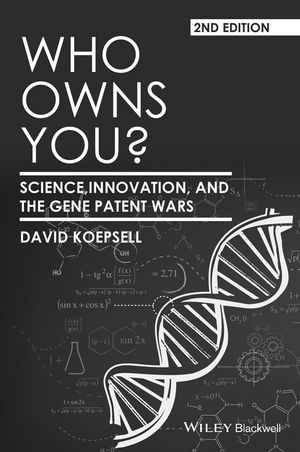
Who Owns You? (eBook)
John Wiley & Sons (Verlag)
978-1-118-94848-4 (ISBN)
- Lays bare the theoretical assumptions that underpin the injustice of patents on unmodified genes
- Makes a unique argument for a commons-by-necessity, explaining how parts of the universe are simply not susceptible to monopoly claims
- Represents the only work that attempts to first define the nature of the genetic objects involved before any ethical conclusions are reached
- Provides the most comprehensive accounting of the various lawsuits, legislative changes, and the public debate surrounding AMP v. Myriad, the most significant case regarding gene patents
David Koepsell is an author, philosopher, attorney, and educator whose recent research focuses on the nexus of science, technology, ethics, and public policy. He has provided commentary regarding ethics, society, religion, and technology for MSNBC, Fox News Channel, The Guardian, The Washington Times, NPR Radio, Radio Free Europe, Air America, The Atlanta Journal Constitution, and the Associated Press, and other media. He is currently Director of Research and Strategic Initiatives, Comisión Nacional de Bioética, and a Visiting Professor at UNAM Instituto de Investigaciones Filosóficas, Mexico, D.F.
The 2nd Edition of Who Owns You, David Koepsell s widely acclaimed exploration of the philosophical and legal problems of patenting human genes, is updated to reflect the most recent changes to the cultural and legal climate relating to the practice of gene patenting. Lays bare the theoretical assumptions that underpin the injustice of patents on unmodified genes Makes a unique argument for a commons-by-necessity, explaining how parts of the universe are simply not susceptible to monopoly claims Represents the only work that attempts to first define the nature of the genetic objects involved before any ethical conclusions are reached Provides the most comprehensive accounting of the various lawsuits, legislative changes, and the public debate surrounding AMP v. Myriad, the most significant case regarding gene patents
David Koepsell is an author, philosopher, attorney, and educator whose recent research focuses on the nexus of science, technology, ethics, and public policy. He has provided commentary regarding ethics, society, religion, and technology for MSNBC, Fox News Channel, The Guardian, The Washington Times, NPR Radio, Radio Free Europe, Air America, The Atlanta Journal Constitution, and the Associated Press, and other media. He is currently Director of Research and Strategic Initiatives, Comisión Nacional de Bioética, and a Visiting Professor at UNAM Instituto de Investigaciones Filosóficas, Mexico, D.F.
Acknowledgments viii
Preface to the Second Edition x
Foreword xiv
Introduction xxiv
1 Individual and Collective Rights in Genomic Data: Preliminary Issues 1
2 Ethics and Ontology: A Brief Discourse on Method 21
3 The Science of Genes 30
4 DNA, Species, Individuals, and Persons 52
5 Legal Dimensions in Gene Ownership 69
6 BRCA1 and 2: The Myriad Case and Beyond 88
7 Are Genes Intellectual Property? 101
8 DNA and The Commons 119
9 Pragmatic Considerations of Gene Ownership 137
10 Nature, Genes, and the Scientific Commons: A Social Ontology of Invention 155
11 So, Who Owns You? Some Conclusions About Genes, Property, and Personhood 165
Notes 182
Index 194
Foreword
David and I have had a friendly disagreement about the subject (and even the title) of this book ever since it was first published, and I am happy that he asked me to write this Foreword to the Second Edition. The issues David raises in the pages to follow continue to be relevant to a discussion of philosophy and patent law, with events that have occurred since the first edition justifying (indeed, demanding) this update.
Without getting into the deep waters of philosophy (David’s métier, not mine), as we have discussed the issues in the book David contends that he takes a deontological approach and has characterized mine as a utilitarian one. Accepting that dichotomy I understand the difference to be that David is operating from “first principles” about the rules society should impose on human activity and specifically on what the law permits individuals to “own” with regard to genes and more broadly naturally occurring substances. I disagree with that approach on several levels, perhaps the most germane of which is that if we posit rules we need to impose a rule-giver and the potential for improvident rules (if not outright abuse of the privilege) makes me wary; in some ways I subscribe to Lani Gruinier’s suspicions about the effects of the “tyranny of the majority” in this regard.
Part of that tyranny is also the tyranny of unintended or intentional ignorance. The issue here—“gene” patenting—is one at the intersection of molecular biology and modern genetics, on the one hand, and patent law (an area notorious for its arcane minutiae). I used to joke with my colleagues about the effect of trying to explain my position to a lay audience of any type and how I distrusted those who advocated that all that was needed was to “educate” the public, the press, and policy makers. The problem for proponents of gene patenting has been that opponents have gotten the better part of the debate, not by making a reasoned philosophical argument such as the one you will find in these pages but instead by making an emotional plea to individuals afraid that corporate America was trying to “steal” their genes, which has proven very effective. This process began with an Op-Ed piece in The New York Times by Michael Crichton, wherein he posited a scenario where a patent holder knocks on your door one day and demands payment for the use of “her” patented gene that resides in your liver. (Not coincidentally, Dr. Crichton had just published a novel on the perils of genetic engineering and corporate ownership of human genes, complete with an essay as an addendum containing his arguments against the practice. And it should be noted that a constant theme in his novels was a mistrust of technology and particularly the ability of humans to use it without dire consequences). Academics like my friend Lori Andrews at Illinois Institute of Technology (IIT)-Kent School of Law joined in this theme, which was picked up eventually by most popular press outlets and became, regrettably, the canonical narrative on gene patenting, culminating in the American Civil Liberties Union’s (ACLU’s) “Keep Your Hands Off My Genes” slogan and logo. I hope that this essay provides some antidote to this argument, which is founded on the literal fear that someone can “own” you. (David assures me that his title is allegorical and that he acknowledges that in all countries that have banned slavery no one can “own” another human being or a part of them. See the 13th Amendment. I assure you that the ACLU has no such illusions about the intended consequences of their ownership rhetoric).
My philosophy is that the principle we should follow is the greatest good to the greatest number, while not infringing on individual rights without (at least) compensation. As regards patent law, this principle is translated into rules that foster the broadest disclosure of technology possible in return for exclusive patent rights and robust-enough enforcement rights for patents that they provide sufficient certainty to promote investment so his technology is commercialized to benefit the greatest number. In my role as a biotechnology patent attorney, I have seen how risky investment in biotechnology can be (indeed, the evidence is overwhelming that for all its successes, biotech’s history is littered with the remains of companies that have failed) and how important it is to have a sound patent system of predictable rights go support that investment.
The evidence in support of “gene patenting” and more broadly natural products patenting is strong: the biotechnology industry has promoted innovation in the form of new drugs and diagnostics assays for a generation. This may continue despite the recent restrictions on patent protection for genes and natural products (including patent-restricting decisions in Mayo Collaborative Labs. v. Prometheus Labs and Assoc. of Molecular Pathologists v. Myriad Genetics and recently promulgated U.S. Patent and Trademark Office Guidances on Subject Matter Eligibility). In fact, these very restrictions suggest that we would benefit from an appreciation of the facts surrounding the past thirty years of gene patenting to understand why these restrictions are not only wrongheaded but dangerous for future innovation.
These include debunking several myths. First, the concern that patents on specific human genes in some way inhibit innovation in basic genetic research is entirely unfounded. One reason is that the genetic information itself is not patented; while isolated DNA is encompassed by gene patent claims and described in those claims by its sequence, the sequence itself is unpatented information that can be used freely for any purpose (e.g., interrogating genetic databases from other species or even human DNA, inter alia, to find related genes in those databases). Indeed, the innovative benefits to gene patenting are evident in at least two ways. First, scientific publication databases reveal that there have been more than 11 000 scientific papers published on the BRCA1 and BRCA2 genes since the patents claiming them were granted. This outcome refutes the prediction that gene patenting would create a “tragedy of the anticommons” where scientific research would be stifled by patenting (see, Heller & Eisenberg, 1998, “Can Patents Deter Innovation? The Anticommons in Biomedical Research,” Science 280: 698–701)), a conclusion supported by the overwhelming majority of studies done on this subject (see, for example, Walsh et al. 2003, “Science and the Law: Working Through the Patent Problem,” Science 299: 1020; Walsh et al. 2005, “Science and Law: View from the Bench: Patents and Material Transfers,” Science 309: 2002–03).
In addition, policies that the U.S. Patent and Trademark Office adopted in 2001 required applicants to disclose a practical utility for the product of a gene claimed in a patent. These requirements were imposed at a time when the standards for scientific journal publication were much less stringent, so that identifying a gene by the extent of genetic similarity between the “new” gene and previously discovered genes was enough for publication. But it was not enough for a patent, which has been held to be “not a hunting license. It is not a reward for the search, but compensation for its successful conclusion.” Thus, genes encoding proteins having no known use or biological activity cannot be patented, because to do so would allow the gene to be within the exclusive patent right undeservedly; the public would not have received its quid pro quo of a useful invention in return for patent exclusivity. All such genes not having patent protection are in the public domain (from which they cannot be retrieved for future patenting), and for humans these constitute the vast majority of genes identified, inter alia, by the Human Genome Project.
The role for patenting genes, and the related genetic diagnostic methods using this genetic information, in the successes of the biotechnology era are evident: The industry has produced hundreds of biologic drugs (at an ever-increasing rate) that have provided effective treatment for a variety of illnesses, and decoding the human genome has enabled researchers to identify genes, like the BRCA1 and BRCA2 genes, that can be used in predictive genetic diagnostic tests. Even the much-maligned Myriad Genetics has played a positive role in the development and prevalence of genetic diagnostic testing. It must be remembered that in 1997 (when Myriad’s BRCA gene patents were granted), genetic testing was in its infancy, and companies like Myriad were under the burden of convincing payers that the tests did the one thing that all insurers, public or private, require of such tests: save them money in the long run, by identifying patients with a high probability of becoming ill and costing the insurers much more for treatment than the costs of prophylaxis. Moreover, Myriad and like companies needed to convince doctors that the testing was worthwhile and to establish a network of genetic counselors who could explain to healthy women that they were at much greater risk of developing breast or ovarian cancer than normal, under circumstances that resulted in empowerment from the information and not abject fear. And in 1997, genetic sequencing technology was not as developed as it is now, and the mechanisms...
| Erscheint lt. Verlag | 27.4.2015 |
|---|---|
| Reihe/Serie | Blackwell Public Philosophy Series |
| Blackwell Public Philosophy Series | Blackwell Public Philosophy Series |
| Sprache | englisch |
| Themenwelt | Geisteswissenschaften ► Philosophie ► Allgemeines / Lexika |
| Geisteswissenschaften ► Philosophie ► Ethik | |
| Medizin / Pharmazie ► Medizinische Fachgebiete ► Medizinethik | |
| Studium ► Querschnittsbereiche ► Geschichte / Ethik der Medizin | |
| Recht / Steuern ► EU / Internationales Recht | |
| Recht / Steuern ► Privatrecht / Bürgerliches Recht ► Medizinrecht | |
| Recht / Steuern ► Wirtschaftsrecht ► Urheberrecht | |
| Schlagworte | Angewandte Ethik • Applied Ethics • Bioethics & Medical Ethics • Bioethik • Bioethik, Medizinethik • Ethik • Gene patenting, gene patents, DNA patenting, human genes, human genomes, artificial genes, genes, Myriad, Myriad Genetics, bioethics, biotechnology • Medical Law & Ethics • Medical Science • Medizin • Medizinrecht u. Ethik • Philosophie • Philosophy • Wissenschaftsethik |
| ISBN-10 | 1-118-94848-3 / 1118948483 |
| ISBN-13 | 978-1-118-94848-4 / 9781118948484 |
| Informationen gemäß Produktsicherheitsverordnung (GPSR) | |
| Haben Sie eine Frage zum Produkt? |
 EPUB (Adobe DRM)
Kopierschutz: Adobe-DRM
Adobe-DRM ist ein Kopierschutz, der das eBook vor Mißbrauch schützen soll. Dabei wird das eBook bereits beim Download auf Ihre persönliche Adobe-ID autorisiert. Lesen können Sie das eBook dann nur auf den Geräten, welche ebenfalls auf Ihre Adobe-ID registriert sind.
Details zum Adobe-DRM
Dateiformat: EPUB (Electronic Publication)
EPUB ist ein offener Standard für eBooks und eignet sich besonders zur Darstellung von Belletristik und Sachbüchern. Der Fließtext wird dynamisch an die Display- und Schriftgröße angepasst. Auch für mobile Lesegeräte ist EPUB daher gut geeignet.
Systemvoraussetzungen:
PC/Mac: Mit einem PC oder Mac können Sie dieses eBook lesen. Sie benötigen eine
eReader: Dieses eBook kann mit (fast) allen eBook-Readern gelesen werden. Mit dem amazon-Kindle ist es aber nicht kompatibel.
Smartphone/Tablet: Egal ob Apple oder Android, dieses eBook können Sie lesen. Sie benötigen eine
Geräteliste und zusätzliche Hinweise
Buying eBooks from abroad
For tax law reasons we can sell eBooks just within Germany and Switzerland. Regrettably we cannot fulfill eBook-orders from other countries.
aus dem Bereich


